AI Supply Chain Optimization: The Manufacturer's 2026 Guide
Guide to AI supply chain optimization for manufacturers. Master techniques, use cases, KPIs, & a roadmap to avoid common pitfalls.
Written by AI for Manufacturing
AI supply chain optimization is the use of machine learning, advanced analytics, and operational automation to improve decisions across forecasting, inventory, sourcing, logistics, and replenishment. For manufacturers, the most important reframing is this: the hard part usually isn't proving that AI can generate value. The hard part is building the data foundation and cross-functional trust needed to let the system influence real production, procurement, and service decisions. That gap matters because 95% of manufacturing leaders report that generative AI is directly improving efficiency, with supply chain and inventory management ranking as the top use case, and AI-enhanced supply chains report a 45% improvement in delivery times and a 36% reduction in operational costs, according to Trax Technologies' review of manufacturer AI adoption.
For a plant manager, that means AI supply chain optimization is no longer a side experiment owned by IT. It directly affects schedule stability, material availability, overtime exposure, expedite costs, and customer service performance. The teams that win aren't the ones buying the most ambitious platform. They're the ones making sure planners, procurement, operations, and finance can trust what the model is telling them and act on it without creating chaos on the shop floor.
Table of Contents
- What Is AI Supply Chain Optimization
- Core AI Techniques Driving Modern Supply Chains
- Proven Manufacturing Use Cases and Measured Outcomes
- Key KPIs and Data Requirements for Success
- A Phased Roadmap for Evaluation and Implementation
- Avoiding Pitfalls and Achieving End-to-End Success
What Is AI Supply Chain Optimization
AI supply chain optimization uses machine learning and advanced analytics to improve day-to-day decisions across demand planning, inventory, supplier management, logistics, and execution. In a manufacturing setting, that means shifting from fixed rules and historical averages to models that update recommendations as new order, production, supplier, and shipment data comes in.
For plant managers, the value is not the model. The value is fewer bad decisions reaching the floor.
A traditional planning process can issue a forecast, a reorder point, and a weekly schedule. An AI-driven process can go further by spotting demand shifts earlier, identifying supplier instability, recommending alternate supply paths, and adjusting inventory or shipment priorities before a disruption turns into downtime. That is the practical difference. Better timing, better exception handling, and less firefighting.
The timing is significant because adoption is no longer a pilot-stage discussion. As noted earlier, AI use in manufacturing supply chains is already widespread. The core question is whether your operation has the prerequisites to use it without hurting service levels, tying up more working capital, or losing planner trust.
Why plant managers should care
The operational payoff is straightforward:
- Fewer material surprises: Better forecasting and supplier risk detection reduce last-minute shortages, expediting, and schedule churn.
- Stronger inventory decisions: Planning teams can set stock levels based on current demand and lead-time behavior instead of padding inventory to cover weak assumptions.
- Faster disruption response: Teams can act on risk signals across suppliers, lanes, and orders before the issue reaches production.
Practical rule: If an AI tool cannot change a real decision in planning, procurement, or logistics, it is not optimizing your supply chain. It is producing output.
The harder part is organizational, not technical. AI supply chain optimization sits on top of ERP, MES, supplier data, transportation systems, and planning workflows. If those inputs conflict, or if planning, procurement, operations, and finance do not trust the same numbers, the model will not create alignment. It will surface the disagreement faster.
That is why many projects stall after a promising pilot. The recommendations may be statistically sound, but planners cannot explain them, buyers do not trust the supplier signals, and plant leaders will not change schedules based on a black-box output. In practice, successful deployments require clean enough data, clear decision owners, and recommendation logic that cross-functional teams can challenge and understand. Without that foundation, teams revert to spreadsheets, manual overrides, and local workarounds.
Core AI Techniques Driving Modern Supply Chains
Most vendors package everything under one label, but in practice AI supply chain optimization is a stack of distinct techniques. Knowing the difference helps manufacturing teams ask better questions and avoid buying a black box that does one thing well and everything else poorly.
Forecasting and inventory decisions
The first technique is demand forecasting. Demand forecasting employs machine learning models that use historical sales, order behavior, lead times, and external signals to predict future demand more accurately than static planning rules. For manufacturing, that directly affects line loading, component availability, and service performance.
The second is inventory optimization. Once the demand signal improves, the next step is deciding where and when to hold stock. That includes reorder logic, safety stock tuning, and balancing service levels against carrying cost. In real operations, forecasting and inventory optimization should never be treated as separate software silos. If they are, planners end up reconciling contradictory recommendations by hand.
A useful operating model is a multi-agent architecture. In Vijan.AI's manufacturing supply chain deployment, seven distinct AI agents handle specialized roles, including a Demand Planner, Supplier Evaluator, Procurement agent, Logistics agent, Risk Monitor, and Alternate Sourcer. That matters for manufacturing teams because it shows why effective systems are usually decoupled modules, not one monolithic model trying to own every decision.
Scheduling routing and risk response
The third technique is dynamic scheduling and replenishment orchestration. In manufacturing, this often sits between planning and execution. It adjusts supply or production decisions when lead times change, orders move, or supplier performance slips. With this approach, AI starts affecting real shop-floor stability instead of just reporting forecasts.
The fourth is logistics and routing optimization. This uses transportation, carrier, and shipment data to improve inbound and outbound flow. For plant managers, the value isn't abstract. It shows up as fewer line stoppages caused by inbound delays and fewer premium freight events.
The fifth is anomaly detection and risk monitoring. These models look for unusual patterns in supplier performance, delivery timing, inventory behavior, and disruption signals. In practice, this is one of the most useful capabilities because it helps teams intervene before service degradation becomes visible in customer complaints or missed production targets.
A good supply chain AI stack doesn't just predict demand. It assigns work to specialized decision engines and makes each recommendation traceable to an operational owner.
If you're evaluating vendors, ask them to map each claimed capability to a concrete workflow. Forecasting belongs to planners. Supplier scoring belongs to procurement. Logistics optimization belongs to transportation or inbound materials teams. When one platform claims to do everything but can't show modular ownership, integration gets messy fast.
Proven Manufacturing Use Cases and Measured Outcomes
Manufacturers that apply AI to a narrow supply chain decision set have reported 15% lower logistics costs, 35% less excess inventory, and up to 65% better service levels, according to documented manufacturing supply chain use cases. Those numbers get attention, but they only matter if a plant can turn model output into a changed planning decision, a changed buy signal, or a changed expedite decision.
That is where many programs stall. The model may be sound, but planners do not trust the recommendation, procurement does not see the supplier logic, and plant leadership will not risk schedule stability on a black-box output. In practice, measured outcomes come from use cases where ownership is clear, exceptions are explainable, and finance can see the before-and-after in operating terms.
Where manufacturers see measurable value
The best results usually show up where service, inventory, and logistics are already fighting each other.
A weak forecast or late supplier signal rarely stays isolated. It turns into the wrong purchase order, then excess stock in one family, shortages in another, and premium freight to protect shipments or keep a line running. AI helps when it improves that chain of decisions faster than the current planning cadence and gives teams enough context to act on the recommendation.
Common examples:
- Automotive and discrete assembly: JIT replenishment breaks down quickly when supplier reliability shifts or production sequencing changes. AI can help planners adjust buffer positions before the line is exposed, but only if supplier, scheduling, and inventory data are aligned well enough for the recommendation to be credible.
- Food and beverage: Better demand and inventory decisions reduce spoilage while protecting service on short shelf-life SKUs. The trade-off is operational. Teams need to decide whether the model should favor waste reduction, fill rate, or production stability when those goals conflict.
- Industrial equipment and aftermarket parts: Service targets often matter more than squeezing every unit of stock out of the network. AI is useful here when it separates true service-critical parts from slow-moving inventory that planners are carrying out of habit.
If a proposed use case cannot show an expected effect on stockouts, excess inventory, service level, or logistics cost, it usually fails the first serious operations review.
Use case ROI snapshot
| Manufacturing Sector | Use Case | Key AI Technique | Measured Outcome |
|---|---|---|---|
| Discrete manufacturing | Inbound and outbound logistics optimization | Routing and shipment optimization | 15% lower logistics costs based on these findings |
| Multi-site manufacturing | Excess inventory reduction | Demand sensing plus inventory optimization | 35% less excess inventory based on the same dataset |
| Service-critical manufacturing | Service performance improvement | Real-time multi-variable planning | Up to 65% better service levels based on these findings |
There is also a governance point behind these ROI stories. Tech-Stack's analysis of AI adoption in manufacturing reports ROI of 150–250% for advanced AI models in supply chain and inventory optimization, along with a production bias target between -2% and +2% and a fill rate improvement of 2–5%. Those figures are useful because they frame AI as an operating system change, not a dashboard upgrade. Teams need bias limits, decision thresholds, and exception handling rules before the gains show up consistently on the floor.
The key lesson for manufacturing leaders is simple. ROI comes from choosing a repeated, expensive decision where the model can influence actions that planners, buyers, and plant teams will accept and use.
Key KPIs and Data Requirements for Success
A lot of AI pilots look promising in demos and fragile in production. The difference is usually visible in the KPI design and the data plumbing. If you only track forecast accuracy in a slide deck, you'll miss the reasons the system becomes unreliable once planners start depending on it.
The metrics that separate pilots from production
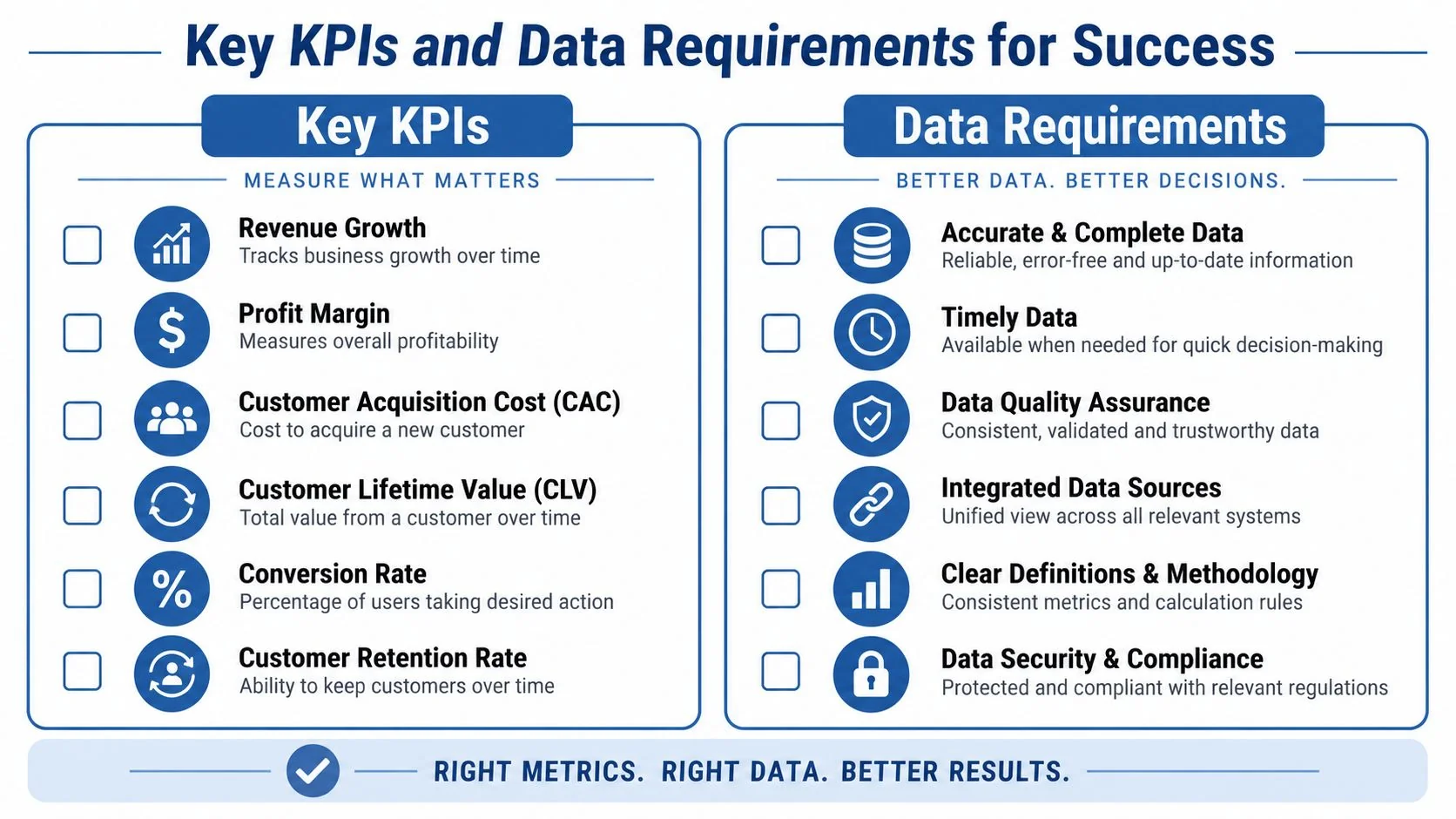
Start with operational outcomes that line teams recognize. Forecast accuracy matters, but it isn't enough by itself. You also need inventory turnover, order cycle time, on-time delivery, and supply chain cost per unit. Those are the indicators operations and finance already use to judge whether a planning change is helping or hurting.
Then add production-grade model controls. In Krishna Gangadhar's benchmark metrics for supply chain AI production, enterprise AI supply chain environments are expected to prevent uncontrolled MAPE spikes greater than 3%. The same production view requires monitoring GPU utilization, memory stability, inference runtime consistency, and the ultimate efficiency metric of accuracy gains per GPU hour.
For manufacturing teams, that isn't a technical side note. It's how you avoid a system that performs well one month and degrades unnoticed the next.
A practical KPI stack looks like this:
- Business KPIs: Service level, stockouts, order cycle time, logistics cost, excess inventory.
- Model KPIs: Forecast error, bias, drift frequency, retraining consistency.
- System KPIs: Runtime stability, memory behavior, compute efficiency, failed job rate.
For teams already working on quality and process discipline, the same mindset applies to AI operations. A useful parallel is the broader discipline of manufacturing quality metrics, where process control matters as much as final output.
The data stack you need before scaling
The data requirements are rarely glamorous, but they determine whether AI supply chain optimization works in a plant environment:
- Historical transaction data: Orders, shipments, returns, forecast history, and inventory movements.
- Supplier performance data: Lead times, delivery reliability, quality events, and sourcing constraints.
- Production and inventory data: Current stock, work-in-process visibility, schedules, and BOM context.
- Transportation data: Carrier performance, route timing, shipment milestones, and exception events.
- External inputs where relevant: Market signals, weather exposure, and disruption indicators.
The fastest way to kill ROI is to ask a model to optimize a process whose source data still lives in disconnected spreadsheets and disputed manual overrides.
If you're assessing readiness, don't ask whether the business has “enough data.” Ask whether the data is clean, connected, current, and owned. Plants can operate for years with informal data workarounds. AI systems can't.
A Phased Roadmap for Evaluation and Implementation
Most failed projects don't fail because the algorithm was weak. They fail because the rollout sequence was wrong. Teams try to jump from fragmented data and vague goals straight into a pilot, then wonder why recommendations create resistance or don't survive production conditions.
Phase one is where most projects are won or lost
Before any vendor demo matters, validate the operating foundation. BCG's 2026 analysis of AI agents in supply chains states that agents require “clean, connected data delivered at business speed via a modern cloud-native platform”, and notes that 60% of mid-sized manufacturers lack that prerequisite. The same source says 6–12 month data migration and integration efforts often undermine ROI before pilots begin, and reports that 52% of failed AI supply chain projects stem from data gaps, not algorithm flaws.
For a plant manager, that changes the implementation priority. You don't start with the smartest model. You start with the ugliest interfaces, the missing master data, the unowned supplier records, and the manual override logic planners use every day.
A practical rollout sequence
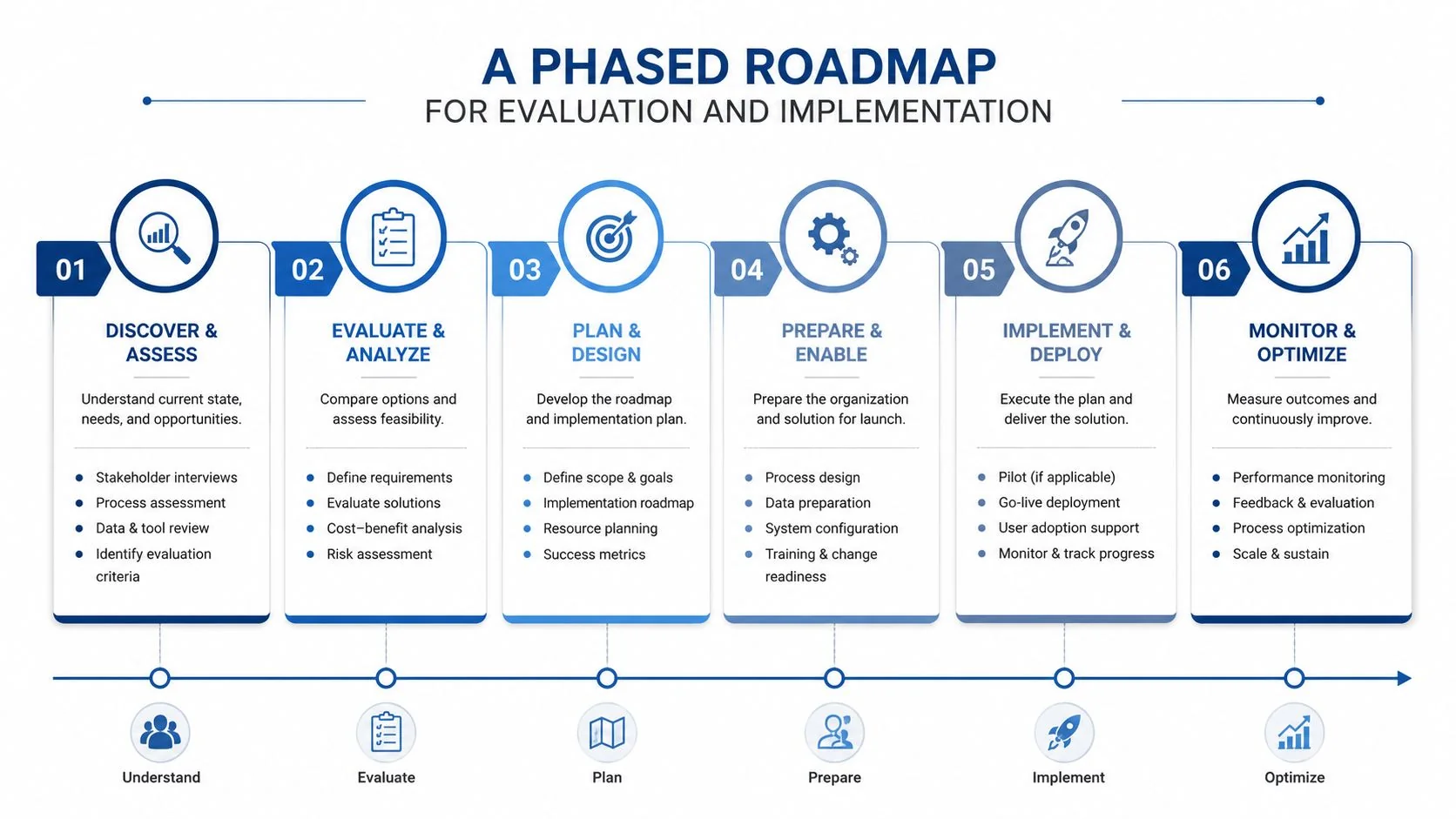
A phased model works better than a broad launch:
-
Data foundation and operating scope
Define which decisions the system will influence. Clean the minimum viable data needed for those decisions. Confirm ERP, planning, supplier, and logistics interfaces. -
Pilot selection and business case
Pick one use case with visible pain and measurable economics. Good candidates are chronic stockouts, unstable inbound materials, or high expedite frequency. -
Vendor evaluation and proof of concept
Test the model against your real planning process, not a sanitized sample dataset. Include planner overrides and exception handling. -
Controlled deployment
Run the system in parallel long enough to expose edge cases. Assign clear owners in planning, procurement, operations, and IT. -
Scale by workflow, not by hype
Expand to adjacent plants or categories only after the original workflow is stable.
A real manufacturing example reinforces the need for structure. PathHub's 2026 case study on AI supply chain planning describes a six-phase project over 22 weeks, including a 4-week Supplier Strategy phase to build dual sourcing and a 3-week negotiating phase. That rollout also selected three suppliers with different risk profiles while avoiding the hardest supplier initially. That's what mature deployment looks like. It stratifies risk instead of pretending all suppliers and plants are equally ready.
For many manufacturers, execution also depends on clean handoffs across systems. That's why manufacturing system integration usually becomes part of the actual project plan whether teams budgeted for it or not.
Vendor questions that expose risk early
Ask these before signing anything:
- How does the system explain recommendations? Show the inputs, assumptions, and tradeoff logic for one forecast, one supplier choice, and one inventory decision.
- How are overrides handled? If planners disagree, what does the model learn from that?
- What happens during data gaps? Does the system degrade gracefully or keep producing false precision?
- How is drift managed? Show retraining triggers, monitoring thresholds, and alerting.
- What systems are already integrated? Ask for named connectors, not generic claims about ERP compatibility.
Buy the implementation path, not the demo. Most demos are optimized for confidence. Operations needs proof of control.
Avoiding Pitfalls and Achieving End-to-End Success
Only a small share of manufacturers turn AI pilots into end-to-end supply chain execution, and the main failure point is rarely the model itself. It is whether operations, procurement, and finance trust the recommendation enough to use it when service levels, inventory, and supplier mix are on the line.
Trust breaks down fast in plants because every recommendation has an operational owner. If a model changes a reorder point, someone on the floor absorbs the stockout risk. If it shifts volume to a secondary supplier, procurement owns the supplier performance risk. If it adds inventory to protect schedule adherence, finance carries the working capital impact. Teams will not adopt a system they cannot question, trace, and override.
The transparency problem teams underestimate
Research summarized in the Semantic Scholar paper on AI explainability and scaling barriers points to the same problem. Supply chain AI needs to show data sources, assumptions, and tradeoff logic in a form people can audit. Without that, pilots stay pilots.
For plant managers, the implication is straightforward. A forecast with no explanation creates work, not confidence. Planners build shadow spreadsheets. Buyers delay decisions until they can validate them manually. Schedulers override the system based on experience because they cannot see what demand signal, supplier lead time, or service target drove the recommendation.
That behavior is rational. Operations teams are held to output, schedule attainment, and customer service, not model adoption.
What durable success looks like in practice
The manufacturers that scale tend to put operating discipline ahead of model complexity.
- They make recommendations inspectable. Users can see the demand inputs, inventory assumptions, sourcing constraints, and cost versus service trade-offs behind each output.
- They define override rules before go-live. Planners, buyers, and plant leaders know when they can intervene, how exceptions are logged, and what the system learns from those interventions.
- They start with a controlled scope. One plant, one product family, or one planning decision is enough to prove adoption behavior before expanding to the full network.
- They assign business ownership to the data. Supplier lead times, BOM accuracy, master data, and inventory status have named owners outside IT.
- They measure operational use, not just model accuracy. A system that forecasts well but gets overridden 70% of the time has an adoption problem, not a math problem.
Cross-functional trust is the gating requirement. If procurement believes the model favors cost at the expense of resilience, they will resist it. If finance suspects inventory logic is inconsistent, they will block expansion. If plant leadership sees recommendations that ignore changeover constraints or labor availability, the program loses credibility in a week.
AI supply chain optimization delivers durable value when it fits production constraints, supplier risk, schedule adherence, and human accountability. For that reason, this topic belongs inside the broader discussion of AI for manufacturing use cases. In a factory, success is not a smarter dashboard. It is fewer shortages, better schedule performance, and decisions people will use under real operating pressure.
