AI Inventory Management Guide for Manufacturing Success
Learn how AI inventory management optimizes manufacturing inventory with forecasting, safety-stock, reorder automation, data needs, roadmap and real-world ROI.
Written by AI for Manufacturing
AI inventory management is the use of artificial intelligence, machine learning, and predictive analytics to improve demand forecasting, replenishment, safety stock, anomaly detection, and inventory control in connected ERP, WMS, and MES environments. In manufacturing, that means shifting from static reorder rules to continuously updated decisions that respond to demand variation, supplier delays, and plant-level execution data.
The market is no longer experimental. One forecast projects the global AI inventory management market will grow from $5.85 billion in 2026 to $17.42 billion by 2031, a 24.4% CAGR (Mordor Intelligence forecast). That growth reflects a simple reality, manufacturers now treat inventory intelligence as a core operating capability, not a side analytics project.
Table of Contents
- Introduction to AI Inventory Management
- Core Concepts of AI Inventory Management
- Key Use Cases in Manufacturing
- Measuring Success with KPIs and ROI
- Data Quality and Integration Essentials
- Implementation Roadmap and Common Pitfalls
- Vendor Evaluation Checklist for Inventory AI
- Real-World Examples and Conclusion
Introduction to AI Inventory Management
AI inventory management is the application of machine learning, predictive analytics, and optimization logic to decide what to stock, where to stock it, and when to replenish it. In manufacturing, the practical goal is to reduce stockouts, avoid excess inventory, and keep service levels stable while protecting working capital.
The reason this matters for manufacturing professionals is straightforward. Inventory touches production continuity, procurement timing, warehouse space, and customer commitments at the same time. If inventory decisions are slow or biased by stale rules, plant teams end up paying for it through expediting, shortages, or surplus materials that sit too long.
A useful way to think about it is operational control, not just forecasting. AI can estimate future demand, calculate replenishment thresholds, flag unusual movement, and feed those recommendations back into ERP and WMS workflows. When done well, the system becomes a decision layer above transactional software rather than a replacement for it.
Practical rule: if the model cannot explain a reorder decision in the context of lead time, demand variability, and service-level targets, it's not ready for manufacturing use.
That distinction matters because manufacturing inventory is usually segmented by SKU, plant, line, and supplier behavior. A generic analytics tool may look useful in a demo, but a production-grade AI system has to survive messy data, shifting schedules, and exception-heavy workflows.
Core Concepts of AI Inventory Management
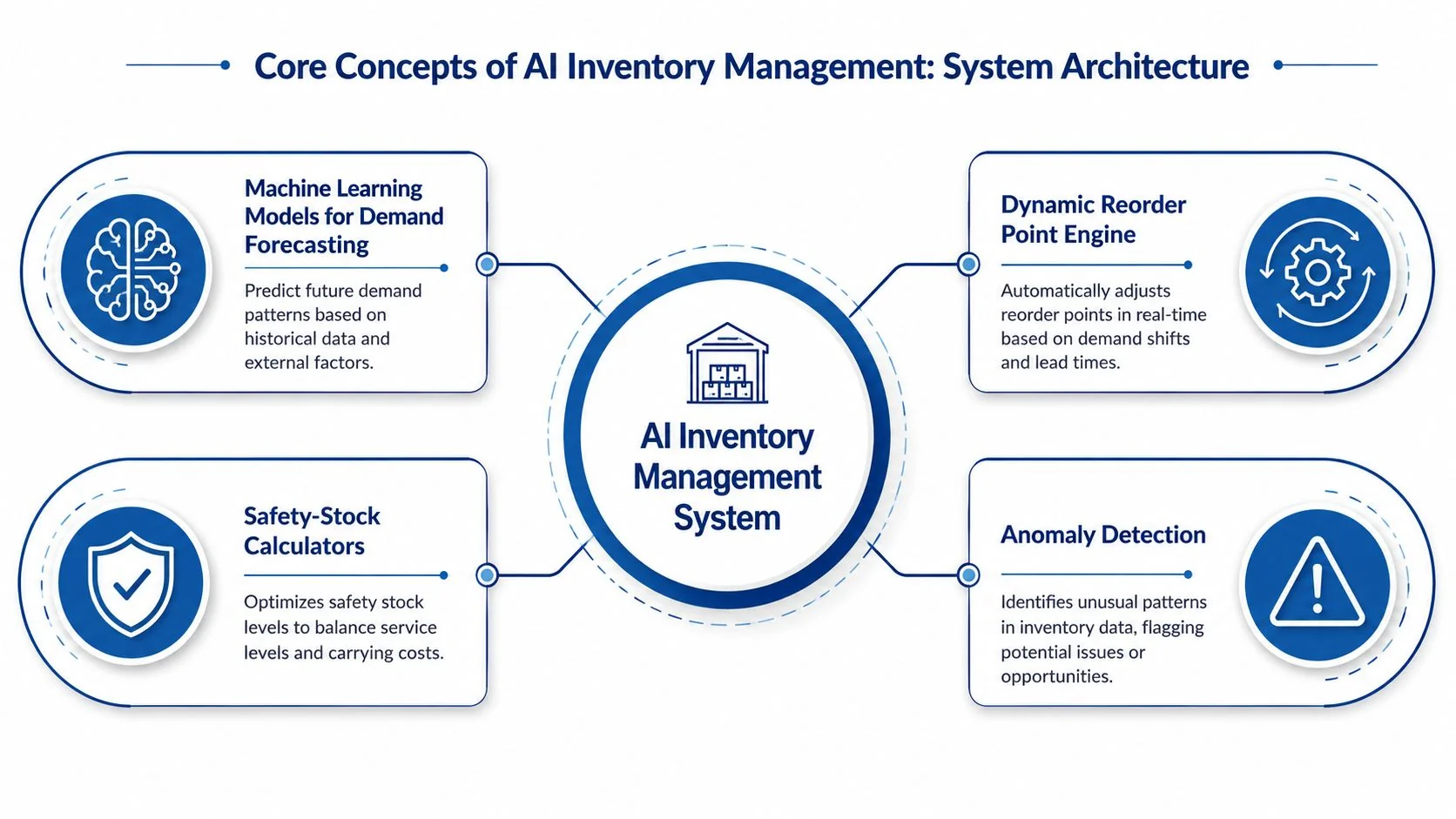
A practical AI inventory stack usually starts with machine learning models for demand forecasting, then layers in a dynamic reorder point engine, safety-stock calculators, and anomaly detection. Those elements work together because forecasting alone doesn't create value unless it changes replenishment behavior. The technical literature points to deep learning, reinforcement learning, and hybrid methods as the dominant approaches, with demand forecasting, inventory control, and replenishment optimization as the main tasks (review of AI in inventory management).
How the system fits together
The best manufacturing deployments ingest ERP, WMS, and POS or production data, then expose results through APIs back into transactional systems instead of trying to replace them. That architecture matters because planners still need familiar execution logic, while AI handles the math behind reorder thresholds and service-level trade-offs. In practice, dynamic policies frequently outperform static ones, especially for high-variability or high-value SKUs.
The most valuable systems are not just predictive, they're adaptive. Demand models learn nonlinear patterns, reinforcement learning can optimize sequential reorder choices under uncertainty, and hybrid systems combine forecasting with explicit optimization. A manufacturing plant benefits when those outputs are connected to the actual replenishment workflow, because a forecast that lives only in a dashboard doesn't move material.
If the inventory system can't push recommendations into the workflows people already use, adoption usually stalls at the pilot stage.
The market signal supports that shift. One forecast projects the global AI inventory management market will grow from $5.85 billion in 2026 to $17.42 billion by 2031, with retail and e-commerce already representing the largest end-user segment at 32.56% of revenue (Mordor Intelligence forecast). For manufacturing teams, that means the core concepts are being standardized fast, but the architecture still has to be fitted to plant realities.
Key Use Cases in Manufacturing
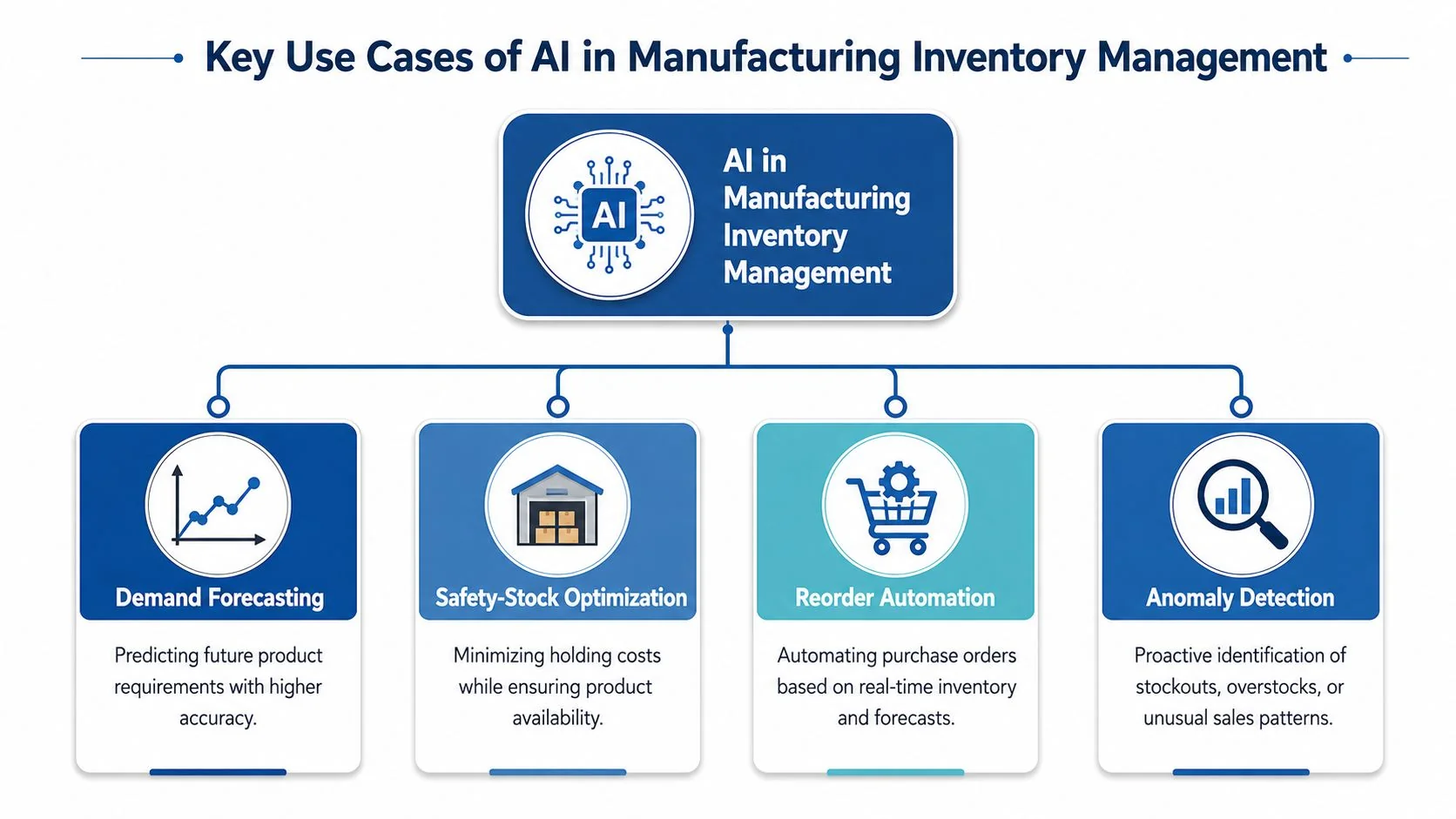
The four use cases that consistently matter in factories are demand forecasting, safety-stock optimization, reorder automation, and anomaly detection. They sound familiar, but the value comes from how they're implemented. A forecast only helps if replenishment rules change, and anomaly detection only helps if someone acts on the alert.
Demand forecasting and replenishment logic
Demand forecasting is usually where teams start because it's the easiest use case to explain and the fastest to pilot. The model ingests historical consumption, production signals, and external drivers, then predicts what the plant is likely to need next. That matters in manufacturing because production schedules and parts consumption rarely move in straight lines.
Safety-stock optimization is the next layer. Instead of using a fixed buffer, the system adjusts inventory protection based on demand volatility, lead time uncertainty, and service targets. That's a better fit for plants with variable suppliers or mixed-service requirements, because it reduces the cost of carrying unnecessary buffer stock.
Reorder automation and anomaly detection
Reorder automation turns predictions into action. AI calculates when to trigger purchase orders or transfers, which reduces manual planner intervention and limits delay between signal and execution. In a manufacturing setting, that can support line-side replenishment, spare-parts control, and multi-site stock balancing.
Anomaly detection is often underrated. It catches patterns that don't belong, such as unexpected stock movement, unusual consumption, or a replenishment loop that's beginning to drift. That matters because a plant can have an apparently healthy forecast and still lose control through bad transactions, missing receipts, or blocked stock.
For readers comparing adjacent use cases, the AI supply chain optimization guide is useful because it shows how inventory decisions connect to broader planning behavior. The point is not to deploy every model at once. It's to start where the operational pain is clearest and the workflow is most measurable.
Measuring Success with KPIs and ROI
AI inventory projects should be measured with operational KPIs first, then financial outcomes. The most useful ones are forecast accuracy, stockout rate, service level, inventory turnover, and carrying cost reduction. If those metrics don't move, the project is probably just producing better dashboards.
Organizations deploying AI-driven inventory optimization report stockout reductions of 30% to 65%, excess inventory falling 20% to 50%, and carrying costs dropping 25% to 35% (inventory optimization benchmark). Those are the kinds of outcomes manufacturing leaders care about because they map directly to lost sales avoided, space released, and cash tied up less aggressively in stock.
Typical AI Inventory KPIs and Financial Impact
| KPI | Improvement Range | Business Impact |
|---|---|---|
| Forecast accuracy | Improves when model inputs and demand history are clean | Better replenishment timing and fewer planning surprises |
| Stockout rate | 30% to 65% reduction (benchmark) | Fewer line stoppages, fewer missed customer commitments |
| Excess inventory | 20% to 50% reduction (benchmark) | Less obsolescence, less warehouse pressure, lower capital lockup |
| Carrying cost | 25% to 35% reduction (benchmark) | Lower storage and working-capital burden |
| Service level | Maintained or improved in AI deployments | Stable customer fulfillment without overbuffering |
What actually drives ROI
The ROI logic is usually simple. Reduce unnecessary inventory, improve service, and shrink the labor spent managing exceptions. IBM's benchmark cited in the same data set found firms using AI-driven inventory management carried 18% to 24% less inventory by value after 18 to 24 months of deployment while maintaining equivalent or better service levels (benchmark summary).
That's why KPI discipline matters. If a plant only tracks forecast accuracy, it can miss the operational win. If it tracks service level and inventory value together, it can see whether the model is helping the business or just making forecasts look prettier.
Data Quality and Integration Essentials
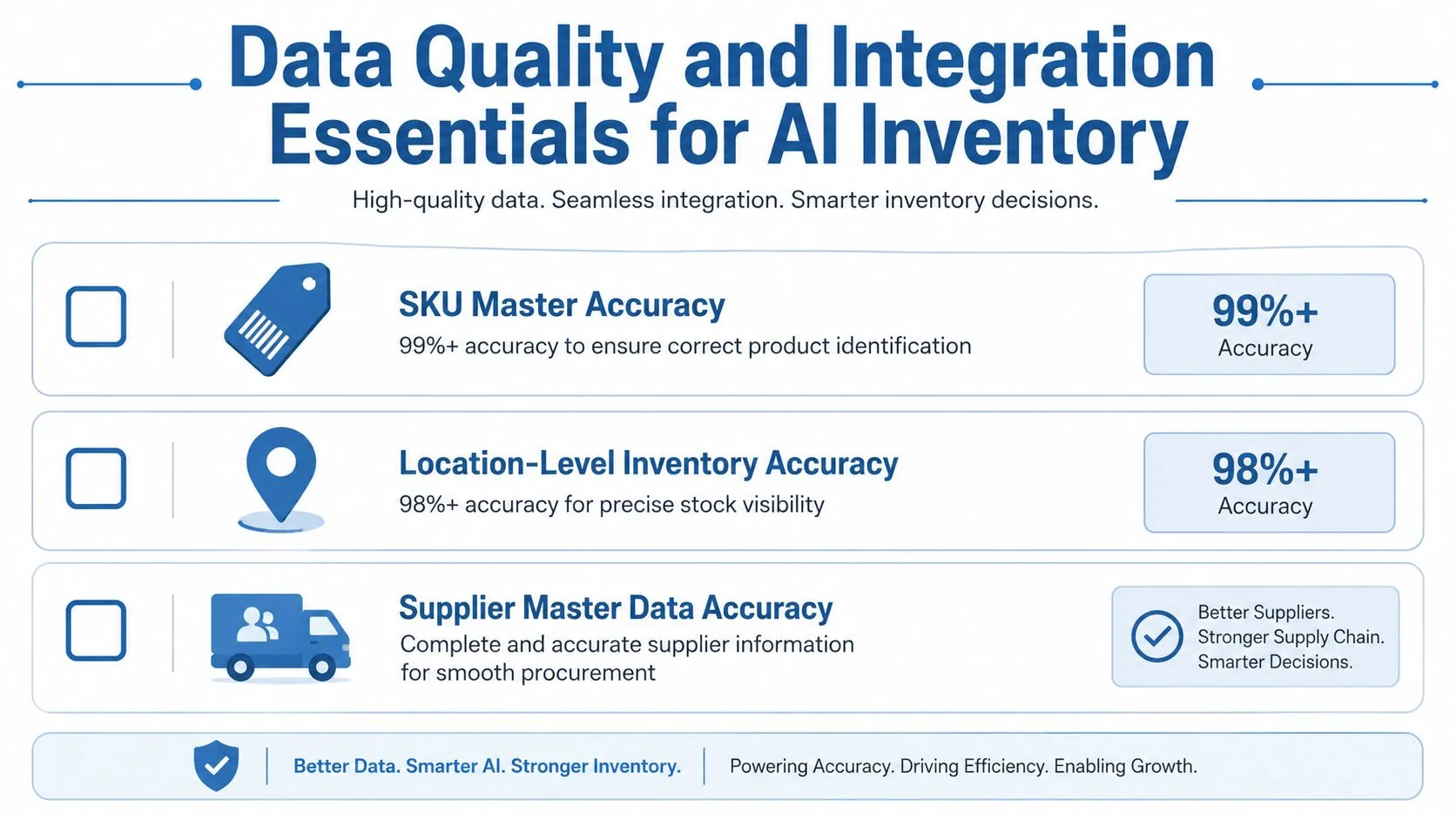
AI inventory systems are only as strong as the master data and event data underneath them. One inventory playbook specifies SKU master accuracy at 99%+, location-level accuracy at 98%+, and quarterly supplier-master validation, with retraining triggers when model performance degrades by more than 5% (playbook). That's not a nice-to-have, it's the minimum condition for trustworthy replenishment logic.
What has to be clean first
Manufacturing data usually fails in predictable ways. SKU codes drift, locations are duplicated, supplier lead times are stale, and stockout-contaminated demand histories get treated as truth. When that happens, even a strong model can optimize the wrong reorder point because the inputs are biased.
The integration layer has to solve that by creating a single golden record and feeding it with event-driven updates. That's especially relevant when ERP, WMS, and MES each hold part of the truth. A source-of-truth architecture is the difference between AI that updates decisions in near real time and AI that merely explains why planners were wrong after the fact.
The governance controls that matter
- SKU master validation: keep product definitions consistent so forecasting and replenishment map to the right item.
- Inventory record reconciliation: align location-level balances before model outputs are trusted.
- Supplier master review: validate lead times, minimum order quantities, and status changes on a regular cadence.
- Drift monitoring: retrain or recalibrate when model performance slips beyond agreed thresholds.
For teams building the data pipeline, the manufacturing data collection guide is a useful companion because it frames inventory AI as a data governance problem before it becomes a modeling problem. In production, the most common failure mode isn't weak math, it's inconsistent data flow.
Implementation Roadmap and Common Pitfalls
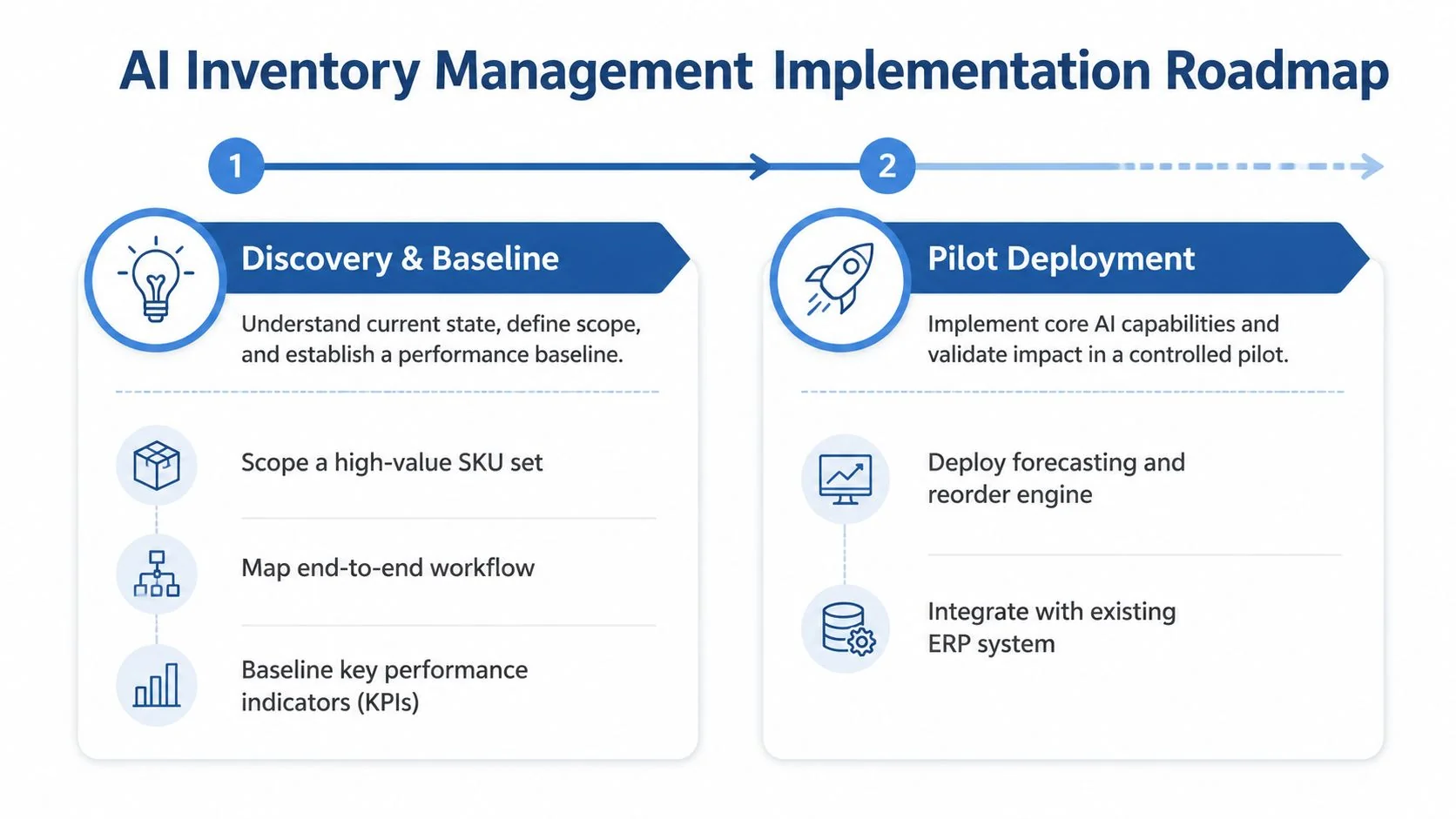
The fastest path is a phased rollout that proves value on one narrow slice of the business before broadening scope. Most organizations lack clean ERP integration out of the box, and an architectural fix with a single golden record and event-driven updates can realize AI value within 3–4 months (integration guidance). That's a realistic window for a focused pilot, not a full enterprise transformation.
A practical rollout sequence
- Discovery and baseline. Scope a high-value SKU set, map the end-to-end workflow, and record the current state of forecast error, stockouts, and excess inventory.
- Pilot deployment. Activate the forecasting model and reorder engine, then connect recommendations to existing ERP execution.
- Controlled expansion. Add more SKUs, more sites, and more exception handling once the pilot is stable.
The biggest pitfall is trying to boil the ocean. Teams often chase too many plants, too many part families, or too many integrations at once. That slows learning and makes it harder to tell whether a poor result comes from the model, the data, or the process.
Change management is the other failure point. Planners won't trust a system that changes their decisions without a clear rationale, and operations teams won't adopt recommendations if exceptions are handled outside the workflow. Cross-functional governance has to include supply chain, operations, IT, and procurement from the start.
Start with one or two low-risk use cases that can show value fast, then use that proof to fund the harder integrations.
The best pilots don't aim for perfection. They aim for credibility, repeatability, and a clean path from recommendation to execution.
Vendor Evaluation Checklist for Inventory AI
A vendor should be judged on more than a polished demo. Ask whether the platform supports DL, RL, or hybrid methods, whether it integrates cleanly with ERP, WMS, and MES, and whether it can prove outcomes in manufacturing settings. A hybrid AI forecasting and optimization approach increased demand satisfaction to 95% and profitability by 14% in a manufacturing supply-chain case study (case study).
Use evidence, not promises. The AI for Manufacturing database is one option for filtering vendors against documented case studies, because it tracks use case, technology, source links, and measured outcomes in one place. That helps separate vendors with real manufacturing proof from those with generic inventory claims.
A solid shortlist should answer four questions. Can the vendor show measured ROI in a factory context. Can it fit your data architecture without a painful rebuild. Can it handle governance and retraining. Can it scale beyond a single pilot without losing control of exceptions.
Real-World Examples and Conclusion
A global CPG manufacturer used AI optimization to identify $63 million in MRO inventory value across 41 sites through the case study documented at AI for Manufacturing's case record. That kind of result shows why inventory AI is often a working-capital project as much as a planning project.
Other manufacturing deployments in the same ecosystem typically follow the same pattern, better visibility, tighter replenishment, and cleaner exception handling. The common thread is not a specific model family, it's disciplined integration, measurable KPIs, and an operating team willing to use the output.
Inventory is a foundational AI use case for manufacturing because it connects procurement, production, warehouse control, and customer service in one loop. If you get it right, the benefits spill into broader AI for manufacturing initiatives by freeing capital, improving data discipline, and creating a reliable pattern for plant-level automation.
If you're evaluating ai inventory management for a plant, start with one high-value SKU family, verify your data thresholds first, and test whether the system can push decisions into your actual ERP and warehouse workflow. Then use those results to expand into broader AI for manufacturing use cases, where inventory control becomes the bridge between predictive intelligence and real production outcomes.
