AI for Asset Management in Manufacturing
Learn how AI for asset management improves manufacturing maintenance, inventory, tracking, and digital twins through practical KPIs and implementation guidance.
Written by AI for Manufacturing
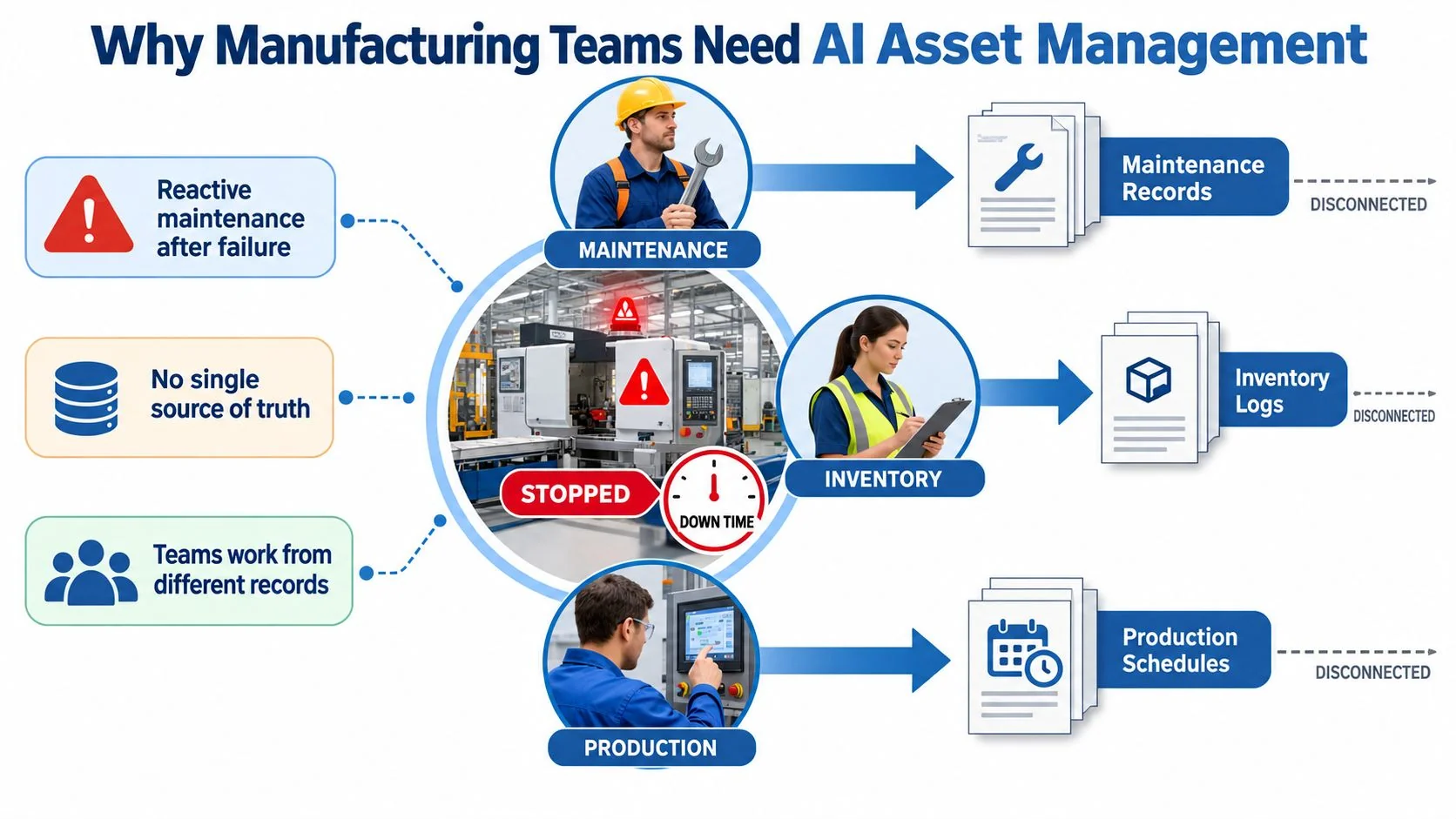
A production line stops, maintenance has a work-order history, stores has a parts list, and production has a schedule, but each team is looking at a different asset record. AI for asset management in manufacturing uses machine learning, intelligent analytics, and related AI techniques to analyze asset data, estimate condition or future behavior, recommend actions, and improve decisions across equipment and production assets. Its value depends on whether a useful prediction changes a maintenance, inventory, inspection, or tracking decision, and whether the plant can measure the operating result.
Table of Contents
- Why Manufacturing Teams Need AI Asset Management
- Build the AI Asset Management Operating Loop
- Compare the Highest-Value Asset Use Cases
- Measure Outcomes With Manufacturing Asset KPIs
- Implement AI Asset Management in Five Stages
- Choose Vendors With Verification Criteria
- Avoid Common AI Asset Management Pitfalls
- Connect Asset Intelligence to Manufacturing Results
Why Manufacturing Teams Need AI Asset Management
When maintenance, inventory, and production teams work from disconnected records, the plant often discovers a problem only after a machine has stopped. A maintenance log may show recurring repairs, while the inventory system doesn't connect the relevant spare part to that machine and the production schedule doesn't reflect the risk. AI can help make those records more useful, but only if a recommendation reaches the people who can act on it.
Conventional preventive maintenance schedules work using a fixed interval or usage threshold. AI-assisted asset management can add condition and operating context, helping a reliability engineer decide whether to inspect, repair, monitor, or defer. That distinction matters: a model can estimate risk, but the engineer still has to consider the failure mode, production consequences, safety requirements, and the availability of people and parts.
The practical progression is asset visibility, diagnosis, prediction, recommendation, and action. A plant might first reconcile asset identities and maintenance histories, then flag an unusual vibration pattern, estimate the likelihood of a developing fault, recommend an inspection, and record the result in a work order. That sequence can support predictive maintenance, anomaly detection, spare-part optimization, digital twins, and asset tracking. The right level of human oversight depends on the operating context and the consequences of a wrong decision.
For teams reviewing asset data and controls, DUCHENG Industrial's VFD fleet guide is a reference point on managing equipment fleets. When purchasing, ask whether the plant can connect the vendor's output to an accountable decision and verify the outcome, however advanced the model looks.
Build the AI Asset Management Operating Loop
An asset-management system becomes useful when the plant connects its data to work that someone owns. Start with reliable asset identity, then gather sensor histories, maintenance records, work orders, production context, inventory status, and relevant failure knowledge. If a sensor stream can't be tied to a specific asset, or a completed repair isn't recorded against that asset, the model's input and its later evaluation both become weaker.
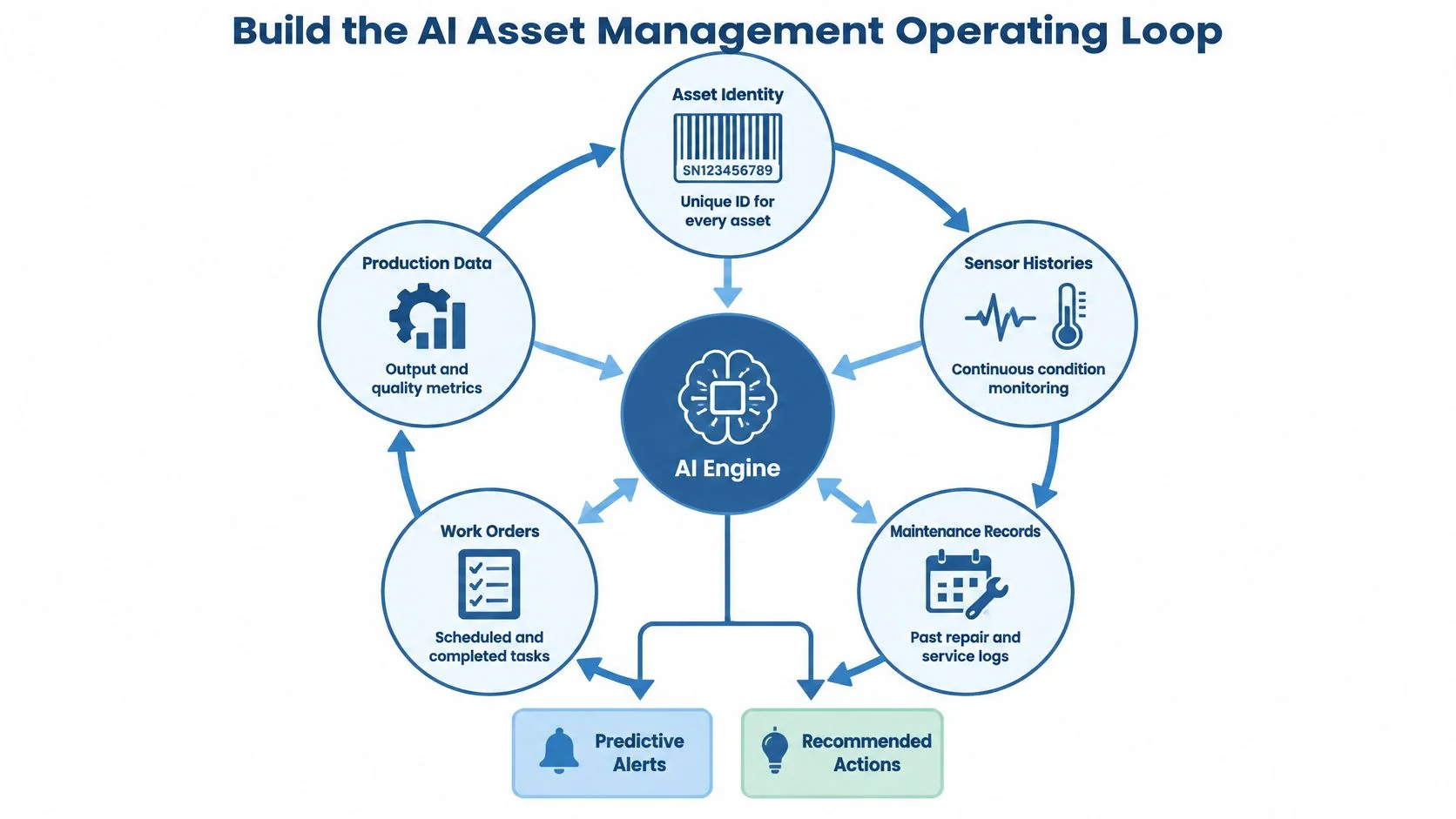
A practical loop has five connected activities:
- Capture and contextualize. Link each reading, work order, and production event to the correct asset, operating state, and time. Check units, missing data, sensor reliability, and naming inconsistencies before treating the history as model-ready.
- Generate an inference. Use a model to identify an anomaly, estimate a condition or failure risk, or help forecast a parts need. The output is a signal to assess, not a maintenance decision by itself.
- Recommend a specific action. State what to inspect, monitor, repair, or stage, and give the reason, supporting evidence, and relevant uncertainty. A general alert doesn't tell a technician what to do next.
- Route and control the work. Send the recommendation into an accountable workflow, such as a CMMS work order or inventory review. A qualified person should approve, reject, or override recommendations when operational or safety consequences require it.
- Record the result. Capture what the team found, what action it took, and whether the suspected issue occurred. That feedback supports model evaluation and gives the plant an auditable record of the decision.
Consider a pump with a new vibration pattern. A forecast matters only if it prompts a useful response before a breakdown, such as an engineer's inspection or a planned intervention. If nobody owns the alert, the model has identified a pattern without closing the operating loop. Teams clarifying the responsibilities of maintenance and asset systems can also consult this guide to CMMS and EAM differences.
The NIST AI Risk Management Framework organizes risk management around Govern, Map, Measure, and Manage. In a plant, Govern assigns ownership, Map documents operating conditions and consequences, Measure tracks model and operational performance, and Manage sets controls such as human approvals and fallback procedures.
Compare the Highest-Value Asset Use Cases
The most useful first application is usually the one tied to a clear operating decision, not the one with the flashiest demonstration. Compare potential projects by what a plant team will do with the output, which information that decision requires, and what evidence would establish that the workflow works in the plant's conditions.
| AI Use Case | Operational Decision | Required Data | Primary KPI | Evidence to Request |
|---|---|---|---|---|
| Predictive maintenance | Schedule an inspection or repair before a likely failure | Asset identity, condition signals, work orders, failure and repair history | Prevented failures or downtime avoided | Results against a baseline, alert lead time, and documented intervention outcomes |
| Anomaly detection | Investigate an unusual machine or process condition | Sensor history, operating state, process context, known normal behavior | Alert precision and response time | Examples tied to confirmed events, false alarms, and operator review |
| Spare-part optimization | Stage, reorder, or redistribute parts for specific asset needs | Parts consumption, asset configuration, repair history, stock status, lead times | Parts availability and spare-parts cost | Forecasts compared with actual demand and documented service impact |
| Digital twins | Test an operating or maintenance scenario before changing equipment or settings | Asset configuration, operating data, process relationships, engineering assumptions | Decision quality or reduction in avoidable disruption | Validation against observed plant behavior and clearly stated model boundaries |
| Asset tracking | Confirm location, configuration, condition, and lifecycle status | Asset identifiers, location records, inspection and maintenance history | Record completeness and time to locate or verify assets | Demonstration using the plant's assets and traceable updates across systems |
A predictive-maintenance model can be evaluated for failure-risk forecasting, but reliability engineers should help define what constitutes a meaningful warning and which interventions are practical. Teams comparing the model's role with broader maintenance workflows can use this guide to understand predictive maintenance.
Anomaly detection, meanwhile, doesn't automatically explain the cause of an unusual reading. It can help prioritize investigation, but the technician still needs to check process state, instrumentation, and equipment condition. Likewise, a digital twin or tracking tool only earns its place if it informs an operating decision or supports a defined lifecycle workflow.
For procurement, insist that vendors demonstrate the use case with the asset type, data, and workflow under consideration. A polished dashboard is not proof that the model's output is accurate enough, timely enough, or actionable enough for the plant.
Measure Outcomes With Manufacturing Asset KPIs
A model's technical accuracy doesn't establish operating value. An alert may correctly identify an abnormal pattern and still fail to prevent a breakdown if it arrives too late, creates no work order, or recommends an action the plant can't complete. Evaluate performance from signal to response to outcome, and keep those stages distinct.
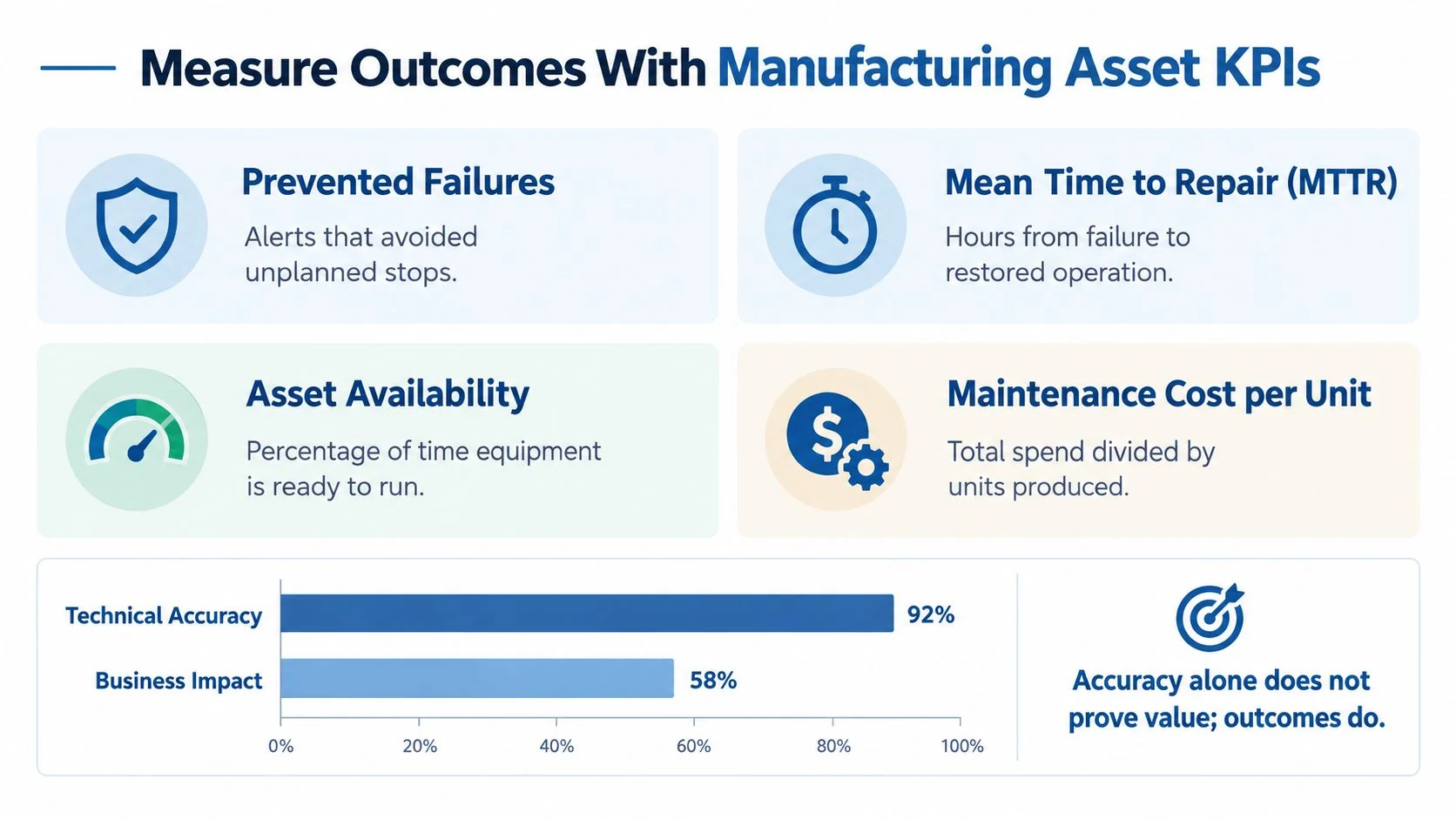
Track measures in four groups:
- Model performance: Prediction lead time, false-negative rate, alert precision, and coverage of the intended assets or failure modes.
- Maintenance execution: Prevented failures, downtime avoided, maintenance labor, work-order completion, and how often operators override or reject recommendations.
- Business impact: Spare-parts cost, production impact, and the verified cost of completed interventions compared with the relevant baseline.
- Adoption: Whether the intended teams review alerts, complete the resulting work, and record findings in a way that supports follow-up.
Before a pilot, agree on the asset population, baseline period, definitions, and data sources. Record the existing failure pattern, downtime cost, labor, inventory conditions, and production constraints. Then tie each claimed benefit to evidence: a prevented failure needs a credible counterfactual, while savings from reduced downtime shouldn't also be counted as a separate production benefit if both represent the same recovered output.
The U.S. Department of Energy's predictive-maintenance benchmarks include an average 10:1 return on investment, 25–30% lower maintenance costs, 70–75% fewer breakdowns, 35–45% less downtime, and 20–25% higher production. These are benchmark ranges, not guaranteed plant outcomes, and are reported in this predictive-maintenance benchmark summary. Compare them with your own reactive-maintenance rate, downtime cost, labor, parts inventory, and production constraints before using them in a business case.
Separate operational productivity from investment claims. A faster inspection or better-maintained record can be valuable without proving improved production or avoided cost. When building a measurement plan, teams can use manufacturing data analytics guidance to organize the evidence behind the reported result. Label each outcome by evidence quality, such as measured against a baseline, estimated from records, or reported without independent verification.
Implement AI Asset Management in Five Stages
A controlled deployment starts with an operating decision, then earns the right to expand. Assign an owner and a tangible deliverable at each stage so the project doesn't drift into an open-ended data or dashboard exercise.
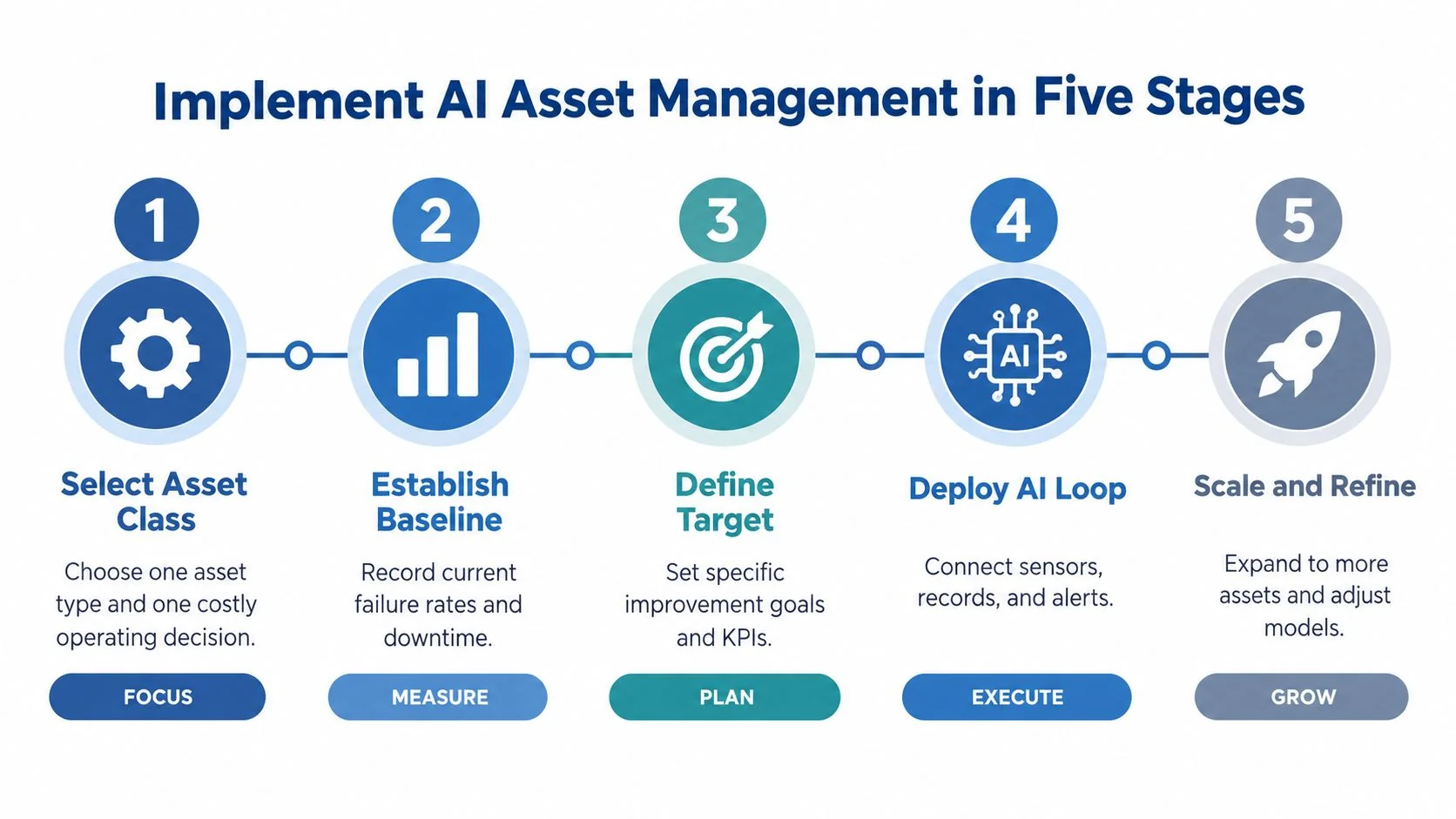
- Select one asset class and decision. The plant manager and reliability lead choose an equipment group with a visible failure, downtime, inventory, or traceability problem. The deliverable is a scoped use case; proceed only when a named team can act on the output. A warning sign is a project defined as “AI across the plant.”
- Set the baseline and intervention. The reliability engineer and finance partner document the current workflow and agree on what action the AI should support. The exit criterion is a measurable baseline and an agreed method for attributing results. If the team can't define the existing process, it can't credibly claim improvement.
- Check readiness and pilot safely. Data and engineering leads review asset identity, sensor quality, work-order history, integrations, and operating constraints. Run in shadow mode or within a constrained workflow, with acceptance thresholds and a fallback process defined before the trial. Poorly linked records or unreliable signals are reasons to fix readiness before expanding.
- Connect the recommendation to work. Maintenance, IT, and cybersecurity teams test how alerts enter the CMMS, inventory, or tracking process. Validate permissions, system behavior, response time, and human-approval boundaries. The deliverable is a controlled workflow; an alert that stays in a disconnected dashboard hasn't reached deployment.
- Scale after sustained value. Operations and model owners review results, adoption, overrides, and control performance before adding assets or use cases. Expand only when the plant can show repeatable operating benefit and a maintained feedback process. Rising alert rejection or missing work-order outcomes should pause expansion.
Practical rule: Keep a manual fallback available until the plant has shown that the recommendation and the workflow remain dependable in real operating conditions.
Choose Vendors With Verification Criteria
A vendor comparison should test fit with the plant's equipment and workflows, not just the model's reported capabilities. Ask providers to show how their system handles the selected asset class and failure modes, connects to existing sensors, CMMS, ERP, historian, and tracking tools, and documents data lineage and deployment assumptions.
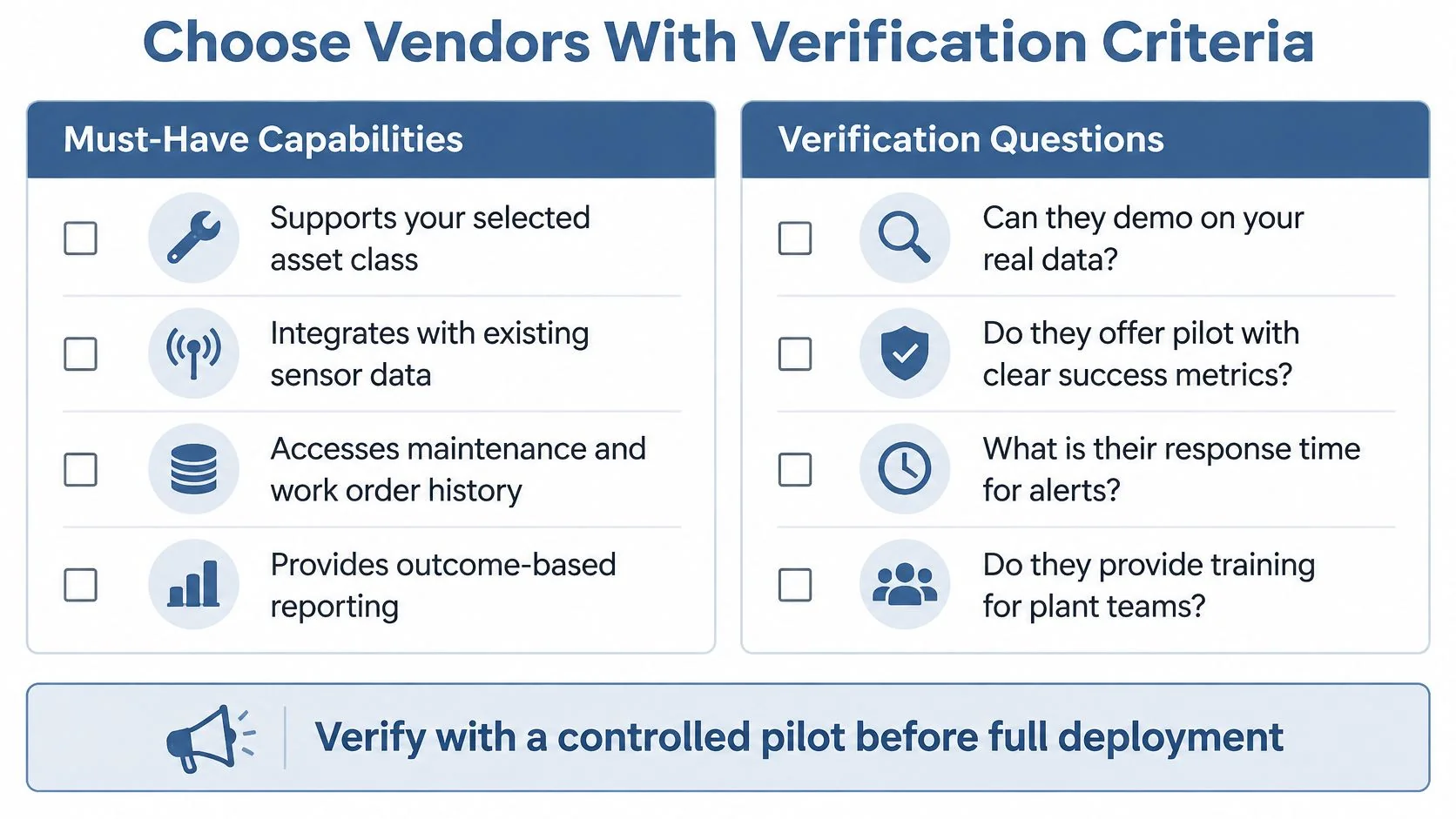
Use a consistent review across candidates:
- Industrial fit: Can the vendor demonstrate the relevant equipment, conditions, and failure modes using your data or a carefully controlled equivalent?
- Integration and evidence: Which systems does the product connect to, and can the vendor explain data lineage, baseline conditions, intervention details, and how outcomes were calculated? Separate vendor-reported results from independently verified ones.
- Control and support: Review alert settings, human approvals, fallback behavior, cybersecurity, audit logs, model retraining, drift monitoring, and the support available to plant teams.
- Operating cost: Clarify implementation effort, ongoing support, integration requirements, and the resources required to keep data and workflows current.
The AI for Manufacturing case-study database is one evaluation aid. You can search manufacturing implementations with structured filters, read standardized case records with a quality level, follow the link back to the original source, and browse a vendor directory. Those records don't all have identical evidence strength, so use the quality level to guide review and verify the original source before relying on a claim in a purchasing decision.
A useful vendor demonstration ends with a traceable action: what signal the system detected, what recommendation it produced, who reviewed it, and how the result appeared in the relevant work or asset record. If the provider can show only a model score or dashboard, ask how it connects that output to an accountable plant workflow.
Avoid Common AI Asset Management Pitfalls
Many projects appear successful in a demo but stall when they meet real records, work practices, and production constraints. Turn each predictable failure into a control with evidence and a named owner.
| Pitfall | Preventive control and evidence | Accountable role |
|---|---|---|
| Treating a dashboard demonstration as proof of value | Establish a baseline and retain records linking alerts to actions and avoided costs | Plant manager with finance |
| Scaling inconsistent asset names and sensor data | Assign data ownership, check lineage and quality, and reconcile identifiers before expansion | Data lead and maintenance systems owner |
| Counting alert volume as success | Track precision, lead time, response, prevented failures, and documented overrides | Reliability engineer |
| Assuming a digital twin or tracking view is valuable on its own | Name the decision or lifecycle workflow it supports, then verify use in that workflow | Operations or engineering lead |
| Comparing vendor claims without shared definitions | Standardize metrics, baselines, evidence quality, and verification requirements | Procurement and analytics lead |
| Treating change management as a final training session | Involve maintenance, production, quality, procurement, IT, cybersecurity, and operators before rollout; gather adoption and feedback evidence | Project sponsor |
One particular trap is equating more alerts with better monitoring. Operators may start ignoring alerts if the system doesn't distinguish actionable conditions from noise. Have the reliability team review alert outcomes with operators, then adjust thresholds and document why changes were made.
A second is assigning responsibility for data quality to a project team without giving anyone ongoing ownership. A pilot can work with hand-corrected records, but routine operations need a process for keeping asset identities, sensor mappings, and work histories usable. If the source records drift, the model's recommendations can become less relevant even when the underlying software hasn't changed.
Connect Asset Intelligence to Manufacturing Results
For a first initiative, choose the asset class with the clearest failure, downtime, parts, or traceability problem and a team that can verify what happens after a recommendation. Before committing, confirm that the plant has usable asset data, a measurable operating decision, an accountable workflow, an integration path, and a controlled feedback loop. That's the difference between deploying a model and improving an operating process.
AI for asset management becomes credible when plant teams can trace model output to inspection, maintenance, production, procurement, and asset-record decisions. For further evaluation, compare traceable manufacturing case studies and examine the original evidence behind their reported outcomes. Across predictive maintenance, anomaly detection, spare-part optimization, digital twins, and asset tracking, the rule is the same: choose evidence, define the action, measure the result, and expand only when the operating loop holds.
Start with one asset class and one costly decision your team can verify. Map the records and workflow, agree on the baseline, and ask potential providers to demonstrate how a recommendation becomes a completed plant action.
