What Is Predictive Maintenance and Why AI Needs It
Learn what is predictive maintenance and how sensors and machine learning detect failures early, a key AI use case in manufacturing.
Written by AI for Manufacturing

Predictive maintenance is a condition-based strategy that uses sensor data and machine learning to forecast failures and trigger maintenance just in time. The industrial market was estimated at USD 6.01 billion in 2020, reached a projected USD 15.60 billion in 2025, and is forecast to reach USD 91.04 billion by 2034, according to IMARC Group's predictive maintenance market analysis.
That scale changes how manufacturing teams should approach the question, what is predictive maintenance. It isn't just a dashboard that displays machine health, and it isn't a sensor installation project that ends when data starts streaming. It's the operating connection between equipment signals, analytical models, maintenance decisions, and completed work orders.
The commercial growth reflects several practical changes, including remote monitoring accelerated by COVID-19, lower IIoT sensor costs, and broader digital transformation spending, as documented in the same IMARC market analysis. But market growth doesn't prove that every plant will achieve fast payback. Recent industry reporting says 95% of predictive maintenance adopters report positive ROI, while only 27% achieve payback within 12 months according to Oxmaint's 2025 manufacturing maintenance report.
That gap is the useful starting point. A plant can have accurate predictions and still fail to create value if its sensors are poorly installed, alerts don't reach planners, work orders aren't prioritized, or the baseline economics are vague. The practical questions are therefore straightforward: what should you instrument, how do the models work, what outcomes have been documented, and how can you test vendor claims before commissioning a pilot?
Table of Contents
- Predictive Maintenance Defined for Manufacturing Teams
- Reactive Preventive and Predictive Compared
- Sensors Data Pipelines and Machine Learning Models
- Documented Outcomes and Real Manufacturing Cases
- Using a Verified Case Study Database for Evaluation
- Implementation Roadmap and Common Pitfalls
- Verifying Vendors and ROI Before You Commit
Predictive Maintenance Defined for Manufacturing Teams
Predictive maintenance is a condition-based strategy that uses sensor data and machine learning to estimate component degradation and schedule service before a failure disrupts production. In practice, it links equipment signals with a maintenance decision. The useful output is not an anomaly score on a dashboard. It is a clear recommendation for a reliability engineer: inspect, lubricate, replace, derate, or plan the work during an available production window.
The timing of the work is the defining difference. Run-to-failure waits for a breakdown. Fixed-interval preventive maintenance follows a calendar, runtime limit, or production cycle, even when the component has remaining useful life. Predictive maintenance adjusts the intervention to the observed condition, while still requiring a person and a workflow to act on the warning.
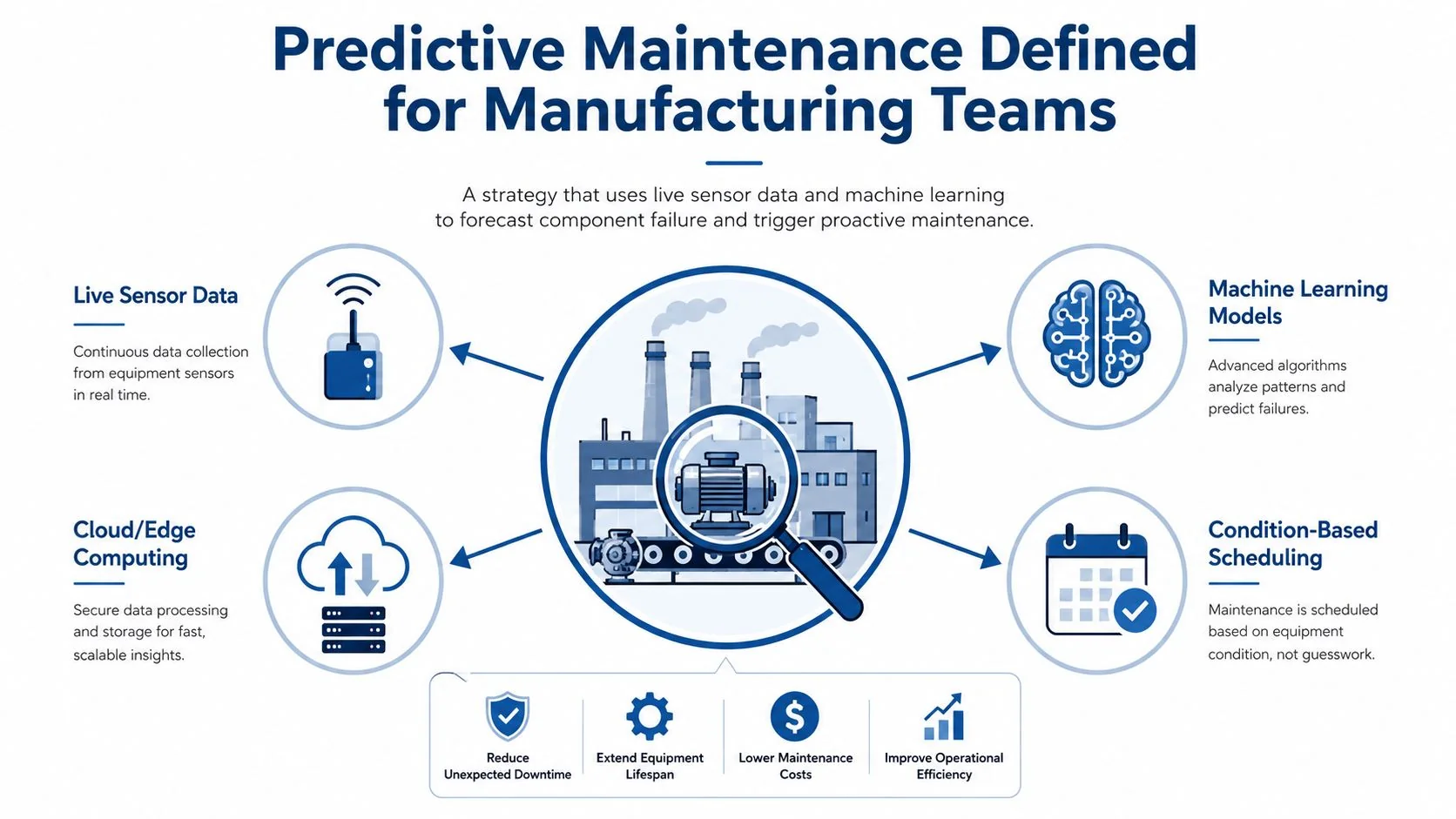
The market has expanded beyond a specialist reliability application. Predictive maintenance now appears as a foundational AI in manufacturing use case because plants already capture signals from motors, drives, pumps, compressors, furnaces, and process equipment. Forecasts place the market at USD 17.11 billion in 2026 and USD 97.37 billion by 2034, according to IMARC Group. Market boundaries vary by forecast, so those figures indicate direction rather than a guaranteed result for an individual plant.
Treat PdM as an operating system for decisions
A PdM project covers more than software. It may require sensors and installation standards, connectivity, data conditioning, failure-mode definitions, model monitoring, maintenance ownership, and integration with a CMMS or EAM system. Ignoring any of these can leave a technically accurate model disconnected from the work that creates value.
Use this evaluation sequence:
- Instrument the right failure modes. Choose assets where vibration, temperature, current, pressure, flow, acoustic, or oil signals can expose degradation.
- Build a trustworthy data path. Preserve timestamps, operating context, maintenance history, and machine identity.
- Configure the model around an action. A forecast has value only when a planner can respond within the available intervention window.
- Measure avoided consequences. Compare downtime, emergency work, maintenance hours, spare-parts consumption, and asset availability with a credible baseline.
For teams evaluating AI in manufacturing, the objective is not a high model count. It is a repeatable decision loop on assets whose failure consequences justify the instrumentation, data work, and ongoing operational ownership. A pilot should therefore test the complete path from signal to completed work order, not just whether an algorithm can flag an anomaly.
Reactive Preventive and Predictive Compared
Maintenance strategies differ by the event that triggers work. Planners should compare four practical factors: the trigger, the data burden, the downtime pattern, and the consequence of failure.
| Strategy | Trigger | Data Required | Downtime Behavior | Cost Profile | Best Fit |
|---|---|---|---|---|---|
| Reactive | Equipment failure | Basic asset and work-order records | Unplanned stoppage and emergency response | Low planning cost, potentially high consequence cost | Noncritical, low-cost assets where failure is tolerable |
| Preventive | Calendar date, runtime, or production cycle | Runtime and maintenance schedule data | Planned stoppage, with some unnecessary interventions | Predictable service cost, possible over-maintenance | Assets with known service intervals or limited sensing |
| Predictive | Condition signature, anomaly, failure probability, or degradation trajectory | Continuous or periodic sensor and operating data | Planned intervention after warning, before critical failure | Higher setup and data cost, targeted maintenance effort | Critical assets with measurable failure consequences |
Reactive maintenance appears inexpensive when the spreadsheet includes only planning and service costs. The calculation changes when a failed pump stops a bottleneck line, damages nearby equipment, creates a safety exposure, or requires expedited parts and overtime. Run-to-failure can fit cheap, redundant assets that are easy to replace. It is a weak default for a single motor controlling throughput.
Preventive maintenance lowers some failure risk by servicing or replacing components at planned intervals. The schedule cannot determine whether a bearing is healthy, degrading, or already damaged. It may also miss defects that develop between inspections, particularly when the failure mechanism is not closely tied to age or runtime.
Predictive maintenance adds condition monitoring to the maintenance decision. Vibration, thermal, acoustic, electrical, pressure, and flow signals show changes in operating state. Analytics then help distinguish normal load variation from deterioration. The condition-based maintenance workflow described in technical research connects data acquisition with feature extraction and prognostic modeling for failure probability or remaining useful life.
The trade-off is measurable at the asset level. PdM requires instrumentation, data handling, model maintenance, and a response process. Its payback depends on whether an alert arrives early enough to schedule work and avoid a consequence that justifies those costs.
Practical rule: Apply predictive maintenance to assets where failure cost, safety exposure, or throughput impact justifies reliable monitoring and a changed work process.
PdM does not replace preventive maintenance across the plant. A workable portfolio may place critical rotating equipment under continuous monitoring, keep simpler assets on time-based schedules, and run inexpensive, replaceable equipment to failure. For AI in manufacturing, this asset-segmentation view matters more than applying machine learning everywhere. The question is whether each asset has a failure mode that can be detected, an intervention window, and a consequence large enough to support the program.
Sensors Data Pipelines and Machine Learning Models
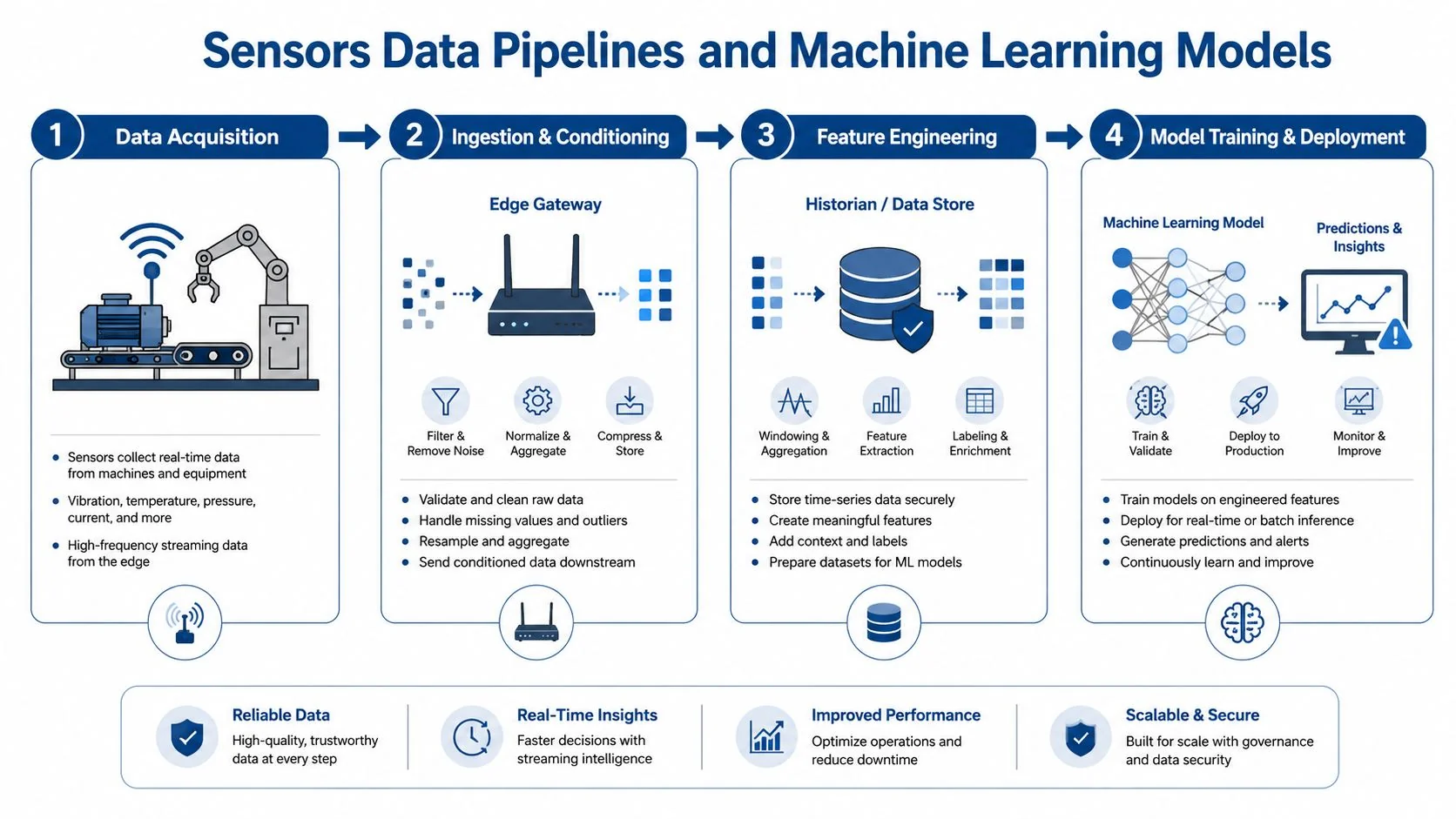
A predictive maintenance system succeeds or fails before the model runs. The pipeline must preserve the machine signal, attach it to the correct operating context, and turn the result into an action a planner can schedule. A typical implementation has four stages:
- Data acquisition: Sensors capture physical signals from the asset.
- Ingestion and conditioning: An edge device or gateway buffers, filters, timestamps, and forwards readings.
- Feature engineering: Software converts raw time series into indicators of operating condition.
- Model inference and workflow: The model produces an alert, risk score, or remaining useful life estimate that can create or prioritize a work order.
Sensor selection follows the failure mode. Accelerometers and velocity probes support vibration analysis on motors, pumps, fans, gearboxes, and compressors. Thermocouples and RTDs track thermal profiles. Current and voltage transducers expose electrical and load-related changes in motors and drives. Ultrasonic detectors can identify compressed-air leaks, steam leaks, bearing friction, and some forms of partial discharge. Pressure and flow transmitters support monitoring on hydraulic circuits and process loops. This guide to IoT sensors for predictive maintenance provides a useful reference for matching sensor types to maintenance applications.
Vibration systems often sample at 1 to 50 kHz, depending on the frequency range and diagnostic objective, as documented in the technical review of predictive maintenance methods. Edge buffering protects the signal when plant networks drop, gateways restart, or cloud connections introduce delay. Sending only a summary can discard the transient that separates an emerging fault from ordinary load variation. Storage, bandwidth, and latency therefore become engineering trade-offs, not minor implementation details.
Feature engineering still earns its place
Useful features may include RMS vibration, kurtosis, FFT spectra, wavelet features, temperature gradients, current harmonics, pressure variance, and operating-state indicators. These representations often give a model a cleaner basis for comparison than raw sensor streams alone. They also make alerts easier for maintenance specialists to inspect.
Classical techniques remain effective in many plants:
- Statistical process control can flag KPI values outside an established operating envelope.
- Anomaly detection can identify unusual feature combinations without a large catalog of labeled failures.
- Regression and random forest models can estimate risk when failure modes and contextual variables are structured.
- Survival and degradation models can estimate failure probability or remaining useful life when historical condition trajectories exist.
- Supervised deep learning becomes more useful when labeled failure histories and consistent operating data are available.
Model complexity does not guarantee better maintenance decisions. An opaque model that produces unexplained alerts may perform worse operationally than a transparent anomaly model tied to a disciplined inspection process. The final workflow should connect inference to the plant's CMMS or EAM, recording asset identity, suspected failure mode, supporting evidence, urgency, and recommended inspection in the work order. A technically accurate alert has limited value if no one owns the response.
Documented Outcomes and Real Manufacturing Cases
Strong PdM evidence connects four points: the asset class, diagnostic signal, intervention, and measurable operational result. Without that chain, a percentage in a sales presentation gives a maintenance leader little basis for comparison.
A manufacturing study reported a 25% reduction in downtime over 12 months versus traditional preventive maintenance. Average monthly downtime for a critical machine fell from 4 hours to 3 hours, according to a 2024 manufacturing study on PdM downtime reduction. The value of this example is its defined baseline and measurement period, not the reported percentage.
A separate analysis found that predictive maintenance reduced equipment downtime by 41% on average compared with reactive maintenance. The work used vibration analysis, thermal imaging, oil analysis, and ultrasonic testing, as described in a 2023 equipment downtime analysis. The diagnostic method shapes the result. A machine-learning model can classify a signal, but it cannot recover information that the sensor never captured.
| Industry | Asset Monitored | Diagnostic Method | Reported Outcome |
|---|---|---|---|
| General manufacturing | Critical production machine | Condition monitoring and predictive analysis | 25% downtime reduction over 12 months versus traditional preventive maintenance, with average monthly downtime moving from 4 hours to 3 hours. Reference: a published manufacturing study |
| Industrial equipment operations | Equipment with emerging mechanical or thermal faults | Vibration analysis, thermal imaging, oil analysis, and ultrasonic testing | 41% average downtime reduction compared with reactive maintenance, according to a 2023 equipment downtime analysis |
| Multiple manufacturing case studies | Equipment monitored for degradation before failure | Predictive condition monitoring | 20–30% decrease in maintenance costs and 30–40% decrease in unplanned downtime, reported in a 2022 case-study analysis of maintenance cost reductions |
These results are reference points, not guarantees. A systematic review of predictive maintenance reports typical outcomes of roughly 30–50% lower unplanned downtime and 18–25% lower maintenance cost when implementation includes disciplined operations and reliable sensor coverage. The overlap with individual case studies is useful, but the operating conditions determine whether a plant can reproduce it.
A practical benchmark matches the vendor claim to the closest asset, failure mode, sensor modality, baseline, and intervention process. A model that flags a bearing defect weeks before failure creates value only when the plant has the parts, labor, access window, and authority to respond.
For a broader example of an industrial AI ROI claim, review the documented DuPont predictive maintenance case study. Treat its headline as a case-specific result, then examine the evidence level, baseline, scope, and measurement context before using it in a business case.
Using a Verified Case Study Database for Evaluation
Vendor case studies can shape a pilot, but they are evidence to inspect, not proof to accept. A useful record identifies the asset class, sensor stack, model approach, deployment scope, baseline, and outcome source. It also separates vendor-reported results from findings verified independently.
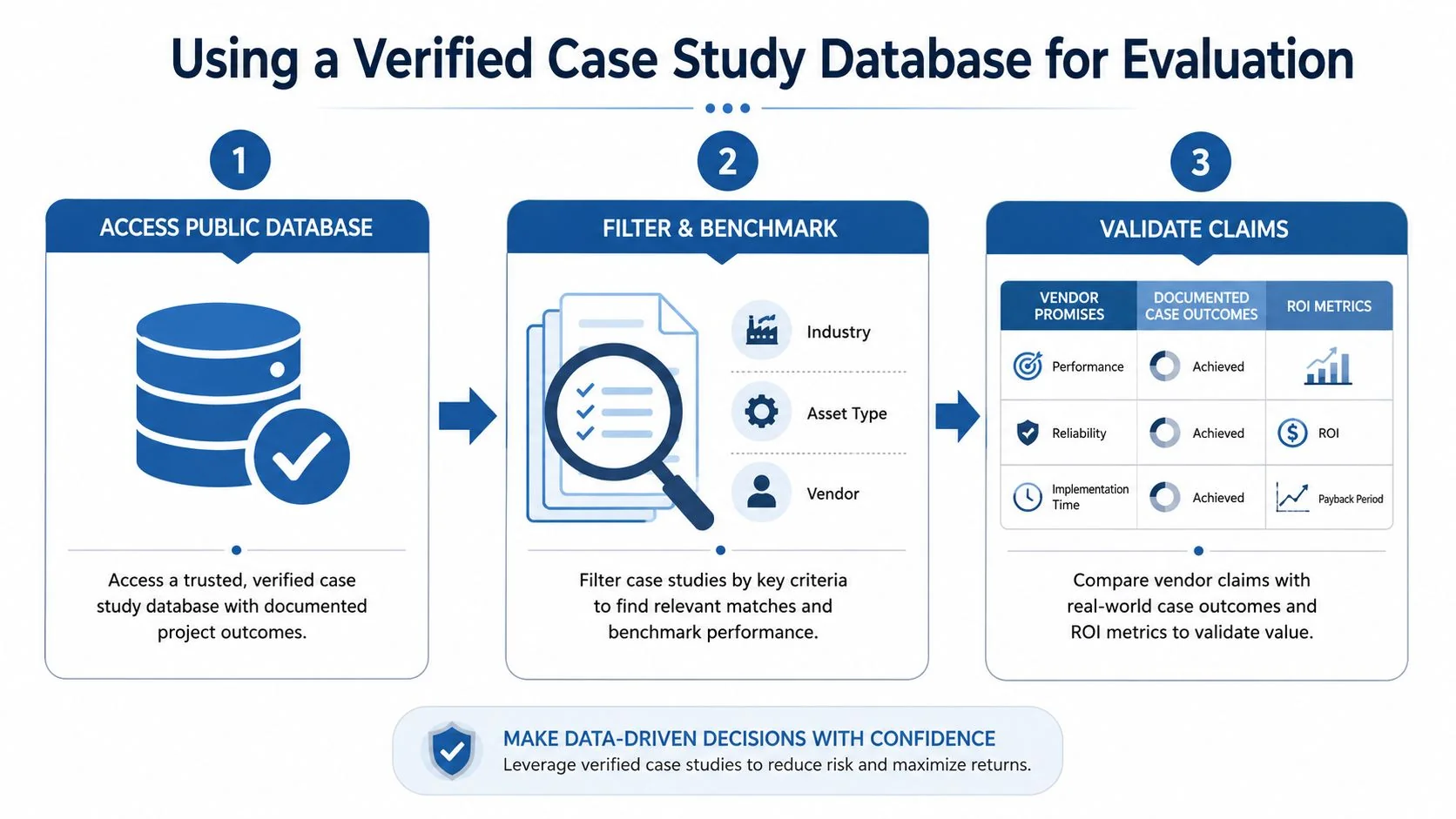
AI for Manufacturing offers a searchable database of documented manufacturing AI implementations. Filters for industry, use case, AI technology, and company size help teams locate predictive maintenance examples that resemble their equipment and operating conditions.
Filter for similarity, not impressive headlines
Begin with the asset type. A vibration model for a centrifugal pump may transfer to another pump fleet, but it does not automatically apply to an injection molding machine, furnace, or packaging line. Then check the failure mode and diagnostic method. A case built on oil debris data is a weak reference if your plant cannot collect or analyze oil samples.
Examine each record for:
- Baseline definition: Does it describe prior downtime, maintenance practice, or cost basis?
- Measurement boundary: Does the result cover one asset, a line, a site, or a larger fleet?
- Intervention evidence: Does it show what technicians changed after an alert?
- Verification level: Is the result independently reported, vendor reported, contributed, or incomplete?
- Operational fit: Does the deployment depend on connectivity, sensors, skills, or integrations your plant lacks?
Missing baselines, testimonials without technical detail, and aggregated ROI that conceals unsuccessful assets should prompt further questions. A database cannot remove uncertainty. Structured records can expose it, giving procurement and AI teams a clearer basis for judging whether a reference case matches their plant.
Use comparable records to build a shortlist, then convert each one into specific vendor questions. Ask which signals were available, how labels were created, how false alarms were handled, how alerts entered the CMMS, and what happened when the model was wrong. The database supports due diligence. It does not replace validation with your assets, workflows, and maintenance records.
Implementation Roadmap and Common Pitfalls
A predictive maintenance program should begin with asset and data readiness, not a model demonstration. The following phased approach keeps the technical work tied to maintenance outcomes.
Phase one audits the foundation
Inventory existing instrumentation, historian tags, PLC and SCADA connections, maintenance records, and CMMS or EAM integration points. Check whether timestamps align, asset names are consistent, sensors are calibrated, and maintenance events are recorded with enough detail to connect a failure to preceding conditions.
A model can't learn a useful degradation path from a historian full of missing values, changing tag definitions, or unlogged repairs. This audit also identifies where edge processing is necessary and where existing data may be sufficient for a first pilot.
Phase two chooses a painful but measurable pilot
Select an asset that is critical, instrumented, and operationally costly when it fails. Establish the baseline before deployment, including downtime, emergency work, maintenance hours, recurring failure modes, and the normal intervention window.
A strong pilot has a clear owner in reliability or operations and a defined action when the model crosses its threshold. It shouldn't be selected because it has the most data. It should be selected because the plant can verify whether an alert changed an outcome.
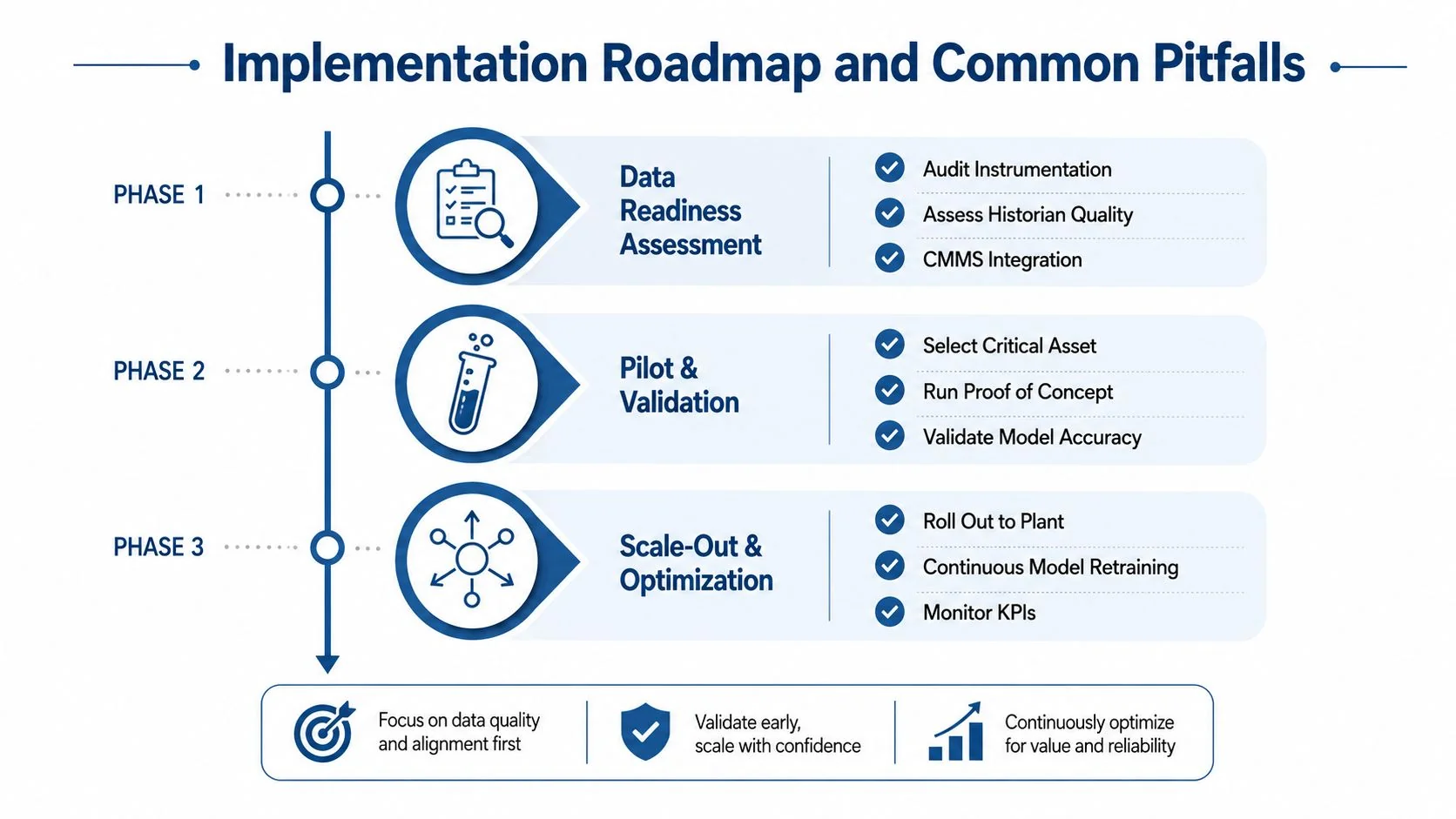
Phase three integrates and scales
Deploy the model, tune thresholds with technicians, and route alerts into the existing work-order process. Record whether an alert was accepted, inspected, dismissed, or converted into planned work. Once the pilot demonstrates useful precision and recall, expand to comparable assets and then to additional failure modes.
Use Pareto analysis for maintenance prioritization to identify the small group of assets or failure modes responsible for a disproportionate share of disruption. The method helps prevent indiscriminate instrumentation and gives the AI team a defensible expansion sequence.
Common pitfalls stretch payback beyond the first year:
- Over-instrumenting low-criticality assets: More telemetry creates more integration and maintenance work without necessarily creating more value.
- Ignoring labels and time synchronization: Unreliable failure histories make supervised models brittle and can make an alert appear early or late.
- Optimizing model accuracy alone: A strong classification score doesn't prove that downtime was avoided or maintenance became more effective.
- Leaving ownership unclear: Reliability, operations, IT, and maintenance planning need explicit responsibilities for data, alerts, and work orders.
The implementation question for AI in manufacturing is not whether a model can detect an anomaly. It's whether the plant can respond consistently enough for that anomaly to change production performance.
Verifying Vendors and ROI Before You Commit
Treat ROI as a verification exercise, not a sales promise. Ask vendors for baseline mean time between failures, mean time to repair, false-alarm rate, and payback month for a named asset class. Require the comparison period, avoided-loss calculation, and maintenance intervention assumptions in writing.
Reject proposals that restrict data access, trap telemetry in a proprietary cloud without acceptable portability, or lack a peer-reviewed or independently verified case study. A clean test-rig demonstration proves that software can generate an output. It does not prove that your plant's sensors, historians, maintenance records, and crews will produce the same result.
Cross-check vendor claims against documented cases. Filter by asset type, sensor modality, industry, and reported outcome. Industry reporting on PdM adoption rates also shows why “positive ROI” and “fast payback” should not be treated as interchangeable outcomes.
A credible financial model names its data sources and assumptions. Have reliability, maintenance, operations, IT, and procurement review them before signing a purchase order.
Start with one critical asset. Document its current failure and downtime baseline, then compare relevant implementations in a verified manufacturing case-study database. Require shortlisted vendors to map sensors, model outputs, CMMS integration, false-alarm handling, and payback assumptions to that asset. That process turns predictive maintenance into a practical AI for manufacturing use case rather than another industrial analytics subscription.
