What Is a Canonical Data Model for Manufacturing AI
Find out what is a canonical data model, which plant entities to standardize, and how to map factory systems for reliable manufacturing AI.
Written by AI for Manufacturing
A canonical data model is a shared, technology-independent information model that defines common entities, attributes, relationships, formats, and meanings so multiple systems can exchange data through one consistent structure. The part plant teams usually miss is the negative half of that definition: a canonical model is not automatically a single enterprise-wide database, and it isn't a universal schema every application must adopt. It's an integration contract that sits between the systems that produce data and the systems that consume it.
That distinction is where projects succeed or die. Teams that read "canonical" as "one database" spend a year forcing plants onto a shared physical schema and get a model nobody can extend. Teams that read it as "one exchange contract with translation at the edges" get a working semantic layer without touching the source systems at all.
The test to apply to any candidate design is whether it can carry context. Asset, product, operation, timestamp, unit, and provenance are not nice-to-have fields; they're the difference between data an AI model can learn from and data that merely looks tidy in a lake.
Table of Contents
- What a Canonical Data Model Is in Manufacturing
- What to Standardize and What to Keep Local
- Entities Every Manufacturing AI Model Must Share
- How the Mapping Layer Turns Plant Data Into Canonical Records
- Ownership, Versioning and Change Control Over Time
- Test Your Canonical Model Before Your Next AI Pilot
What a Canonical Data Model Is in Manufacturing
A canonical data model is a shared, technology-independent information model that defines common entities, attributes, relationships, formats, and meanings so multiple systems can exchange data through one consistent structure. In a factory it works as an integration model: each source keeps its native schema and maps into the shared definition, rather than every application being pushed onto one physical database.
The OPC Foundation's ISA-95 reference material is the practical anchor. ISA-95 defines standard information for exchanges between Manufacturing Operations Management systems and enterprise resource planning systems, covering material, equipment, physical assets, and personnel, and it specifies the relationships among those information types rather than treating them as isolated tables. Relationships are the part homegrown models skip, and they're the part that makes cross-system questions answerable.
Compare the three ways to connect a historian and a maintenance application.
- Point-to-point interfaces: each pair of systems needs its own translation, so the interface count grows with every new machine, plant, or application you add.
- One shared database: every system must change its schema to participate, and the model drifts toward the lowest common denominator of every department's requirements.
- Canonical model with edge translation: each source maps once into shared semantics, and consumers read a consistent structure without owning the source systems.
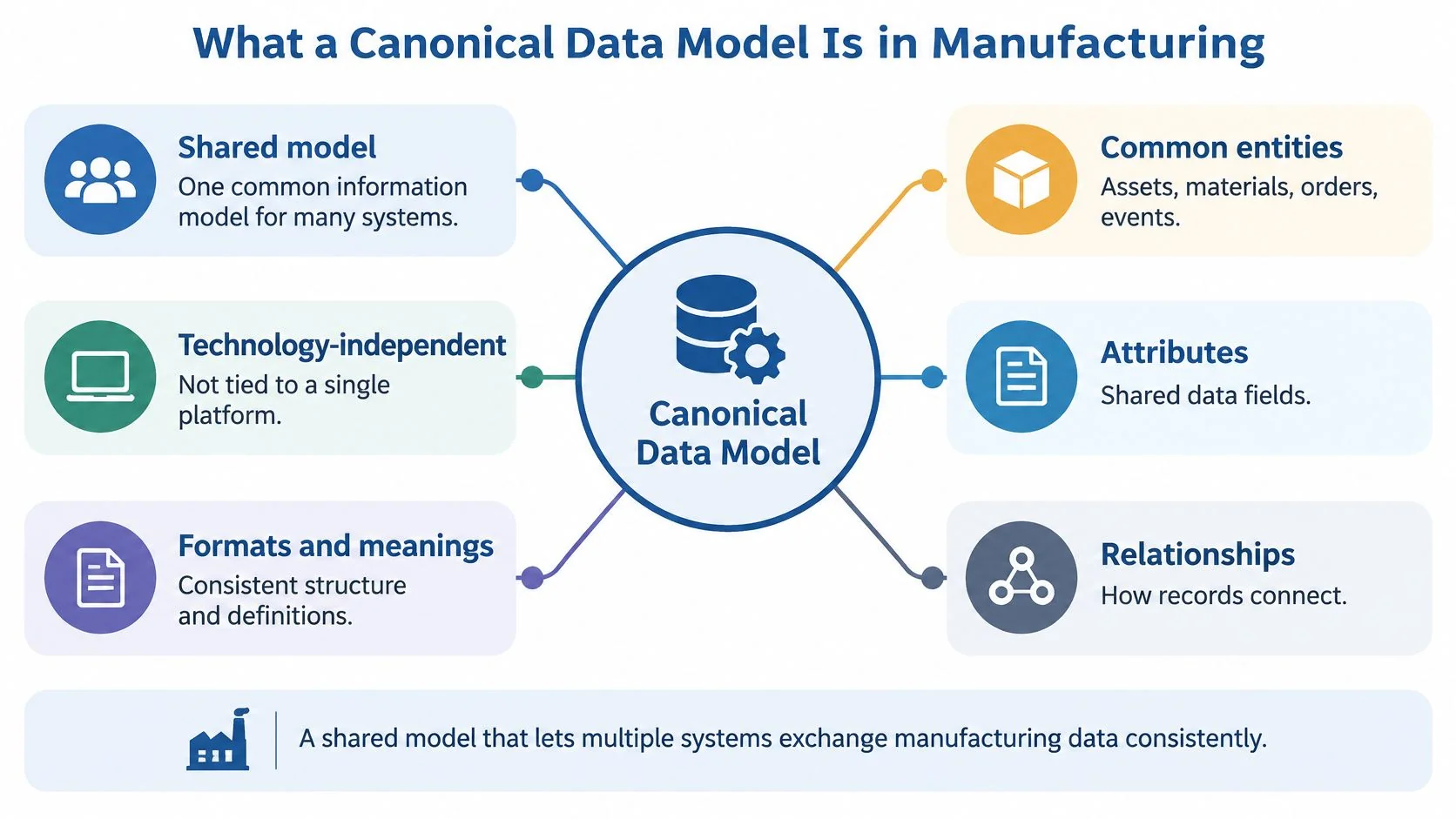
The third option is the one that scales, which is why how canonical models reduce integration sprawl is worth reading before you sketch your first entity list. The gain isn't a prettier schema. It's that a new line or supplier becomes one more adapter instead of a fresh set of pairwise integrations.
For someone pursuing AI in manufacturing, the value is entirely contextual. A temperature value with no asset, product, operation, timestamp, or unit attached can't be compared across lines, plants, or years, and that gap accounts for a large share of models that look accurate in a notebook and useless on the floor.
What to Standardize and What to Keep Local
Broader standardization can reduce interoperability. That sounds backwards until you've watched a plant committee bolt every department's field into one shared object until nobody can say what a valid record looks like. Neutral manufacturing guidance frames a canonical model as an integration model that represents data from connected enterprise systems and supports unambiguous translation to and from each source model, which is a narrower job than typically assumed (NIST manufacturing integration guidance).
Factories make this harder than other industries because ERP, MES, PLM, QMS, historians, and machine systems each keep different internal structures, identifiers, units, timestamps, and quality rules. NIST attributes manufacturing integration difficulty to the sheer scope of products, machines, and materials, combined with varied data types and high-volume, high-velocity unstructured data.
Standardize the decisions, localize the detail
A model that works standardizes only the semantics needed for cross-system decisions: equipment identity, work order, operation, material, lot, measurement, and nonconformance. Everything else can stay where it lives.
- Vendor alarm codes stay local, with a pointer back to the source record and a canonical severity classification alongside them.
- Machine-specific parameter names stay local, mapped to a canonical measurement type through the parameter registry.
- Raw controller fields stay local and immutable, so an engineer can always trace a derived value back to the register it came from.
Practical rule: if only one system uses a field to make a decision, it stays local. If two or more systems must agree on it, it enters the canonical model.
The evaluation question isn't whether two systems can exchange JSON or relational rows. It's whether the model supports lossless mappings, uncertainty values, versioned master data, unit handling, time alignment, and exception records. Those six capabilities decide whether the model survives contact with a real plant.
The failure mode is specific. A model that harmonizes names but drops sensor context, genealogy, or quality flags produces training data that appears comparable and is operationally misleading. Two "temperature" readings from different sensor generations, one calibrated and one not, become indistinguishable to the model.
To decide which fields earn a place in release one, run three tests on each candidate.
- Decision test. Does more than one system use this field to make a decision or trigger an action?
- Loss test. If the canonical layer discards this detail, can a downstream consumer still answer its question?
- Trace test. Can a user get from the canonical value back to the original source record?
Fields that fail all three stay local. Fields that pass all three get defined, versioned, and tested. If you're still aligning teams on what interoperability should mean in practice, this explanation of what interoperability means is a reasonable shared starting point before the field-by-field argument begins.
Entities Every Manufacturing AI Model Must Share
Start from the entities, not the pipeline. The table below is the minimum set I'd expect any manufacturing AI program to define before it writes ingestion code.
| Entity | Canonical attributes | Why AI needs it |
|---|---|---|
| Site, area and line | Site ID, area, line and work center hierarchy | Places every measurement in the same asset context |
| Equipment and physical asset | Stable asset ID, hierarchy position, capabilities | Stops a renamed machine looking like a replaced one |
| Product and material lot | Product ID, lot ID, genealogy link | Ties quality labels to the correct batch |
| Work order and operation | Order ID, operation ID, routing step | Links a reading to the process step that produced it |
| Measurement | Semantic type, value, unit, effective time | Keeps readings comparable across lines and plants |
| Personnel role | Role identifier, shift or crew reference | Explains operator-driven variation |
| Quality result and nonconformance | Result status, defect code, validity flag | Gives models trustworthy outcome labels |
| Event and source lineage | Source ID, event ID, ingestion time, mapping version | Lets engineers reproduce any prediction |
Context belongs at the source
A NIST workshop report on semiconductor manufacturing describes data interoperability as shared, multi-use data models for physical devices that provide persistent and consistent contextualization, formatting, categorization, and qualification at the source, making data reusable across applications and operational scales (NIST semiconductor data interoperability report). Contextualizing after the data has been copied into a lake is the expensive version of the same work.
Every canonical record should therefore carry a globally stable identifier, a source identifier, a semantic type, the value, the unit, the event or effective time, its location in the asset hierarchy, a quality or validity status, and provenance. Miss any of those and a consumer has to guess.
If your mental model of master data, transactions, and observations is still fuzzy, master and transaction data explained is worth twenty minutes, because the separation rule below depends on it.
Keep three record types apart
Master data, time-series observations, and business events belong in separate structures even when they share identifiers. Without that separation, a changed equipment name reads as a physical replacement, and a late-arriving ERP update gets treated as a real-time sensor event.
The asset model itself follows ISA-95 standards closely enough that ERP, MES, and quality data line up on the same hierarchy. That alignment is what makes a maintenance record and a process reading joinable without a text match.
Set validation thresholds before model development. Reject impossible units. Flag out-of-order timestamps. Detect duplicate event IDs. Require lineage for every derived value. Version the mapping whenever equipment or process definitions change.
The action that follows is small and unglamorous. List the entities your first AI use case cannot run without, then confirm each has a stable identifier and an explicit unit. If either is missing, you have found the project's scope.
How the Mapping Layer Turns Plant Data Into Canonical Records
The mechanic is a four-stage chain: source record, then canonical entity and attribute, then validated event or master-data object, then consumer-specific projection. Nothing upstream changes, and nothing downstream sees a raw tag.
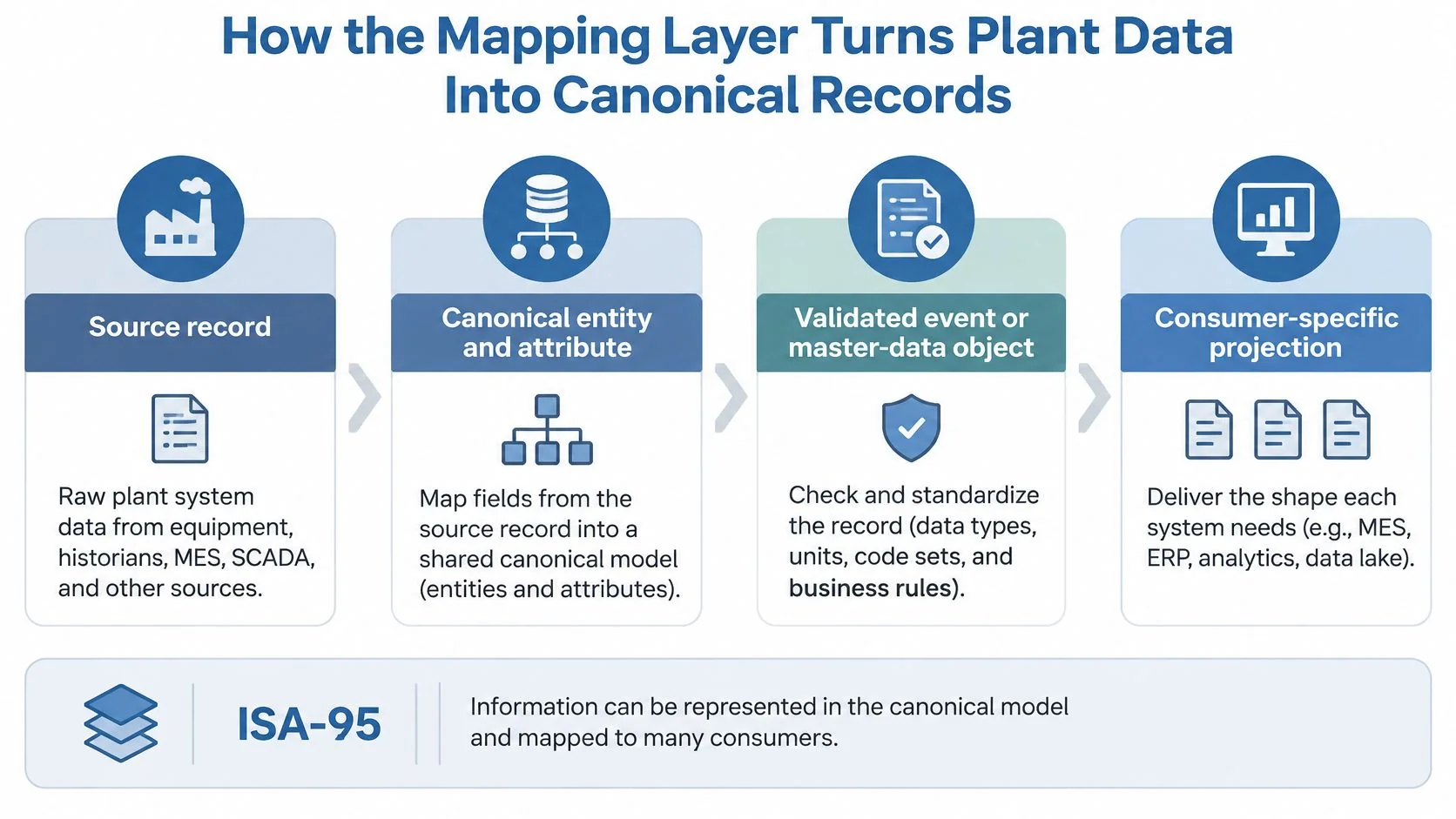
The OPC UA mapping of ISA-95 shows why this works without a single shared protocol: ISA-95 object models for role-based equipment, physical assets, materials, and personnel can be exposed through OPC UA services, or expressed as B2MML XML schemas. Domain protocols such as OPC UA handle operational data while the canonical layer handles meaning.
Worked example, one historian tag
Take LINE7.PMP03.TEMP. Here's how I'd walk it through the layer.
- Read the source record. Pull the tag and its native identifier from the historian, unchanged.
- Map the asset. Resolve the tag to canonical equipment asset PMP03 on line 7, using the hierarchy cross-reference rather than the tag string.
- Map the measurement type. Bind the variable to canonical type temperature with an engineering unit of degrees Celsius.
- Carry time and quality untouched. The event timestamp and source quality status pass through as recorded, never overwritten by ingestion time.
- Attach lineage. Record the source system, the source event ID, and the current mapping version.
- Validate. Apply unit, ordering, and duplicate rules, and quarantine the record rather than guessing when a rule fails.
- Project to consumers. Serve a predictive maintenance feature store, a visual inspection dataset, and an energy analytics view from the same canonical record.
| Canonical attribute | Canonical value | Source origin |
|---|---|---|
| Source identifier | LINE7.PMP03.TEMP | Historian tag name |
| Asset ID | PMP03 on line 7 | Equipment hierarchy cross-reference |
| Measurement type | temperature | Mapping rule for the variable |
| Unit | degrees Celsius | Mapping rule, validated on load |
| Event timestamp | source time carried unchanged | Historian record |
| Quality status | source quality flag carried unchanged | Historian record |
| Mapping version | current version ID | Mapping registry |
| Consumer projections | predictive maintenance, visual inspection, energy analytics | Consumer-specific views |
A maintenance system's asset identifier must be cross-referenced to the same canonical asset, never joined by text description. "Pump 3 Line 7" and "PMP03" are the same machine until someone renames one of them.
This is the step that stops every pilot from building its own translation layer. When the mapping layer is shared, feature definitions, labels, and data-quality rules are reusable across predictive maintenance, process optimization, and energy work. It also gives procurement something enforceable: a vendor has to show how its interface maps to your canonical identifiers, units, timestamps, quality flags, and object relationships.
If your current data collection effort is a pile of tag exports and spreadsheets, start by documenting manufacturing data collection for one line before you generalize. One row of mapping specification for one tag is a better deliverable than a 40-page schema nobody has tested.
Ownership, Versioning and Change Control Over Time
A canonical model is not a mapping exercise you finish. Recent guidance on common data models is explicit that they require ownership, change control, version policy, mapping responsibilities, exception handling, and recurring review (ThoughtSpot's overview of common data models). Skip those and you get a model that was correct in the quarter it shipped.
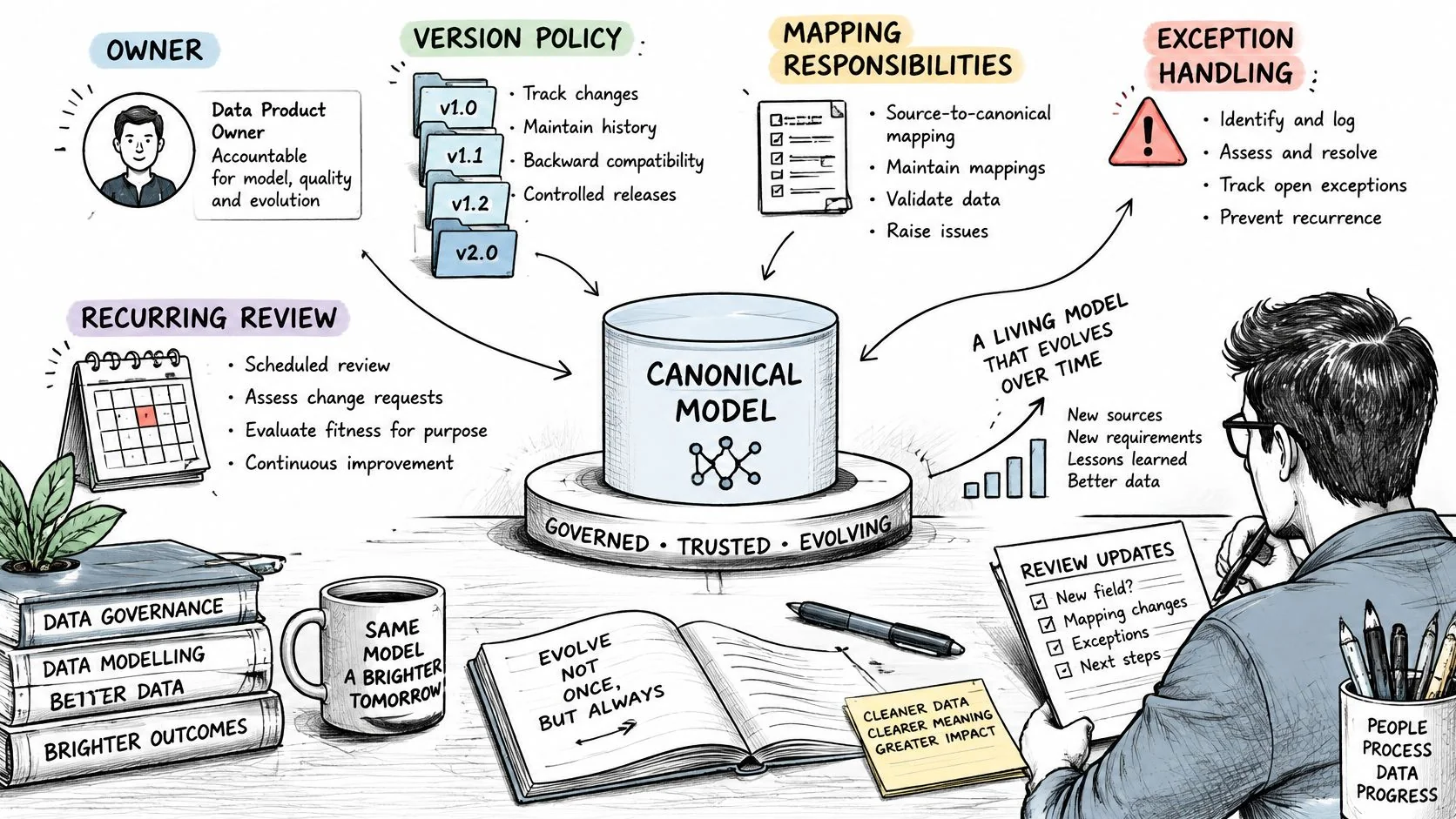
Manufacturing adds pressure that other domains don't have. Equipment gets replaced, product variants multiply, suppliers change identifiers, and data crosses organizational boundaries mid-process. A model with no owner absorbs all of that as silent drift.
What versioning actually has to publish
A workable model publishes versioned contracts, deprecation rules, lineage, data-quality status, named ownership, and mapping tests. Deprecation rules matter as much as the contract: consumers need a date and an alternative, not a warning that a field "may change."
The metric that matters: not how many integrations you removed, but the cost and lead time to add a plant, machine, supplier, or AI application without breaking existing consumers.
That reframing changes how you staff the work. You're funding semantic governance, adapters, validation, and lifecycle management. The integration count is an output, not the objective.
Who owns which facts
| System | Authoritative for | Must not overwrite |
|---|---|---|
| ERP | Orders and material master data | Execution timestamps and sensor values |
| MES | Execution status and production genealogy | Master data definitions |
| Historian | Time-series process observations | Order status and quality outcomes |
| Quality system | Inspection results and nonconformance records | Equipment identity and asset hierarchy |
| AI platform | Model predictions, scores and action status | Source-of-record facts from ERP, MES or historian |
Getting this table signed by process owners is the cheapest governance work available. It settles most future arguments before they start.
The direction of travel is toward cross-company exchange with formal usage control. Emerging Manufacturing-X work requires standardized protocols for cross-company exchange and interoperability between data spaces, while operational data continues to ride domain protocols such as OPC UA. Your internal model should be able to hand off to that world without a rewrite.
Test Your Canonical Model Before Your Next AI Pilot
Every prediction your models produce should carry a canonical asset reference, the operation, the product or lot, prediction time, model version, the input-data window, a confidence or score, and an action status. With those fields present, an anomaly links to the affected machine and production context, routes to a maintenance or operations system, and later connects to the confirmed failure or process outcome. That closed loop is what turns a pilot into a measurable capability.
NIST's work on digital twins makes the same point from the architecture side: a twin is a virtual object representing a physical entity with a two-way connection maintained through data and models, and an interoperable ecosystem needs open standards to connect equipment twins with process models, enterprise systems, and supply-chain representations (NIST digital twin interoperability report). The canonical model is where static asset identity and the event relationships that keep state synchronized come together.
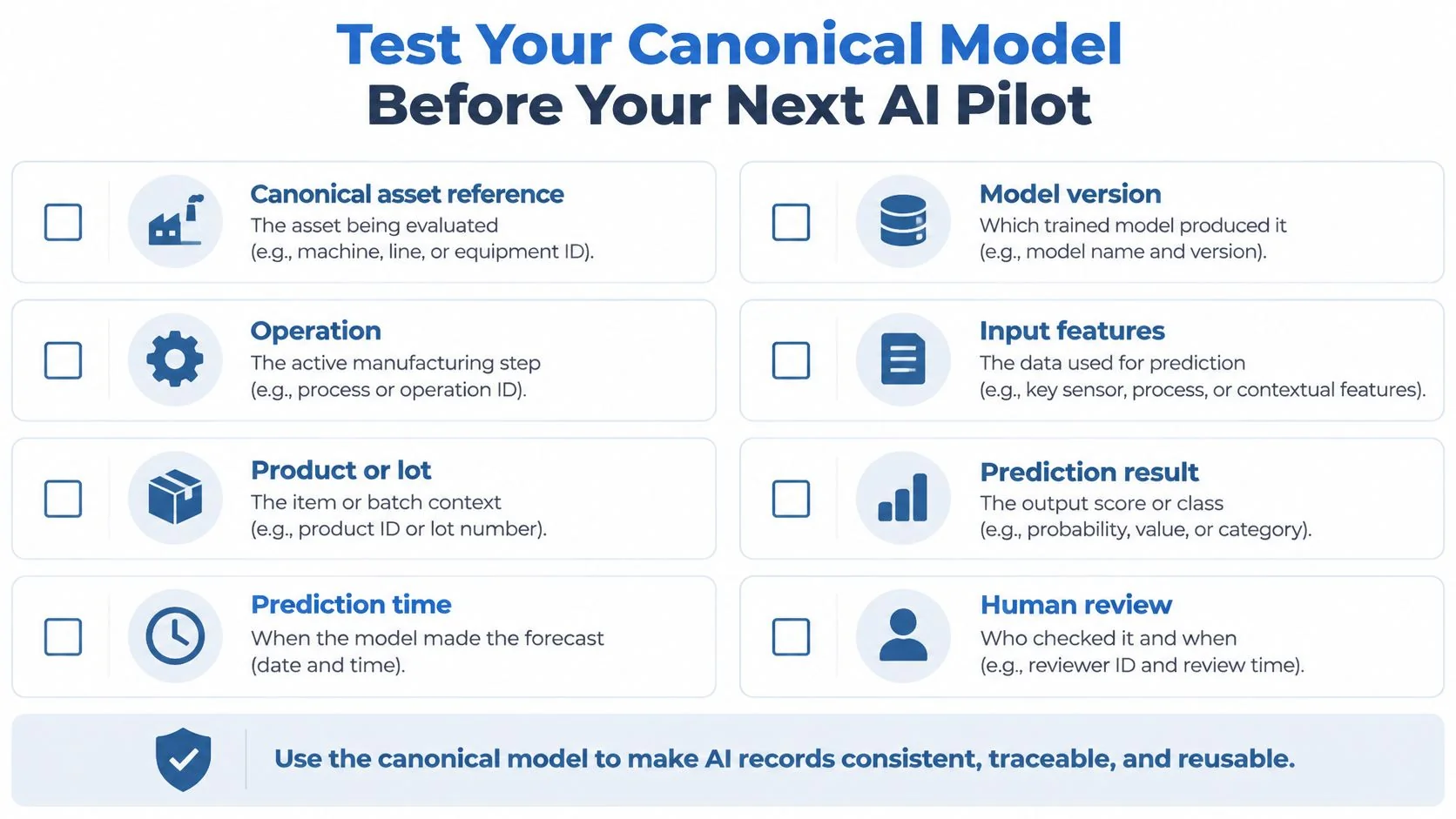
These six tests are pass or fail. Run them before you sign a pilot statement of work.
- Asset agreement. Two source systems return the same canonical asset ID for one machine.
- Label traceability. A confirmed failure traces back to the asset and to the source records behind its label.
- Rule coverage. Unit and timestamp validation rules are defined, tested, and produce quarantine records you can inspect.
- Version linkage. Each mapping version is recorded and linked to the records it produced.
- Adapter test. Adding a new machine requires an adapter, not a new point-to-point interface.
- Rename test. A renamed asset does not create a new physical asset identity.
If you want a practical next step, write a one-page entity list for your first pilot, then ask every AI vendor how its outputs map to your canonical identifiers. Vendors that can answer in a paragraph are easier to integrate than vendors with a better model and no mapping documentation. When you compare their claims, remember that our directory records each documented deployment as one data point rather than a track record, and that each record captures the use case, the technology when classified, the outcomes reported by the source, and the source link. Editorial summaries of publicly available facts and vendor-reported outcomes are attributed wherever the original is available, which is why a growing body of AI-driven CX and automation practice is worth reading alongside the deployment evidence rather than instead of it.
When predictive maintenance and visual inspection share the same asset IDs, the same unit rules, and the same quality labels, results from one line become comparable with another, and a new plant extends the model instead of rebuilding the integration. That's the outcome worth budgeting for. If you're scoping an AI pilot this quarter, do the entity list first and the model second. Then browse our case study directory for two or three documented implementations in your industry, check whether the outcomes reported by each source depend on the entities you've listed, and let that comparison set the scope of your own build.
