What Does Interoperability Mean in Manufacturing?
What does interoperability mean in manufacturing? Learn the technical, semantic, and organizational layers that determine AI success.
Written by AI for Manufacturing
What does interoperability mean in manufacturing? It means two or more systems can exchange information and use the information that has been exchanged. If data only moves from one place to another, but the receiving system can't interpret it reliably or act on it, that isn't interoperability.
The popular advice says connectivity solves the problem. It doesn't. In manufacturing, interoperability is the difference between a line that is technically networked and a plant that can coordinate machines, quality systems, historians, MES, ERP, and analytics without constant manual cleanup.
Table of Contents
- Defining Interoperability Beyond Simple Connectivity
- The Three Layers of Manufacturing Interoperability
- Industrial Standards and Protocols That Enable Interoperability
- Why Interoperability Determines Manufacturing AI Success
- Real Manufacturing AI Cases Where Interoperability Made the Difference
- Interoperability Assessment Checklist and Quick Actions
- Connecting Interoperability to Your Manufacturing AI Strategy
Defining Interoperability Beyond Simple Connectivity
A connected plant is not automatically an interoperable plant. The foundational IEEE definition from 1991 is still the cleanest way to say it: interoperability is “the ability of two or more systems or components to exchange information and to use the information that has been exchanged” source. That second half matters just as much as the first. If a gateway can publish a tag, but the downstream system can't use it without custom mapping, the integration is incomplete.
Practical rule: if people still have to explain what the data means every time it crosses a boundary, the system is connected, not interoperable.
In manufacturing, that distinction shows up everywhere. A PLC can expose values, a historian can store them, and an analytics platform can ingest them, yet the whole chain still fails if one system labels temperature in one unit, another assumes a different timestamp convention, and a third lacks the context to know whether the reading came from a batch, a machine, or a test station. The National Library of Medicine's glossary makes the core issue explicit, interoperable datasets must measure phenomena “in the same way” or they may not be usable together without significant data cleaning source.
The World Health Organization's 2021 framing pushes this further by describing interoperable applications as systems that can “access, exchange, integrate and cooperatively use data” across organizational and regional boundaries source. That broader view is the right mental model for manufacturing too. Plant software doesn't live in a vacuum, it sits inside supplier relationships, quality procedures, internal approvals, and site-specific naming conventions.
A useful way to think about it is this. Connectivity moves bytes. Interoperability preserves meaning and enables action. That's why a MES, historian, PLC gateway, and analytics stack only become interoperable when data can flow through them and still trigger the right downstream behavior, such as a quality alert or maintenance workflow source.
The Three Layers of Manufacturing Interoperability
Manufacturing teams usually find interoperability problems in the wrong order. They start with the network, then run into the schema, then hit the org chart. The cleaner way to break it down is into syntactic, semantic, and organizational layers, because each one can fail on its own and each one needs a different fix.
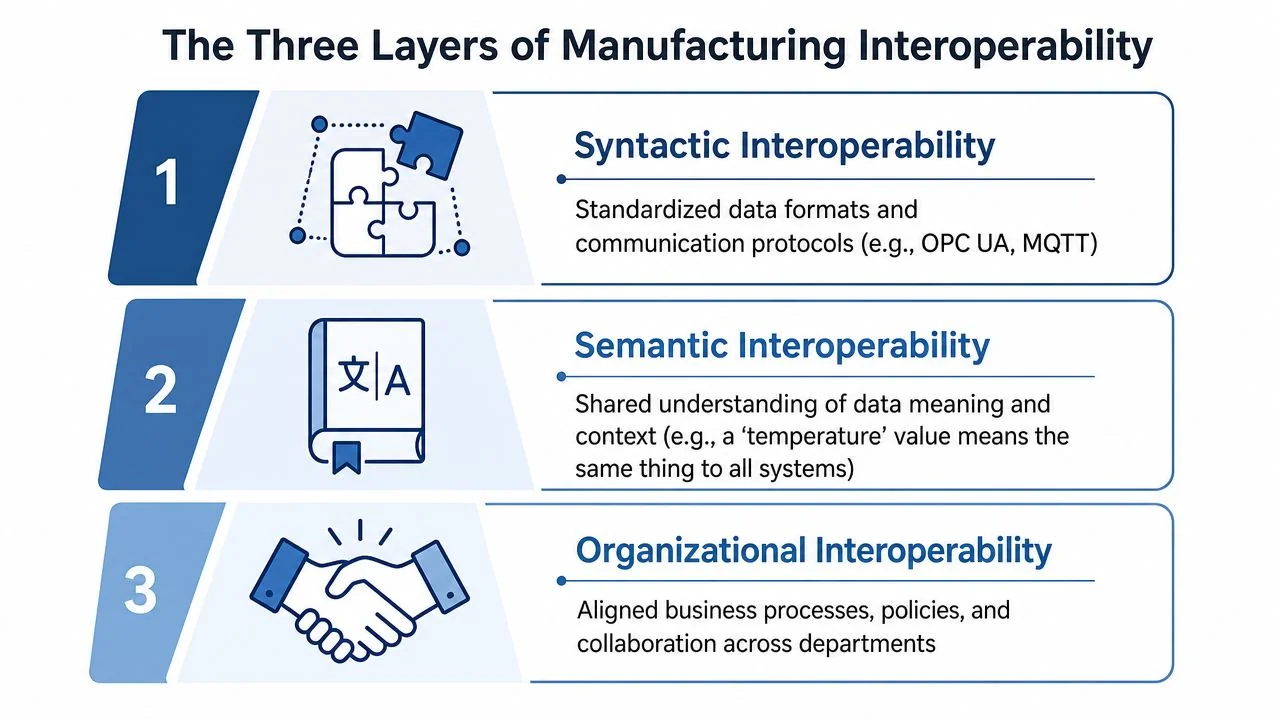
Syntactic interoperability
This is the lowest layer, and it answers a simple question, can systems physically exchange messages in a shared format. Common protocols, structured payloads, and standard interfaces belong here. IBM describes interoperability as a standards-based approach that lets systems exchange data and share functionality with minimal end-user intervention source, and AWS frames it as relying on common protocols, formats, and metadata source.
In manufacturing, syntactic interoperability is the difference between a sensor stream that arrives cleanly and one that needs a custom adapter for every vendor. If every machine family exposes a different payload shape, the data team ends up writing translation code forever. That is not a platform strategy, it is a maintenance trap.
Semantic interoperability
This layer answers the harder question, do both systems mean the same thing when they see the data. The National Library of Medicine's definition is useful here, because the issue is not just whether a field exists, but whether the variable asks the same question and formats the answer the same way source. A temperature value does not help cross-line analytics if one source reports machine enclosure temperature and another reports process fluid temperature.
Semantic gaps are where many manufacturing AI pilots stall. The API works, the dashboard fills up, but the model learns from mixed meanings and the output becomes hard to trust on the floor. I have seen teams spend weeks tuning models while the problem was a tag that meant three different things in three plants.
Organizational interoperability
This is the layer that many teams underestimate. The European Interoperability Framework formalized interoperability across legal, organizational, semantic, and technical layers source. In plant terms, organizational interoperability means operations, IT, quality, and suppliers can agree on who owns the data, who approves changes, and who can use the output.
A common failure mode is simple. The data pipeline works in staging, but production access stalls because the quality team will not release context fields, or the vendor contract does not permit export in a usable form. The software is fine. The workflow is not.
This is also where enterprise AI architecture guidance matters, because plant data flows only hold up when ownership, governance, and deployment responsibilities are defined before the model goes live.
| Layer | What it checks | What breaks when it is missing |
|---|---|---|
| Syntactic | Protocols, payloads, APIs | Data cannot move reliably |
| Semantic | Meaning, units, vocabularies | Data moves, but gets misread |
| Organizational | Governance, access, ownership | Data exists, but nobody can use it consistently |
For an AI team, this breakdown is diagnostic. If the models fail because tags will not stream, the problem is syntactic. If the models fail because values are misinterpreted, the problem is semantic. If the pipeline fails because departments cannot agree on access or definitions, the problem is organizational.
Industrial Standards and Protocols That Enable Interoperability
Standards matter because they reduce the amount of custom glue every plant has to maintain. Oracle describes standards, protocols, data formats, and metadata as the basis for allowing heterogeneous systems to share, read, update, modify, and analyze data with minimal human interaction source. That's exactly what manufacturing teams need when they're dealing with mixed-vendor equipment and layered software stacks.
Where the common standards fit
OPC UA is usually the first standard manufacturing teams reach for when they need a structured machine-to-system interface. It helps at the syntactic layer, and in many plants it becomes the bridge between PLCs, gateways, and software platforms. MQTT is similarly useful for lightweight message transport, especially for event-driven architectures and edge-to-cloud flows.
MTConnect shows up when equipment data needs a common machine-centric model, especially in production environments where machine state and process signals must be exposed in a repeatable way. ISA-95 matters one layer higher, because it gives teams a vocabulary for separating shop floor systems from enterprise systems and defining where responsibilities belong.
The key point is that these standards stack. A plant might use one protocol at the device layer, another model at the equipment layer, and a governance framework at the enterprise boundary. That's normal. The mistake is assuming one standard solves every interoperability problem.
Manufacturing Interoperability Standards Overview
| Standard | Layer Addressed | Primary Use Case | Typical Scope |
|---|---|---|---|
| OPC UA | Syntactic, some semantic support | Secure machine and control-system data exchange | Machine, line, cell |
| MQTT | Syntactic | Event messaging for edge and cloud data flow | Device, gateway, platform |
| MTConnect | Syntactic and equipment data modeling | Machine-tool and equipment monitoring | Equipment, shop floor |
| ISA-95 | Organizational | Boundary between manufacturing operations and enterprise systems | Plant to enterprise |
The best vendor demos usually prove one layer and quietly ignore the others.
That's why procurement teams should ask which layer a product supports. A platform may support a protocol and still fail at semantic alignment. Another may promise AI readiness but leave the data dictionary entirely custom. In practice, the right standard is the one that matches your current bottleneck, not the one that sounds most modern.
Why Interoperability Determines Manufacturing AI Success
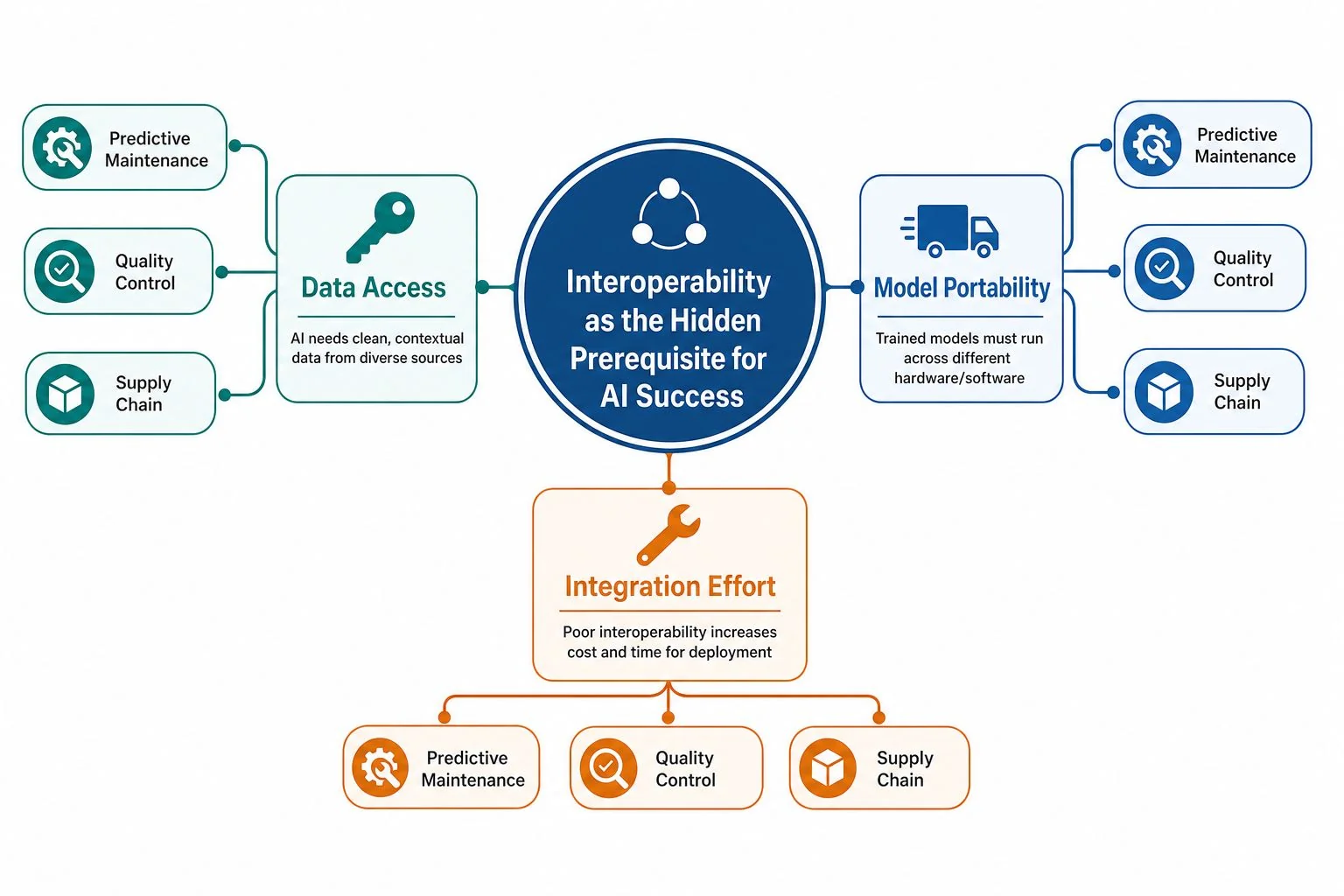
AI projects in manufacturing fail for a boring reason more often than they fail for a model reason. The model might be fine. The data is not reusable enough to support training, validation, deployment, and audit in more than one place. That is why interoperability is the hidden prerequisite for production AI, not a cleanup task after the pilot.
The AI failure modes are usually upstream
A model can fail long before it reaches inference if the upstream data has no shared meaning. One line may label the same field as runtime, another as cycle time, and a third as machine state, and the model will treat those as if they were comparable unless the plant has done the hard work of alignment. That is not a data science problem alone. It is an interoperability problem.
IBM's framing is useful here, because it separates simple data exchange from the ability to use the exchanged information source. Manufacturing AI needs that higher bar. A predictive maintenance model that consumes sensor values but cannot align them with equipment hierarchy, shift timing, or work-order context will produce weak recommendations, even if the data pipeline is technically connected.
The same issue shows up in manufacturing data collection, where teams often optimize for getting bytes off the machine and forget the context that makes those bytes usable. A feed can be live and still be wrong for analysis if timestamps drift, identifiers change by site, or operators record the same event in different ways. By the time the model team sees it, the damage is already baked into the dataset.
What good interoperability changes
When interoperability is strong, teams spend less time reconciling timestamps, units, and naming conventions. They can validate one model across multiple lines because the same variables mean the same thing in each place. They can also audit model inputs more cleanly, which matters whenever decisions touch quality, maintenance, or safety.
Data interoperability should mean data can be accessed and processed without losing meaning, then integrated for analysis and decision-making source. That is the standard manufacturing AI should use internally, too.
In practice, I treat interoperability work as part of the AI system, not as an IT pre-step. If the plant cannot move trusted context across boundaries, the model ends up trained on partial truth. The result is predictable. The pilot looks healthy in a narrow test, then breaks when it meets another line, another shift, or another site.
Real Manufacturing AI Cases Where Interoperability Made the Difference
Two deployments can start with equally strong models and end in very different places. The difference usually comes down to whether the data ecosystem was interoperable enough to support the work.
A rollout that scaled because the data model was stable
In one plant family, the team standardized equipment identifiers, timestamps, and operational metadata before training any model. The result wasn't glamorous, but it mattered. Data from multiple lines could be joined without custom translation, validation was repeatable, and the first deployment could move from one machine class to another with far less rework.
That kind of outcome depends on syntactic consistency and semantic alignment. Once the team had one shared meaning for key tags, feature engineering became a controlled process instead of a rescue operation. The model wasn't magical. The environment was legible.
A pilot that stalled even though the model looked good
A different pilot had strong vendor support and good-looking test metrics. It still stalled because the data came from multiple sites with different naming conventions, timestamps weren't aligned, and the operations team didn't give the data engineers enough process context to interpret the signals correctly. The team could move files, but they couldn't trust the combined dataset.
That's the classic interoperability trap. The pilot appears healthy until the cleanup burden grows, then the deployment slows, then the model drifts, then stakeholders lose confidence. None of those failure points look dramatic at first. They show up as small inconsistencies that compound.
If a pilot succeeds only after one person manually fixes the same mapping every week, it hasn't scaled.
For manufacturing AI, the lesson is simple. Strong models don't compensate for weak interoperability. They only expose the gap faster.
Interoperability Assessment Checklist and Quick Actions
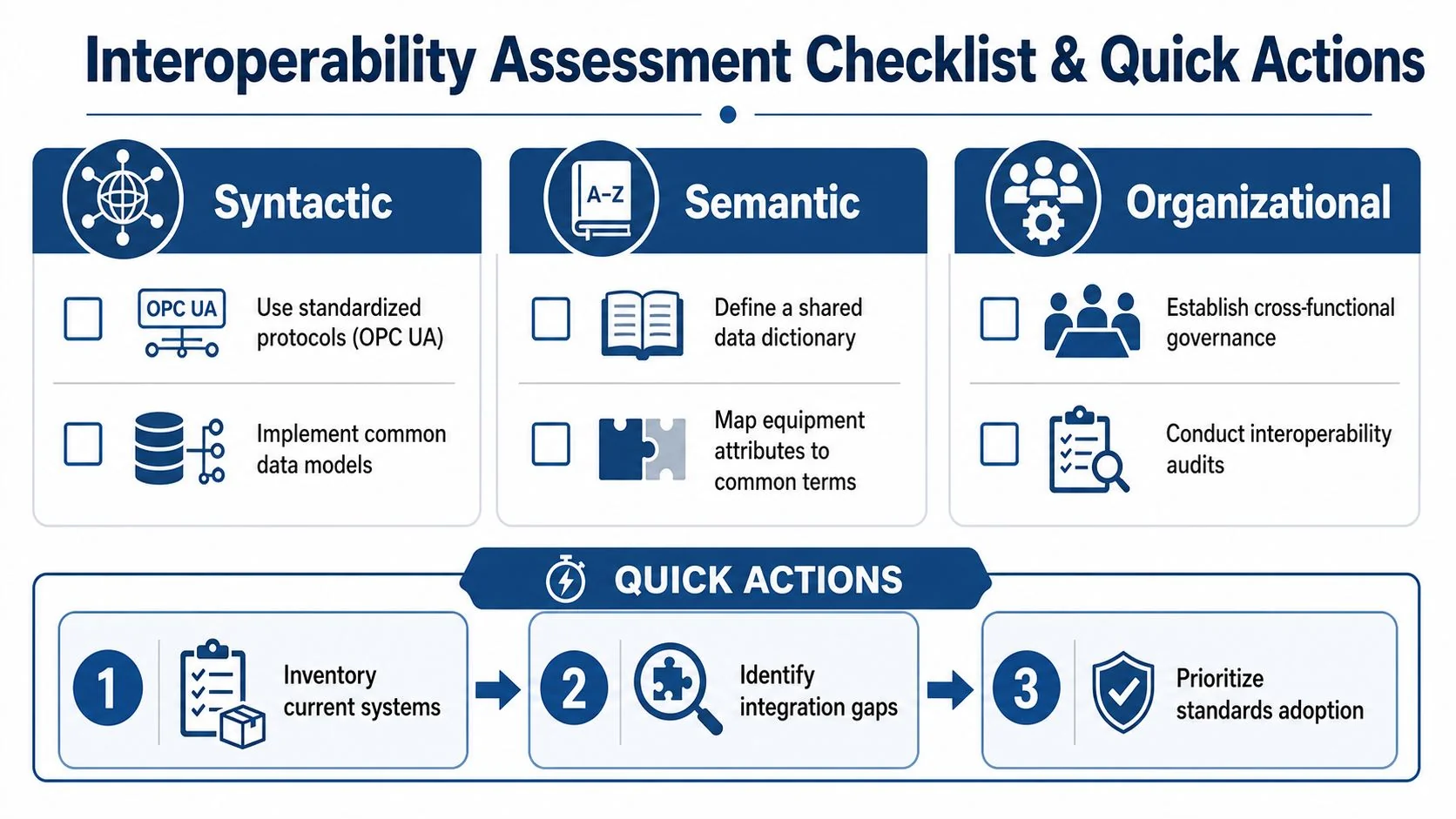
A plant doesn't need a grand strategy deck to start evaluating interoperability. It needs a blunt checklist and a willingness to ask uncomfortable questions. That's especially true before buying another platform that promises smooth integration without showing its data model.
Quick assessment
- Syntactic check: Do the systems support standard protocols such as OPC UA or MQTT, and can they expose data in a consistent format?
- Semantic check: Is there a shared data dictionary, and do units, timestamps, and equipment attributes mean the same thing across systems?
- Organizational check: Are governance rules clear, are cross-functional access rights defined, and do vendor contracts allow data portability?
Those three checks reveal most of the risk. If one fails, AI work downstream gets slower and less trustworthy. If two fail, the team usually spends more time normalizing data than building value.
Quick procurement actions
- Ask for sample schemas before purchase. If the vendor can't show you how their payloads are structured, you're buying ambiguity.
- Require proof of protocol support. Don't accept vague “integration-ready” language. Ask how the product handles your actual machine and platform mix.
- Include interoperability terms in contracts. If data portability, metadata access, or export formats matter to deployment, they should be explicit.
For teams already working through systems sprawl, the internal integration conversation at manufacturing system integration guidance is a useful companion. The point isn't to purchase more middleware. The point is to reduce translation work so AI systems can consume data that stays meaningful across use cases.
Connecting Interoperability to Your Manufacturing AI Strategy
Interoperability is not a one-time infrastructure project. It's a capability that determines whether AI can move from one line to a plant, from one plant to a network, and from one vendor stack to another without rebuilding the data layer each time. That makes it a strategic design choice, not a back-office detail.
The best roadmaps treat interoperability as part of model governance, not just data engineering. They define shared vocabularies, align process ownership, and select vendors based on how well they preserve meaning across systems. That's what makes feature engineering trustworthy, cross-system validation possible, and AI decisions auditable in production environments.
If you're evaluating manufacturing AI, start with the data path before you start with the model choice. Ask whether the system can exchange information, use that information, and do it across technical, semantic, and organizational boundaries. Then compare implementations against real evidence in the AI for Manufacturing case database, where the strongest examples make it clear that scalable AI starts with interoperable data.
