Supply Chain Control Tower: A Manufacturing Leader's Guide
Learn how a supply chain control tower centralizes data, drives AI-based decisions, and what manufacturing teams should evaluate before deployment in 2026.
Written by AI for Manufacturing
A supply chain control tower is a centralized planning-and-execution capability that ingests near-real-time data from ERP, WMS, MES, IoT, and supplier systems to detect deviations, trigger corrective actions, and coordinate decisions across the network. Market estimates place the global category at USD 10.04 billion in 2025, rising to USD 10.77 billion in 2026 and USD 15.99 billion by 2032, although another projection puts it at USD 32.14 billion by 2030, showing how quickly adoption has accelerated (360iResearch market estimate).
The counterintuitive point is that visibility isn't the hard part. Manufacturing organizations usually have plenty of data, but it sits in disconnected systems, arrives with inconsistent definitions, and lacks an agreed response when an alert appears. A tower that only displays those problems creates a polished dashboard graveyard. A manufacturing-ready implementation connects predictions to ownership, standard operating procedures, and approved actions.
Table of Contents
- What a Supply Chain Control Tower Actually Is
- Architecture and Data Plumbing Behind a Control Tower
- Core Functions That Turn Data Into Action
- Manufacturing KPIs and Where AI Lifts the Ceiling
- Implementation Reality Check and the Governance Gap
- How to Evaluate Control Tower Vendors and Platforms
- Documented Use Cases From Manufacturing AI Implementations
- Your Next 30 Days Building Toward a Manufacturing-Ready Control Tower
What a Supply Chain Control Tower Actually Is
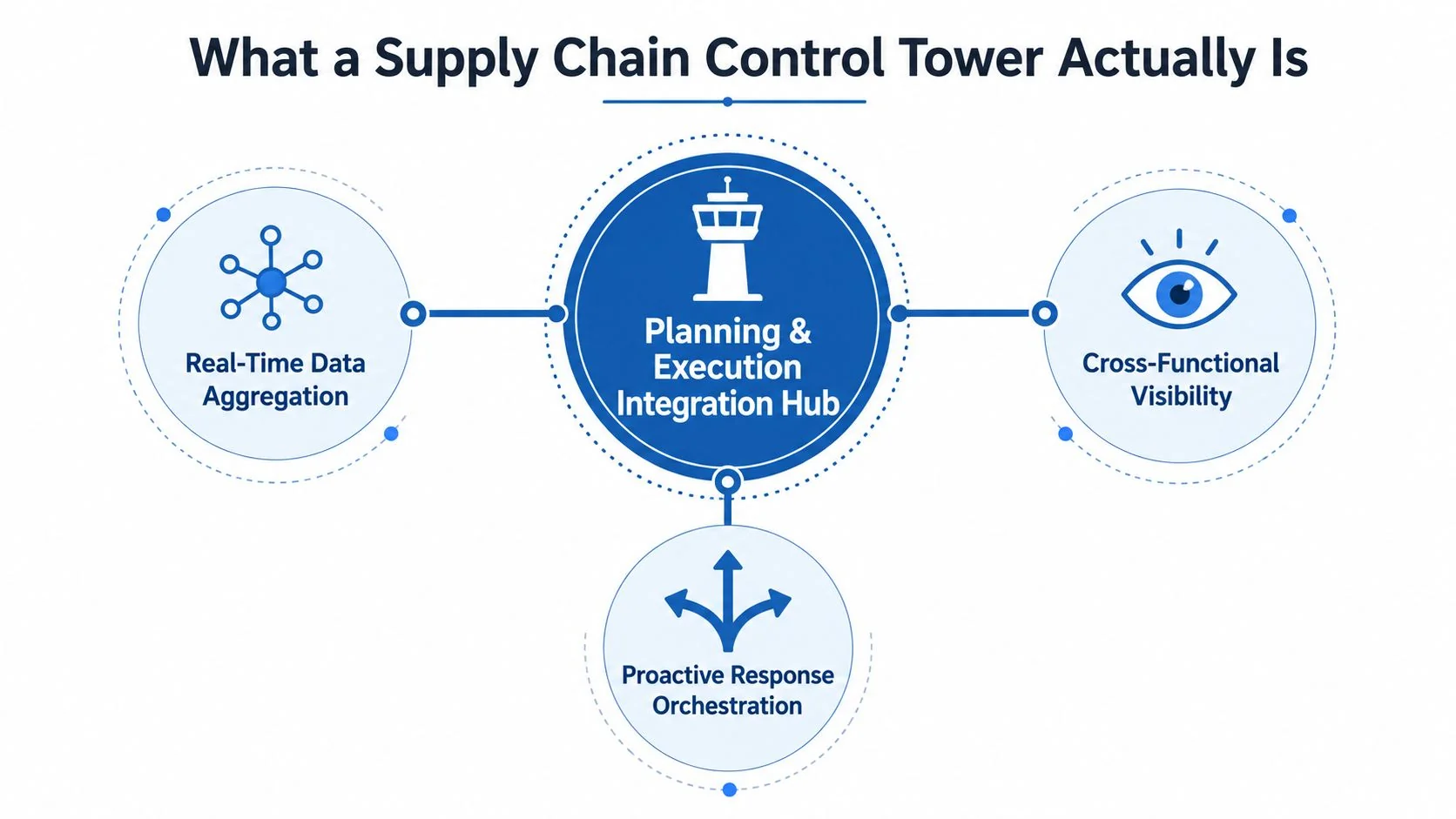
A supply chain control tower is a planning-and-execution layer that sits above existing operational systems. It gathers events from ERP, MES, WMS, TMS, IoT platforms, supplier portals, and partner interfaces, normalizes them, detects exceptions, prioritizes their business impact, and routes corrective actions back to the teams or systems responsible for execution. It isn't a replacement for the systems that record production, inventory, orders, or transportation transactions.
That distinction matters for AI in manufacturing because a model's prediction has no operational value until someone can act on it. A supplier-delay model might identify a likely shortage, but the control tower is where the planner sees the affected production order, evaluates substitute inventory, invokes an approved playbook, and records the decision. The tower becomes the practical surface where AI outputs become plant decisions.
What it isn't
A business intelligence dashboard reports historical or current indicators. A manufacturing execution system manages shop-floor execution, including production activity and operational records. Advanced planning and scheduling tools support constrained planning. The control tower coordinates signals and decisions across those systems.
Gartner describes the capability as an integrated capability embedded in a broader supply chain management environment, not a stand-alone application. That framing is useful during vendor evaluation. Ask where the tower's data model ends and where source-system execution begins. If a vendor can't demonstrate both directions, you're likely looking at reporting software with an exception-themed interface.
The practical test is simple. When a model identifies a probable line disruption, can the tower show the affected orders, inventory, suppliers, and transport commitments in one operational context? Can it assign a decision owner, present a recommendation, capture an override, and send the approved action to the relevant system? If the answer is no, the product may improve awareness, but it hasn't yet become an execution layer.
Architecture and Data Plumbing Behind a Control Tower
The architecture determines whether a control tower supports factory decisions or merely aggregates screens. In a fragmented manufacturing network, data may span multiple ERP instances, MES platforms, warehouse systems, plant controls, supplier applications, and homegrown tools. Under-invested plants often provide delayed or incomplete signals, while partners may expose only partial milestone data. The implementation problem is therefore correlation and synchronization, not just collection.
A useful architecture has three connected layers.
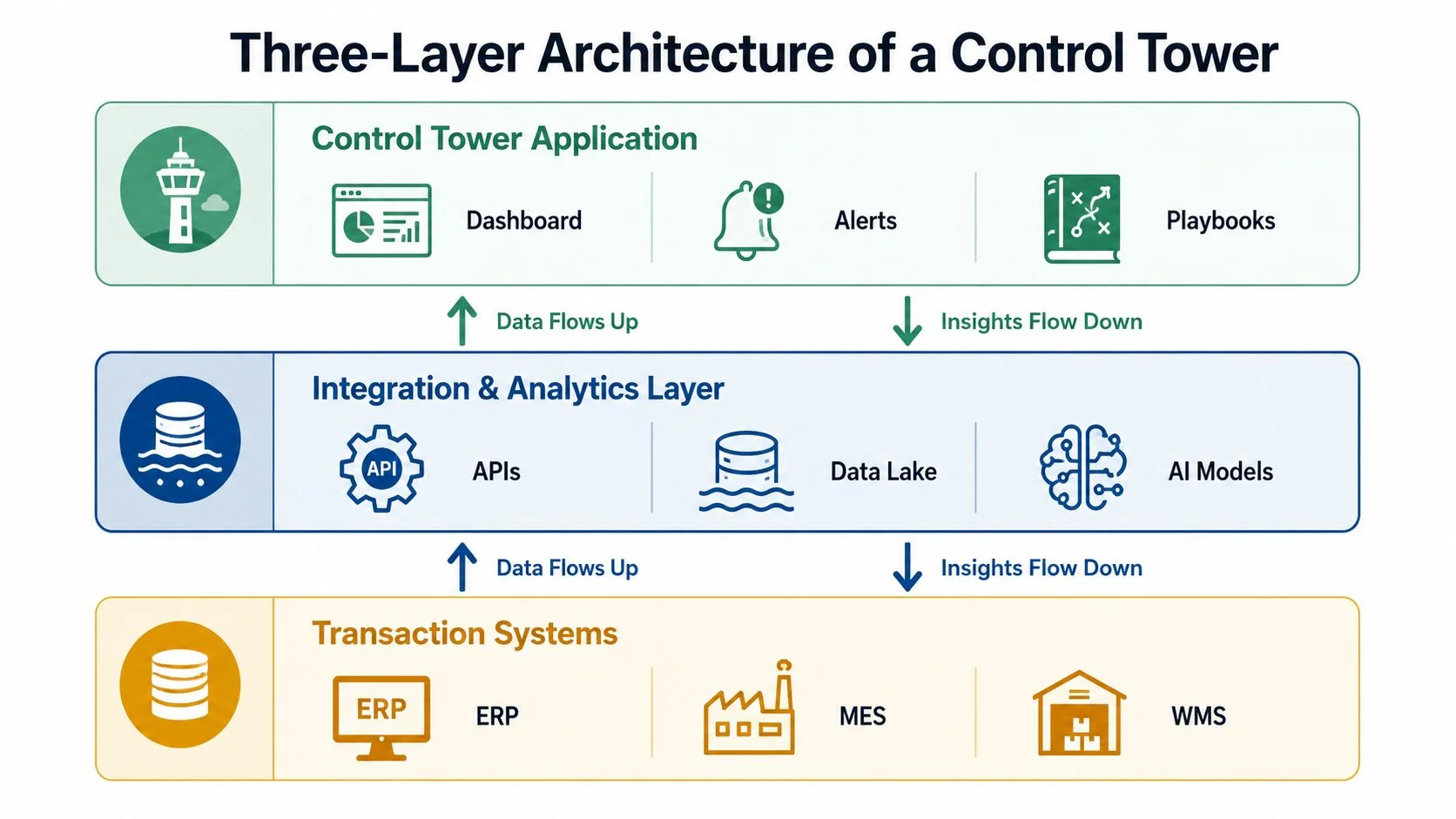
Transaction systems
ERP, MES, WMS, and TMS remain systems of record and execution. They hold production orders, material movements, inventory transactions, shipment milestones, and other operational events. The tower should ingest these records without creating a second, conflicting version of the truth.
The integration layer needs more than a collection of point-to-point connectors. It should apply a shared data model, reconcile identifiers, preserve event timestamps, and make data quality visible. A manufacturing engineer evaluating a pilot should trace one material from supplier commitment through receipt, plant consumption, production order, and customer allocation. If the identifier changes at every handoff, AI models will struggle to connect cause and consequence.
A practical manufacturing data collection foundation should therefore support event streams where latency matters, batch ingestion where the source can't provide live events, and clear lineage for every derived field.
Analytics and AI
This layer hosts forecasting, anomaly detection, predictive lead-time models, risk scoring, optimization, and scenario analysis. It should separate prediction from decision authority. A model can estimate that a shipment will miss a required date, but a planner or approved workflow still needs to determine whether to expedite, rebalance inventory, change sequence, or accept the risk.
Model transparency matters on the factory floor. Users need to see the signals that influenced a recommendation, the confidence or uncertainty associated with it, and the data freshness behind the conclusion. Retraining also needs ownership. A model trained on historical supplier behavior may degrade when sourcing, product mix, or plant constraints change.
Coordination and execution
The application layer presents prioritized exceptions, playbooks, collaboration spaces, and action status. It pushes validated decisions back into source systems or creates assigned work for people who must execute them.
Practical rule: Don't approve an integration because data appears in a screen. Approve it when an action can travel back to the system that owns the process and leave an audit trail.
Core Functions That Turn Data Into Action
A control tower earns its name through behavior. It should detect a meaningful deviation, determine its operational consequence, guide the right decision, and confirm that someone completed the response. A passive dashboard stops after the first step.
Exception detection
Rules catch explicit violations, such as a shipment missing a milestone or inventory falling below a policy threshold. AI adds value when the expected pattern is difficult to encode. An anomaly model might identify an unusual combination of supplier delay, production demand, and available stock before a shortage becomes visible in a standard report.
The tower should connect the exception to its downstream exposure. A late Tier-2 component isn't equally urgent for every plant. The priority depends on production schedules, substitute material, customer commitments, and replenishment options. Demonstrate that chain during a pilot rather than accepting a generic red alert.
Alert prioritization
Alert volume can overwhelm planners when every deviation receives equal treatment. The system should group related events, suppress duplicates, rank exceptions by operational impact, and explain why one issue outranks another.
For a line-side quality deviation, the useful alert isn't merely “quality event detected.” It should identify affected lots, open orders, inventory locations, and containment responsibilities. It should also distinguish an issue requiring immediate production intervention from one suitable for the next review cycle.
Scenario simulation
A recommendation should expose trade-offs. If a supplier misses a commitment, the tower might compare alternate sourcing, inventory reallocation, production resequencing, or transport changes. Each option should show effects on service, capacity, inventory, and risk using the organization's actual constraints.
AI needs disciplined boundaries. Optimization that ignores minimum order quantities, qualification rules, tooling, or labor constraints will produce attractive but unusable answers. Let domain owners reject infeasible recommendations, then feed those decisions back into the model and playbook design.
Decision routing and closure
Every exception needs an owner, deadline, escalation path, and status. A cross-plant inventory rebalance should route to the person authorized to release stock, not to a broad distribution list. The system should record the original signal, selected action, override reason, completion evidence, and post-action result.
That audit trail supports continuous improvement. Teams can identify recurring exceptions, revise policies, and decide whether automation is safe. Without closure data, an AI pilot can't distinguish a helpful recommendation from one that operators routinely ignore.
Manufacturing KPIs and Where AI Lifts the Ceiling
A control tower should connect operational metrics to decisions, not display an undifferentiated scorecard. The right KPI set depends on the process being governed, but manufacturing teams commonly need a view across service, supply, inventory, supplier reliability, and response speed. IBM's description of control towers emphasizes connected data, events, prioritization, and real-time issue resolution, while AWS guidance describes near-real-time streams producing actionable insights and predictive recommendations.
| KPI | Manufacturing Definition | AI Lever | Realistic Direction |
|---|---|---|---|
| OTIF | Orders delivered on time and in full against the committed requirement | Predictive delay detection, allocation optimization, and exception routing | Earlier intervention and fewer avoidable service failures |
| Forecast accuracy | Difference between planned demand and realized demand at the relevant product and location level | Demand sensing, anomaly detection, and bias correction | More responsive planning signals |
| Supply chain cycle time | Time from supply or order initiation through the required manufacturing and delivery milestone | Predictive lead times and bottleneck analysis | Shorter decision and execution cycles |
| Inventory days of supply | Available inventory expressed against expected consumption | Multi-echelon optimization and shortage-risk prediction | Better balance between availability and excess |
| Perfect order rate | Orders meeting required conditions across accuracy, completeness, timing, and documentation | Order anomaly detection and coordinated fulfillment decisions | Earlier correction of compound order failures |
| Supplier risk index | A governed composite view of supplier reliability, capacity, quality, and disruption signals | Supplier risk scoring and change detection | Earlier investigation of vulnerable supply |
| Exception-to-resolution time | Elapsed time between a recognized exception and completed corrective action | Alert triage, recommended actions, and workflow automation | Faster ownership and closure |
Where AI is realistic
AI is most useful when the process contains repeated patterns, enough history to learn from, and a clear action once risk is detected. Predictive lead-time models can support procurement and production planning. Anomaly detection can surface unusual inventory movements or supplier performance. Multi-echelon optimization can evaluate competing demands across plants and stocking points.
AI isn't a substitute for KPI definition. If teams disagree about what counts as an on-time delivery, the model will optimize disagreement at scale. Establish metric ownership, calculation logic, data freshness rules, and override handling before adding advanced models.
The best pilot usually ties one prediction to one decision workflow. For example, a predicted supplier delay can trigger a material-risk review with explicit checks for substitute stock, affected orders, and escalation authority. That design lets the team measure not only model performance, but also whether the organization responds consistently.
Implementation Reality Check and the Governance Gap
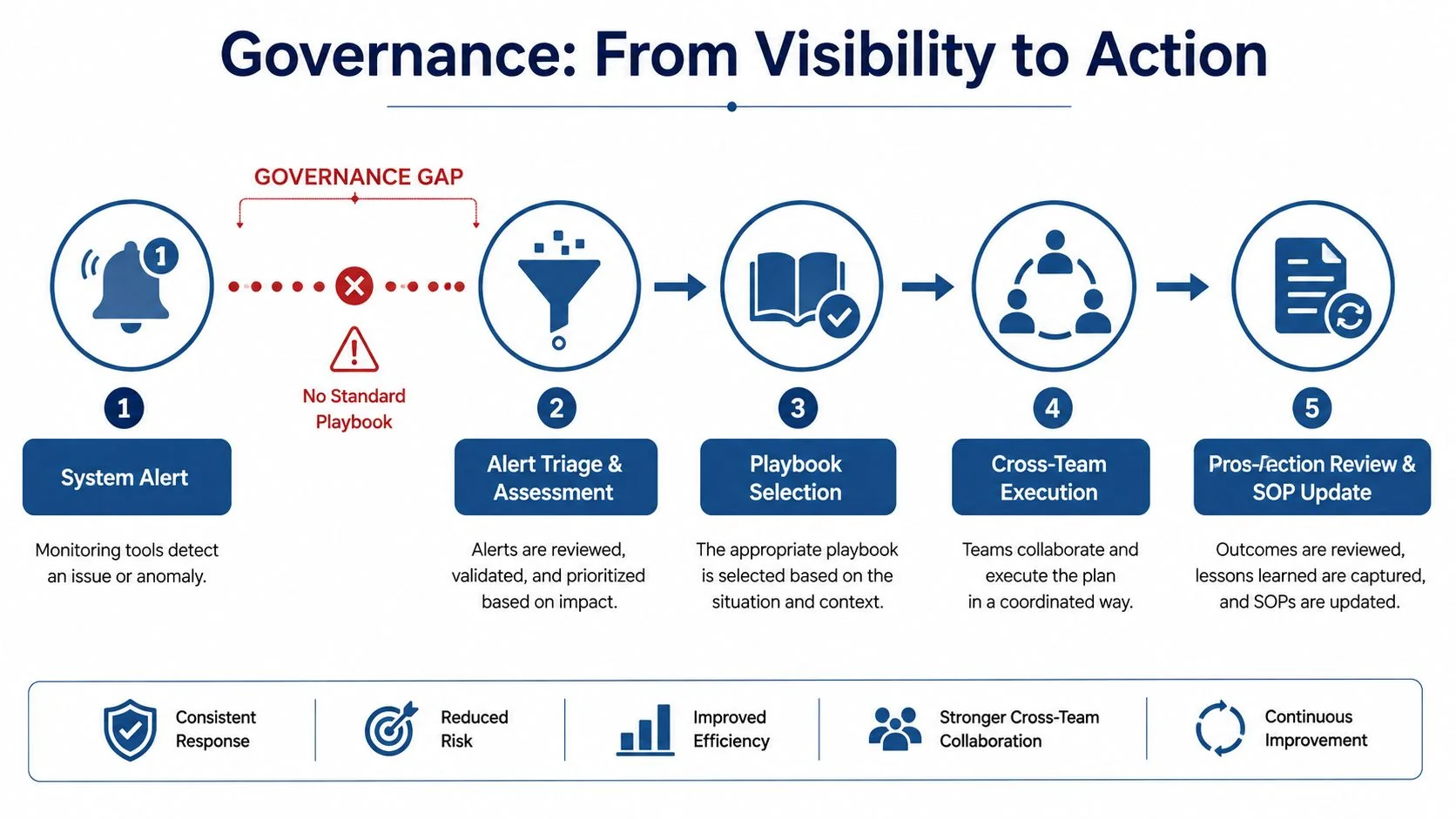
Many control-tower programs fail because leaders fund visibility before defining action. In a 2025 supply-chain technology survey, 71% of respondents identified a lack of clearly defined SOPs as one of the top three blockers to proactive decisions from real-time data (ABI Research survey). The implication is direct: a better signal won't create a better response when ownership and procedures remain ambiguous.
Initiation
Start with a narrow end-to-end process, not a global command center. Select a material, product family, or supply path where teams can identify the trigger, decision owner, and measurable consequence. Document data sources, event definitions, escalation rights, and the action that should follow each priority exception.
The Initiation phase should end with a tested data contract and signed playbooks. Include operations, planning, procurement, quality, IT, and the people who execute changes in the plant. Governance also needs explicit rules for AI overrides, model access, and when a human must approve an action.
Live
The Live phase begins when the tower supports real work, not when the dashboard is switched on. Monitor data freshness, false alerts, unresolved exceptions, user overrides, and action completion. Stabilize the first three integration domains before expanding into additional plants or partners. In practice, that stabilization commonly takes 6 to 12 months, depending on data quality, process variation, and integration complexity.
Use interoperability guidance for manufacturing systems to test whether systems exchange meaning, not merely files. A successful live deployment reduces decision friction. If planners still export spreadsheets to reconcile inventory or message colleagues to confirm ownership, the operating model isn't live yet.
Continuous improvement
The final phase turns recurring exceptions into process improvements. Review closed events, identify weak signals, revise SOPs, retrain models where appropriate, and retire alerts that don't lead to useful action. The tower should mature from visibility to synchronized decisions, with governance treated as a permanent operating capability.
How to Evaluate Control Tower Vendors and Platforms
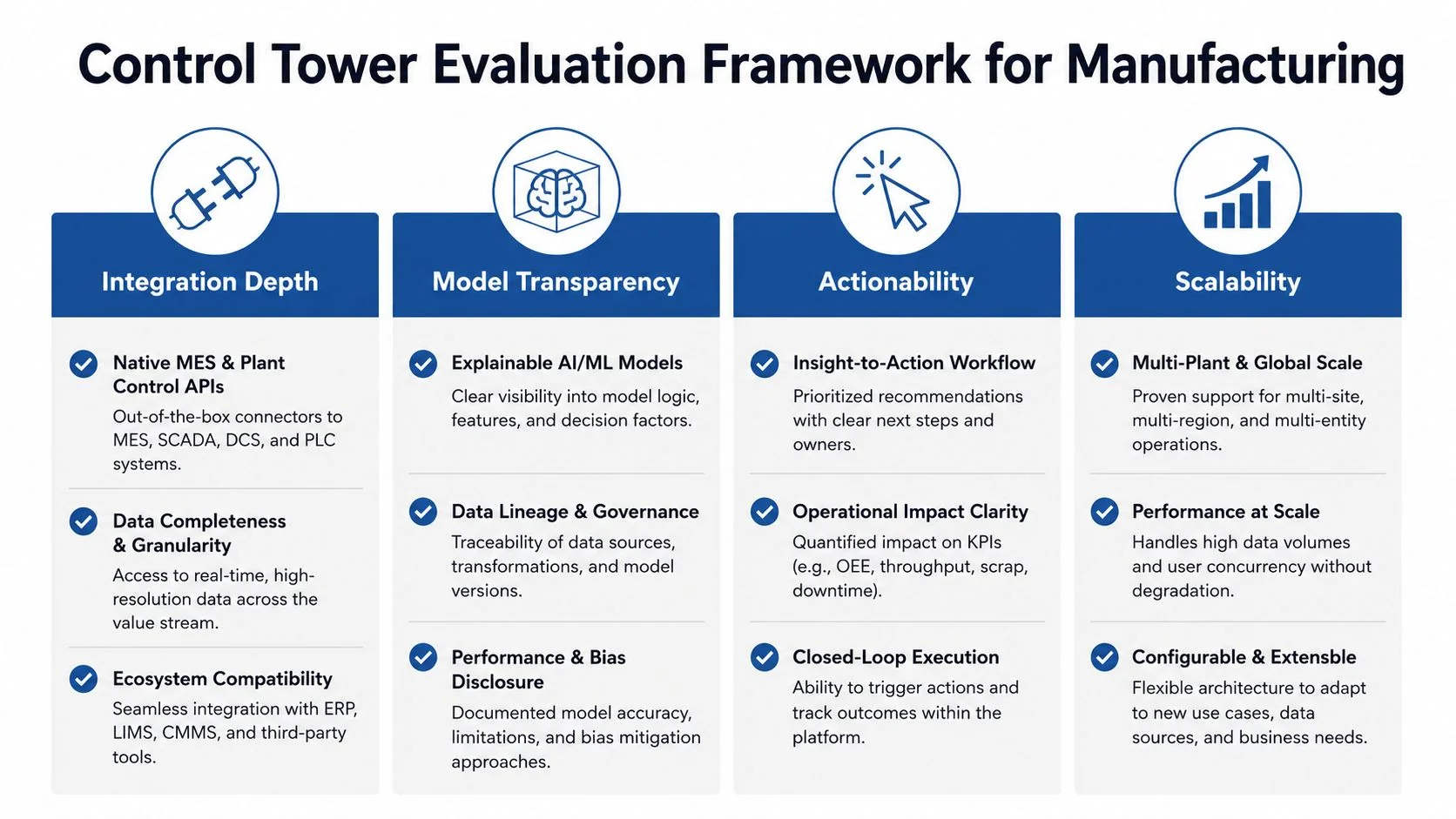
Don't start with the dashboard. Start with a production disruption and ask the vendor to demonstrate the full path from event to executed response.
Integration depth
Ask whether the platform has native or proven interfaces for your MES, ERP, WMS, TMS, plant controls, supplier systems, and edge environments. Request a walkthrough using your event definitions, identifiers, timestamps, and failure modes. A slide showing “API connectivity” isn't enough. You need to know how the platform handles missing events, duplicates, late updates, and conflicting records.
Clarify whether actions flow back into the source systems. A tower that can read a production status but can't create or update the governed work item leaves the most important step outside the platform.
Model transparency
Ask what features drive a prediction, how users inspect the reasoning, how data freshness is shown, and how models are retrained. Require a method for comparing recommendations against planner decisions. For manufacturing, model governance should include versioning, approval, monitoring, and rollback.
A black-box score may be acceptable for triage, but it shouldn't trigger a consequential production or sourcing change. Human approval thresholds need to be configurable.
Actionability and alert load
Have the vendor import a realistic exception set and show how the system groups, suppresses, prioritizes, and escalates alerts. Ask the team to configure a playbook during the demo. Then test an override and inspect the audit record.
Review whether users can work from a shared exception queue, assign ownership, attach evidence, and close the event. AI supply chain optimization guidance is useful for testing scope, interfaces, planner overrides, and exception management rather than treating optimization as an isolated model feature.
Scalability and operational fit
Evaluate cloud, edge, and on-premises options against plant connectivity and security requirements. Confirm identity controls, audit logging, tenant separation, data retention, and relevant security certifications. Ask for references with similar plant variation, system fragmentation, supplier relationships, and operational governance.
Use a weighted decision based on the disruption workflow, integration effort, data ownership, and change-management burden. A platform with fewer visible features may be the stronger choice if it reliably closes exceptions in your environment.
Documented Use Cases From Manufacturing AI Implementations
A control tower doesn't replace manufacturing AI use cases. It gives their outputs a governed operational destination. The most useful design question is, “What decision should this prediction change, and who owns that decision?”
Predictive maintenance models can send equipment-risk signals into a control-tower queue when a likely failure threatens a production schedule or material commitment. The tower can correlate the prediction with spare parts, maintenance capacity, alternate lines, and customer orders before assigning an action to maintenance and operations.
Demand sensing belongs in the planning context. A demand signal should not just change a forecast value. It should expose the affected products, production constraints, supplier commitments, and inventory positions, then route a review to the planner authorized to change the plan.
Supplier risk monitoring can combine delivery, quality, capacity, and external event signals. The control tower should distinguish a watch condition from a material threat, identify exposed production, and present approved alternatives. A human-in-the-loop workflow preserves accountability while allowing models to perform broad screening.
Quality inspection models also have a place beyond the quality workstation. A detected defect pattern may require containment, inventory quarantine, supplier escalation, or a production-sequence change. The tower coordinates those consequences across functions.
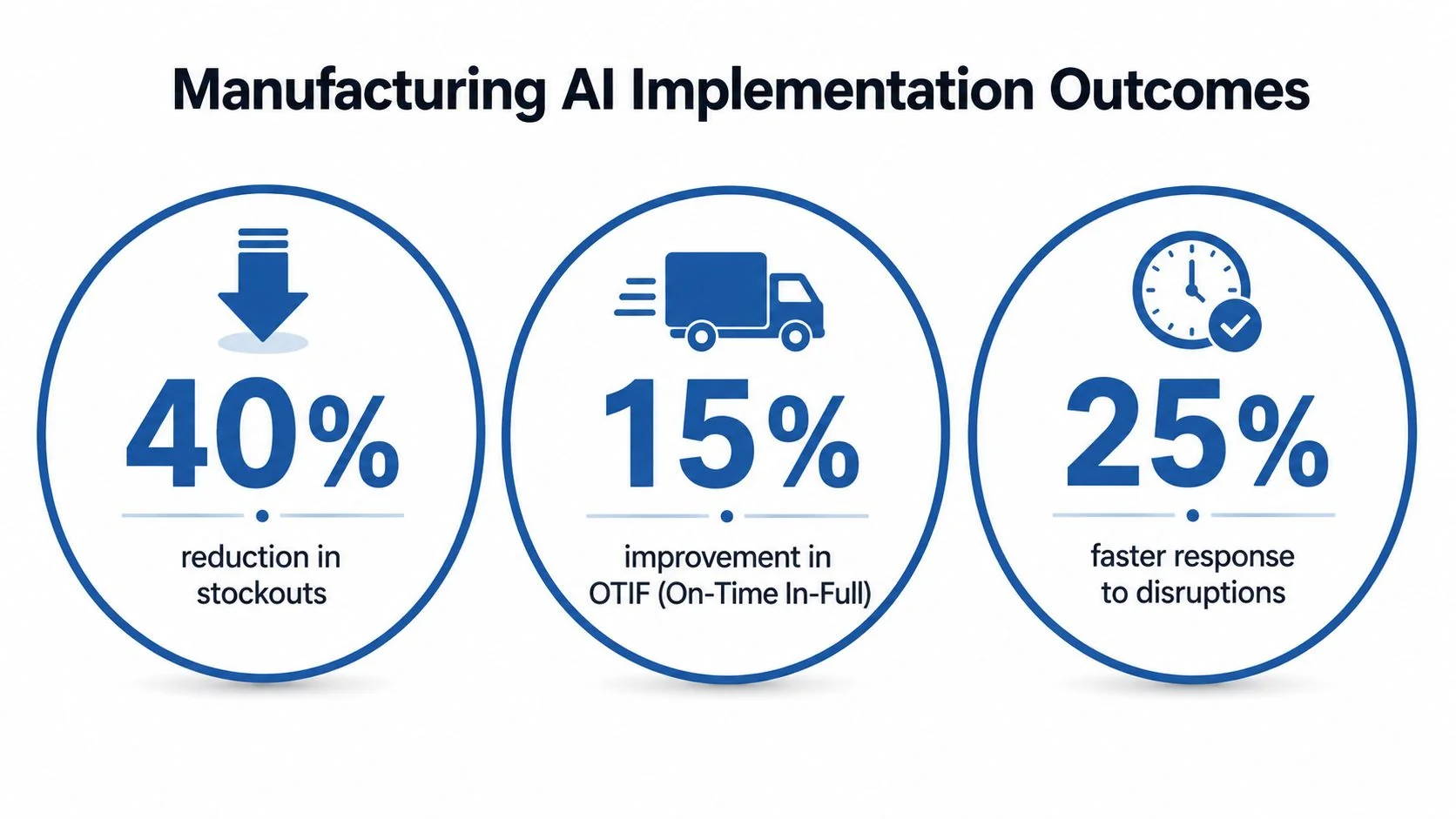
For evidence review, AI for Manufacturing provides a searchable database of documented factory and industrial AI implementations, with filters for industry, use case, technology, and company size. Use documented cases to benchmark the type of outcome and implementation pattern, then test whether a vendor can reproduce the relevant workflow under your data and governance constraints.
Your Next 30 Days Building Toward a Manufacturing-Ready Control Tower
Use the next month to define the operating model before selecting software.
- Choose two end-to-end processes. Pick workflows such as supplier delay to production response or quality deviation to inventory containment. Document every handoff and system involved.
- Close the SOP gaps. Define alert thresholds, triage rules, decision owners, escalation timing, approved actions, and override requirements.
- Form a governance group. Include plant operations, planning, procurement, quality, maintenance, IT, data, and security. Give the group authority over definitions, playbooks, and model changes.
- Audit the data path. Trace identifiers, timestamps, event freshness, missing records, and action feedback across ERP, MES, WMS, supplier, and IoT sources.
- Run evidence-based demos. Give vendors the same disruption scenarios and require them to show detection, prioritization, recommendation, execution, and audit closure.
A manufacturing-ready supply chain control tower is the layer where AI predictions become accountable plant decisions. Build that layer around governed exceptions and reliable integration, then use documented manufacturing implementations to choose AI use cases with evidence instead of vendor promises.
Bring your two selected workflows, SOP gaps, and representative data events to a cross-functional workshop this month. Define the first exception playbook, assign its decision owner, and require every shortlisted platform to demonstrate the complete path from AI signal to approved manufacturing action.
