Production Planning & Scheduling for AI in Manufacturing
Learn production planning & scheduling essentials, KPIs, AI case studies, and a practical roadmap for manufacturing teams pursuing AI-driven operations.
Written by AI for Manufacturing
You're likely dealing with a familiar failure pattern: the production plan looks achievable in the ERP, but the shop-floor schedule starts breaking as soon as a machine goes down, a setup runs long, or a material arrives late. Production planning and scheduling are the connected manufacturing disciplines that decide what to make, in what quantity, by which date, and in what sequence on available resources. Planning establishes the demand, material, capacity, and timing requirements. Scheduling turns those requirements into executable work on specific machines, lines, tools, and crews.
For teams pursuing AI in manufacturing, the distinction matters because planning errors cascade into schedule churn, overtime, expedited freight, excess work in progress, and missed equipment commitments. AI doesn't replace the planning chain or the planner who owns it. It can improve demand sensing, constraint resolution, sequencing, and rescheduling when plant data is reliable enough to support those decisions.
Table of Contents
- What Production Planning and Scheduling Actually Mean
- How Production Planning and Scheduling Evolved
- The Core Planning and Scheduling Workflow
- Planning Approaches Compared From MRP to APS
- Scheduling KPIs That Matter for AI Programs
- Why Most Scheduling Pilots Actually Fail
- AI Case Studies With Measured Scheduling Outcomes
- A Practitioner Roadmap for AI Scheduling Adoption
What Production Planning and Scheduling Actually Mean
Production planning is the medium-to-long-range decision layer. It determines which products the plant or plant network should make, how much is required, what materials and resources are needed, and when finished goods must be available. The planning horizon needs to extend at least through the longest cumulative lead time in the product structure, including raw material, manufacturing, and assembly lead times, according to this manufacturing planning horizon definition.
Production scheduling is the short-range execution layer. It assigns released orders to specific machines, tools, operators, and time slots while respecting capacity, material availability, setup dependencies, operation sequences, and due dates. Detailed schedules commonly cover the next few days to two weeks, as described in this industrial guide to detailed scheduling.
The simplest distinction is practical:
| Decision layer | Core question | Typical owner | AI opportunity |
|---|---|---|---|
| Planning | Which products, quantities, and dates? | Supply chain and planning teams | Demand sensing, scenario analysis, material and capacity balancing |
| Scheduling | Which operation runs next on which resource? | Production control and shop-floor planners | Finite scheduling, sequence optimization, disruption response |
| Dispatching | What should the operator run now? | Supervisors and operators | Priority recommendations and rule adaptation |
Both layers sit within manufacturing operations, but they use different data horizons and decision cadences. A quarterly capacity decision shouldn't be handled by the same logic used to choose the next job at a bottleneck machine. Teams that blur the two often deploy an AI model against the wrong decision, then conclude that the model isn't useful.
The connection to process optimization in manufacturing is direct. A schedule can only optimize the process that the plan makes possible. If the plan assumes unavailable material or unrealistic lead times, a scheduler will produce a more precise version of an infeasible outcome.
Practical rule: Use AI to reduce the manual work inside each layer, but keep a named human owner accountable for the decisions that cross departments, customers, and financial commitments.
How Production Planning and Scheduling Evolved
The factory schedule didn't begin with machine learning. It began with visual control. In the early 1900s, Frederick Taylor's scientific management, Henry Gantt's calendar-based charts, and Karol Adamiecki's similar bar-chart methods created practical ways to organize factory work. The historical record of production planning and scheduling development traces the later move toward computerized reorder-point systems, statistical inventory control, and material requirements planning.
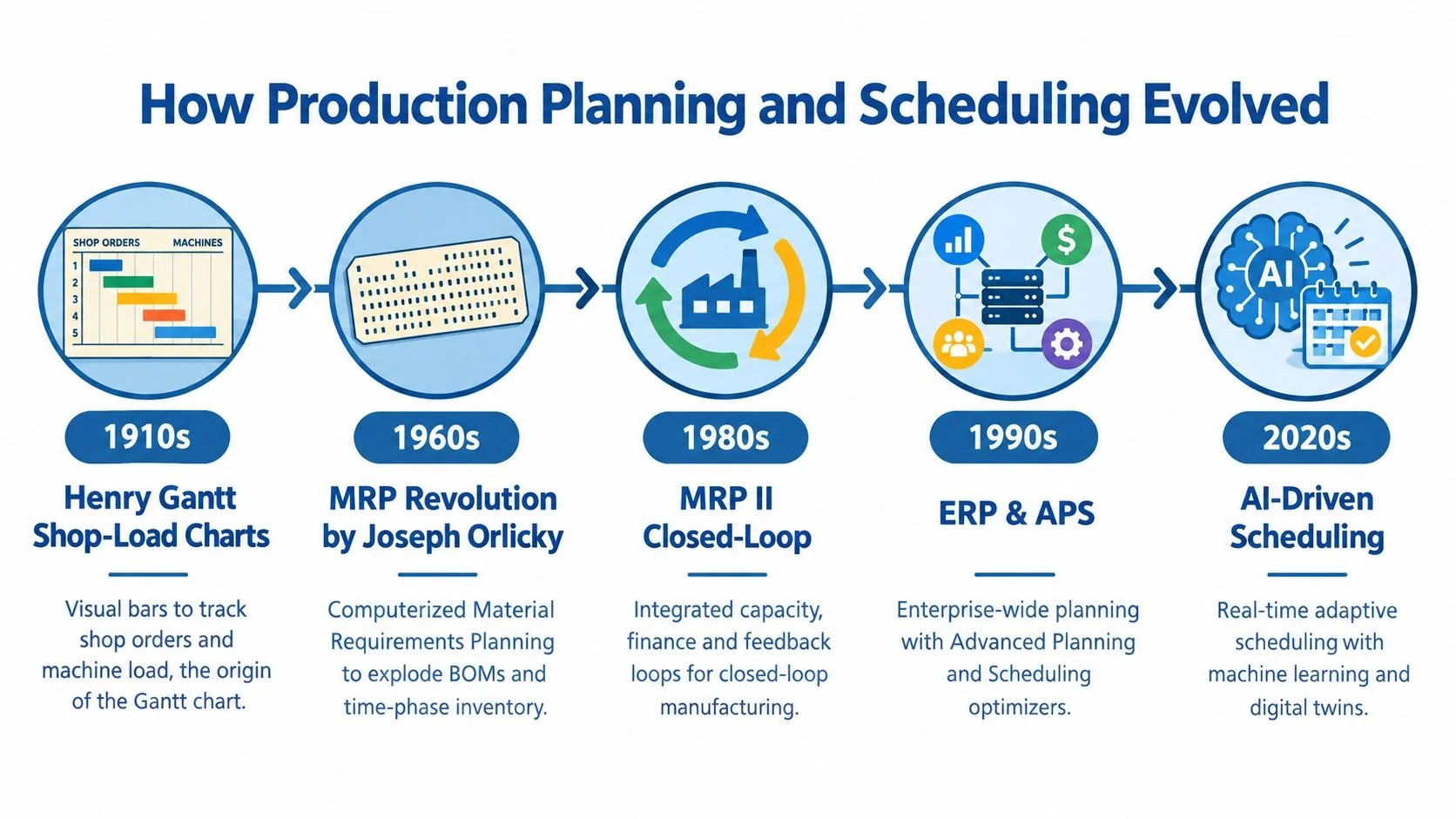
During World War II, operations research brought mathematical and statistical methods into industrial optimization. That foundation still supports modern planning and scheduling systems, and a review of journal trends from 1961 to 2017 found scheduling remained a consistently prominent topic in production and industrial research, as documented in this history of production scheduling research.
Computers then changed the scale of the problem. Material requirements planning could explode bills of material and time-phase requirements more consistently than manual systems. MRP later expanded toward closed-loop capacity and resource checks, while enterprise systems connected planning data across functions. Advanced planning and scheduling added more explicit constraint logic, especially where an infinite-capacity material plan repeatedly collided with finite machines, labor, setups, and due dates.
What AI adds to the stack
AI should be treated as another layer on this progression, not as a replacement for Gantt charts, MRP, APS, or operations research. Optimization solvers already handle much of the combinatorial structure. Machine learning can help estimate realistic processing times, detect likely disruptions, rank feasible alternatives, and adapt dispatching decisions as conditions change.
That distinction prevents a common pilot mistake. A team may describe a reinforcement learning project as a new scheduling system, when the useful implementation is an overlay that learns when to follow or override rules such as FCFS, SPT, EDD, or shortest setup time. These dispatching rules select the next job from a queue, as described in this academic treatment of sequence-dependent setup scheduling.
The Core Planning and Scheduling Workflow
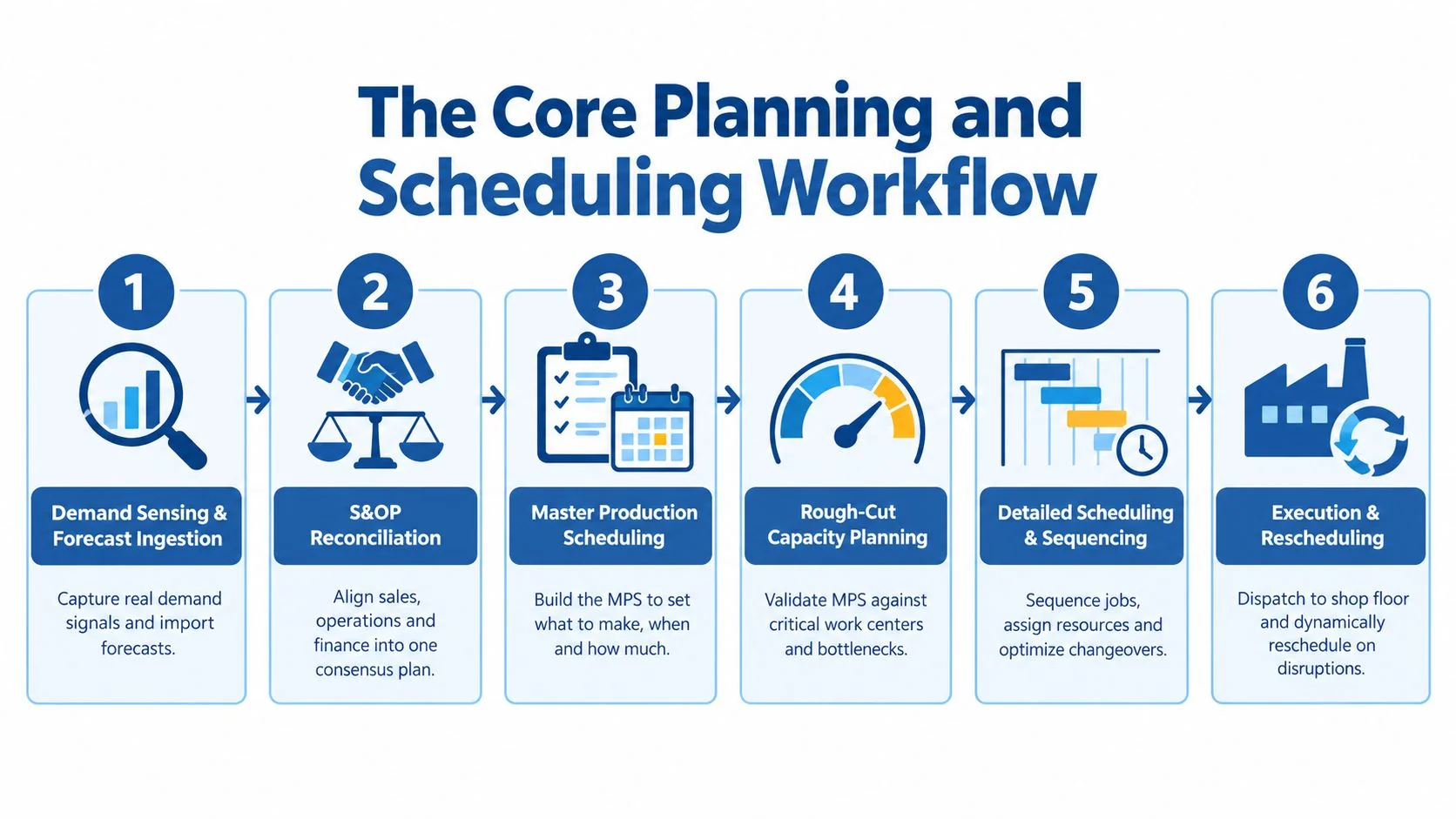
A workable production planning and scheduling process is a chain of decisions, not a single optimization run. Each stage has its own inputs, horizon, owner, and appropriate role for AI.
-
Demand sensing and forecast ingestion starts with orders, forecasts, inventory signals, market inputs, and customer changes. The planning team uses these signals to establish expected demand. AI is often useful here because it can identify patterns across history and current order behavior, but the output remains a planning input, not an approved production commitment.
-
S&OP reconciliation brings sales, operations, supply chain, and finance into the same discussion. Participants weigh demand, capacity, inventory, service expectations, and commercial commitments. AI can provide scenarios, but it shouldn't decide whether the business accepts a customer promise that requires capital expenditure, overtime, or a lower-priority order to move.
-
Master production scheduling converts the reconciled plan into a more specific statement of what to produce, in what quantities, and by which dates. Planners validate material availability, production policy, and customer priorities before approving the MPS. AI can identify conflicts and test alternatives, while governance determines which version becomes official.
-
Rough-cut capacity planning checks critical work centers, labor groups, tooling, and supplier dependencies. An attractive MPS can meet a hard bottleneck. Finite-capacity methods are valuable because they evaluate resource limits instead of assuming that every required hour is available, as shown in this peer-reviewed finite-capacity MRP paper.
-
Detailed scheduling and sequencing assigns operations to resources and places them on a near-term time axis. AI commonly targets this stage through constraint-based optimization, learned processing times, setup-aware sequencing, and alternative schedule generation. The schedule must include operation order, lead times, due dates, machine calendars, and resource limits. A published APS mixed-integer formulation demonstrates why integrating those elements matters for minimizing idle time and earliness or tardiness penalties.
-
Execution and rescheduling sends work to the shop floor, captures starts, completions, downtime, quality events, and material status, then regenerates the schedule after disruptions. AI is most useful when the feedback loop is fast and explicit. Operators and supervisors still need clear exception handling, because a recommendation that can't be understood or challenged won't survive real execution.
The planning team should own the workflow end to end, even when AI performs calculations inside it. Human-led approval remains essential for cross-functional trade-offs, capital decisions, customer commitments, and change control.
Planning Approaches Compared From MRP to APS
The right starting point depends less on the sophistication of the algorithm than on the quality of the operating model underneath it. A plant with poor routings and no reliable downtime events isn't ready for a complex AI scheduler, regardless of the vendor's solver or model architecture.
| Method | Capacity Assumption | Sequencing Logic | Best Fit Scenario | AI Readiness |
|---|---|---|---|---|
| MRP | Often treats capacity as effectively unlimited | Plans material and operations from demand and bills of material | Stable demand, repeatable products, and material-focused planning | Low until routings, calendars, and execution feedback improve |
| Finite-capacity MRP | Checks resource limits across the product structure | Places work around available machines, labor, and time | Plants where bottlenecks and lead times determine feasibility | Strong foundation for learned times and exception prediction |
| APS | Models multiple constraints, sequences, lead times, and due dates together | Uses rules, optimization, and scenario analysis | High-mix, multi-order, or multi-resource environments | Strong, especially for AI overlays and rapid scenario evaluation |
| Constraint-based methods | Focuses attention on limiting resources | Prioritizes work around bottlenecks and constraint policies | Plants with a small number of dominant constraints | Focused opportunity for targeted optimization |
Classic MRP remains useful for material planning, but it can't repair missing machine availability or unrealistic operation times. Finite-capacity MRP adds operational realism and gives machine learning a better target because the model can refine a schedule that already respects important limits.
APS systems offer richer rule engines and constraint representations. They can pair well with reinforcement learning when the AI model learns which feasible sequence performs best under changing demand, setup conditions, or due dates. Constraint-based approaches can be simpler to pilot because the team can focus on one bottleneck rather than attempting to optimize the entire factory.
Benchmarking also matters. Standard job-shop and flow-shop datasets give teams a common basis for comparing algorithms instead of overfitting to one plant's historical schedule. A recent benchmark study of AI approaches for production planning and scheduling tested Genetic Algorithms, Reinforcement Learning, Neural Networks, Ant Colony Optimisation, and Deep Q-Learning against benchmark and simulated data.
Scheduling KPIs That Matter for AI Programs
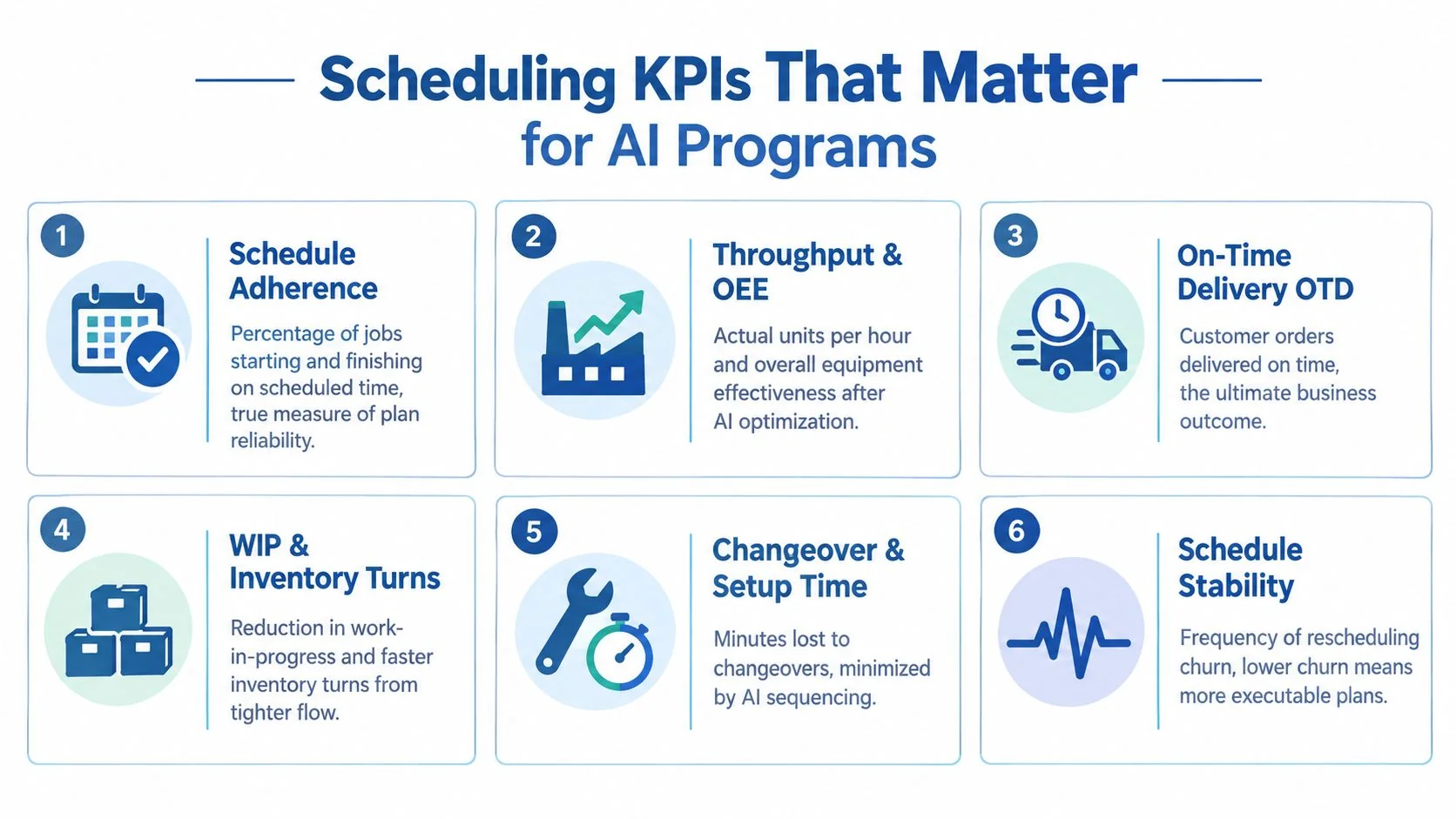
A scheduling pilot needs an operational scorecard before anyone tunes a model. The right metrics show whether the plan became more executable, not merely whether an algorithm generated a visually attractive sequence.
Start with schedule reliability
Schedule adherence measures whether jobs start and finish when the schedule says they should. It exposes plan reliability more directly than utilization, which can rise while the plant produces the wrong mix or builds inventory ahead of demand.
On-time-in-full delivery connects the schedule to the customer outcome. Tardiness shows how late individual orders or operations become, which makes it useful for testing a reinforcement learning policy at a bottleneck work center.
Throughput measures actual output through the constrained process. Pair it with OEE carefully, because high utilization can hide quality losses, long queues, or an unhealthy production mix.
Measure the mechanics that AI changes
Sequence optimization should be judged through changeover and setup time, especially on packaging, paint, molding, or batch lines where product sequence affects cleaning, tooling, or material changes. A model that reduces setup burden but causes late orders hasn't improved the operation overall.
Track WIP and inventory turns to see whether tighter sequencing improves flow rather than just moving congestion downstream. Track schedule stability by counting how often planners regenerate or manually alter the plan. Frequent churn signals that the model lacks reliable event data, realistic buffers, or usable exception rules.
Use manufacturing data analytics to connect ERP order status, MES events, machine states, quality records, and planner overrides. Compare like with like. Demand mix, product complexity, staffing, maintenance events, and material availability can all change between a baseline and a pilot period.
Measurement rule: Treat forecast accuracy, constraint slack, and override frequency as leading indicators. Utilization and delivery performance are important, but they can lag behind the data and workflow improvements that make an AI pilot viable.
Why Most Scheduling Pilots Actually Fail
The algorithm is rarely the first thing that breaks. The pilot usually fails earlier, when the data pipeline turns a real factory into an inaccurate mathematical description.
Bad master data produces schedules that look optimized but can't run. A routing with stale cycle times trains the model on fantasy capacity. A missing setup dependency makes two jobs appear interchangeable when operators know they aren't. A shift calendar that excludes neither planned maintenance nor labor restrictions gives the optimizer hours that the plant doesn't have.
The recurring failure modes
- Unreliable routings: Standard times don't match actual operation durations, so predicted completion dates drift immediately.
- Incomplete event capture: The MES records job completion but not the reason for waiting, blocked flow, or micro-stoppage, leaving the model unable to distinguish capacity from execution loss.
- Broken integration: ERP, MES, warehouse, and maintenance systems use different order identifiers or status definitions, so updates disappear between systems.
- Invisible constraints: Tool availability, operator qualifications, fixture limits, material holds, or quality release rules never reach the scheduler.
- Planner rejection: The system recommends a schedule without showing the constraints or trade-offs, so experienced planners override it and the team never captures why.
A review of 51 papers identified 30 distinct challenges in data-driven production planning and control, with recurring issues in data quality, integration, interoperability, real-time data management, adaptability, and generalizability, according to this review of why production plans fail. The operational implication is straightforward. Don't ask which algorithm is best until the plant can explain where every critical scheduling input comes from.
Planner expertise creates a second risk. In a 2025 Deloitte survey, 46% of manufacturers reported moderate to significant difficulty filling planning and scheduling roles, while 48% reported the same challenge for production and operations management roles, as reported in this Fraunhofer-hosted document containing the survey findings. Experienced planners also carry tacit knowledge that often isn't documented.
Implementation rule: Capture planner overrides as training data. An override isn't merely a rejection. It may reveal an undocumented constraint, a customer priority, or a rule the model needs to learn.
AI Case Studies With Measured Scheduling Outcomes
Documented implementations show that AI outcomes depend on the use case, data connection, and operational decision being changed. The figures below are benchmarks, not promises. Some examples concern inspection, maintenance, logistics, or forecasting rather than a standalone scheduler, so each KPI must match the pilot's scope.
| Company / Plant | AI Use Case | Measured Outcome |
|---|---|---|
| Foxconn | Edge AI for vision inspection | Yield rose above 99%, while inspection labor fell by roughly 80%, as documented in the Foxconn manufacturing AI case record. |
| Bosch plant in Germany | AI-driven scheduling linked with predictive maintenance | Downtime fell by about 15%, with improved scheduling reliability, according to the Bosch manufacturing AI case record. |
| BMW Group | AI for logistics and inbound material-flow planning | Inbound-parts lead times were shortened, as documented in the BMW Group logistics planning case record. |
| Automotive OEM project | Reinforcement learning for scheduling optimization | Order-to-delivery variability was reduced, according to the automotive reinforcement learning scheduling case record. |
| Siemens electronics plant | Neural-network demand and capacity forecasting | Planning cycle time was compressed from days to hours, as documented in the Siemens electronics planning case record. |
The table also shows why source quality matters. The quantified Foxconn and Bosch outcomes should be verified against their published case records before they become pilot targets. The BMW, automotive, and Siemens entries describe directional outcomes without linked source documents here, so treat them as examples of decision areas, not validated targets.
Foxconn's result is not a scheduling result. It shows that inspection data and labor constraints can shape the value of a broader AI program. Bosch is closer to scheduling because maintenance events change available capacity and affect schedule reliability.
BMW connects planning with material flow. A schedule becomes infeasible when inbound components arrive unpredictably. The reinforcement learning example points to adaptive dispatching policies, while Siemens highlights the benefit of shortening planning latency before decisions reach the shop floor.
For a directly documented planning-time benchmark, the large steel manufacturer AI schedule optimization case reports a reduction from 5 to 7 days to 1 hour. Use that result to frame a planning-cycle discussion, not to set an automatic expectation. AI can recompute options quickly, but planners still define acceptable trade-offs among capacity, materials, due dates, maintenance, and production priorities.
A Practitioner Roadmap for AI Scheduling Adoption
A first pilot should be narrow enough to control and realistic enough to expose the plant's actual constraints. A three-checkpoint rollout gives the team time to validate data before asking operators and planners to trust a new decision system.
Days 0 to 30 focus on data readiness
Start with an audit of ERP and MES event granularity. Confirm that orders, operations, starts, completions, downtime, material status, shift calendars, and maintenance states can be connected to the same work identifiers.
Create one source of truth for:
- Routings: Validate operation sequences, standard times, alternate resources, and setup dependencies.
- Calendars: Include shifts, planned downtime, holidays, maintenance windows, and labor restrictions.
- Constraints: Record tooling, fixtures, skills, quality holds, material availability, and bottleneck policies.
- Exceptions: Define what counts as a late start, blocked operation, missing material, or schedule override.
Select one pain point, such as changeover sequence on a packaging line or dispatching at a constraint resource. Don't begin with a plant-wide objective.
Days 31 to 60 establish a controlled pilot
Run a baseline for two weeks covering on-time delivery, schedule adherence, and changeover hours. Keep the calculation definitions fixed. Then run the AI scheduler in shadow mode on one cell or line, with human planners comparing its recommendations against the live schedule.
The model should explain infeasibility, identify the binding constraints, and show what changes when a planner alters a priority. Capture every override and its reason. If the system can't support that workflow, the pilot isn't ready for go-live.
Days 61 to 90 decide whether to scale
Compare pilot performance with the baseline while controlling for product mix, demand, staffing, maintenance, and material conditions. Review schedule stability, planner effort, exception volume, and operator acceptance alongside delivery and throughput outcomes.
Use a simple decision gate:
| Gate | Evidence required |
|---|---|
| Data readiness | Critical inputs arrive consistently and map to the correct orders and resources |
| Operational fit | Planners and supervisors can review, explain, and override recommendations |
| KPI movement | The selected metric improves without unacceptable trade-offs elsewhere |
| Integration safety | ERP and MES status updates don't silently overwrite or discard decisions |
| Scale case | Additional lines share enough data structure and constraint logic to justify expansion |
Scale rule: Don't expand because the model performs well in a demonstration. Expand when the plant can operate the exception workflow, maintain the data, and explain the result.
For the next quarter, assign owners for retraining cadence, constraint updates, override review, integration monitoring, planner training, and change-control approval. Use a searchable evidence source such as AI for Manufacturing to compare documented implementations by use case, technology, industry, and measured outcome, but validate every case against your own data and operating conditions.
Start your AI scheduling program by choosing one constrained cell, auditing its routings and event data, and agreeing on three baseline measures before selecting a model. Then run a human-in-the-loop pilot, record every override, and connect the outcome to a manufacturing AI use case such as finite-capacity scheduling, predictive rescheduling, demand forecasting, or material-flow planning.
