Choosing Predictive Maintenance Models: A Manufacturer's
Explore predictive maintenance models for manufacturing. Compare statistical, ML, & deep learning methods to choose the right fit for your factory.
Written by AI for Manufacturing
Predictive maintenance models are data-driven systems that use sensor, machine-log, maintenance-record, and operational data to detect early warning signs of failure and estimate when an asset may need service, instead of relying only on fixed schedules or waiting for breakdowns. That definition matters because the data architecture has to match the maintenance problem. If the model doesn't ingest condition, operating, and maintenance history together, it can't support reliable maintenance prioritization or work-order integration.
The timing is right. IoT Analytics reported that 38% of manufacturers had deployed predictive maintenance AI in at least one facility by 2025, up from 22% in 2022, and 31% were running active pilots, which is why the installed base could exceed 50% by 2027 if conversion rates hold steady (IoT Analytics market summary). That same market estimate put predictive maintenance at $14.2 billion in 2025 and projected $47.8 billion by 2030 at about 28% annual growth (IoT Analytics market summary).
The practical challenge isn't whether the category matters. It's choosing the right model family for your plant's data maturity, failure history, and operating constraints. The sections below stay focused on that decision, from model choice to validation to deployment.
Table of Contents
- What Are Predictive Maintenance Models
- Comparing Predictive Maintenance Model Families
- Fueling Your Model Data and Feature Requirements
- How to Select and Validate the Right Model
- From Pilot to Production Deploying Models on the Shop Floor
- Predictive Maintenance Models in Action
What Are Predictive Maintenance Models
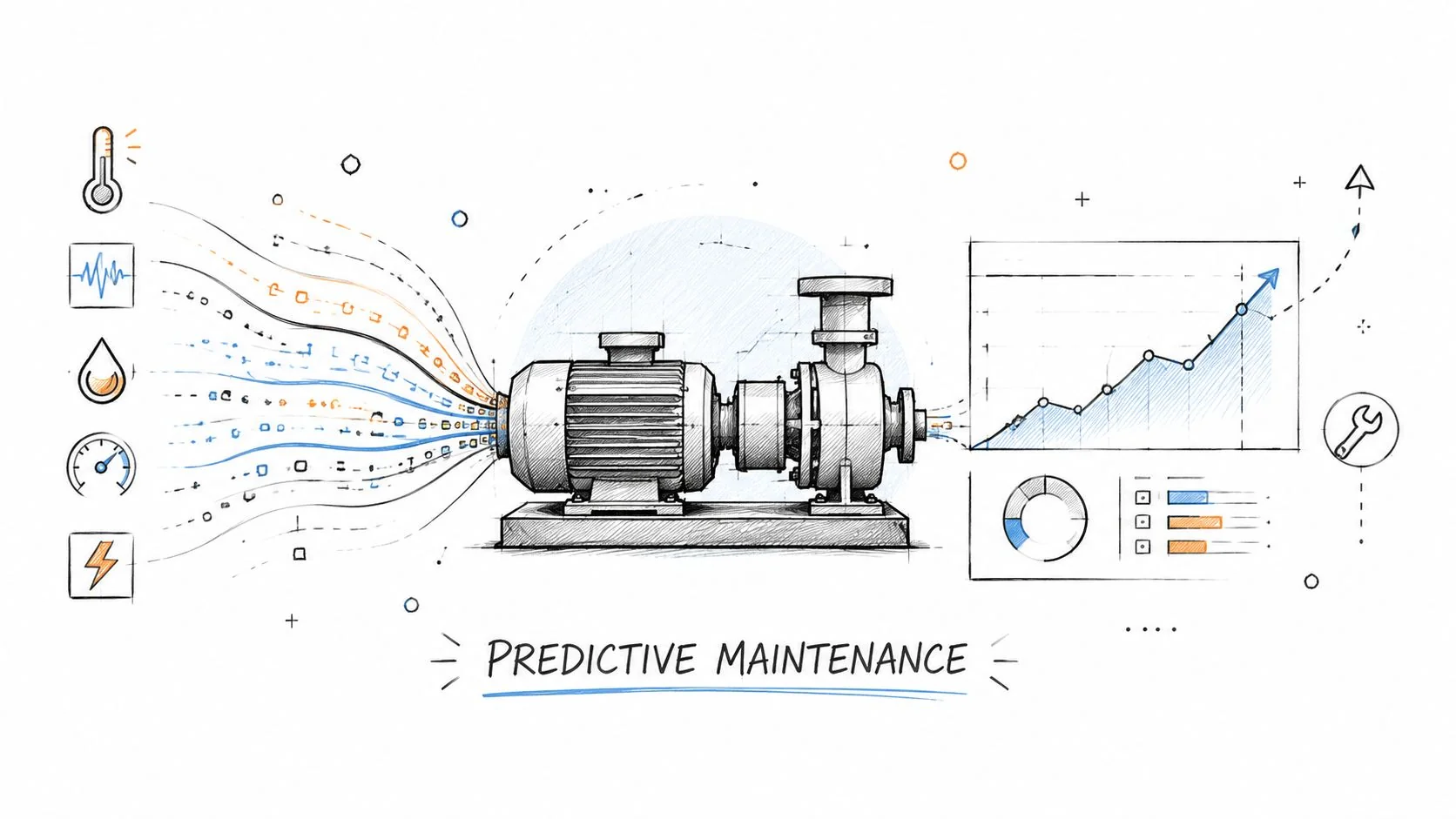
A predictive maintenance model is a system that learns patterns in equipment condition, operating behavior, and service history so it can estimate when an asset is likely to fail or need intervention. In manufacturing, the most useful versions do more than flag a fault. They help maintenance and operations teams decide what to service, when to service it, and which work can safely wait.
The value shows up in day-to-day maintenance planning. Plants adopt these models because they want fewer surprise stoppages, better use of planner time, and tighter control over critical assets. That is why the category keeps moving from pilot projects into production use, even when teams are still sorting out data quality and integration issues.
Practical rule: If the model cannot connect sensor data to maintenance records, it is not ready for production maintenance decisions.
The typical workflow moves from anomaly detection to diagnosis, then prognosis, then mitigation. In plant terms, the model first spots unusual behavior, then narrows the likely cause, then estimates remaining life or failure timing, and finally supports a maintenance action. That sequence is what makes predictive maintenance a practical part of AI in manufacturing, because it connects raw machine data to service planning and downtime avoidance.
For a plant manager, the choice of model affects sensor strategy, CMMS integration, and how much trust operators place in the alerts. The predictive ML overview for manufacturing is useful background if you want a broader view of how these systems fit into the stack, but the core decision starts with matching the model family to the asset problem.
Comparing Predictive Maintenance Model Families
The biggest mistake in predictive maintenance is treating every use case as if one model can solve it. That's how teams end up overbuilding for simple fault detection or underbuilding for remaining useful life prediction. Technical overviews separate the work more clearly, with regression for remaining useful life, classification for failure prediction, and anomaly detectors like isolation forests or autoencoders for early warning (IoT Analytics market analysis).
What each family does well
| Model Family | How It Works | Data Needs | Best For | Key Trade-off |
|---|---|---|---|---|
| Statistical models | Uses historical patterns and thresholds to estimate future behavior | Moderate historical data, stable processes | Simple trend-based maintenance and baseline forecasting | Easy to interpret, but limited when equipment behavior shifts |
| Classical machine learning | Learns relationships between condition signals and failures | Structured sensor and maintenance history | Failure classification, prioritization, RUL estimation | Strong on tabular data, but depends on labeled failures |
| Deep learning | Learns complex temporal or multichannel patterns from high-volume data | Large sensor streams, longer histories | Complex assets, noisy signals, richer pattern detection | Powerful, but harder to explain and maintain |
| Physics-based models | Uses engineering rules and asset behavior equations | Domain knowledge plus operating data | Assets with known wear mechanisms | Interpretable, but can be brittle if assumptions drift |
| Hybrid models | Combines data-driven learning with engineering logic | Multi-source data, domain expertise | Plants with mixed asset types or partial labels | Best balance for many factories, but more integration effort |
How to choose in practice
If failures are sparse, anomaly detection often gives the best starting point because it can learn from normal operation and still raise useful warnings. If you have clean labels and a clear failure pattern, classification is stronger because it translates directly into “will fail” or “won't fail.” If your maintenance question is about service timing, not just failure yes or no, regression is the better fit because it estimates remaining useful life.
Practical rule: Sparse failures usually favor anomaly detection. Stable, well-labeled failure histories favor classification or regression.
Complexity isn't the same as fit. A plant with limited sensor coverage and shifting operating modes may get more value from a simpler anomaly detector than from a deep sequence model. The reason is operational, not theoretical. A model that needs perfect labels, heavy compute, and constant tuning can be technically impressive while still being awkward to use on the floor.
This is also where physics-based or hybrid approaches earn their place. They're often useful when maintenance engineers already understand the dominant failure mode and want the model to respect that knowledge. In that situation, the model isn't replacing engineering judgment. It's scaling it.
Fueling Your Model Data and Feature Requirements
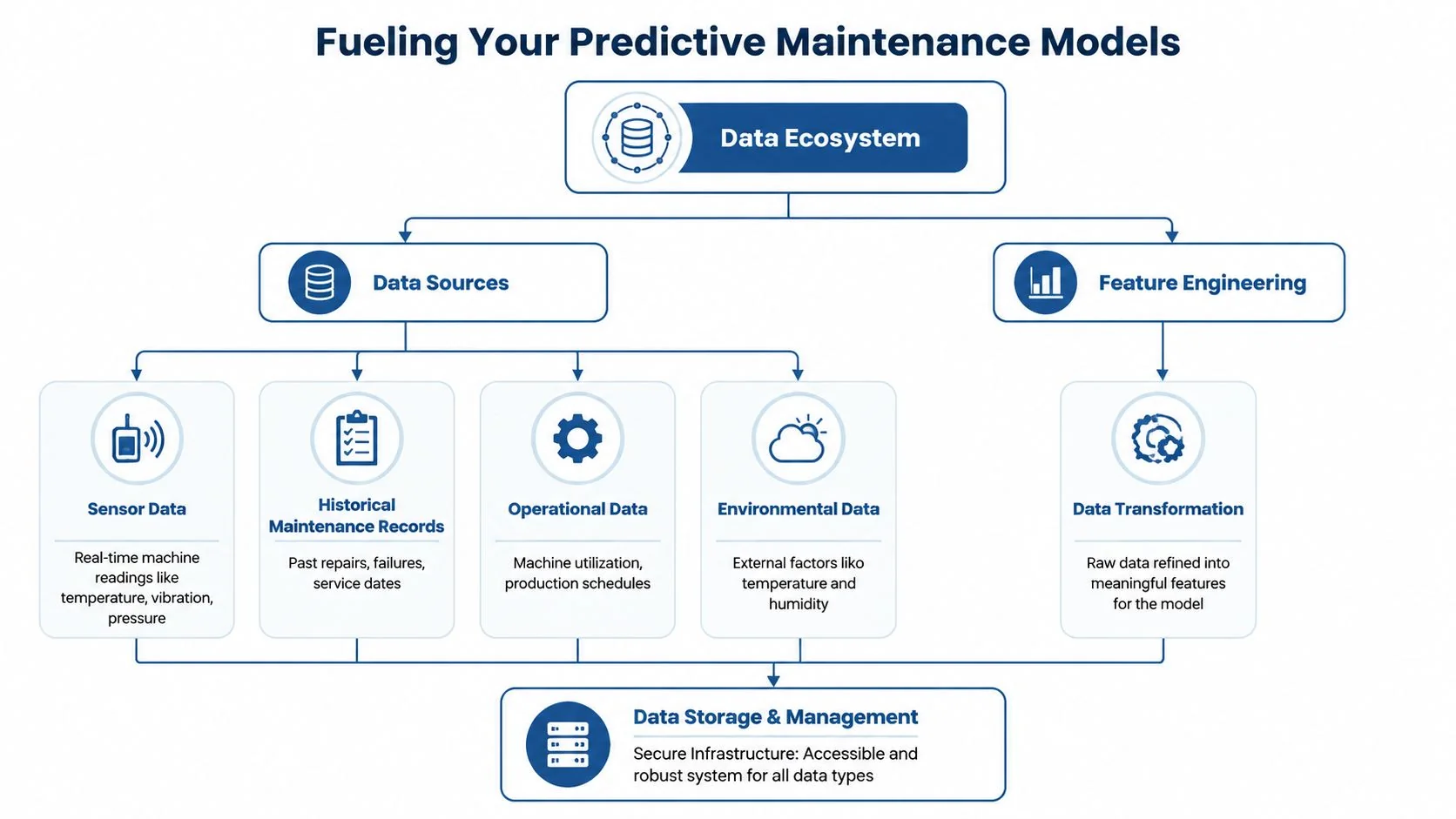
A model can only be as useful as the data feeding it. Predictive maintenance performance depends on data quality, failure labeling, and recalibration, and the model has to learn equipment-specific thresholds and alert levels before its predictions settle into something operations teams can trust. For that reason, data readiness should be the first gate, not a cleanup task after the fact.
At minimum, the model needs condition data and maintenance context together. That usually means vibration, temperature, pressure, thermal imaging, or ultrasonic signals, plus CMMS and operating records that show what happened before and after each failure. A practical manufacturing data collection guide explains that machine condition, operating history, and maintenance history have to be combined if the system is going to prioritize work reliably.
Turn raw signals into usable features
Feature engineering is where raw machine signals become maintenance clues. A vibration stream by itself is just a stream. Once you turn it into rolling averages, peaks, trend rates, spectral features, or threshold-crossing counts, it becomes usable to a model. The same logic applies to temperature, current, acoustic data, and pressure. The model usually does not need every raw value. It needs the right summary of behavior over time.
Practical rule: If a maintenance planner cannot explain the feature in plain language, the feature probably needs a better business framing.
Historical labeling matters more than many teams expect. If work orders are incomplete, late, or inconsistent, the model learns noisy patterns instead of failure precursors. Recalibration is part of the operating model because operating regimes change. Continuous monitoring for drift and periodic retraining keep the model aligned with the plant, and that operating discipline is part of the practical guidance covered in WorkTrek guidance.
Physics-based or hybrid approaches earn their place in these scenarios. They are often useful when maintenance engineers already understand the dominant failure mode and want the model to respect that knowledge. In that situation, the model does not replace engineering judgment. It scales it.
For an AI in manufacturing program, this is the core readiness check. You are not just asking whether sensors exist. You are asking whether sensor, CMMS, and operational data can describe the full maintenance story well enough for a model to act on it.
How to Select and Validate the Right Model
A model is only useful if it fits the plant's decision cycle. Its true value lies not in whether it scores well in a notebook, but whether it helps a planner, reliability engineer, or operator make the right call early enough to matter. Missed failures create unplanned downtime. False alarms create extra work and can train people to ignore the alerts.
Tie metrics to factory consequences
Precision matters when false alarms are costly. Recall matters when missed failures create production risk. F1 score can help when you need a balanced view, but it still has to be judged against the asset and the way the plant runs. For a compressor that can take down a line, missing a failure is usually worse than a few unnecessary work orders. For a lower-priority utility asset, too many false positives can still damage trust quickly.
Validation should start from the maintenance process, not from the metric list. A model trained on historical CMMS records and sensor data can look strong on paper while still failing in the field if the thresholds are not matched to the equipment and operating context. Manual spot checks against known failures matter because they show whether the alert logic makes sense to the people who will act on it. If technicians keep seeing noisy alerts, the model may be statistically sound and operationally weak.
Validate after launch, not just before it
A model's behavior changes when process conditions, operating regimes, or asset wear patterns change. That is model drift, and it is one of the main reasons a pilot that looked promising starts to slip in production. The practical response is continuous monitoring, periodic retraining, and clear ownership for threshold tuning and feedback loops.
The internal deployment guidance in manufacturing predictive maintenance follows the same logic. The team that owns the model has to keep checking whether the alert logic still matches the plant's current reality.
Validation is not a one-time gate. It is an operating discipline.
If the production process changes, the model changes with it or it becomes noise.
That matters for AI in manufacturing because the value comes from repeatable maintenance decisions over time. A model that works for one quarter and drifts in the next one is not a maintenance solution. It is a temporary analytics artifact. The plants that do well are the ones that watch drift, retrain with intent, and keep maintenance and data teams working from the same operating picture.
From Pilot to Production Deploying Models on the Shop Floor
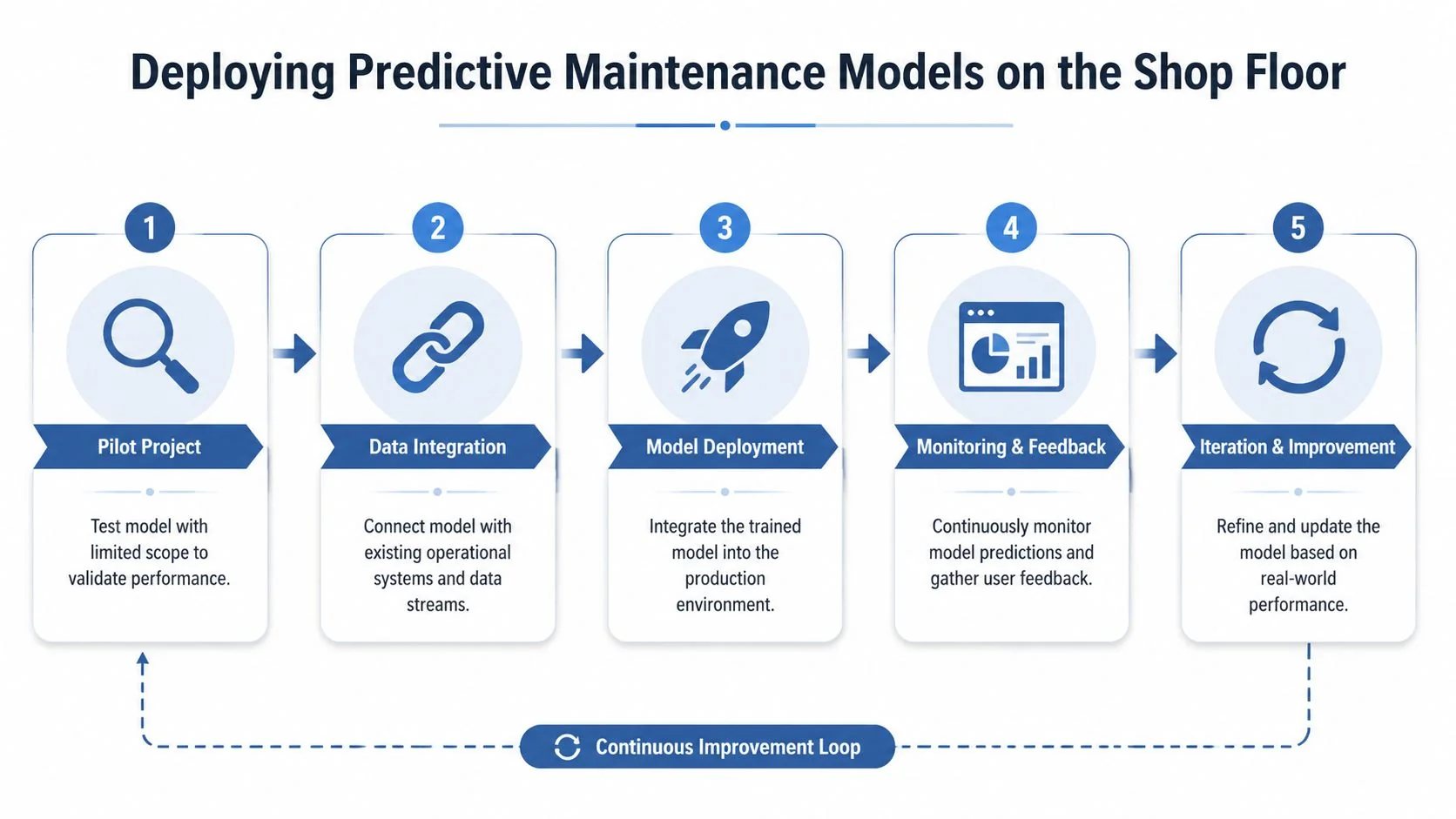
The cleanest deployment pattern is to start where the pain is concentrated. One practical rollout approach is to begin with the 5 to 10 machines that cause the most downtime or are most vital to production, then add vibration, thermal, current, and acoustic sensors before expanding further (deployment pattern reference). That rule works because predictive maintenance ROI is usually concentrated on a small set of critical assets, not on the whole plant at once.
Make the pilot operationally useful
A pilot should prove more than model accuracy. It should show that the alert reaches the right person, at the right time, with enough context to trigger action. If the output stays trapped in a dashboard, nothing changes on the floor. That's why the model has to be integrated with CMMS and scheduling workflows, not isolated in a data science environment.
The internal deployment guide on manufacturing predictive maintenance aligns with the same operational logic. The first step is not scale, it's relevance. You want a pilot that touches assets people already care about and a workflow that maintenance supervisors can use.
Choose the deployment shape with the plant in mind
Cloud deployment can simplify retraining and fleet-level visibility. Edge deployment can reduce latency and help where connectivity is unreliable. On-premise can be the safer choice where data governance is strict. The right answer depends on response time, security posture, and how the plant already handles OT systems.
The main mistake is to overbuild the first release. A narrow pilot with good data plumbing, alert routing, and feedback capture beats a broad but shallow rollout. Once the team trusts the signal, scaling to additional assets becomes an operational decision instead of a debate about whether the model works at all.
Predictive Maintenance Models in Action

The benchmark matters because it keeps expectations realistic. In one academic review, published manufacturing predictive-maintenance studies commonly showed 25% to 30% maintenance-cost savings and 10% to 12% lower energy consumption, while a separate paper reported a General Motors deployment with 60% lower unplanned downtime and about $40 million in annual savings (IJSATE review). Those aren't promises for every plant, but they're useful reference points when you assess whether a pilot is producing credible value.
The useful pattern across these results is consistent. The gains come from combining the right asset choice, useful sensor data, and a model that's tightly linked to maintenance execution. Where teams get stuck is usually not in the algorithm itself. It's in the handoff from prediction to action.
That's why a good predictive maintenance program should be judged on more than alert quality. It should be judged on whether planners trust the model, technicians receive clear work orders, and operations sees fewer avoidable disruptions. The closer the model is tied to maintenance scheduling, the more likely those gains are to show up in real production.
For plant leaders building AI for manufacturing use cases, predictive maintenance is one of the clearest places to start because it connects data, operations, and ROI in a single workflow. If you want to compare model families, review documented factory implementations, and pressure-test your own pilot plans against measured outcomes, explore the evidence base at AI for Manufacturing and use it to anchor your next maintenance AI decision.
