OPC UA Communication Protocol Guide for AI
Learn how the opc ua communication protocol structures data, secures transport, and feeds AI pipelines in modern manufacturing environments.
Written by AI for Manufacturing
The OPC UA communication protocol is a platform-independent, service-oriented industrial communication architecture that standardizes the exchange of structured data, metadata, and services across automation systems. Its counterintuitive value is that it isn't one fixed network protocol. OPC UA separates the information model from the transport, so the same industrial meaning can move through OPC UA TCP, HTTPS, WebSockets, MQTT, AMQP, or UDP-oriented PubSub patterns, depending on the plant's operational needs. That flexibility matters because manufacturing AI projects usually fail first at data acquisition, semantics, and trust, not at model selection.
OPC UA was released on July 28, 2006, following more than three years of specification work and one year of prototype implementation. It replaced the Windows COM/DCOM foundation of OPC Classic with a platform-independent architecture, and it later became the IEC 62541 international standard series. The OPC Foundation reported support from more than 480 members by 2013, across China, Europe, Japan, and North America, evidence of the standard's expansion beyond its original development base. (OPC Foundation history)
Table of Contents
- What OPC UA Is and Why It Matters for AI in Manufacturing
- The Information Model That Makes Plant Data AI-Ready
- Choosing the Right Transport for Your AI Pipeline
- Security and Certificate Lifecycle as an AI Prerequisite
- Real Deployment Patterns on the Factory Floor
- Feeding Machine Learning and Analytics Through OPC UA
- Best Practices, Troubleshooting, and Decision Framework
What OPC UA Is and Why It Matters for AI in Manufacturing
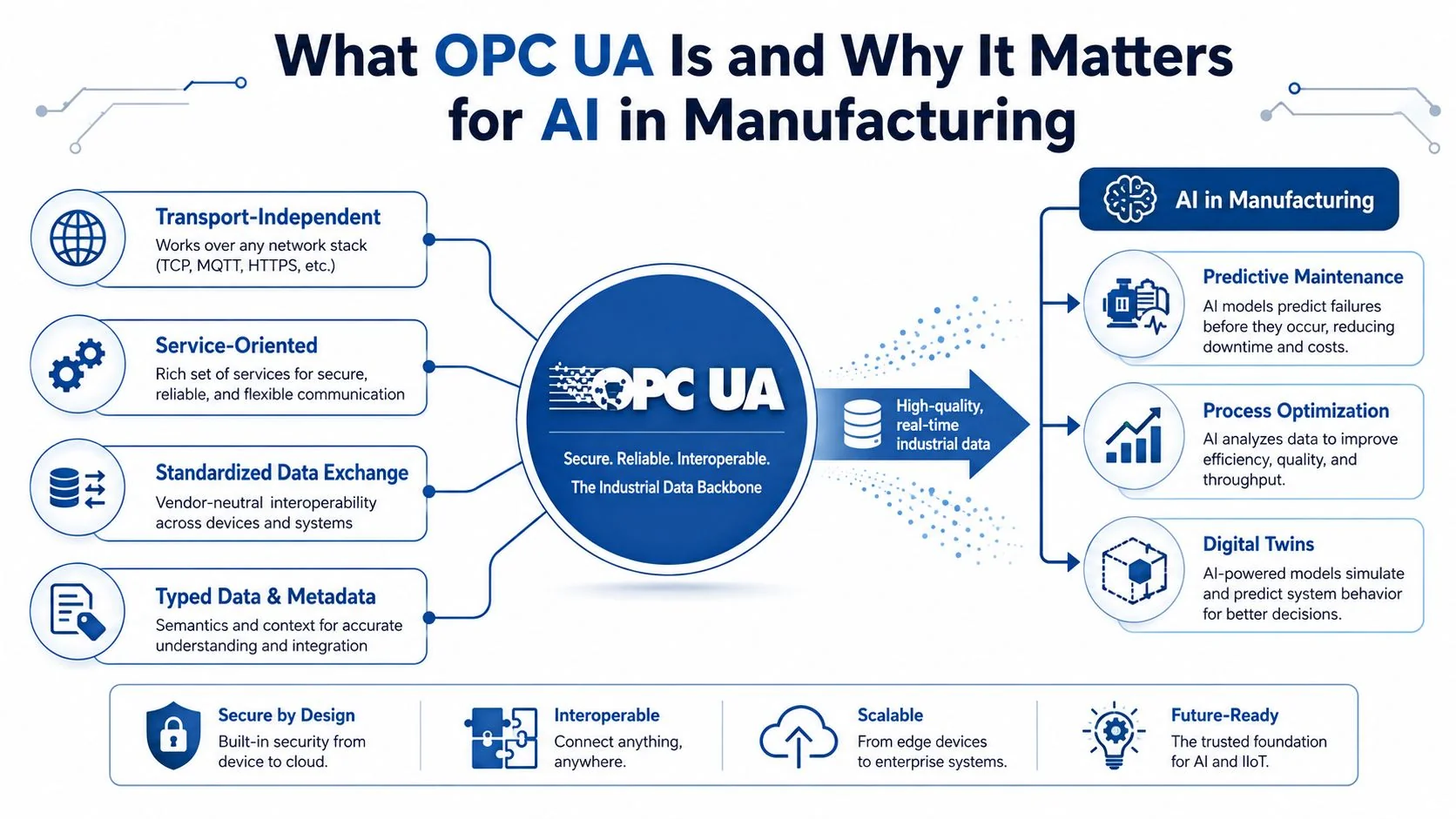
OPC UA is a transport-independent industrial protocol architecture with a standardized information model, services, and security framework. In practical terms, it gives controllers, machines, gateways, historians, MES platforms, and analytics applications a common way to exchange typed values and the context that makes those values usable.
That context is the dividing line between a useful AI pipeline and a large folder of misleading files. A raw integer from Modbus might represent temperature, a state code, a counter, or an alarm. OPC UA can expose the value with a meaningful node, data type, engineering unit, timestamp, quality status, and relationship to the machine or process that produced it. A model can consume that structure directly instead of relying on an engineer to reconstruct meaning from tag names and undocumented spreadsheets.
The architecture behind the flexibility
Think of an OPC UA deployment as three coordinated layers:
- Information model: Defines objects, variables, data types, references, metadata, and relationships.
- Services: Provide operations such as browsing, reading, writing, subscribing, discovering, and calling methods.
- Transports: Carry those services or published datasets across plant and enterprise networks.
The transport-independent design lets vendors preserve the same data model while changing how messages travel. OPC UA TCP is often appropriate for direct plant connections, while MQTT or AMQP can distribute data through brokers. HTTPS and WebSockets suit selected IT integrations, and UDP-based PubSub patterns can serve field-level distribution where network determinism matters. (OPC UA technical overview)
For a manufacturing AI team, this layered design creates a reusable data foundation. You can connect a brownfield PLC through a gateway today, feed a historian and edge feature service, and later move selected streams to a broker without redesigning the meaning of every tag. The protocol isn't the model, but it can provide the semantic floor that makes model training, inference, and cross-line comparison defensible.
The Information Model That Makes Plant Data AI-Ready
The OPC UA address space is a graph of nodes and references, not merely a flat list of tags. Object nodes organize equipment and processes, Variable nodes expose values, and Method nodes represent callable operations. Attributes describe each node, while references express relationships between assets, components, variables, and types.
That structure changes how an AI engineer approaches feature engineering. Instead of receiving columns such as T_101, MTR_4, and STAT_7, a pipeline can discover that a variable belongs to a motor object, carries a temperature data type, has an engineering unit, and participates in a defined equipment hierarchy. The model still needs domain validation, but the pipeline starts with explicit semantics rather than guesses.
From raw tags to reusable types
Companion specifications provide vertical information models for domains such as devices, asset management, industrial automation, ISA-95 job control, PackML, and machinery. They define reusable ObjectTypes, VariableTypes, DataTypes, and ReferenceTypes, allowing equipment from different vendors to expose comparable structures. (OPC Foundation modelling guidance)
The practical result isn't that every installation becomes automatically consistent. Vendors can still expose incomplete or awkward models, and integrators can still create poor namespaces. The benefit is that a disciplined team has a standard vocabulary to enforce during commissioning.
A manufacturing AI group should validate the model before collecting a large historical dataset. Confirm the node identity, unit, data type, timestamp behavior, quality status, state enumeration, and relationship to the production asset. Those checks prevent a common failure mode, where a model trains successfully on values that were technically valid but semantically wrong.
Services are the operational verbs applied to that graph:
- Browse discovers available nodes and references.
- Read retrieves current values or attributes.
- Write changes permitted values, though write access should be tightly controlled.
- Subscribe monitors changes or sampled values.
- Call invokes a server-defined method.
A useful interoperability layer must preserve both values and meaning. The distinction is central to what interoperability means in manufacturing systems, because AI portability depends on whether equivalent assets expose comparable concepts, not merely whether two systems can exchange bytes.
Common OPC UA Companion Specifications and Their AI-Relevant Fields
| Companion Spec | Example Type | AI-Relevant Fields | Typical Source |
|---|---|---|---|
| OPC UA for Devices | DeviceType | Identity, manufacturer data, capabilities, health | Device vendors and automation suppliers |
| PackML | PackML state model | Machine state, mode, transition, production status | Packaging equipment |
| ISA-95 | Equipment and job models | Work order context, equipment hierarchy, production activity | MES and plant integration |
| OPC UA for Machinery | Machinery types | Machine components, operating data, alarms, methods | Machinery builders |
| Domain-specific models | Sensor or asset types | Typed measurements, units, status, ranges | Vertical industry groups |
The AI payoff is reduced ambiguity. Standardized semantics can support cross-vendor feature extraction, asset comparison, and model portability, but only if the plant treats information modelling as an engineering deliverable rather than a documentation afterthought.
Choosing the Right Transport for Your AI Pipeline
OPC UA's transport independence is useful only when engineers choose deliberately. The information model can stay stable while the communication pattern changes, but each pattern produces a different operational shape for latency, fan-out, firewall traversal, discovery, and certificate management.
Client-server remains the best default for commissioning, browsing, control interaction, and targeted inference lookups. A client opens a session to a server and can browse the address space, read and write permitted values, create monitored items, and call methods. It carries the full OPC UA service set, which makes it valuable when an AI application needs to inspect a machine, retrieve a specific attribute, or send a tightly governed command.
PubSub is the stronger choice for distribution. Publishers send datasets without knowing which subscribers exist. Brokered transports such as MQTT and AMQP support decoupled pipelines, while UDP multicast supports field-level distribution. The OPC Foundation describes PubSub as an architecture for scalable and deterministic communication, with symmetric encryption and signatures available in broker-less models. (OPC UA PubSub and Industrie 4.0)
For manufacturing AI, PubSub fits a machine stream that must feed an edge historian, quality service, dashboard, and inference process without creating a separate direct session for every consumer. It also reduces publisher-side fan-out complexity. The trade-off is that subscribers receive published data rather than browsing an unknown server or invoking its full service set.
Match the transport to the dataflow
REST and OpenAPI-compatible work can make OPC UA data easier for conventional web applications to consume, particularly across IT boundaries. It isn't the right replacement for every plant connection, however. Gateway compatibility, service coverage, and the direction of standard development need review before making REST the core of a production OT architecture.
TSN-aligned PubSub is aimed at deterministic communication across suitably engineered Ethernet infrastructure. It belongs in controller-to-controller or field-level designs where bounded timing matters more than cloud convenience. An AI system may observe or assist such a process, but it shouldn't be inserted into a fast control loop merely because it can receive the data.
| Transport | Latency Profile | Firewall/NAT Fit | AI Pipeline Suitability |
|---|---|---|---|
| OPC UA client-server over OPC UA TCP | Session-based and configurable | Strong inside segmented plant networks, less convenient across NAT | Browsing, targeted reads, commands, commissioning, inference lookups |
| PubSub over MQTT | Broker-mediated and decoupled | Good for segmented plant-to-enterprise flows when broker access is governed | Historian fan-out, edge analytics, cloud ingestion, many consumers |
| PubSub over AMQP | Broker-mediated with enterprise messaging features | Good for managed enterprise integration | Queued plant-to-enterprise data exchange |
| PubSub over UDP | Low-overhead local distribution | Poor across routed or tightly filtered networks | Field-level fan-out and local edge processing |
| REST or WebSockets | Web-oriented request or stream pattern | Familiar to IT and web infrastructure | API access, selected cloud and application integrations |
| TSN-aligned PubSub | Deterministic when the network is engineered for it | Requires compatible managed infrastructure | Motion-adjacent data distribution and tightly timed control architectures |
The machine-to-machine communication overview is a useful companion when deciding whether the dominant problem is direct interaction or scalable distribution. Don't choose MQTT, REST, or TSN because another plant used it. Choose based on whether the AI pipeline needs synchronous lookup, high-cardinality fan-out, broker resilience, or deterministic local delivery.
Security and Certificate Lifecycle as an AI Prerequisite
OPC UA security has several layers, and confusing them creates weak designs. X.509 v3 certificates and private keys establish application identity for client-server communication. User tokens can add username and password, X.509 certificate, or JWT-based authentication. Asymmetric cryptography supports key agreement, while symmetric encryption protects message confidentiality and signatures protect integrity. (OPC UA security model)
Application instance certificates are typically part of application-level security, not decorative configuration. They can allow a server to communicate only with preconfigured clients, which is important when a plant must restrict historians, gateways, or inference services to approved identities. (OPC UA security overview)
The operational bottleneck is identity management
Encryption rarely causes the most painful AI outage. Certificate governance does. Every client and server needs a trust decision, and that decision must survive software upgrades, vendor replacement, plant expansion, and incident response.
A workable operating model separates:
- Root and issuing authorities: Keep authority ownership explicit, with a documented process for issuing and revoking certificates.
- Trust lists: Maintain approved application identities on servers and clients, rather than copying certificates manually without ownership.
- Security policies: Standardize supported policies across vendors and reject accidental mixed-mode production deployments.
- Renewal ownership: Assign a team responsible for expiration monitoring, replacement, testing, and rollback.
- Discovery and credentials: Make endpoint discovery reproducible, especially where multiple plants use different vendor stacks.
Recent standard updates for 2025 and 2026 emphasize security mappings, ECC support, JSON encoding changes, revocation handling, discovery, and credential management in IEC 62541-6:2025 and IEC 62541-12:2025. (Manufacturing standards update) Older policies are also being retired in tooling while newer choices are added, so version fragmentation becomes a migration concern.
Practical rule: Treat the plant PKI as production infrastructure. A certificate that works in a lab but has no owner, renewal path, or revocation process isn't an AI-ready connection.
| Security Policy | Encryption/Hashing | Performance Overhead | AI Pipeline Risk |
|---|---|---|---|
| None | No message protection | Lowest | Unauthorized access, tampering, and unusable audit posture |
| Sign | Integrity and identity protection | Lower than signing plus encryption | Confidentiality gaps for sensitive process data |
| Sign and encrypt with modern policy | Integrity, identity, and confidentiality | Requires certificate and policy compatibility | Renewal failures, trust-list drift, and version mismatch |
A secure model doesn't guarantee a reliable feed. If certificates expire, trust lists diverge, or a server exposes a different namespace after an upgrade, the analytics tier sees missing data regardless of the model's quality.
Real Deployment Patterns on the Factory Floor
The cleanest OPC UA architecture often begins with equipment that wasn't designed for it. Brownfield plants usually have a mixture of PLCs, proprietary gateways, OPC Classic servers, Modbus devices, historians, and newer controllers. The engineering challenge is to add structure without creating a fragile chain of translation boxes.
Legacy migration
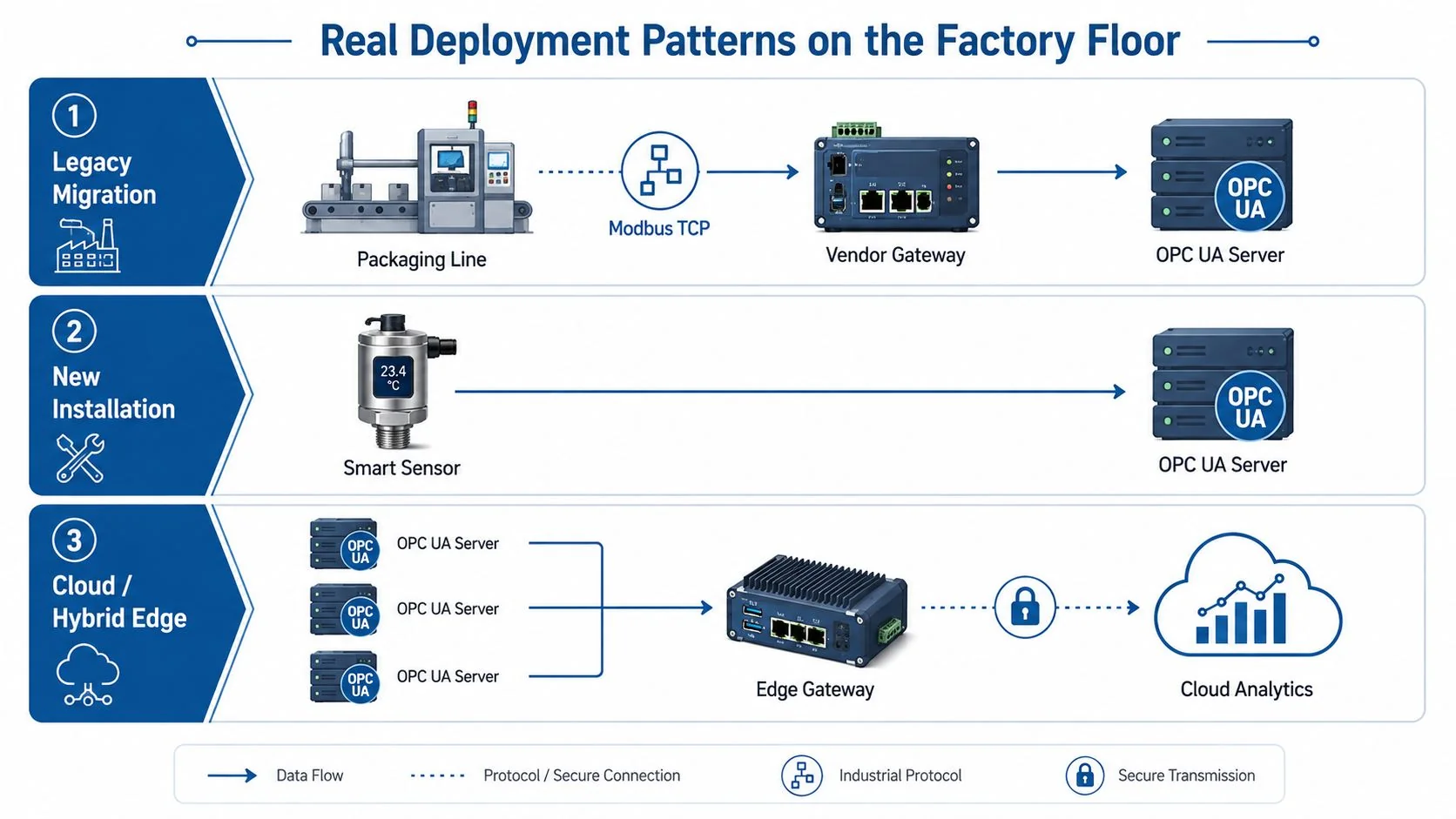
A packaging line speaking Modbus TCP can connect to a vendor gateway that exposes an OPC UA server. The gateway maps registers into a structured namespace, and a new MES consumes the resulting objects and variables.
The physical setup is straightforward: the gateway sits in an industrial cabinet or protected edge enclosure, with one network path toward the line and another toward the plant integration zone. The certificate authority usually belongs on the plant or industrial security side, while the gateway's trust list permits only the approved MES client and administrative tools.
The failure at two in the morning is rarely the Modbus cable. It's usually a register map change, a gateway restart that loses a subscription configuration, or a certificate replacement that wasn't imported into the MES trust list. This pattern works as a bridge, but it adds a translation dependency that the team should document and eventually retire as native OPC UA support becomes available.
Brownfield MES bridge
An existing OPC Classic server can remain in place behind an aggregation node. The aggregation node connects to the legacy server, restructures selected tags into ISA-95-oriented objects, and presents one OPC UA endpoint to the historian and MES.
This reduces the number of downstream integrations and gives the analytics team a stable namespace while the controls group preserves the existing line logic. Use a dedicated issuing authority for the aggregation tier, and keep the legacy server isolated because its security and operating assumptions differ from modern OPC UA systems.
The night-shift failure mode is a namespace mismatch. The client connects successfully, but a vendor update changes a node identifier, removes a reference, or alters a state enumeration. A successful TCP connection proves very little. The pipeline must validate the expected namespace and semantic contract.
Edge-to-cloud AI pipeline
A rugged industrial PC can subscribe to local OPC UA sources, normalize selected values into companion-specification types, and forward event-shaped data toward a cloud analytics tenant. PubSub is appropriate when multiple downstream consumers need the same stream, while the edge computer can filter, aggregate, buffer, and enforce the feature contract before data leaves the plant.
The certificate topology should distinguish machine identities, edge application identities, and cloud broker identities. Avoid one shared certificate across an entire line. When that credential is revoked or replaced, the blast radius becomes needlessly large.
At two in the morning, engineers usually find queue buildup, a broker session failure, a clock or timestamp problem, or a subscription that expanded far beyond the intended dataset. The edge layer should expose health metrics for each source, queue, and forwarding path so the team can identify whether the fault began at the machine, gateway, broker, or analytics consumer.
Feeding Machine Learning and Analytics Through OPC UA
OPC UA is not an AI data pipeline by itself. It provides access to structured machine data, while the engineering team must decide which values enter the training set, how often they arrive, which quality rules apply, and which machine states make comparisons valid.
Transport choice affects the pipeline's operating profile. An OPC UA client can create monitored items and write selected values to a historian such as InfluxDB or Timescale. The historian buffers time-series data, preserves timestamps and quality information, and gives feature jobs a queryable source, as detailed in our guide to manufacturing data collection. This client-server pattern suits brownfield systems and targeted reads, but its subscription scope and certificate governance still need active maintenance.
An edge application can subscribe directly, keep changed or sampled items, and filter by node attributes before forwarding data to an inference service. That reduces bandwidth and feature cardinality, while adding another identity, queue, and failure point to operate. PubSub fits fan-out pipelines where several consumers need the same event stream, but it does not replace client-server services for every read, method call, or commissioning task.
Build the feature contract first
Companion specifications can provide consistent concepts for machine state, axis position, setpoints, alarms, and equipment relationships. Models for machine tools, plastics, or pneumatics help expose comparable semantics across vendors, yet every implementation still requires verification.
A practical feature contract records:
- Identity: Which asset, line, operation, and component produced the value?
- Meaning: What does the variable represent, and what are its engineering units?
- Timing: Is it event-driven, sampled, aggregated, or delayed by buffering?
- Quality: Which status codes exclude a point from training or trigger a missing-value rule?
- State: Which machine modes make the feature comparable?
- Version: What changes after a namespace, enumeration, or companion model update?
Cardinality grows quickly. A broad subscription that streams every analogue point at an unnecessarily high rate can overload a gateway, fill storage, and hide useful signals among redundant data. Start with features tied to a defined use case. Add points only after validation shows that they improve the decision.
Labels require the same discipline. A state enumeration from one vendor may mean something different on another machine. Preserve the original value, map it to a controlled plant vocabulary, and version that mapping with the model.
For manufacturing AI, OPC UA works best as one governed layer in the feature pipeline, not as a data dump. Define feature semantics before selecting client-server, PubSub, storage schema, or model architecture. That sequence limits brownfield risk and produces an asset model that can survive commissioning.
Best Practices, Troubleshooting, and Decision Framework
Start commissioning with a written contract. Pin server URIs, record namespace expectations, define allowed security policies, and assign ownership for the certificate authority. Production clients shouldn't fall back to anonymous access or weaker mixed-mode endpoints.
Use a troubleshooting sequence that isolates the layer:
- Endpoint check: Confirm the URI and application identity.
- Trust check: Verify certificates, issuer chains, trust lists, and expiration.
- Namespace check: Browse the expected objects and confirm identifiers and data types.
- Subscription check: Adjust sampling and publishing intervals in controlled increments, including 250 ms increments where that suits the test, then observe queue behavior and data quality.
- PubSub check: Inspect broker queue depth and subscriber health before blaming sensor noise.
- Feature check: Confirm timestamps, status codes, units, and state mappings at the analytics boundary.
| Primary Goal | Recommended Transport | Security Posture | Top Gotcha |
|---|---|---|---|
| Brownfield compatibility | Client-server through an aggregation gateway | Sign and encrypt with governed trust lists | Gateway namespace changes |
| Targeted reads and commands | Client-server over OPC UA TCP | Certificate-based application identity and least-privilege users | Assuming PubSub supports full service interaction |
| Cloud and historian fan-out | PubSub over MQTT or AMQP | Broker access controls plus OPC UA message protection | Unbounded datasets and queue growth |
| Local field distribution | PubSub over UDP | Managed network segmentation and message integrity | Multicast routing and discovery complexity |
| Deterministic controller exchange | TSN-aligned PubSub | Coordinated device identities and network policy | Treating a normal Ethernet network as TSN-ready |
| Web application integration | REST or WebSockets where supported | HTTPS authentication, certificate governance, and API authorization | Assuming web access exposes every OPC UA service |
The 47 million-plus installed automation products using OPC client technology, with much of that base concentrated in PLCs, PACs, and operator interface devices, explains why migration matters. OPC UA isn't limited to greenfield equipment. It can provide a structured path from legacy deployments into secure, interoperable data exchange. (ARC installed-base analysis)
The practitioner takeaway is simple: OPC UA's AI value is earned through modelling discipline, transport selection, and certificate operations. If you're building a manufacturing AI pipeline, inventory your namespaces, define a feature contract, test the transport against the dataflow, and make identity lifecycle part of the plant's operating model before training begins.
If you're evaluating an AI initiative, use the AI for Manufacturing database to compare documented implementations by industry, use case, technology, company size, and reported outcomes. Start with one production problem, map the required machine semantics and data quality conditions, then build an OPC UA architecture that can support a trustworthy pilot and a maintainable deployment.
