Manufacturing System Integration: AI Practitioner Guide
Master manufacturing system integration. Learn architectures, data flows, and a 2026 roadmap for building an AI-ready factory.
Written by AI for Manufacturing
Manufacturing system integration is the process of connecting machines, control systems, operations software, and enterprise applications so they work as one coordinated production environment with shared, reliable data. For anyone pursuing AI in manufacturing, that definition matters more than the latest model architecture, because AI only becomes useful when it can access synchronized context from the shop floor through business systems. The scale of investment makes that clear. The global system integration market was valued at USD 516.8 billion in 2024 and is projected to reach approximately USD 1,946.37 billion by 2034, expanding at a 14.18% CAGR, driven by sensors, cloud computing, and AI adoption according to Precedence Research's system integration market analysis.
Plant teams often treat integration as an IT modernization task. That framing is too narrow. In practice, manufacturing system integration determines whether your AI initiative gets clean production truth or a stitched-together set of partial records, delayed exports, and conflicting identifiers. If you're evaluating connected factory programs, examples in the journey toward the connected enterprise are more relevant than generic AI demos, because they show the kind of operational groundwork serious AI depends on.
Table of Contents
- What Is Manufacturing System Integration
- The Core Architecture of an Integrated Factory
- Key Integration Patterns and Protocols
- Data Governance The Unsung Hero of Manufacturing AI
- A Stepwise Roadmap for System Integration
- Conclusion From Integrated Data to Actionable AI
What Is Manufacturing System Integration
Manufacturing system integration connects disparate factory systems, software, and machines so they function as a cohesive whole. That includes equipment controllers, SCADA or HMI layers, MES or MOM platforms, ERP, quality systems, maintenance systems, PLM, and the interfaces that move data among them. For AI in manufacturing, this isn't background infrastructure. It's the condition that makes training data trustworthy and live decisions usable.
Many failed AI pilots have the same root problem. The model isn't the issue. The plant has one naming structure in ERP, another in MES, machine states that don't align across lines, and quality records that arrive too late or without process context. In that environment, teams can produce dashboards and proofs of concept, but they can't produce dependable AI that operators will trust during production.
Why integration is a strategic investment
The money flowing into this area tells you how manufacturers are prioritizing digital transformation. The market isn't growing because executives suddenly enjoy middleware. It's growing because manufacturers need unified data flows to support connected operations, adaptive scheduling, traceability, and AI-driven decisions. The investment is going into the layer that turns isolated systems into an operational data backbone.
Practical rule: If a plant can't reliably connect what happened at the machine with what was planned in MES and what was ordered in ERP, it isn't ready for serious AI deployment.
That point matters for plant managers because AI use cases only look simple in vendor slides. A predictive maintenance model needs more than sensor values. It usually needs asset identity, maintenance history, runtime state, product context, and enough event consistency to distinguish a real precursor from noise. A predictive quality model needs process parameters tied to the right work order, material, operator workflow, and inspection result.
What works and what doesn't
What works is treating manufacturing system integration as an operations initiative with IT and OT participation. The plant defines the business problem. Controls engineers define what can be collected from equipment. MES and ERP owners define process context and transaction truth. Data teams define how that information is exposed, governed, and consumed.
What doesn't work is starting with a broad AI platform purchase and assuming the data problem will sort itself out later. It won't. Plants that delay integration discipline usually end up building one-off connectors, exporting spreadsheets, and manually reconciling identifiers between systems. That creates exactly the instability that causes AI outputs to drift away from production reality.
For anyone pursuing AI in manufacturing, the practical takeaway is simple. Manufacturing system integration isn't adjacent to AI strategy. It is the foundation of AI strategy.
The Core Architecture of an Integrated Factory
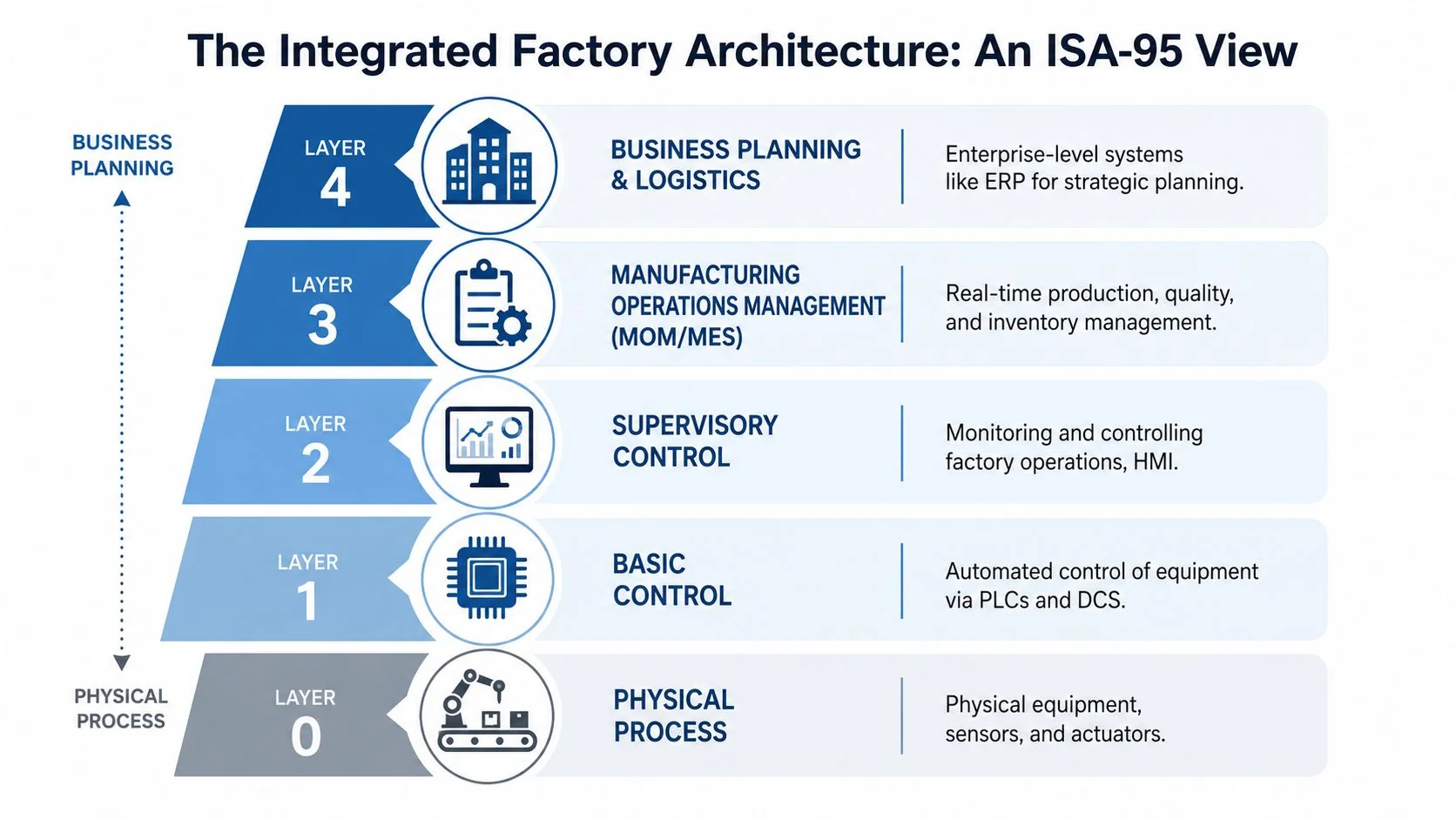
Manufacturing integration architecture needs structure, not just connectivity. The most useful organizing model remains ISA-95, which defines five hierarchical layers for manufacturing systems. According to Control Ink Systems on ISA-95 integration architecture, failure to align with this layered model can create data silos that increase mean-time-to-repair by 30-45% in high-mix environments. For AI teams, that same misalignment also corrupts context, lineage, and timing.
Plants exploring connected equipment often start with IoT sensors in manufacturing environments, but sensor projects only become useful at scale when they fit into a clear ISA-95-aligned architecture.
Why ISA-95 matters to AI teams
AI models need more than raw signals. They need signals placed inside a production hierarchy. If vibration spikes on a spindle, the model should know which asset it came from, what product was running, whether the machine was in production or idle, what material lot was loaded, and whether downstream quality results changed. ISA-95 gives teams a practical way to map those dependencies without mixing every data source into one undifferentiated pool.
A lot of plants skip this discipline and push data into a historian or cloud platform as fast as possible. That can create visibility, but it doesn't create decision quality. AI depends on consistent relationships between data generated at different layers of the operation.
What each layer contributes to AI
| ISA-95 layer | Typical systems | What data it contributes | Why it matters for AI |
|---|---|---|---|
| Level 0 | Physical process | Sensor readings, physical states, actuators | Supplies the direct signal of what the process actually did |
| Level 1 | PLCs, DCS, embedded control | Machine logic states, alarms, control setpoints | Tells AI how the equipment was commanded and how it responded |
| Level 2 | SCADA, HMI, supervisory systems | Operator interactions, line status, trends, process supervision | Adds event timing and operational visibility |
| Level 3 | MES, MOM, quality, maintenance coordination | Work orders, recipes, genealogy, quality records, production states | Provides manufacturing context needed for traceability and model labels |
| Level 4 | ERP and business planning | Demand, inventory, procurement, cost, order commitments | Connects plant behavior to business constraints and planning decisions |
The pattern is consistent. Lower layers give you high-frequency operational truth. Upper layers give you business and process context. AI becomes valuable when you combine them correctly.
A defect classifier that only sees machine parameters may identify correlation. A defect classifier that also sees work order, material, and routing context can support action.
That distinction matters on the plant floor. A quality engineer doesn't just want a probability score. They want to know whether the issue is tied to a specific machine center, product family, supplier lot, or routing condition. Without layered integration, the model can't answer those questions in time to change the outcome.
Key Integration Patterns and Protocols
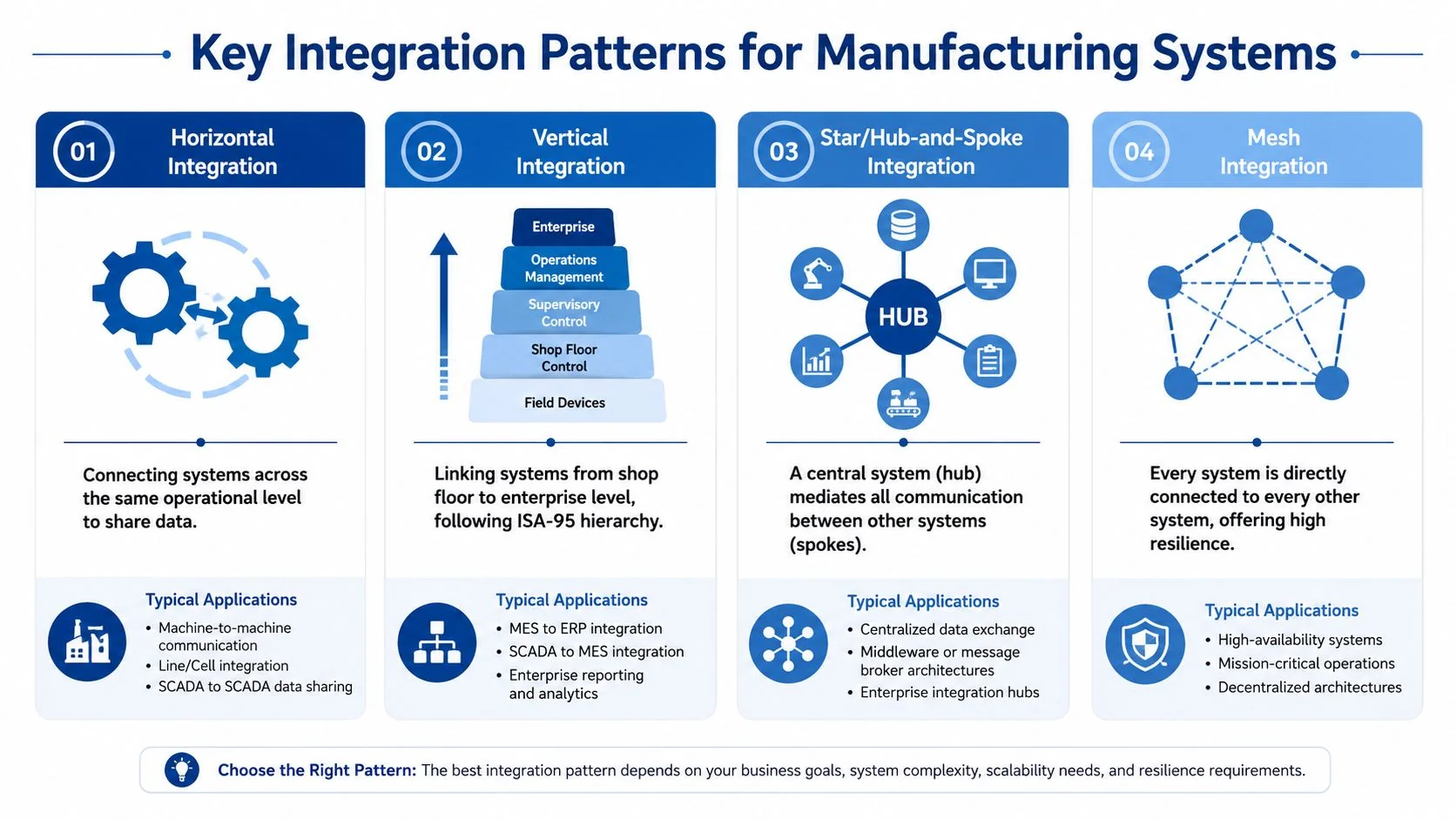
Not every integration approach enables the same AI use cases. In manufacturing, the pattern you choose determines what data relationships are even possible. According to Excellerant Manufacturing on manufacturing system integration types, there are four distinct types of manufacturing systems integration: horizontal, vertical, end-to-end, and machine-level. For AI, that distinction is operational, not academic. Predictive quality models need horizontal integration, while inventory optimization AI requires vertical integration.
The four patterns serve different AI jobs
Here's the practical comparison plant teams should use:
| Integration pattern | What it connects | Best fit for AI use cases | Common failure mode |
|---|---|---|---|
| Machine-level | Individual machines to networks or IIoT platforms | Equipment monitoring, condition-based alerting, basic anomaly detection | Data arrives without production context |
| Horizontal | Systems and machines across the same shop-floor level | Predictive quality, line balancing, bottleneck detection | One machine looks optimized while the line still underperforms |
| Vertical | Shop floor systems to enterprise systems | Scheduling, inventory optimization, order-aware analytics | ERP and production data disagree on actual status |
| End-to-end | Design through delivery | Traceability, closed-loop product improvement, cross-functional optimization | Engineering, production, and supply chain remain fragmented |
If you're evaluating AI for scrap reduction, horizontal integration often matters first. You need data from upstream and downstream stations, not just the machine where the defect was detected. If you're evaluating AI for order prioritization or inventory positioning, vertical integration matters first because the model needs production status and enterprise demand in the same frame.
Choosing architecture over convenience
Plants often drift toward point-to-point connections because they feel fast. One PLC gets wired to one dashboard. One MES export feeds one analytics tool. That may solve a local problem, but it creates long-term fragility. Every new use case requires another custom connection, another transformation rule, and another place where timestamps and identifiers can diverge.
For AI work, I usually push teams to think in terms of reusable data pathways instead of project-specific feeds. Protocols such as OPC-UA and MQTT matter because they help equipment and systems speak a common operational language, but protocol choice alone won't save a poor architecture. The core issue is whether data can move with enough context, consistency, and governance to support reuse.
A useful decision test is simple:
- If the use case needs line-wide correlation, prioritize horizontal integration.
- If the use case needs production-to-business synchronization, prioritize vertical integration.
- If the use case depends on product lifecycle traceability, plan for end-to-end integration.
- If the use case starts at one asset, machine-level integration is a valid entry point, but don't stop there.
Plants pursuing AI in manufacturing need to choose integration patterns based on the decisions they want AI to support, not based on which connector happens to be easiest to install.
Data Governance The Unsung Hero of Manufacturing AI
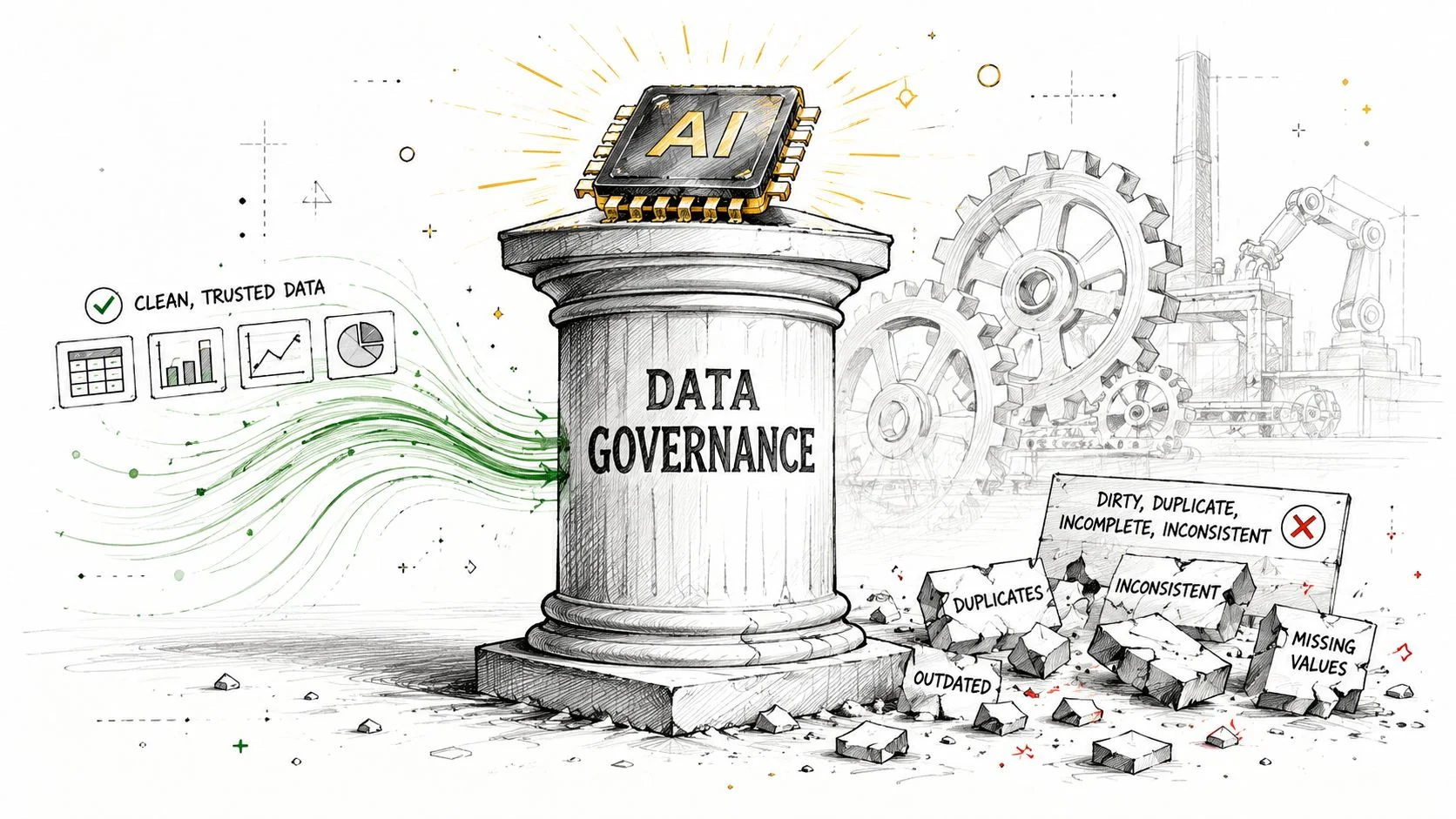
Most manufacturing AI problems are data governance problems in disguise. The model gets blamed because it's visible. The actual failure usually happened earlier, when teams allowed conflicting master data, inconsistent timestamps, uncontrolled parameter names, or duplicate business logic to flow into the pipeline.
Successful integration requires an API-first data flow that unifies PLM, MES/MOM, and ERP into a single source of truth, and this matters because AI models trained on unsynchronized data, such as BOM mismatches between PLM and MES, produce unreliable outputs according to Gocious on manufacturing system integration and single-source data flow. That is exactly the kind of issue that causes a model to look promising in a notebook and fail on the line.
A useful example of why harmonized data matters shows up in multi-plant MRO inventory harmonization work, where the hard part isn't analytics first. It's getting naming, classification, and system truth aligned well enough for analytics to become trustworthy.
Why model quality starts before the model
In manufacturing, "single source of truth" isn't a slogan. It means one agreed record for product structure, one interpretation of order status, one governed mapping of machine states, and one approved definition for metrics that cross systems. Without that, teams train AI on blended datasets that contain hidden contradictions.
A classic example is BOM drift. Engineering updates a structure in PLM. MES still references an older version. ERP reflects planning assumptions that no longer match the actual line setup. The AI model then tries to learn from records that appear complete but describe different production realities. The output isn't just noisy. It's misleading.
Operator check: If production, quality, and planning teams would answer the same traceability question with different system records, your AI pipeline isn't ready.
A practical governance baseline
You don't need a giant governance program to start, but you do need discipline. The minimum baseline usually includes:
- Data ownership: Assign clear owners for product master, production events, quality results, maintenance records, and machine state definitions.
- Canonical naming: Create one controlled vocabulary for equipment IDs, line names, material codes, defect classes, and order references.
- Interface rules: Use APIs and governed integration services rather than unmanaged file drops and email-based extracts.
- Context requirements: Define what must travel with a record, such as timestamp, unit, asset, order, product, and revision.
- Change control: Require review when teams alter tags, recipes, schemas, mappings, or business logic that feed analytics and AI.
What usually doesn't work is assuming a data lake will normalize everything later. It rarely does. By the time the issue is visible in model output, the plant has already accumulated a pile of semantic debt that's expensive to unwind.
For AI in manufacturing, governance matters because the model can't compensate for structural inconsistency. If you want dependable dynamic scheduling, predictive quality, or anomaly detection, the plant first needs dependable data contracts.
A Stepwise Roadmap for System Integration
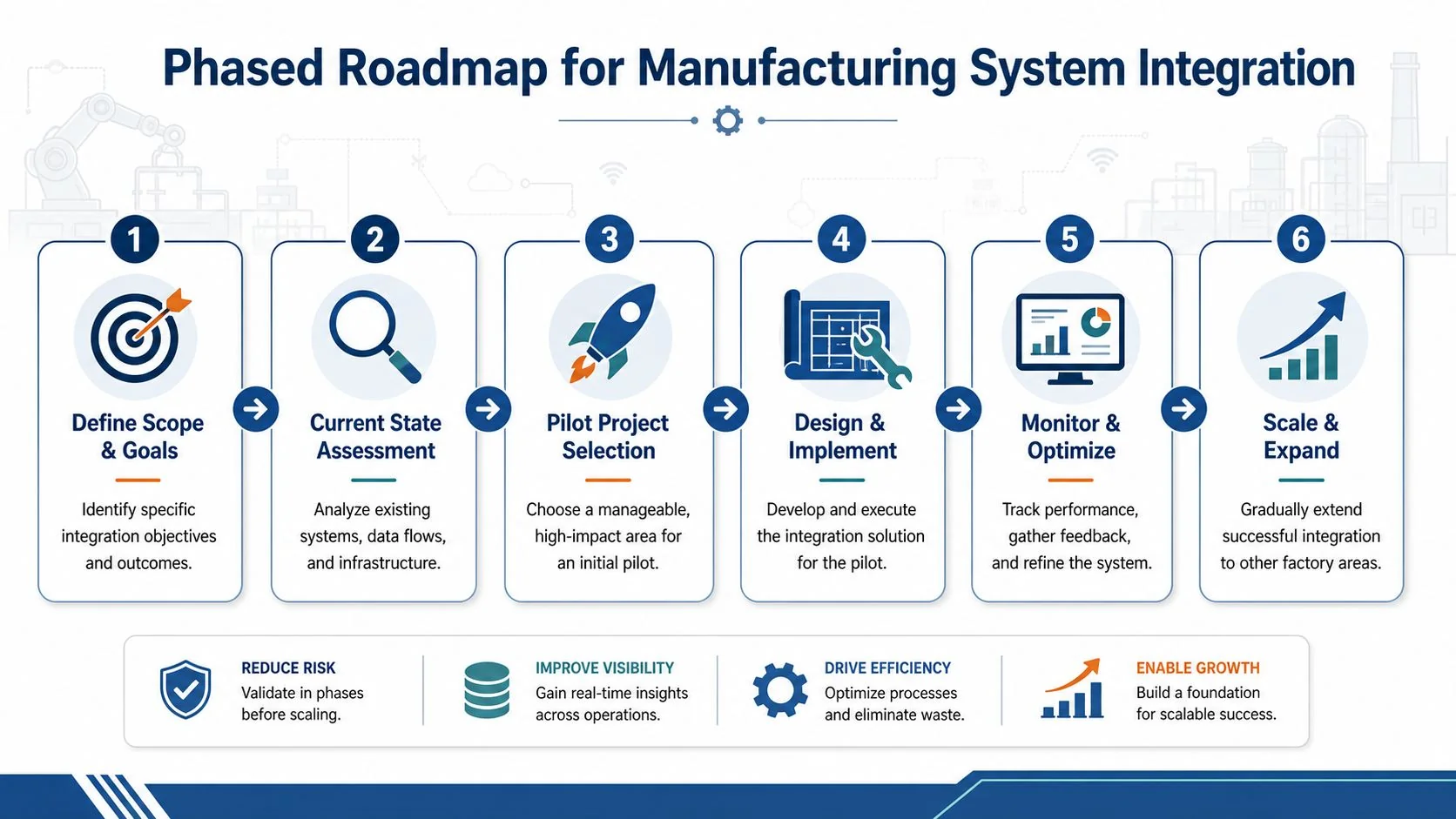
The most reliable path is phased execution. Plants that try to integrate everything at once usually stall under scope, custom work, and internal disagreement over priorities. Plants that pick one high-value connection and prove value tend to build momentum faster.
Well-executed manufacturing system integration can reduce changeover times by 45% and improve overall equipment effectiveness by 20% to 30%, and Hasit Vibhakar's analysis of manufacturing systems integration notes that starting with a single high-value connection helps teams measure and demonstrate ROI before scaling. For AI leaders, that's the right operating model because it builds the data foundation one validated use case at a time.
Start with one problem that operators care about
A workable roadmap looks like this:
- Choose a painful business problem. Unplanned downtime on a constrained asset, unstable changeovers, or recurring quality escapes are good candidates because production teams already care about them.
- Map only the required systems. If the target is downtime reduction, you may only need PLC states, alarm history, maintenance records, and MES order context.
- Define success before implementation. Decide who will judge the outcome, what operational behavior should change, and how the plant will verify that improvement.
- Build the minimum integration path. Avoid broad platform work until the first data flow is stable and useful.
That approach matters for AI because it keeps teams from collecting everything and learning nothing. A narrow, production-linked scope forces clarity about labels, context, latency, and actionability.
Build proof before scale
After the first integration path is live, pressure-test it in production.
- Watch data behavior: Check timestamp consistency, missing events, tag quality, and order alignment.
- Validate with operators: If the line team says the data doesn't reflect real plant behavior, treat that as a system defect, not user resistance.
- Measure operational impact: Track whether the integration improved the targeted workflow, not just whether data is arriving.
- Reuse what worked: Standardize connectors, naming, event models, and governance controls before expanding to the next line or use case.
Start small enough that the team can finish, but choose a problem important enough that success changes budget conversations.
What doesn't work is running a "pilot" with no path to operational ownership. If no one owns the interface, the data definitions, and the business response process, the pilot becomes another isolated digital artifact. For AI in manufacturing, a phased roadmap de-risks both integration and model deployment because each step proves data quality and operational relevance before scale.
Conclusion From Integrated Data to Actionable AI
Manufacturing system integration is where smart factory claims either become operational reality or collapse into disconnected projects. The plants that get value from digital initiatives don't treat integration as a side task for IT. They align architecture, data pathways, ownership, and plant workflows so production systems can exchange reliable information without constant manual reconciliation.
The practical pattern is consistent. Use a structured architecture. Choose integration patterns based on the decisions the plant needs to make. Govern the data before building models on top of it. Roll out in phases that solve real production problems and prove value in terms operations leaders respect.
According to WJARR on principles for successful manufacturing integration, organizations that implement system integration successfully establish clear requirements, strong data governance, and phased approaches. For AI in manufacturing, those principles are foundational because they ensure models are trained on verified, consistent datasets and reduce implementation risk.
If you're evaluating where to start, don't start with the AI tool. Start with the data path that connects the relevant machine signals, manufacturing context, and business constraints for one high-value problem. Once that path is stable, AI becomes much more than an experiment. It becomes usable plant infrastructure. That's when predictive maintenance can combine PLC and maintenance context, dynamic scheduling can sync ERP demand with live shop-floor status, and predictive quality can use line-wide production data to issue alerts early enough for operators to act. For teams pursuing AI in manufacturing, that is the ultimate payoff of manufacturing system integration.
If you want to evaluate proven factory AI use cases before committing to an integration roadmap, review the documented implementations in AI for Manufacturing. It's a practical way to compare use cases, evidence quality, and measured outcomes by industry, workflow, and technology.
