Manufacturing Process Automation: A Practical 2026 Guide
Manufacturing process automation explained from the plant floor up. Core tech, real use cases, ROI, and a step-by-step implementation roadmap.
Written by AI for Manufacturing
A shift supervisor at a Tier-1 automotive supplier can spend the morning moving between three MES dashboards, an email backlog from quality, and a PLC alarm that nobody can diagnose remotely. The machines are automated, but the production process still depends on manual reconciliation, delayed decisions, and people transferring information between systems. Manufacturing process automation is the use of control systems, sensors, software, and AI models to execute, monitor, and adjust industrial processes with minimal human intervention, across discrete and process manufacturing.
Table of Contents
- What Manufacturing Process Automation Actually Means on a Plant Floor
- How Automation Evolved From the Moving Assembly Line to AI-Enabled Systems
- The Core Technology Stack Behind Modern Process Automation
- Fixed-Sequence Automation vs Feedback-Driven Process Control
- Measurable Business Outcomes From Process Automation
- High-Value Use Cases and Where to Start
- An Implementation Roadmap That Actually Holds Up
- Using a Validated Case Study Database to De-Risk Decisions
What Manufacturing Process Automation Actually Means on a Plant Floor
Automation isn't limited to robotic arms. It includes recipe management, closed-loop quality control, material tracking, alarm handling, exception workflows, and the integration between ERP and MES. A robot may complete a physical operation, but the wider process still needs to know which order is running, whether the correct material was issued, whether the result passed inspection, and what should happen when a condition falls outside the expected range.
A useful working definition separates the plant into three responsibilities:
- Execute: Controllers, drives, robots, valves, and actuators perform defined actions.
- Observe: Sensors, vision systems, historians, SCADA, and MES capture process conditions and production context.
- Adjust: Operators, control logic, optimization software, and AI models respond to deviations, constraints, and changing demand.
The distinction matters for AI projects because models need reliable signals and a safe mechanism for acting on their output. Industrial automation commonly combines PLCs, sensors, robotics, drives, and software to run and monitor production with reduced human intervention, as described in this overview of AI adoption in manufacturing.
Practical rule: If an AI system can identify a defect but can't connect that result to a work order, machine parameter, or controlled operator action, you've built analytics, not process automation.
The hardest problems often sit between systems. An ERP may hold the customer order and material requirement, while MES holds the operation sequence and genealogy. If those records don't reconcile, the plant can have excellent machine data and still produce the wrong schedule, duplicate transactions, or incomplete traceability. For someone pursuing AI in manufacturing, this vocabulary prevents a common mistake: treating automation as a hardware purchase instead of an end-to-end operating process.
How Automation Evolved From the Moving Assembly Line to AI-Enabled Systems
Modern automation is cumulative. Henry Ford's moving assembly line at Highland Park, introduced in 1913, demonstrated that synchronized machinery, standardized tasks, and flow-based production could transform manufacturing into a scalable industrial system. Ford's system reduced the time to build a Model T from 12.5 hours to 93 minutes, helped push wages to $5 a day, and cut unit costs by more than 60%, according to this history of industrial automation.
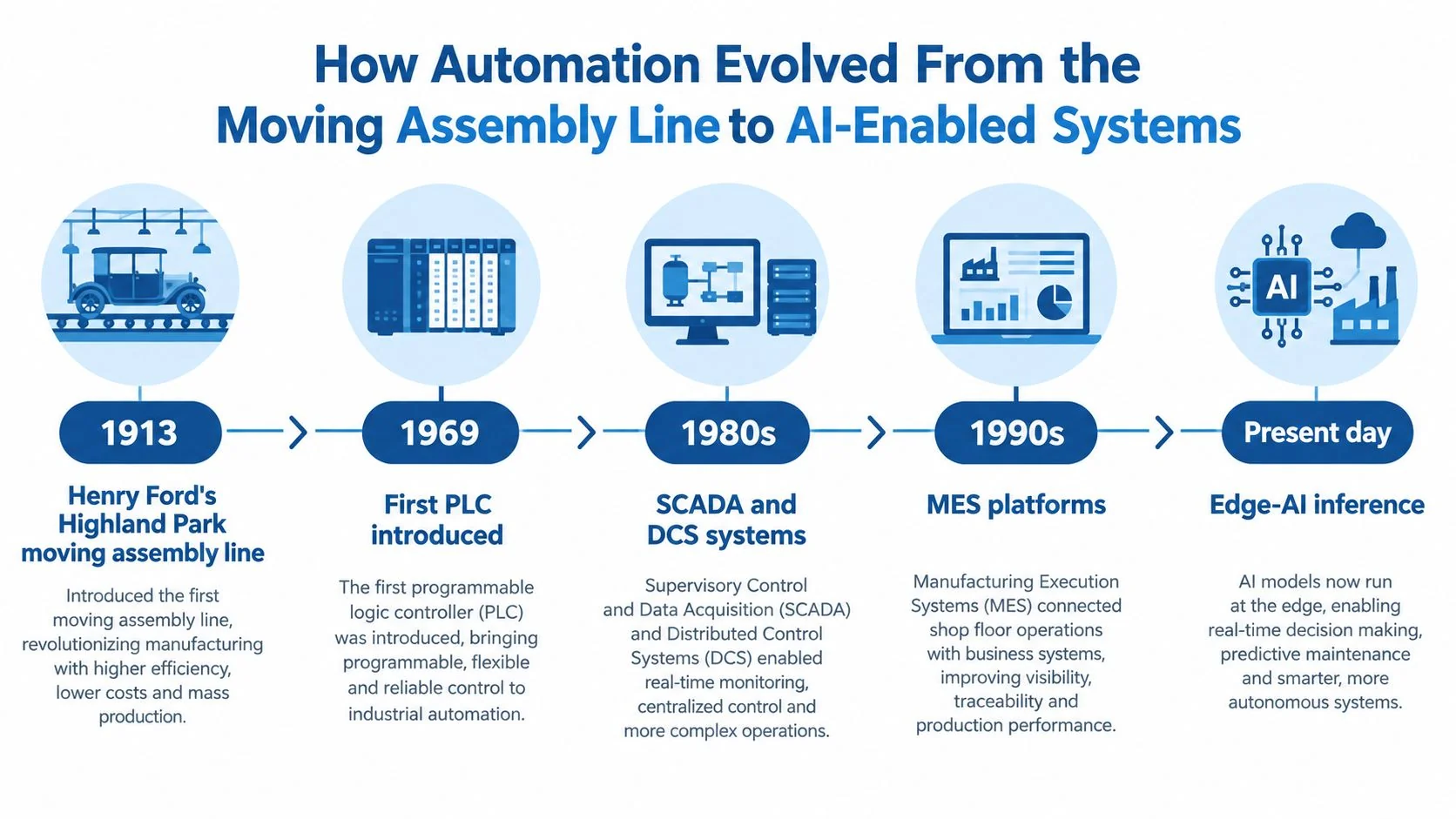
Later layers didn't erase the earlier ones. Relay logic gave way to PLCs, but PLCs still execute deterministic machine logic. SCADA and DCS systems added supervisory visibility and process control. MES platforms added production orders, work instructions, quality records, downtime reasons, genealogy, and traceability, while many plants continued using paper travelers alongside digital records.
The current shift adds edge computing and AI inference to this established stack. AI usually belongs above the fastest deterministic control layer, where it can interpret context, anticipate drift, recommend changes, or optimize a constrained process. It shouldn't replace a safety interlock or a time-critical PLC routine because a model is available.
That history explains why brownfield deployment dominates practical manufacturing work. A plant's installed controllers, sensors, networks, and MES contain operational knowledge that can't be discarded without cost and risk. AI adoption succeeds more often when teams connect and govern those layers incrementally, rather than attempting a wholesale replacement.
The Core Technology Stack Behind Modern Process Automation
A useful implementation view divides the stack into four functional tiers. Field devices generate the signals, control systems make deterministic decisions, supervisory systems organize visibility, and operations software adds production context and intelligence.
| Level | Function | Typical Systems | Latency Budget | AI Fit |
|---|---|---|---|---|
| Field | Measure and actuate physical conditions | Sensors, actuators, vision, RFID, IO-Link | Physical process dependent | Data source and local anomaly signals |
| Control | Execute deterministic logic and interlocks | PLCs, DCS, drives, safety controllers | Millisecond-level for critical loops | Constrained inference and recommendations |
| Supervisory | Present status, alarms, and historical trends | SCADA, HMI, historians | Near real time | Contextual monitoring and operator support |
| Operations and intelligence | Coordinate production and optimize outcomes | MES, APS, data platforms, ML services | Seconds to planning horizons | Quality, maintenance, energy, throughput |
At the field level, sensors, actuators, motors, valves, VFDs, encoders, switches, and drives capture or execute physical actions. A manufacturing AI model can't compensate for missing tags, inconsistent units, or sensors that aren't calibrated. The industrial automation stack overview shows why machine signals need to be joined with MES context such as work orders, product genealogy, quality results, and downtime reasons.
PLCs and DCS controllers remain the right place for deterministic control. Supervisory systems expose alarms and trends to operators, while MES connects production execution to orders, instructions, quality, and traceability. The practical boundary is often defined through ISA-95 concepts and OPC UA communication, particularly when teams need consistent information exchange between plant assets and enterprise applications. A detailed explanation of OPC UA for manufacturing communication is useful when designing that integration layer.
The ERP-MES boundary deserves special attention. ERP knows what the business wants produced, while MES knows what the plant can execute and what happened. AI scheduling, quality optimization, and material decisions fail when those two representations disagree.
Fixed-Sequence Automation vs Feedback-Driven Process Control
A fixed-sequence cell follows predetermined steps. A bottling line may use a timer-based indexing wheel to cap bottles at a constant rate, then rely on a downstream reject sensor to expose deviations. The sequence is explicit, repeatable, and easy to validate, but it doesn't understand why a cap failed or anticipate that equipment behavior is changing.
Feedback-driven control continuously measures process variables and adjusts the actuator command. Temperature, pressure, viscosity, torque, and speed can be regulated through PID or model-based loops. An extruder, for example, can adjust heating and speed in response to melt-temperature changes caused by raw-material variation, rather than running the same command regardless of the measured result.
| Dimension | Fixed-Sequence Automation | Feedback-Driven Process Control |
|---|---|---|
| Decision basis | Predetermined steps and conditions | Measured process variables |
| Typical example | Timed indexing and capping | Temperature or pressure regulation |
| Main strength | Repeatability and predictable logic | Compensation for variation and drift |
| Typical failure | Deviation appears downstream | Bad sensors or unstable tuning |
| AI placement | Limited, mostly monitoring | Prediction, optimization, and adaptive tuning |
The distinction determines whether an AI project is properly scoped. Sequence logic rarely benefits from machine learning when the rules are already explicit. Feedback-driven processes can benefit when a model anticipates drift, compensates for sensor lag, or recommends settings across product changeovers.
Teams pursuing AI in manufacturing should classify the process before choosing a model. If the actual problem is an undocumented sequence or a faulty interlock, machine learning adds complexity without solving the cause. If the process has measurable variation and a controllable response, an AI layer may improve the existing feedback loop, provided operators can override it and the system has a safe fallback.
Measurable Business Outcomes From Process Automation
Capital reviews are easier when automation is framed around margin per machine-hour, not a promise to remove headcount. The plant leader needs to connect each measure to a decision, an owner, and a financial consequence.
A real-time OEE program illustrates the connection. OEE combines availability, performance, and quality, so instrumentation turns those components into continuously captured variables instead of end-of-shift estimates. In a Brazilian eyewear assembly study, integrating IoT, Big Data, and Cloud Computing across three work centers reduced unplanned stops and improved average efficiency by 12.3% in 7 months, as reported in the Brazilian Journal of Operations and Production Management study.
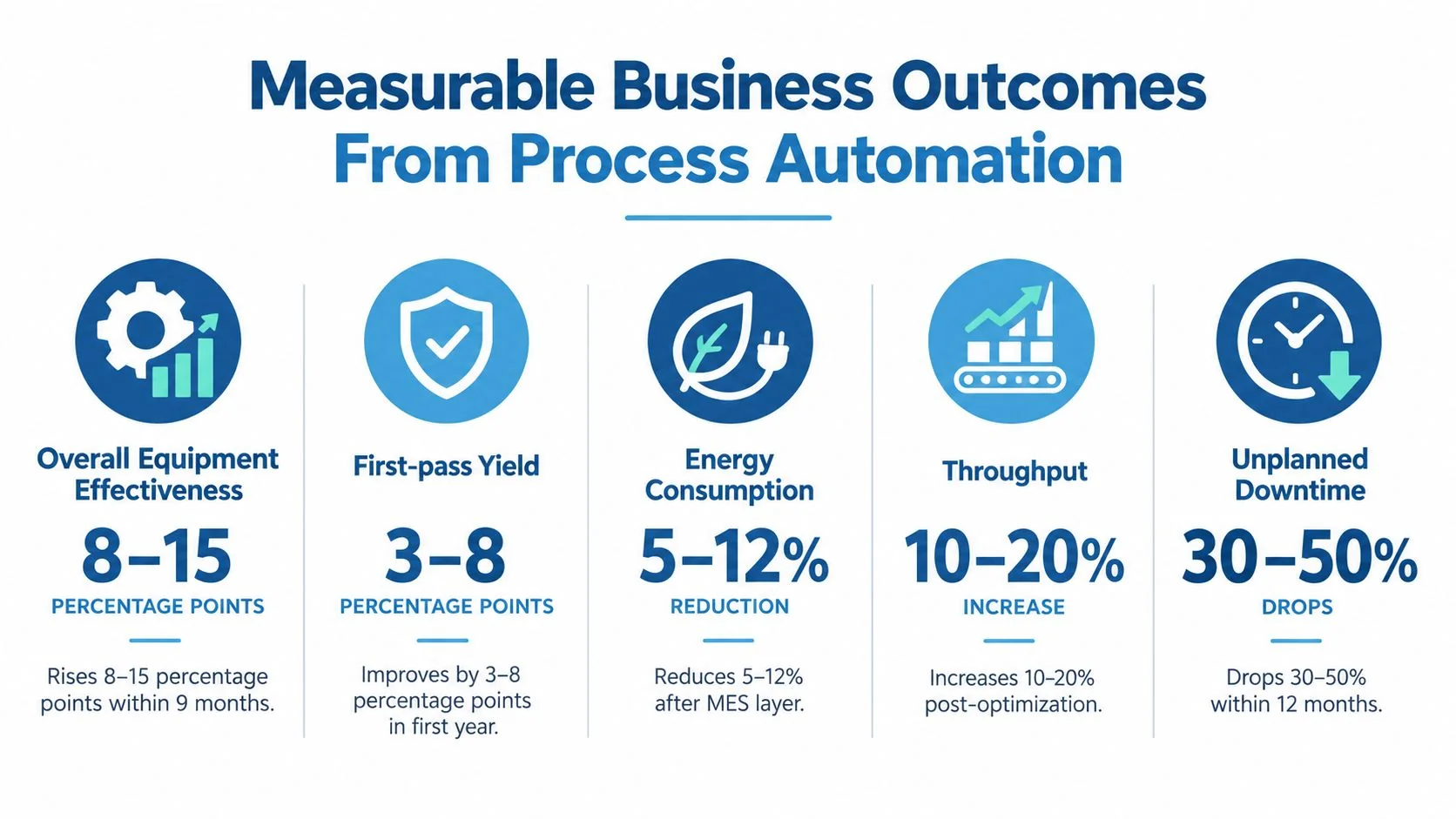
A second study of a large metal-mechanical company reported an 8% productivity increase in the last semester after implementing MES and OEE. The project targeted a 12% annual productivity lift and a 10% reduction in non-quality, with reduced downtime, improved resource use, and better traceability identified as mechanisms, according to the MES and OEE implementation study.
Use the measures operationally:
- OEE: Change daily-standup priorities and expose the bottleneck.
- First-pass quality: Control scrap, rework, and customer-claim exposure.
- Energy per unit: Inform utility budgets and equipment operating decisions.
- Downtime attribution: Separate maintenance causes from material, quality, and scheduling losses.
- Scrap cost per shift: Quantify the economic effect of parameter changes.
The value appears when the metric changes a decision. A dashboard that reports downtime without assigning a reason won't create improvement. An OEE measure tied to a stoppage code, owner, and corrective action can.
High-Value Use Cases and Where to Start
Start with the use case that has existing instrumentation, a well-understood failure mode, and one operations manager accountable for the result. That usually means a constrained machine or cell, not an enterprise-wide orchestration program.
Visual inspection is a practical first candidate when manual inspection is inconsistent or sampling leaves defects undiscovered. A camera, lighting setup, defect taxonomy, and reject mechanism create a clear path from detection to action. The model still needs disciplined image labeling, recipe control, and an escalation route for uncertain classifications.
Predictive maintenance fits rotating equipment when vibration, temperature, current, or acoustic signals already exist. The objective isn't a generic failure prediction. It is a usable maintenance decision, such as creating an inspection task, checking a component, or changing the operating envelope. Teams can use this guide to frame the predictive maintenance use case around actionability rather than model accuracy alone.
Robotic palletizing can be worthwhile when ergonomic risk, inconsistent end-of-line handling, or staffing constraints create an immediate operational priority. It doesn't require the same data maturity as autonomous scheduling, but it still needs product identification, case presentation, safety validation, and recovery procedures for jams.
Higher-value opportunities require deeper integration:
- Closed-loop quality: Adjust process parameters from in-line measurements, with guarded limits and operator approval.
- Energy optimization: Coordinate utilities, heaters, motors, and production state instead of optimizing one asset in isolation.
- Autonomous scheduling: Reconcile orders, capacity, material availability, changeovers, and constraints across ERP and MES.
The pattern is consistent. Near-term wins sit close to reliable data and a clear owner. The most strategic opportunities sit at system boundaries, where data plumbing and exception handling usually take longer than model development.
An Implementation Roadmap That Actually Holds Up
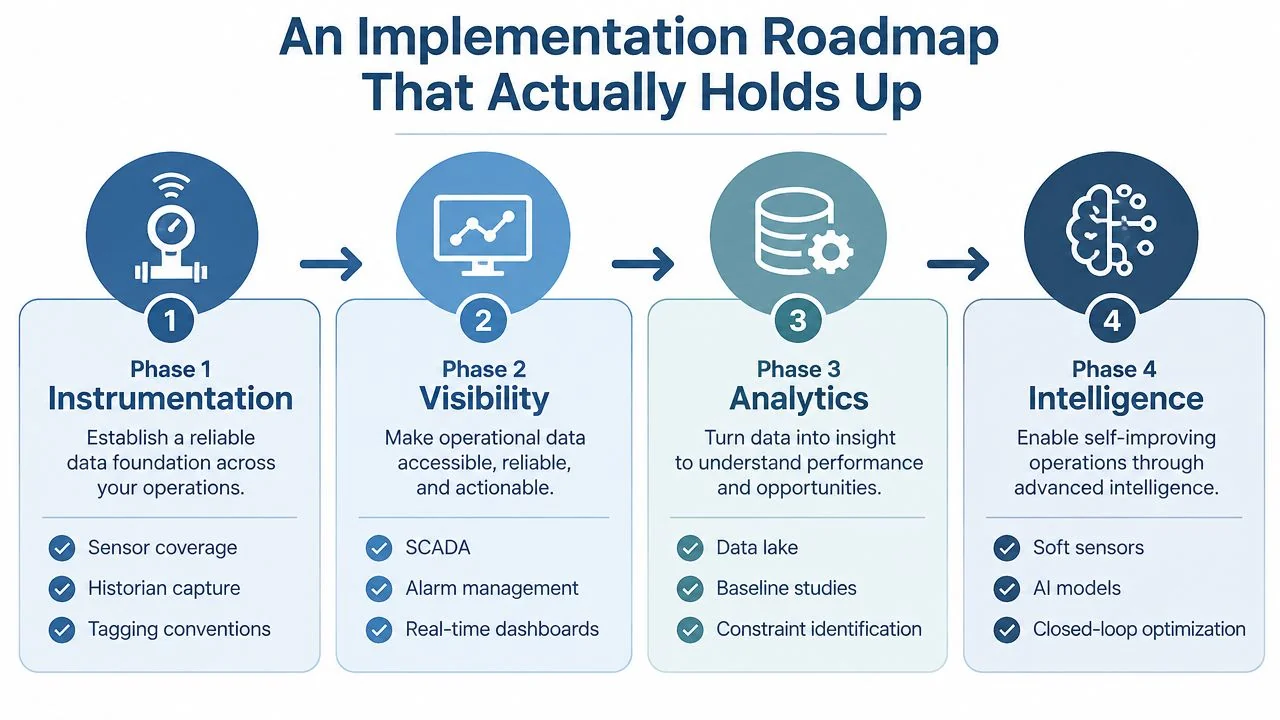
A durable roadmap moves from instrumentation to visibility, analytics, and intelligence. Each phase needs a go/no-go gate, a named owner, and a rollback path.
Phase one builds trustworthy signals
Inventory sensors, PLC tags, historian coverage, and units of measure. Define naming conventions and record when tags change. The gate is not the number of connected devices. It is whether the data is complete enough to support a specific operational decision.
Phase two stabilizes visibility
Repair PLC and SCADA handshakes, standardize alarm states, and reconcile ERP orders with MES execution records. Track data completeness and downtime attribution accuracy as go/no-go measures. If operators still classify most losses as “unknown,” an AI model will learn the reporting problem rather than the production problem.
Phase three tests intelligence on one constrained line
Run the model in shadow mode before allowing it to influence control. Compare first-pass yield delta, mean time to detect, operator override rate, and model drift against a defined baseline. Set explicit rollback criteria, such as unsafe recommendations, unacceptable override frequency, or missing input data.
Phase four expands orchestration
Connect cells only after the single-line proof has held through two full production cycles. Verify OEE, energy per unit, and scrap cost per shift, then test how the system handles missing data, schedule changes, material substitutions, and equipment recovery.
Deployment discipline: A pilot is successful only when the plant can operate it during an abnormal condition, not just during a clean demonstration.
Big-bang deployments fail because they combine unresolved data definitions, system integration, operator workflow, and model validation in one release. A one-line proof creates reusable standards, but only if the team documents overrides, rollback decisions, maintenance ownership, and the conditions under which automation must defer to a person.
Using a Validated Case Study Database to De-Risk Decisions
Vendor proposals usually explain the technology more clearly than the operating conditions. A validated case-study database helps close that gap by allowing teams to compare deployments by industry, process type, automation tier, use case, and reported KPI before approving capital.
Start with the decision, not the vendor:
- Choose the target metric. Define whether the project aims to change OEE, defect rate, downtime, traceability, energy use, or another operational outcome.
- Filter for comparable conditions. Match process type, equipment class, production pattern, and integration depth. A vision system on a highly instrumented line may tell you little about a line with manual records.
- Compare documented deployments. Review two or three relevant examples. Extract the sensors, control systems, MES connections, workflow changes, and reported result.
- Pressure-test the proposal. Ask the vendor to explain differences between its benchmark and the documented operating conditions, including ERP-MES handoffs and exception handling.
- Record the baseline. Preserve assumptions, source evidence, ownership, and unresolved data gaps so the next plant or line does not restart the research.
This process does not remove uncertainty. It makes the uncertainty visible and usable. Separate vendor-reported outcomes from independently documented measurements, then note whether the result depended on operator intervention, custom integration, or ongoing model maintenance.

AI for Manufacturing's case-study database provides searchable records of manufacturing AI implementations, including use cases, technology classifications, industries, measured outcomes, and source links. Used with plant data, it supports an evidence review rather than a feature comparison.
The database becomes more useful as each validated deployment informs the next scoping decision. That matters at the ERP-MES boundary, where inconsistent transactions, unclear exception ownership, and difficult maintenance often limit results more than the selected model. A case study should therefore be tested against the plant's actual interfaces and recovery procedures, not copied as a target outcome.
Reliable manufacturing process automation programs begin by mapping the process, defining the handoffs, and identifying where exceptions stop production. Teams can then assess predictive maintenance, machine vision, quality optimization, energy control, or scheduling intelligence without displacing deterministic systems that keep production safe. Select one constrained line, define its measurable decision and rollback criteria, and validate the integration pattern before scaling.
Bring plant data and the target KPI into a structured assessment. Choose a line with existing instrumentation and clear ownership, document the ERP-MES handoffs that block action, then test one use case in shadow mode. Scale only after operators, maintenance, and engineering can support it during normal and abnormal production.
