Manufacturing Data Collection Guide for AI-Driven Factories
Master manufacturing data collection with actionable guidance on sources, architecture, quality, KPIs, and vendor evaluation to power AI in modern factories.
Written by AI for Manufacturing
Manufacturing data collection is the structured capture, time-stamping, contextualization, and storage of production, equipment, process, quality, and labor data so a plant can monitor operations, control variation, and support downstream analytics. For teams pursuing AI, it matters because models only work when the underlying factory data is timely, trustworthy, and tied to real operating conditions. One number reframes the urgency: as of 2025, 29% of manufacturers report using AI or machine learning at the facility or network level, while 23% remain in the pilot stage, which tells you data infrastructure is no longer a side project but a gating requirement for deployment (manufacturing analytics adoption data from Mordor Intelligence).
The mistake I still see is treating manufacturing data collection as a reporting exercise. It isn't. It's an operational design decision that determines whether you can train a defect model, detect machine drift early, or trust a maintenance alert enough to act on it.
Table of Contents
- Introduction to Manufacturing Data Collection
- Defining Goals and Core Concepts
- Comparing Common Data Sources
- Mapping Transmission and Storage Architectures
- Ensuring Data Quality and Governance
- Analyzing Key KPIs and Measurement Strategies
- Implementation Roadmap and Vendor Evaluation
- Conclusion and Next Steps with AI for Manufacturing
Introduction to Manufacturing Data Collection
Manufacturing data collection covers the systems and methods used to capture what happened on the shop floor, when it happened, and under what conditions. That includes machine states, process settings, production counts, quality outcomes, operator inputs, material traceability, and events such as downtime or changeovers. For AI, the key issue isn't just capture. It's whether the data preserves causal context well enough to support prediction and intervention.
Plants usually start with one of two motives. They either want visibility, such as better downtime tracking or yield reporting, or they want action, such as predictive maintenance, defect prevention, or adaptive process control. AI belongs in the second group. That means your manufacturing data collection design has to answer a harder question than "Can I see the signal?" It has to answer "Can a model use this signal to improve a decision in time?"
Practical rule: If a data point can't be tied to a machine, product, process step, batch, or time window, it probably won't help an AI system make a reliable production decision.
That's why mature plants think beyond dashboards. They build a data layer that can support real-time monitoring, historical analysis, and feedback into operations. If you're pursuing AI in manufacturing, manufacturing data collection isn't an upstream IT task. It's the first operational capability you need to get right.
Defining Goals and Core Concepts
Most data collection projects fall short because the plant never decided what the data was supposed to improve. Better AI outcomes come from sharper goals, not broader collection.
Start with the operating objective
Three goals matter most on the factory floor:
- Reliability improvement: collect machine state changes, alarms, run hours, and failure context so maintenance models can separate normal wear from emerging faults.
- Quality improvement: collect process conditions and inspection outcomes together so engineers can trace which variables drive defects.
- Process optimization: collect cycle-level production data, changeover states, and bottleneck signals so planners and supervisors can tune flow, not just observe it.
For AI work, each goal maps to a different model family. Reliability data supports failure prediction and maintenance prioritization. Quality data supports defect prediction and process adjustment. Flow data supports anomaly detection, scheduling support, and line balancing.
Focus on causal data, not just descriptive data
A common mistake is relying too heavily on summary metrics such as OEE alone. OEE is useful, but it doesn't explain why output or quality changed. AI systems need the variables that influence the outcome.
Process parameter data is where that usually starts. In manufacturing, temperature, pressure, speed, and tool wear serve as primary causal variables for defect generation, and a 5°C deviation in molding temperature can increase scrap rates by 12% to 18% when not compensated by real-time feedback loops (manufacturing process parameter guidance from Intelycx). That matters for AI because a model trained only on final scrap counts will tell you what went wrong too late. A model trained on process parameters can help you prevent the defect.
Keep the basic concepts straight
A practical manufacturing data model usually includes:
| Concept | What it tells you | Why it matters for AI |
|---|---|---|
| OEE | Combined view of availability, performance, and quality | Good for operational benchmarking, weak as a sole model input |
| SPC | Statistical control of variation over time | Helps identify drift and label abnormal process states |
| Event data | Downtime, changeovers, alarms, interventions | Essential for failure context and sequence analysis |
| Parameter data | Setpoints and measured process conditions | Strongest input for root-cause and defect models |
| Outcome data | Yield, defects, rework, throughput, maintenance events | Required for labeling and validation |
Plants get better AI results when they collect the variables that can explain an outcome, not just the KPI that reports it afterward.
Comparing Common Data Sources
Not all shop-floor data sources are equal. Some are rich but messy. Some are clean but too narrow. The best AI programs don't chase every source at once. They pick the smallest source mix that can answer a real production question.
What each source is good at
The six sources I evaluate first are sensors, PLCs, MES, SCADA, quality systems, and manual logs. Each contributes something different.
| Data Source | Typical Data | AI Use Cases |
|---|---|---|
| Sensors | Vibration, temperature, current, acoustic signals, pressure | Predictive maintenance, anomaly detection, process monitoring |
| PLCs | Machine states, counters, interlocks, cycle signals, setpoints | Downtime analysis, sequence modeling, machine behavior prediction |
| MES | Orders, routing, work-in-progress, genealogy, labor events | Scheduling support, traceability models, cross-line optimization |
| SCADA | Supervisory states, trends, alarms, operator interactions | Process drift detection, alarm analysis, control-room visibility |
| Quality assurance systems | Inspection results, SPC records, pass/fail data, measurements | Defect prediction, quality classification, parameter-to-outcome modeling |
| Manual logs | Reason codes, observations, shift notes, failure descriptions | Context enrichment, labeling, maintenance triage |
Sensors often give the highest-value raw signal for AI, especially when the machine controller is inaccessible or incomplete. PLCs are usually stronger for deterministic machine states and production sequencing. Quality systems matter because they create the labels that let you train and validate models instead of just plotting trends.
How to choose the right mix
For legacy-heavy plants, retrofitting every asset into a modern stack is usually the wrong first move. A more practical path is selective overlay.
In 2025, 40% of new AI implementations in mid-market factories used non-invasive sensor overlays such as acoustic sensors, vibration tape, or current clamps to capture machine health without full PLC integration, and those approaches reduced deployment time by 6 months and costs by $150K per line (legacy asset data capture examples from Acerta). For anyone pursuing AI in manufacturing, that's the difference between getting a pilot into production and getting stuck in a capital approval loop.
A simple decision pattern works well:
- Use PLC data when you need machine state truth, counts, and sequence timing.
- Add non-invasive sensors when you need health signals from older assets or don't want to touch controls.
- Pull quality data early if the use case involves yield, defects, or parameter tuning.
- Keep manual logs, but use them as contextual annotations, not as the primary operating record.
When a plant starts with the highest-value causal source instead of the easiest available source, model performance usually improves faster and integration risk drops.
Mapping Transmission and Storage Architectures
The architecture matters because AI projects fail in two opposite ways. Some plants send everything upstream and drown in noise. Others filter too aggressively and lose the event context needed for training and root-cause work.
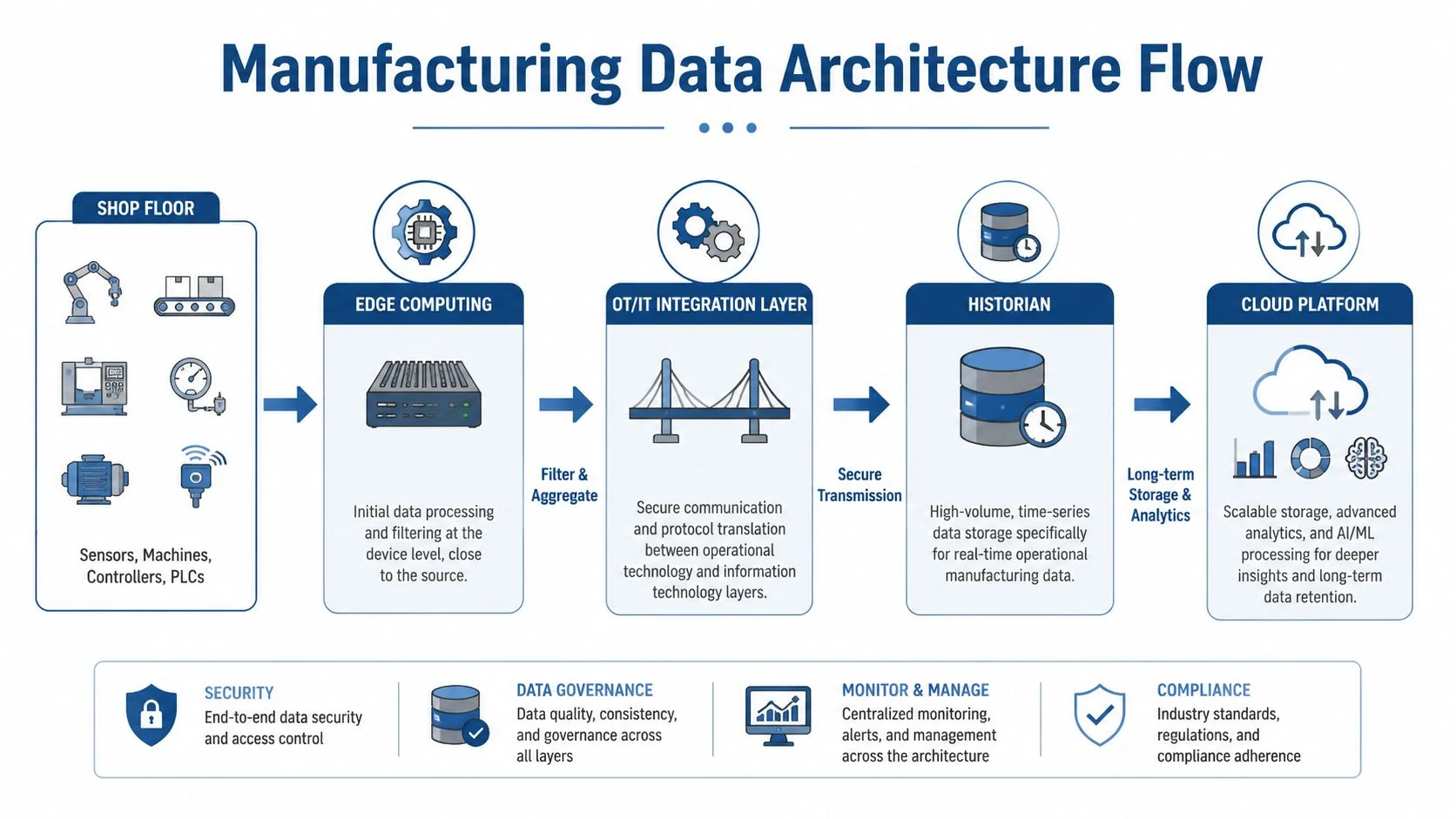
The market trend reflects how central this stack has become. The global Shop Floor Data Collection Software market was valued at $2.84 billion in 2025 and is projected to reach $6.12 billion by 2033 at a 10.2% CAGR, driven by demand for real-time equipment monitoring and anomaly detection (shop floor software market outlook from DataHorizzon Research). That growth makes sense. Without a coherent pipeline from edge to storage, AI use cases stay trapped in pilot mode.
Where filtering should happen
The cleanest architecture usually follows four layers.
- Edge computing handles initial processing close to the machine. At this stage, the goal is to normalize high-frequency signals, compute basic health features, and filter out obvious junk.
- OT/IT integration translates protocols, enforces secure communication, and keeps industrial systems from becoming direct dependencies of enterprise applications.
- Historian storage preserves time-series operational data for engineers who need replay, trend analysis, and high-resolution event history.
- Cloud or central analytics platforms support longer retention, multi-site aggregation, model training, and heavier analytics workloads.
This pattern works because not every AI task has the same latency need. A local anomaly alert may need near-real-time processing. A cross-site quality model can tolerate more delay if the contextual data is complete.
Architecture choices that help AI
A few design choices consistently pay off:
- Preserve raw and derived forms: keep the original signal where possible, then store engineered features separately so data scientists can revisit assumptions.
- Attach business context early: machine IDs, product codes, work orders, and shift boundaries should travel with the data, not get added later by spreadsheet reconciliation.
- Use the historian for operations truth: don't treat cloud storage as a replacement for operational history that engineers use day to day.
- Separate inferencing from archival paths: the path for live alerts should stay lean, while the training path can be broader and slower.
If your plant is working through OT/IT design questions, this overview of manufacturing system integration approaches is a useful complement to the architecture decisions above.
Ensuring Data Quality and Governance
The biggest misconception in manufacturing data collection is that more data automatically creates more value. It doesn't. Poorly structured, low-context data creates data debt, and that debt shows up as storage sprawl, brittle pipelines, and AI models that don't generalize outside a single line or shift.
Why more data can hurt
A neglected but important reality is that 60% to 70% of collected factory data is discarded before analysis due to poor quality or lack of context, and excessive, low-fidelity data can increase infrastructure costs by 30% while diluting AI model accuracy (manufacturing data debt analysis from Worximity). For AI teams, that should change the question from "How do we collect more?" to "Which data is trustworthy enough to survive into model training?"
The damage usually starts with missing context. A vibration trace without machine identity, maintenance state, or production mode is hard to label. A quality result without lot, cavity, operator, or process settings is even worse. Teams think they have data. What they have is disconnected evidence.
Cleaner, contextualized data usually beats larger noisy datasets in production AI, especially for maintenance and quality use cases.
Governance rules that actually hold up
Good governance in a factory isn't bureaucratic. It's operational.
- Define ownership: maintenance owns asset condition fields, quality owns inspection labels, operations owns production state and reason codes.
- Standardize timestamps: choose one plant-wide time standard and enforce it across PLCs, sensors, historians, and business systems.
- Set tolerance rules: decide what level of missingness is acceptable for each use case. A dashboard can survive gaps that a control-oriented model can't.
- Label events consistently: downtime reason codes, defect classes, and maintenance interventions need stable vocabularies.
- Audit data lineage: engineers should be able to trace a KPI or model feature back to the source system and transformation rule.
The practical goal is simple. Every important record should answer four questions clearly: what happened, where, when, and under what operating condition. If your data can't answer those, AI won't rescue it.
Analyzing Key KPIs and Measurement Strategies
KPIs are useful only when they drive a measurement plan. For AI projects, that means defining formulas first, then deciding what raw signals you need to compute them reliably.
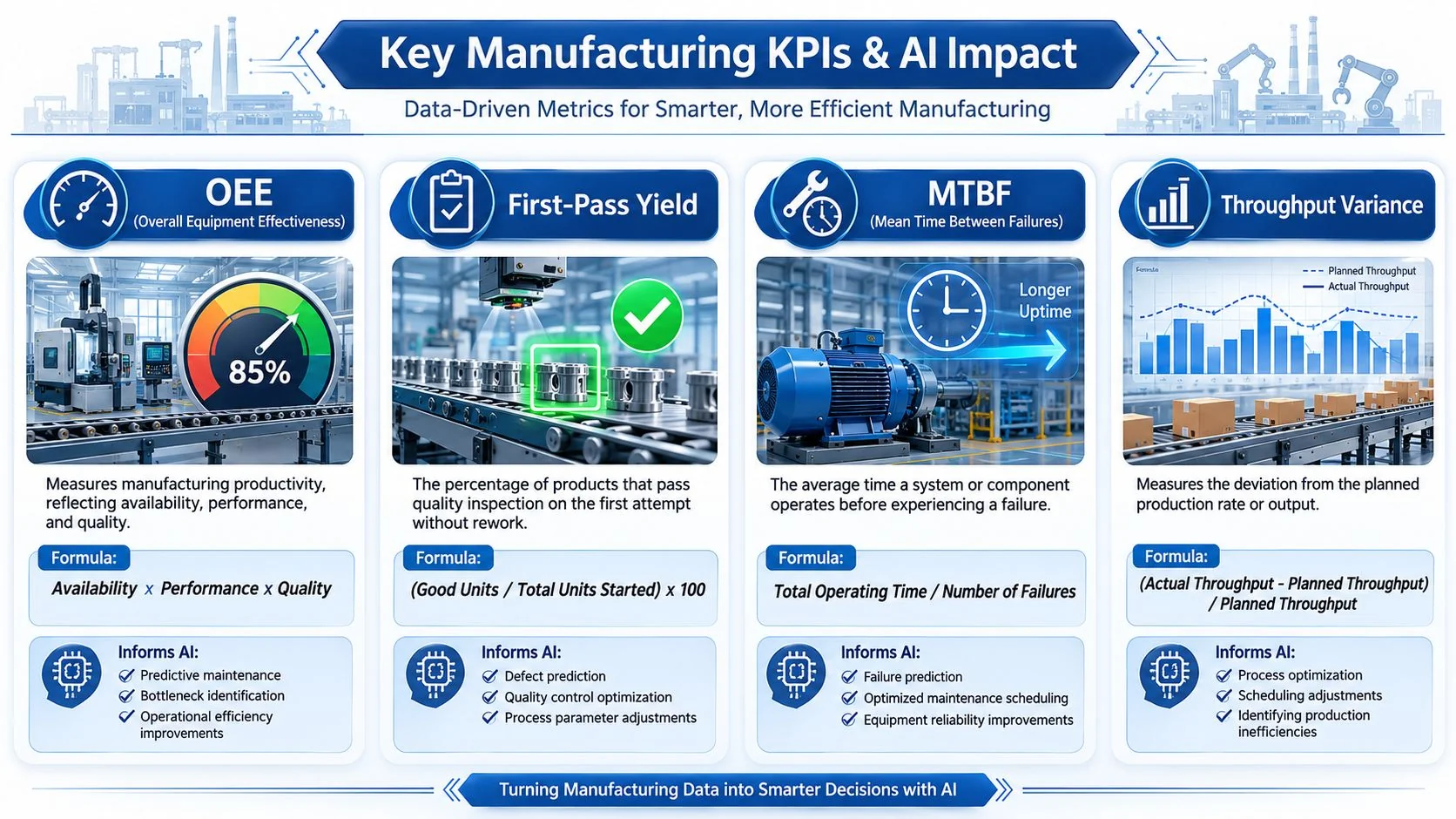
Use formulas to define data requirements
The core KPI set is still practical:
- OEE = Availability × Performance × Quality
- First-Pass Yield = (Good Units / Total Units Started) × 100
- MTBF = Total Operating Time / Number of Failures
- Throughput Variance = (Actual Throughput - Planned Throughput) / Planned Throughput
These formulas tell you what to collect. OEE requires run states, ideal cycle assumptions, and quality counts. First-pass yield requires a clean distinction between initial good output and rework. MTBF requires failure event definitions that maintenance and operations both accept. Throughput variance requires a trustworthy planned rate, not a rough target from a whiteboard.
Match measurement cadence to model purpose
The wrong sampling strategy creates either blind spots or bloat.
- High-frequency signals fit asset health and fast process diagnostics.
- Event-based capture fits downtime, alarms, and maintenance actions.
- Lot or batch-level capture fits traceability and many quality workflows.
- Shift and order-level aggregation fits management reporting, but it's rarely enough for model training.
For teams linking operations metrics to AI outcomes, this overview of manufacturing quality metrics is useful because it helps connect line KPIs to model validation logic.
A final rule matters here. If a KPI will later be used to judge model success, compute it from governed source data, not from presentation-layer dashboard logic. Otherwise the model and the plant end up arguing over which number is real.
Implementation Roadmap and Vendor Evaluation
Most plants don't need a giant rollout plan. They need a short sequence with tight scope, clear ownership, and a use case that can survive contact with reality.
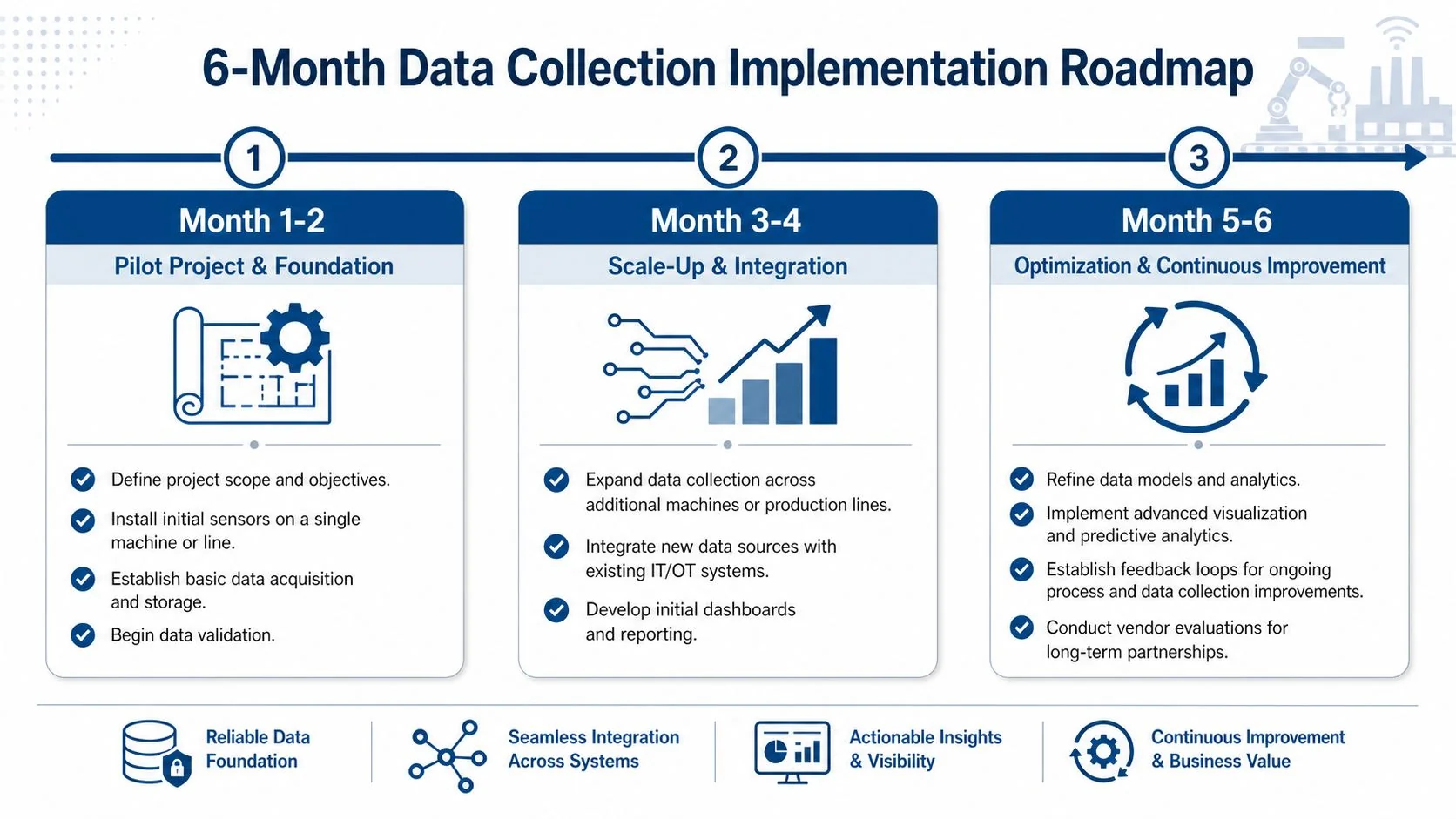
A practical six-month sequence
Months 1 and 2 should stay narrow. Pick one line, one machine family, or one quality bottleneck. Install the minimum sensing and connectivity needed, stand up basic storage, validate timestamps, and test whether operators and engineers trust the event stream.
Months 3 and 4 are where weak designs usually crack. Expand to adjacent assets, connect quality or maintenance context, and confirm that IDs, naming conventions, and event semantics still hold across equipment. This is also the point to decide which transforms belong at the edge and which belong centrally.
Months 5 and 6 should focus on operationalizing insight. Build dashboards that supervisors will use, define intervention rules, and start measuring whether the data is good enough for prediction rather than just visualization.
A six-month roadmap works only if the pilot is disciplined:
- Choose one business outcome: scrap reduction, downtime reduction, or process stability. Don't mix all three.
- Define a data acceptance test: before talking about AI, verify event completeness, clock alignment, and contextual fields.
- Review with operators weekly: they catch false states and bad labels faster than any integration team.
What to ask vendors before signing
Vendor evaluation should be technical and operational, not just commercial.
Ask these questions:
- How do you connect to legacy assets? If the answer assumes modern PLC access everywhere, the rollout risk is high.
- Where is data filtered and stored? You need clarity on edge processing, historian compatibility, and cloud dependencies.
- How are labels and context handled? Quality, order, and maintenance context shouldn't require custom spreadsheet workarounds.
- Can the system support predictive workflows later? A reporting-only tool often creates rework when the AI team arrives.
If predictive maintenance is one of your target use cases, this guide to manufacturing predictive maintenance helps frame the vendor questions around actual downstream model requirements.
Conclusion and Next Steps with AI for Manufacturing
Strong manufacturing data collection isn't about collecting everything. It's about collecting the right signals, preserving context, and designing a pipeline that operations can trust. The practical levers are clear: start from a use case, prefer causal variables over summary-only reporting, avoid data debt, and use non-invasive sensing when legacy assets would otherwise block progress.
For teams planning next steps, AI for Manufacturing is useful because it lets you review documented factory AI implementations by use case, technology, industry, and vendor in one place. You can use the database to compare evidence, narrow vendor shortlists, and see how others structured pilots before committing budget.
That closes the loop back to AI. Predictive maintenance, defect prediction, adaptive control, and quality optimization all depend on the same foundation: manufacturing data collection that is timely, contextualized, and operationally usable. If the data layer is weak, AI stays in pilot mode. If the data layer is designed well, AI has a real chance to improve production decisions on the floor.
