Machine to Machine M2M Communications in Manufacturing
Learn how machine to machine M2M communications power factory AI, from protocols and architecture to security, use cases, and real implementation results.
Written by AI for Manufacturing

Machine to machine communications is the autonomous exchange of data between devices, sensors, controllers, and applications without human intervention in the communication process. On the factory floor, that matters because AI cannot infer, predict, or control anything until machine data is already flowing reliably across the plant network. Statista's historical view shows why this stopped being a niche topic years ago, with about 100 million M2M connections in 2012 and a forecast of more than 350 million by 2018, alongside M2M traffic that moved from more than 20 thousand terabytes per month in 2013 toward a projected more than 900 terabytes per month by 2018 (Statista's M2M topic page).
Table of Contents
- What Machine to Machine Communications Actually Means on a Factory Floor
- The Three-Layer M2M Architecture You Will Keep Seeing
- Choosing Between Cellular and Capillary Connectivity
- Where M2M Ends and Industrial IoT Begins
- Security and Identity as a Manufacturing Reliability Problem
- Evaluating M2M-Backed AI Use Cases with the AI for Manufacturing Dataset
What Machine to Machine Communications Actually Means on a Factory Floor
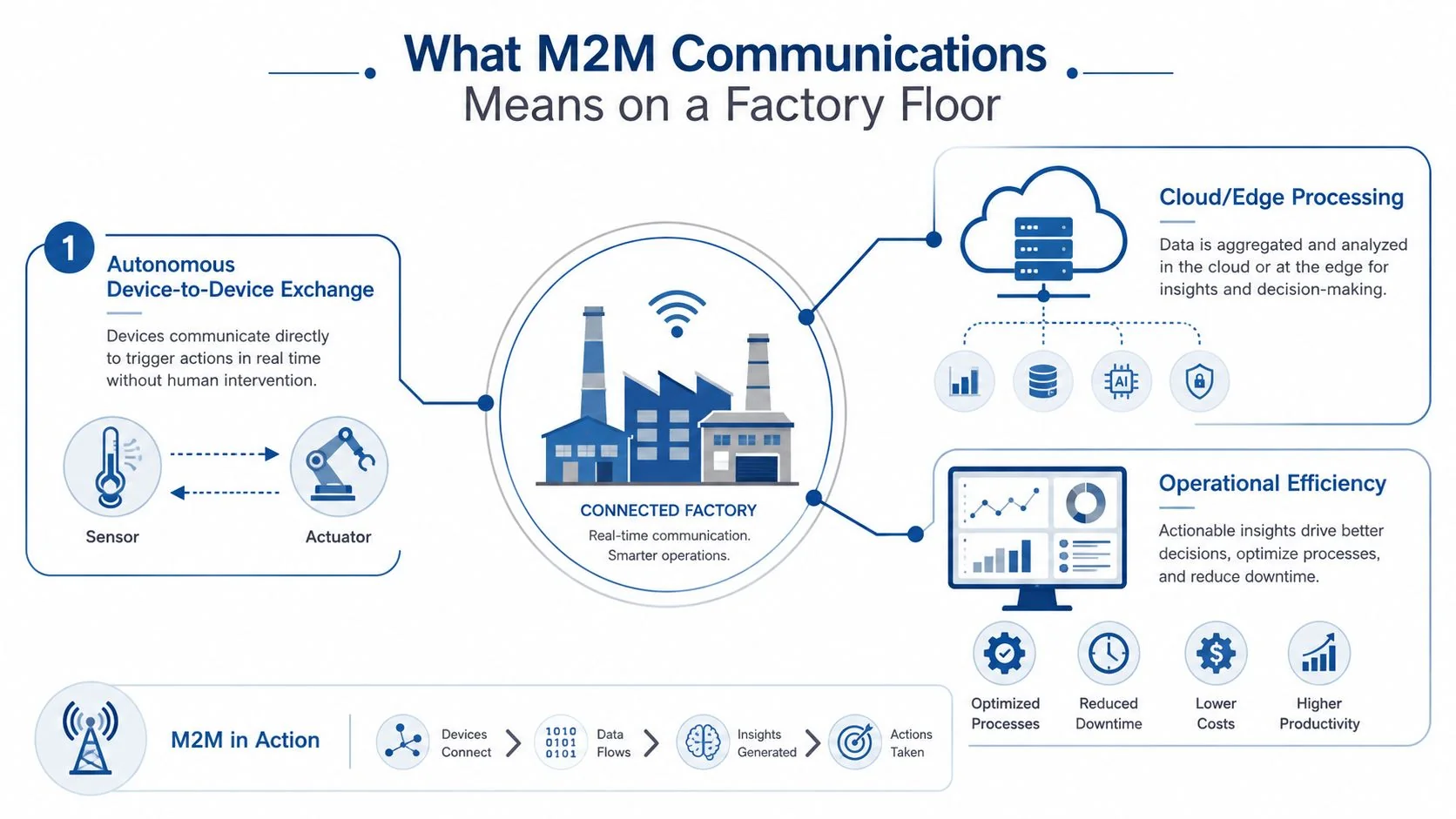
M2M communications is data communication in which machines exchange information without human interaction or intervention in the communication process. That definition matters because it describes the operational layer every manufacturing AI system depends on. If sensors, meters, PLCs, and actuators are still waiting for a person to read a screen, copy a value, or trigger a response, the plant is not ready for closed-loop AI.
The practical definition
Regulatory material describes M2M as a technology that lets networked devices exchange information and perform actions with minimal human involvement, and IEEE frames it as the protocols, systems, and infrastructure that let devices, sensors, and embedded systems exchange data autonomously (TEC white paper on M2M communicationCommunication.pdf), IEEE topic page on M2M communications). That is the version that matters on a production line. It means a temperature sensor can push a condition change, a gateway can relay it, and a controller or application can act without waiting on a technician.
Why AI teams care first
AI in manufacturing only works when machine data is already being captured at the right point in the process and moved with enough consistency to support inference. Predictive maintenance, anomaly detection, quality inspection, and closed-loop optimization all depend on that autonomous data path. If the plant can't move a pressure reading, alarm state, or cycle event without manual handling, the AI stack becomes a reporting layer instead of an operational one.
Practical rule: if a use case depends on “someone noticing” a signal, it's not yet an M2M-ready AI use case.
That is why M2M is not a side topic. It's the part of the stack that determines whether AI will have timely data or just retrospective logs. In a brownfield plant, that distinction is usually the difference between a pilot that looks good in a dashboard and a deployment that changes maintenance behavior, line balancing, or process control.
The Three-Layer M2M Architecture You Will Keep Seeing
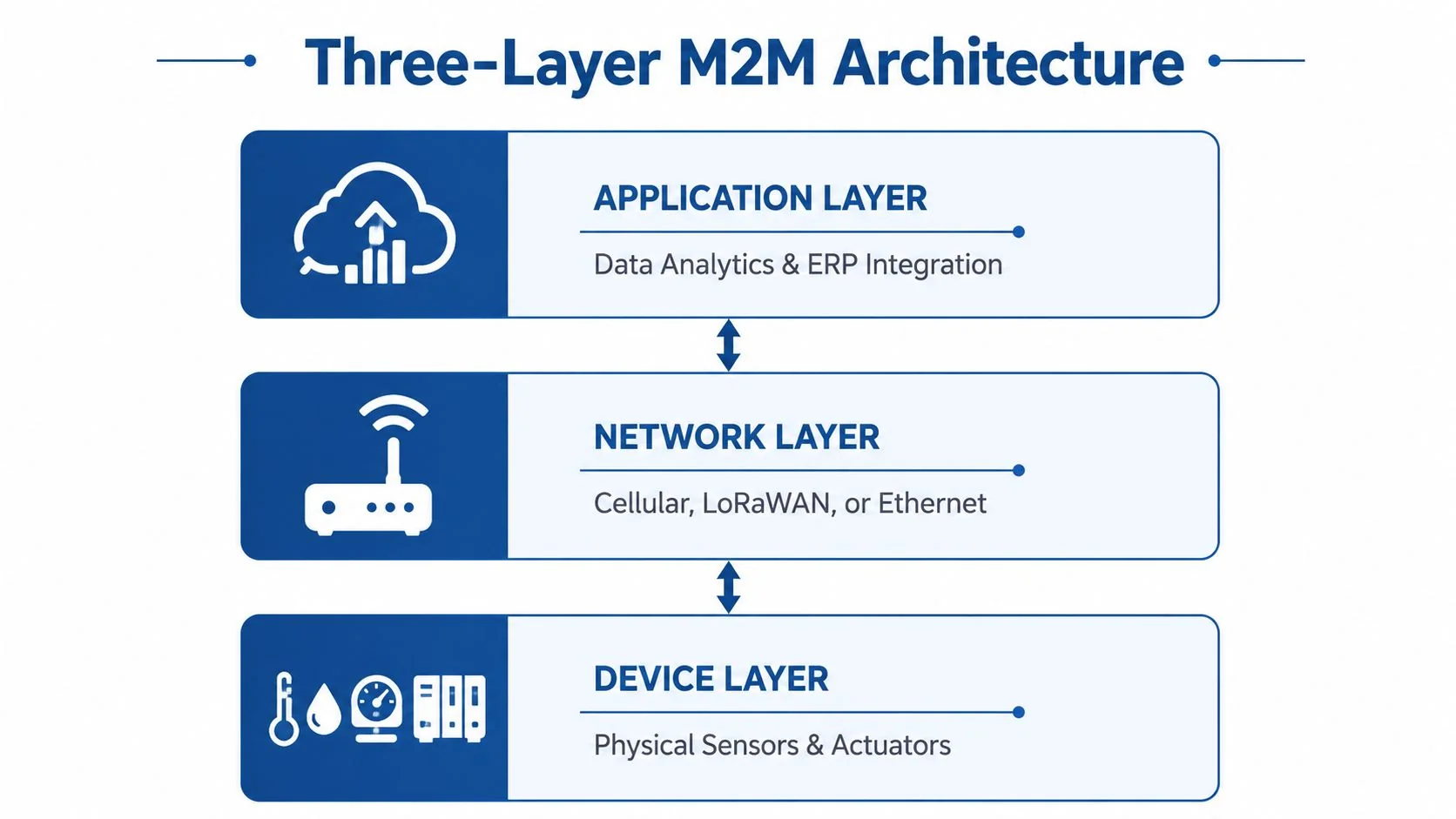
The cleanest way to think about M2M architecture is as a device, network, application pipeline. A sensor or meter captures an event. The network carries it over wired, wireless, or hybrid links. The application turns it into a decision, alert, record, or machine action. That structure is simple on paper and messy in a plant, because every layer can fail in a different way.
Device layer, where the data starts or dies
The device layer includes sensors, meters, PLCs, embedded controllers, and actuators. In practice, drift, calibration problems, and bad tagging create silent failures that AI models later misread as process variation. If the device layer is wrong, the model is trained on bad truth. No amount of analytics will fix that.
Network layer, where most brownfield pain shows up
The network layer relays data across wired Ethernet, wireless links, cellular, or hybrid paths. Gateway loss, protocol mismatch, and bandwidth constraints show up here, especially when old equipment sits beside newer controllers. The technical limits here decide whether the plant can collect data at the frequency, latency, and reliability needed for predictive quality, OEE analytics, or edge inference.
Application layer, where value is either realized or delayed
The application layer converts machine events into something a human system can use. That could be a maintenance alert, a historian entry, an ERP update, or a model input. If this layer is disconnected from OT realities, it becomes a nice dashboard that no one trusts. If it's tightly bound to actual process behavior, it becomes the bridge between telemetry and action.
What usually breaks first: not the model, the handoff between device data and plant systems.
For manufacturing AI teams, the architecture is a planning tool. It forces you to ask where the data originates, how it moves, and where it becomes operationally useful. If you can't answer those three questions for a target asset, the AI use case isn't ready, no matter how polished the vendor demo looks.
The best way to use this model is to trace one signal end to end. Start at the sensor, follow the transport path, then inspect the application that consumes it. That habit exposes the exact point where a modern AI initiative will either plug into the plant cleanly or stall at the OT/IT boundary.
Manufacturing data collection guidance
Choosing Between Cellular and Capillary Connectivity
A plant can get the connectivity decision wrong long before anyone notices it in a dashboard. Cellular M2M and capillary M2M solve different problems, and the wrong fit usually surfaces later as latency complaints, coverage holes, or integration work that nobody planned for. Industry sources classify cellular M2M as direct attachment to networks such as 2G, 3G, LTE, or 5G, while capillary M2M uses short-range links and gateways to collect traffic before backhaul (ScienceDirect topic on machine-to-machines).
Cellular M2M fits the asset, not the room
Cellular is the cleaner choice when a device needs broad coverage, simple deployment, or a direct path off-site. It also makes sense when assets sit in yards, remote utilities, fleet equipment, or locations that are painful to cable. The trade-off is carrier dependence, plus more attention to endpoint management and integration in some plants.
For isolated assets, retrofit points, and equipment that must report without relying on local plant infrastructure, cellular keeps the topology simple. That simplicity matters when maintenance crews rotate, vendors change, or the site has no stable local network to build on.
Capillary M2M fits the cell, not just the device
Capillary designs use Wi‑Fi, ZigBee, Bluetooth, Ethernet, or power-line communications locally, then push traffic through a gateway. That works when you have clusters of machines on one line, higher internal data density, or a need to keep traffic local before backhaul. The downside is gateway complexity. You end up managing local transport, aggregation logic, and the handoff to the rest of the plant stack.
That extra layer can be the right compromise in brownfield plants. It lets legacy devices stay in place while the gateway handles translation, buffering, and policy enforcement, which is often easier than rewiring the line or forcing every asset onto a wide-area link. For teams working through manufacturing system integration, this is usually where the work begins.
The protocol choice depends on payload and timing
For smaller payloads and machine events that do not need heavy transport, messaging patterns like MQTT, CoAP, SMS, and USSD often appear in M2M environments. IP-based transport is used where integration and scale matter more than simplicity. The question is not which protocol sounds modern. It is which one survives plant floor conditions, the maintenance model, and the timing requirements of the use case.
On a line with mixed vendors and uneven network quality, protocol choice is tied to failure tolerance as much as bandwidth. Some systems can buffer and retry without issue, while others need predictable delivery and clearer fault isolation. The wrong match forces controls teams to troubleshoot transport instead of process behavior.
| Criterion | Cellular M2M | Capillary M2M |
|---|---|---|
| Coverage | Better for distributed or hard-to-wire assets | Better for local zones and machine clusters |
| Latency | Depends on carrier and network path | Often better inside a plant cell, but gateway dependent |
| Power use | Can be efficient for sparse reporting, but varies by module | Can suit low-power local devices, depending on the link |
| Integration complexity | Often simpler at the edge, harder in fleet-scale management | More moving parts because of gateways and local aggregation |
| Brownfield fit | Good for isolated assets and retrofit points | Good for lines with existing local infrastructure |
For a procurement lead, the decision rule is direct. Use cellular when the asset sits outside a stable local network or needs direct reachability. Use capillary when you can collect locally and only need to backhaul consolidated events. If the plant's pain is already at the OT/IT interface, capillary can make the stack more manageable, but only if the gateway layer is governed properly.
Where M2M Ends and Industrial IoT Begins
A lot of people use M2M and Industrial IoT as if they're the same thing. They're not always the same, and that distinction matters when you're trying to justify an architecture in a brownfield plant. OECD material treats M2M as a communications layer with sector-specific deployments, while later survey work points to broader machine-type communications and the harder problems of scalability, interoperability, and security (OECD machine-to-machine communications publication).
M2M is enough when the job is narrow
If the goal is to move signals from machines to another machine, a controller, or a maintenance system, M2M can be enough. That includes simple monitoring, automated alarms, and direct control loops inside a defined operational boundary. In that setting, the value is in disciplined communications, not in a sprawling platform.
Industrial IoT becomes necessary when the scope widens
Once the plant wants cross-site analytics, cloud integration, broader human-machine interfaces, or multi-vendor orchestration, M2M becomes a subset of a larger IIoT stack. That stack usually adds more data modeling, more integration surfaces, and more governance overhead. It can be the right move, but it's expensive when the original need was just reliable machine telemetry.
Brownfield plants should start from the installed base
The core issue in legacy manufacturing is not choosing the buzzword. It's mapping existing PLCs, SCADA, short-range links, and cellular endpoints into a modern data platform without rebuilding everything. That means deciding what stays local, what gets normalized at the edge, and what should flow into central systems only after the plant has a stable data contract.
Decision rule: if the use case can be solved by reliable machine-to-machine exchange inside one operational domain, don't buy a platform built for enterprise-wide orchestration on day one.
System integration guidance for manufacturing teams
The boundary is practical. M2M is the communications layer. Industrial IoT is what happens when that layer is wrapped in broader data, analytics, and management capabilities. AI leaders should resist overbuilding at the start, because integration work multiplies fast once the plant moves from one line to many assets, or from one site to a portfolio.
Security and Identity as a Manufacturing Reliability Problem
Security in M2M is usually sold as an IT issue. On the plant floor, it behaves like a reliability issue. If a device can't be authenticated cleanly, if credentials drift across gateways, or if suppliers ship inconsistent firmware and identity behavior, operations teams end up dealing with alarms, failed audits, and poor incident response.
Authentication has to work without a person in the loop
M2M authentication means proving a machine's identity without human involvement. That sounds straightforward until you're managing thousands of endpoints across sensors, controllers, gateways, and maintenance devices. The practical challenge is not just initial enrollment. It's provisioning, rotation, revocation, and auditability over time.
Trust needs a lifecycle, not a setup wizard
A plant that treats device onboarding as a one-time task will eventually lose visibility into which device is trusted, which certificate is stale, and which gateway is acting as an exception. That's where zero-trust thinking helps, but only if it's adapted to constrained power, intermittent links, and operational uptime requirements. Security controls that assume constant connectivity can fail in exactly the environments where M2M is most valuable.
Reliability checklist for M2M identity
- Provision cleanly: assign device identity before the asset goes live, and keep the record tied to the physical machine.
- Rotate credentials deliberately: make renewal a scheduled maintenance activity, not an emergency fix.
- Revoke fast: remove trust as soon as a device is retired, replaced, or suspected of compromise.
- Audit continuously: track who changed what, when, and on which endpoint.
- Control supplier variance: require consistent onboarding behavior across OEMs and integrators.
Operational truth: unmanaged device trust hurts uptime long before it becomes a headline security event.
The interoperability angle matters here too. If one vendor's gateway handles identity one way and another vendor's controller handles it differently, incident response slows down and plant maintenance absorbs the pain. For manufacturing AI teams, secure M2M is not just about protection. It's about keeping the data stream trustworthy enough that model outputs can be acted on.
Interoperability guidance for manufacturing environments
Evaluating M2M-Backed AI Use Cases with the AI for Manufacturing Dataset
A representative plant case usually starts with a familiar mix, production-line equipment, connected sensors, PLCs, and ERP systems. The aim is often predictive maintenance, because that's where M2M data immediately affects operating cost and downtime risk. The implementation pattern that shows up again and again is simple enough to remember and hard enough to execute well, target high-value assets, define objectives, standardize data and communication protocols, and build cross-functional collaboration between IT, OT, and maintenance teams (Advanced Tech M2M manufacturing article).
What a credible evaluation looks like
The first step is asset selection. Don't start where the data is easiest, start where the plant has meaningful exposure if the signal fails. The second step is objective setting, which keeps the project tied to a maintenance or quality outcome instead of a vague modernization narrative.
Standardization comes next. If data formats, reporting frequency, and communication conventions aren't aligned, the AI layer inherits inconsistency and the model results become hard to trust. Cross-functional ownership closes the loop, because IT, OT, and maintenance all touch the same telemetry but rarely care about it in the same way.
How to judge evidence before you spend
For comparing similar plants and use cases, use the AI for Manufacturing database to filter by industry, use case, AI technology, and company size. Then compare documented implementations by the quality level attached to each record, Verified, Contributed, or Scraped, before you treat a result as a planning benchmark. That keeps vendor claims and real plant evidence in separate buckets.
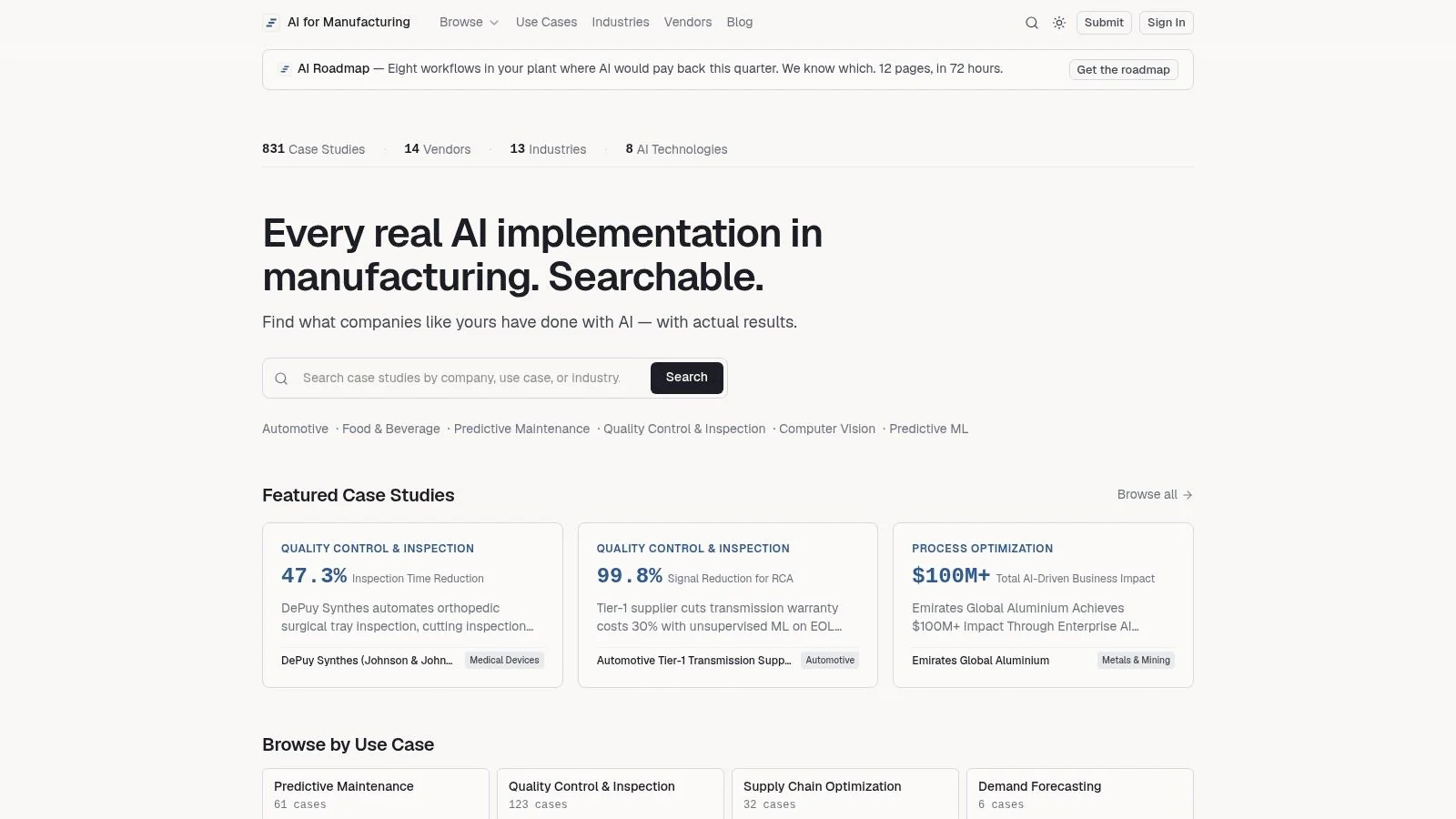
Use the database to ask one question first: which plants like yours documented a similar M2M-to-AI path, and what evidence level backs the result?
That approach is more useful than chasing the newest platform pitch. It ties M2M infrastructure to documented manufacturing outcomes, and it gives procurement and operations teams a disciplined way to check whether the telemetry layer is strong enough for the AI workload they want to add. For anyone building predictive maintenance, quality monitoring, or closed-loop optimization, the test is whether the machine data can carry the model into production without breaking trust, timing, or integration on the way.
If you're planning a factory AI rollout, start by auditing the M2M layer first, then compare your target use case against documented manufacturing implementations in the AI for Manufacturing database so you can separate promising architecture from proven plant reality before you commit budget.
