ISA 95 Standards: Complete Guide for Manufacturing AI
Master ISA 95 standards for manufacturing AI: hierarchy, models, implementation, and data preparation for ML use cases with practical guidance.
Written by AI for Manufacturing
ISA-95 is a multipart international standard for enterprise-control system integration that defines a five-level functional hierarchy and common information models for materials, equipment, physical assets, and personnel. First published in 2000, it standardizes data exchange between manufacturing operations management and enterprise resource planning systems.
The counterintuitive point is that ISA-95 isn't primarily an architecture diagram. Its lasting value is semantic. The framework was created because existing enterprise-to-control integration models were fragmented, lacking detail, and dated, and it established common models and logical boundaries to reduce integration costs and improve project success rates, as ISA explains in its overview of the standard.
For manufacturing AI, that distinction matters. A model can process large volumes of sensor readings and production records, yet still fail if one plant's “equipment status” means something different from another plant's, or if a production result can't be tied to a material, operation, asset, or person. ISA-95 provides the vocabulary that makes those relationships explicit.
Table of Contents
- What ISA-95 Standards Define for Manufacturing AI
- The Five-Level Functional Hierarchy Explained
- Object and Message Modeling for Data Standardization
- ISA-95 in Context, MES, ERP, and Modern Integration
- 2025 ISA-95 Revision and Contemporary Implementation
- Practical Implementation Steps and Common Pitfalls
- Why ISA-95 Matters for Manufacturing AI Use Cases
What ISA-95 Standards Define for Manufacturing AI
ISA-95 is becoming a semantic framework for event-driven manufacturing, not just a diagram of system layers. It defines how plants describe activities, resources, relationships, and information exchanged between enterprise systems and manufacturing operations. The framework spans Level 0 through Level 4, while its common models cover materials, equipment, physical assets, and personnel.
That structure gives AI teams a way to design usable data products before selecting a model. A predictive maintenance use case needs measurements tied to a known asset, operating state, and maintenance history. A quality model needs process conditions associated with a product, material, operation, and inspection result. A workforce model needs qualifications, assignments, and work context represented consistently instead of hidden in local spreadsheets.
In an event-driven plant, these relationships determine whether an event is useful for machine learning. A temperature event without an asset, operation, or material reference may be easy to stream but difficult to label, join, or act on. ISA-95 concepts help define the context that turns an isolated event into training data and an operational decision.
ISA-95 began as a normalization effort rather than a narrow vendor specification. The original committee work found that enterprise-to-control reference models were fragmented, lacked sufficient detail, and were outdated. ISA's objectives included reducing integration costs and improving project success through common models and logical boundaries, as documented in its historical account of ISA-95.
Why semantic consistency affects model quality
Interoperability means more than moving a message from an MES to an ERP. Systems also need a shared interpretation of that message, as explained in this discussion of what interoperability means in manufacturing.
Without shared semantics, data engineers repeatedly resolve the same questions:
- Which asset is this? A controller tag, maintenance asset, and ERP work center may use different identifiers.
- What does the result describe? A quantity may refer to a shift, operation, order, or machine counter.
- Who owns the status? ERP, MES, automation, and manual records may all claim authority.
- Which material is involved? Batch, lot, grade, and product identifiers may not align.
ISA-95 does not repair poor data automatically. It gives teams a disciplined way to define concepts, ownership, relationships, and exchange boundaries. Those decisions support feature engineering, event correlation, label creation, and model monitoring, whether the deployed system runs in a cloud platform or a local industrial data environment.
The Five-Level Functional Hierarchy Explained
The five-level hierarchy gives AI practitioners a useful map of where manufacturing facts originate and where operational decisions are made. It describes function and responsibility, not a mandatory physical arrangement of software.
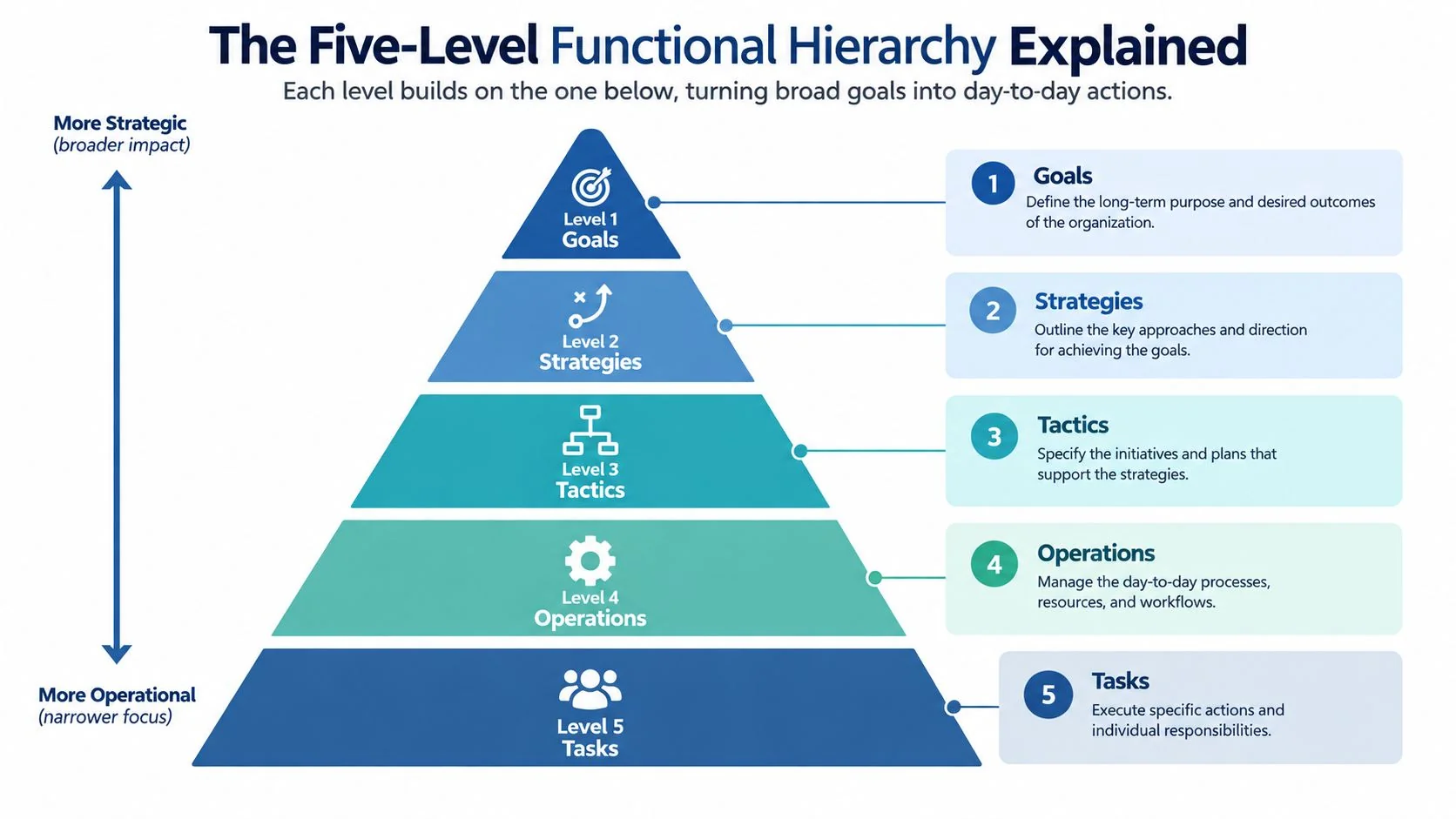
| Level | Functional scope | Typical data | AI relevance |
|---|---|---|---|
| Level 0 | Physical process | Material transformation, assembly, machining, handling | Defines the real outcome the model is trying to predict or optimize |
| Level 1 | Sensing and manipulation | Sensors, actuators, drives, measurements | Supplies raw signals and control inputs |
| Level 2 | Monitoring and control | PLC, SCADA, HMI, alarms, setpoints | Adds operating state, limits, and control context |
| Level 3 | Manufacturing operations management | MES or MOM workflows, maintenance, quality, production execution | Connects signals to orders, operations, work, and results |
| Level 4 | Business-related manufacturing management | ERP planning, materials, schedules, commercial constraints | Supplies demand, product, resource, and planning context |
Level 0 is the physical process itself. In a process plant, it includes transformations such as heating, mixing, or chemical reaction. In discrete manufacturing, it includes assembly, machining, and material handling. AI teams need this level because it defines the physical phenomenon behind a target such as defect formation, energy use, or throughput.
Level 1 contains sensing and direct manipulation. Temperature probes, vibration sensors, flow meters, valves, drives, and actuators produce or influence the signals used by models. A sensor value without asset identity, timestamp quality, unit, and operating context is a weak feature.
Level 2 covers monitoring and control through PLCs, SCADA systems, and operator interfaces. This level adds alarms, modes, setpoints, interlocks, and control states. Those details often distinguish a normal transient from an abnormal condition.
Level 3 manages manufacturing operations. MES and broader MOM functions connect equipment behavior with production orders, workflows, maintenance activity, quality operations, materials, and personnel. Predictive maintenance therefore needs Level 1 signals joined with Level 3 work order history, not sensor data in isolation.
Level 4 handles business-related activities needed to manage manufacturing operations, commonly through ERP. Production optimization may require Level 2 control data joined with Level 4 constraints such as planned demand, product requirements, or material availability.
Practical rule: Start every AI data map with the decision being supported, then trace the required context across levels. Don't assume the model should live at the same level as its source data.
Object and Message Modeling for Data Standardization
ISA-95 becomes most valuable for AI when its object and message models provide shared meaning across plant systems. The standard defines common information for materials, equipment, physical assets, and personnel or qualifications, plus message models for exchanges between manufacturing operations management and ERP. The OPC Foundation's ISA-95 companion specification shows how these concepts can be represented in machine-readable industrial information models.
For AI teams, this turns integration into a semantic design task. ERP and MES can align production orders, capabilities, performance, resource status, materials, and personnel instead of creating plant-specific definitions for every interface. That alignment improves data preparation by reducing ambiguity between business, operations, and control functions.
Canonical objects are feature-engineering assets
A quality model deployed across several production sites exposes the value of canonical objects. If each site defines equipment, material grade, operation status, and inspection result differently, data scientists must rebuild feature logic for each location. Shared identifiers, attributes, units, event meanings, and relationships let the pipeline use a more consistent schema and make cross-site validation more practical.
ISA-95 is often paired with machine-readable implementations such as B2MML and OPC UA mappings, as explained in this overview of the OPC UA communication protocol. B2MML supports XML-based exchange, while OPC UA provides communication and information-modeling mechanisms. Neither defines the plant's semantics for the team. Engineers still need agreement on what a material, production response, capability, or asset status means.
A practical implementation pattern is:
- Define the canonical object. Establish the identity, ownership, attributes, and lifecycle of an asset, material, order, or personnel record.
- Map local systems to it. Record how ERP, MES, PLC, historian, maintenance, and quality systems represent the same object.
- Separate meaning from transport. Choose an API, message bus, file, B2MML, or OPC UA after the information content is clear.
- Expose usable metadata. Include units, timestamps, state definitions, source system, quality status, and relationships required by ML pipelines.
Canonical objects also support event-driven plants. A status change, material movement, inspection result, or work-order update can become a usable event when its object identity and context are consistent.
Portability still depends on comparable processes, labels, sampling practices, and operating conditions. ISA-95 removes a major semantic obstacle, but disciplined feature validation remains necessary.
ISA-95 in Context, MES, ERP, and Modern Integration
ISA-95 is commonly introduced as the boundary between ERP at Level 4 and MES or MOM at Level 3, with automation and control below. That description is useful for assigning responsibilities, but it becomes misleading when teams treat the hierarchy as a rigid deployment diagram.
Modern plants may distribute functions across cloud services, edge applications, historians, message buses, APIs, and industrial platforms. A scheduling service might consume ERP constraints and shop-floor events. An edge application might calculate a condition indicator close to the machine and publish it to a central data platform. A single product may also span MES, quality, maintenance, and analytics functions.
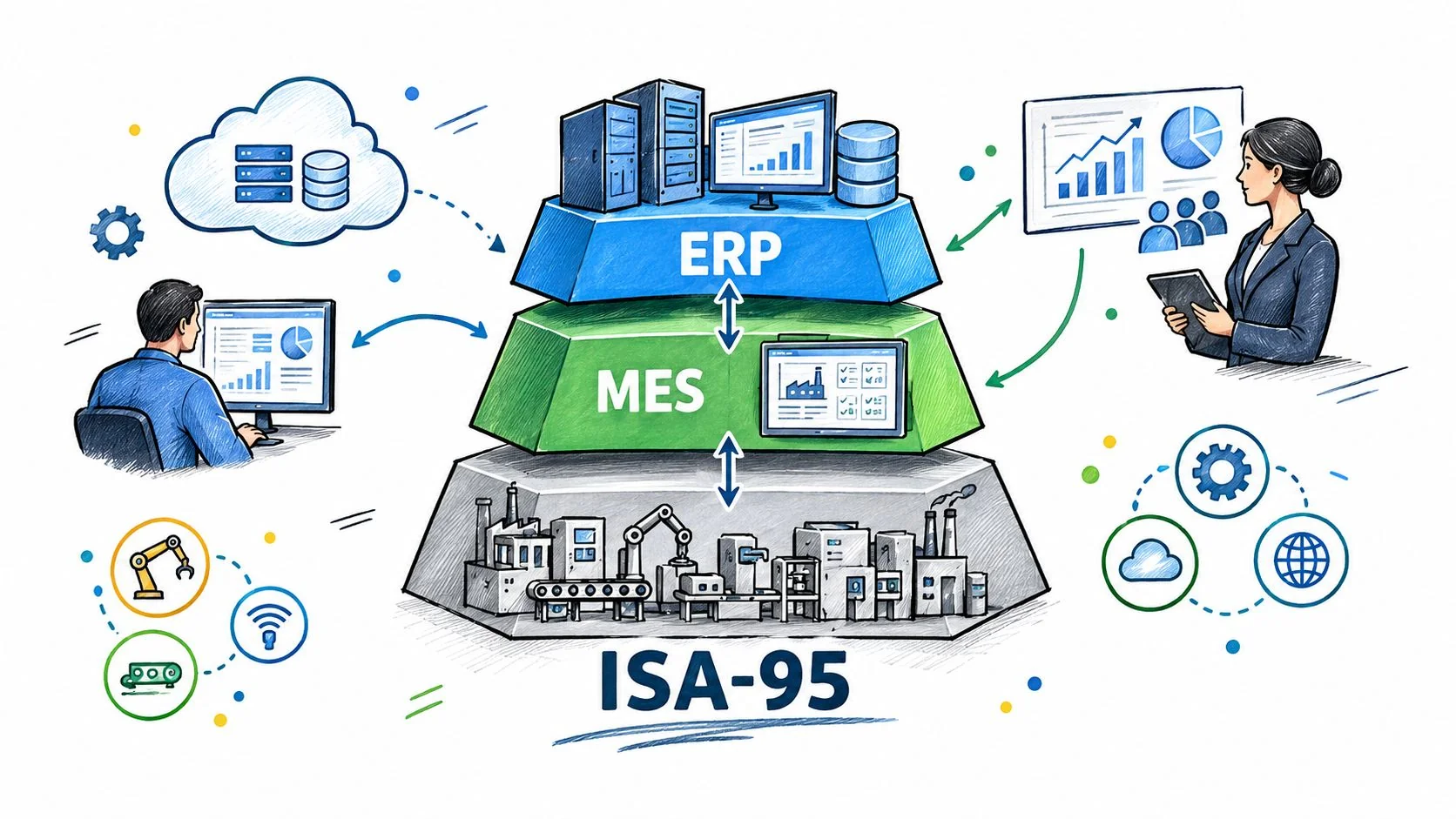
The better interpretation is that ISA-95 supplies a semantic framework for integration. A message bus can carry an order response using ISA-95 concepts. An Industrial DataOps platform can organize equipment and material context around the same model. An iPaaS can orchestrate API exchanges without forcing every application into a strict layered topology.
Architecture choice versus semantic discipline
| Rigid interpretation | Contemporary interpretation |
|---|---|
| Levels represent fixed software tiers | Levels describe functions and responsibilities |
| Interfaces are designed system by system | Events and APIs carry shared business meaning |
| Data moves mainly through predefined boundaries | Data is distributed, but ownership and semantics remain explicit |
| AI is added after integration | AI requirements influence metadata and event design early |
This approach doesn't mean boundaries no longer matter. It means teams should define who owns a decision, who owns a record, and what each event means rather than enforcing physical separation for its own sake. For a broader view of how modernisation and AI software affect factory architecture, Rite NRG's manufacturing modernisation perspective provides useful context.
A sound integration design can use ISA-95 semantics with Kafka or another message bus, REST APIs, OPC UA, an industrial historian, and cloud storage. The choice depends on latency, resilience, security, data volume, and operational ownership. Guidance on manufacturing system integration is most useful when it starts with those constraints rather than treating ISA-95 compliance as a software procurement checklist.
2025 ISA-95 Revision and Contemporary Implementation
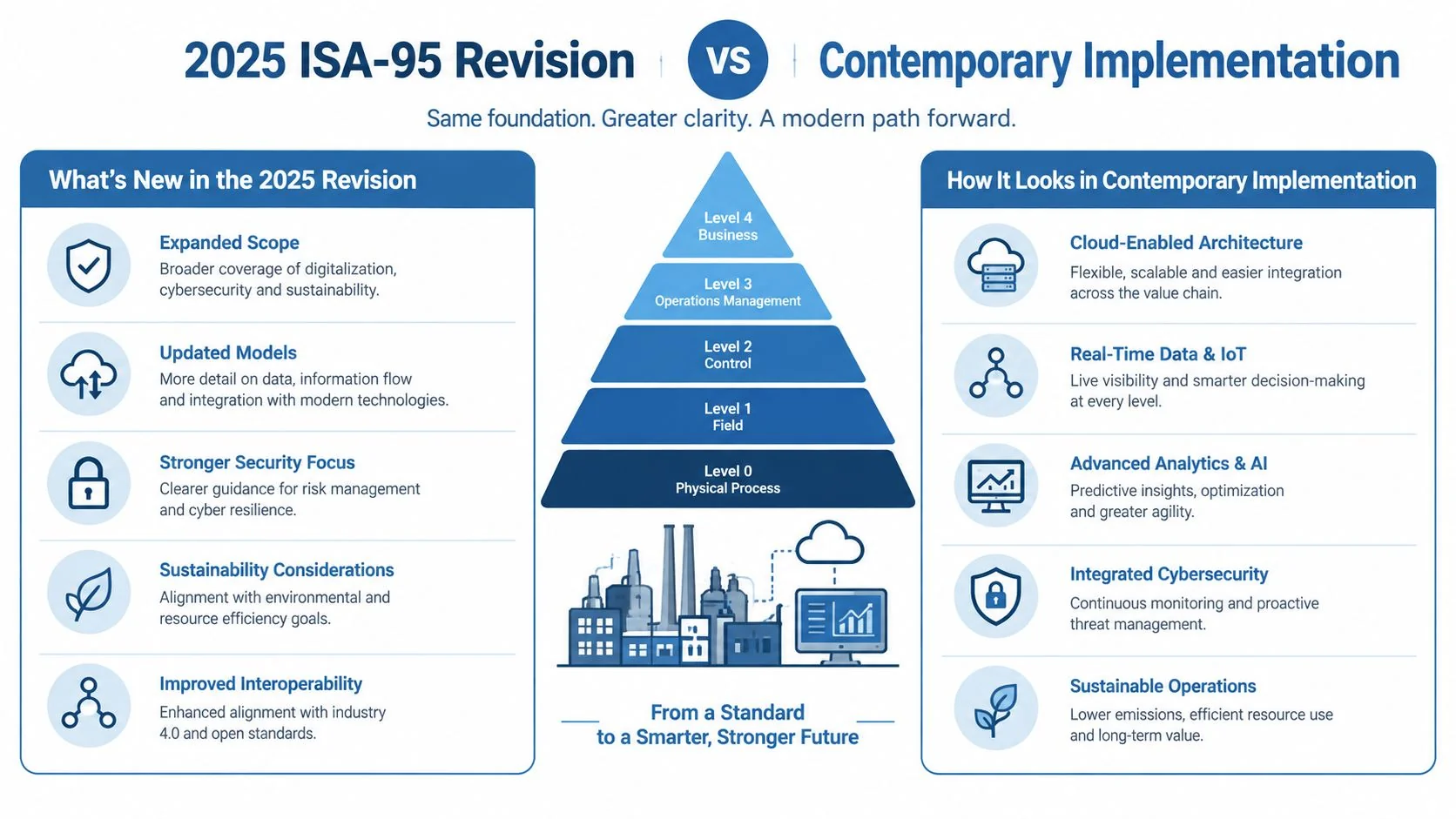
ISA-95 Part 1 was updated in April 2025, its first update since 2010, according to ISA's announcement about the revision. ISA says the revision reflects specific enterprise functions, clarifies the boundary between enterprise and manufacturing or control domains, and adds consistency with other details in the standard.
That matters because many explanations stop at the familiar five-level pyramid. The difficult implementation questions now concern event-driven plants, API-heavy estates, cloud-connected operations, and AI pipelines that need governed context across all of them.
Two implementation approaches
A traditional implementation often creates a clear chain from ERP to MES to control systems. That can work well where responsibilities are already stable, interfaces are limited, and the plant needs strong transactional control. Its weakness appears when teams force every data flow through a prescribed layer even though an event, feature, or decision logically spans several systems.
A contemporary implementation keeps the functional model but distributes technology:
- Message buses publish production, equipment, quality, and maintenance events for multiple consumers.
- Industrial DataOps adds lineage, validation, context, and governance to operational data.
- iPaaS platforms connect APIs and applications while preserving canonical object definitions.
- Cloud and edge services place computation where latency, resilience, and security require it.
- AI services consume governed features without becoming the system of record for production transactions.
The trade-off is clear. Flexible architectures scale integration patterns more easily, but they can create semantic drift if teams publish events without ownership, versioning, identifiers, and quality rules. Rigid architectures simplify responsibility at first, but they can constrain useful data flows and encourage workarounds.
The 2025 revision reinforces ISA-95's conceptual role. It doesn't turn the standard into a recipe for one architecture. It gives teams updated boundaries and functions they can apply while selecting an architecture appropriate to their plant, security model, and AI operating requirements.
Practical Implementation Steps and Common Pitfalls
Start with a production order, an asset, or a quality event that currently causes operational confusion. Trace its origin, transformations, decisions, and final record. This exposes the integration problem faster than drawing an idealized architecture.
A workable implementation checklist
- Map the current environment. Identify ERP, MES or MOM, PLC, SCADA, historian, maintenance, quality, planning, and analytics systems.
- Assign system responsibility. Decide which application owns each order status, material identity, asset record, production result, and inspection result.
- Choose a bounded pilot. Select one workflow with measurable operational value and enough cross-system context to test the model.
- Define canonical metadata. Specify identifiers, units, timestamps, states, relationships, source ownership, quality flags, and version rules.
- Test failure behavior. Check duplicate messages, delayed events, offline equipment, corrected orders, changed product versions, and retransmission.
- Scale by reusable semantics. Add lines and sites by mapping them to the existing model instead of copying custom interfaces.
Don't treat ISA-95 as a software purchase requirement. A vendor can use ISA-95 terminology while implementing only selected models, and a technically connected system can still disagree about ownership or meaning.
Design test: If two systems exchange a “production result,” can your team state exactly which order, operation, asset, material, time window, unit, and quality status it describes?
Another common mistake is enforcing strict layer boundaries in a cloud-native environment. Use the hierarchy to clarify responsibility, not to prevent an edge service from publishing a governed event to a data platform or an AI service from consuming context from several functional levels.
Data governance must begin before model training. Engage an integrator when the plant lacks cross-domain integration experience, safety constraints are complex, or multiple legacy systems need coordinated ownership decisions. Build internal capability around canonical modeling, data contracts, validation, and ML metadata so the organization doesn't outsource the knowledge it needs to operate and improve the system.
Why ISA-95 Matters for Manufacturing AI Use Cases
ISA-95 gives AI teams a practical way to identify the data needed for a use case without treating the factory as one undifferentiated data lake. The hierarchy separates physical signals, control context, operational execution, and business constraints. The object model then provides the relationships needed to join those sources.
For predictive maintenance, Level 1 and Level 2 data can describe vibration, temperature, current, alarms, modes, and control conditions. Level 3 contributes maintenance work orders, failure descriptions, inspections, operating context, and asset history. A model trained only on sensor values may detect patterns, but it won't reliably distinguish a developing failure from a planned changeover, cleaning cycle, recipe change, or known maintenance event.
For quality optimization, Level 2 process parameters can be joined with Level 3 inspection results and Level 4 material specifications or product requirements. That linkage lets engineers investigate not just whether a defect occurred, but which process conditions, material characteristics, operation, resource, and product definition were associated with it.
Modeling concepts that improve ML readiness
| AI requirement | ISA-95 contribution |
|---|---|
| Stable asset identity | Equipment and physical asset concepts |
| Traceable material context | Material and material relationship modeling |
| Operational labels | Production responses, quality records, and maintenance activity |
| Workforce context | Personnel and qualification information |
| Cross-system joins | Common messages and logical integration boundaries |
| Multi-site feature reuse | Shared semantics mapped to local implementations |
Canonical objects also support more consistent feature engineering across plants. That doesn't guarantee transfer learning or model generalization, because processes and sensors still differ. It does give data scientists a defensible starting point for comparing equivalent assets, materials, operations, and outcomes instead of rebuilding semantics at every site.
The message models reduce custom data engineering around orders, capabilities, performance, resource status, confirmations, inventory, quality, and maintenance. The practical benefit is less time spent reconciling definitions and more time validating labels, leakage risks, drift, and operational usefulness.
For evidence-based AI evaluation, the AI for Manufacturing database documents manufacturing implementations with use cases, technologies, industries, measured outcomes, standardized metrics, and source links. It can complement ISA-95 work by helping teams compare candidate use cases after their plant data has been mapped and governed.
ISA-95's dual identity as ANSI/ISA-95 and IEC 62264 reinforces its international role, while ISA's continuing updates show that the framework remains relevant beyond its original publication. The standard began as a way to normalize enterprise-control integration, but its strongest future role is as a shared semantic contract for event-driven manufacturing data.
Manufacturers pursuing AI should model the data before selecting the algorithm. Define the asset, material, operation, order, result, and responsibility boundaries first, then build the feature pipeline and choose the model. That investment gives predictive maintenance, quality optimization, process control, scheduling, and emerging AI applications a foundation they can trust.
Map one production order and one priority AI use case in your plant this week. Document the source system, owner, identifier, timestamp, status, and required context for every field, then compare the gaps with the ISA-95 concepts and the 2025 Part 1 update. Use that map to brief your operations, IT, and data teams, and turn the first semantic model into a focused pilot for manufacturing AI.
