IoT Sensors for Predictive Maintenance: Your 2026 Guide
Implement IoT sensors for predictive maintenance effectively. Explore sensor types, edge design, KPIs, & vendor evaluation for optimal results.
Written by AI for Manufacturing
IoT sensors for predictive maintenance are connected devices that collect machine-condition data from assets like motors, pumps, gearboxes, and conveyors, send that data through gateways or networks, and feed analytics or machine-learning models that predict failures before they happen. On a plant floor, the buying decision isn't “which sensor sounds advanced,” it's which signal set gives the highest diagnostic value for the asset and failure mode you care about, at a cost the plant can sustain.
Start under pressure. A line has a repeat offender, maintenance is tired of chasing alarms, and operations wants proof before approving another pilot. The right sensor strategy turns that tension into a measurable program, but only if the data pipeline, sampling choices, edge architecture, and work-order workflow are designed together.
Table of Contents
- What IoT Sensors for Predictive Maintenance Actually Mean on a Plant Floor
- Choosing Sensors by Asset Class and Failure Mode
- Sampling Rate, Mounting, and Data Quality That Survives a Pilot
- Edge, Gateway, and Cloud Architecture for Sensor Streams
- Connecting Sensor Streams to AI Models and Maintenance Actions
- Validation, Pilots, and KPIs a Reliability Team Will Sign Off On
- Vendor Evaluation Checklist and Implementation Timeline
What IoT Sensors for Predictive Maintenance Actually Mean on a Plant Floor
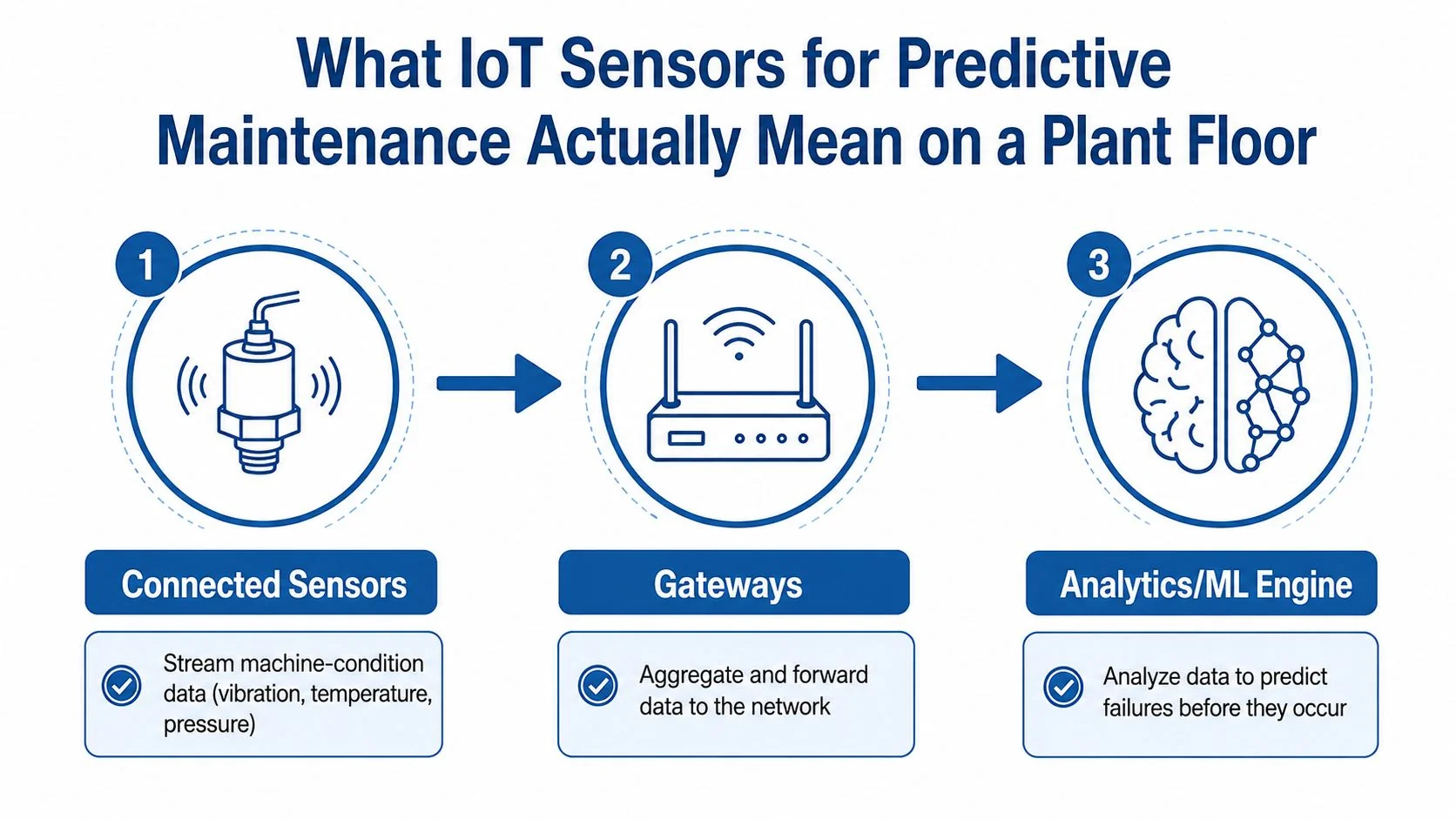
IoT-based predictive maintenance in manufacturing means connected sensors collect machine-condition data, gateways forward it, and analytics or machine-learning models predict failures before they occur. The OECD's framing is useful because it makes the point plainly, sensor data from machinery can be used to predict failure, reduce maintenance costs and downtime, and support either rule-based or ML-based analysis. That is the primary distinction on the plant floor, because the sensor is only the start of the decision chain, not the decision itself. OECD IoT report on machine sensor data and predictive maintenance
A rule-based setup compares readings against thresholds. It works when the failure mode is well understood, the operating envelope is stable, and the team needs a fast, explainable alert path. An ML-based setup learns patterns across vibration, temperature, current, or other signals, then detects degradation that a static threshold would miss. That matters for AI in manufacturing because the goal isn't just anomaly detection, it's an operational system that routes the right work to the right technician at the right time.
Practical rule: if a failure mode is obvious and expensive, start with thresholds. If the asset has messy operating states or subtle degradation, start planning for learned baselines and retraining.
The rest of the buying decision is a sequence of trade-offs. First, pick the asset class and failure mode. Then decide whether the signal should live on a sensor, an edge device, or a gateway. After that, validate whether the alert can become a work order, not just another notification. A plant manager or reliability lead usually needs one of those decisions first, so the sections below are ordered to help you jump to the part that will move the pilot forward.
Choosing Sensors by Asset Class and Failure Mode
Sensor selection is an economics problem, not a shopping list. The right question is not “what sensors do we own already,” it's “what is the cheapest signal set that catches the dominant failure modes on this asset class with enough lead time to act?”
A review of predictive maintenance sensor usage in smart factories found that vibration and temperature are the most common starting points, because they're effective for early degradation signals and real-time diagnostics. That lines up with what works in plants, vibration usually gives the earliest clue on rotating equipment, while temperature confirms friction, overload, or electrical stress. Review of predictive maintenance sensor usage in smart factories
Baseline signals and when to extend them
For motors, pumps, fans, and gearboxes, vibration is usually the first sensor to justify, with temperature as the next one when thermal drift or lubrication loss matters. For motors with electrical failure risk, current signatures add value because they can expose load anomalies and insulation or rotor issues that don't always show up clearly in simple vibration trends. For pumps and hydraulic systems, pressure often matters more than teams expect because leaks, cavitation, or valve problems can express themselves in process behavior before a mechanic hears anything unusual.
Complementary sensors make sense when they're tied to a failure mode, not when they're added because a vendor bundle looked attractive. Acoustic sensing is often stronger for friction, leaks, or impact-like events. Oil-debris or fluid-condition sensing can be valuable when wear particles or lubrication condition are the main clue. Process sensors like flow and pressure can outperform an extra vibration node on assets whose failure mode is in the process loop rather than the rotating element itself.
Rule of thumb: if two sensors tell you the same story about the same failure mode, the second one is often a cost add, not a diagnostic gain.
| Failure mode | Best primary signal | Supporting signals | Typical rotating equipment affected |
|---|---|---|---|
| Bearing wear | Vibration | Temperature, acoustic | Motors, pumps, gearboxes |
| Imbalance | Vibration | Speed, current | Fans, motors, conveyors |
| Misalignment | Vibration | Temperature, current | Motors, pumps, couplings |
| Cavitation | Pressure | Vibration, flow | Pumps |
| Gear wear | Vibration | Acoustic, oil-debris | Gearboxes, conveyors |
| Motor insulation breakdown | Current | Temperature, vibration | Motors |
The 2025 PMC review of AIoT predictive maintenance matters here because it shows the field isn't converging on one universal sensor package. Different studies use different sensing stacks and computing models, which is exactly what a practitioner should expect. The best sensor set is asset- and failure-mode-specific, and the value of another sensor point falls quickly once the main failure modes are already covered. 2025 PMC review of AIoT predictive maintenance sensor and model diversity
That's why this choice matters for AI in manufacturing. The model can't learn a meaningful degradation pattern if the sensor only captures noise, and it won't generalize if the sensor mix doesn't cover the dominant failure physics of the asset. Good sensor economics produce better labels, better features, and less wasted training time.
Sampling Rate, Mounting, and Data Quality That Survives a Pilot
Data quality is usually decided before the model ever sees a record. If the sensor is mounted poorly, sampled too slowly, or filtered badly, the pilot doesn't fail because AI is weak, it fails because the input was bad.
The main technical split is between raw waveform capture and pre-aggregated features. Raw data preserves retraining flexibility later, while features like RMS reduce storage and bandwidth now. In practice, that choice determines whether the program can evolve into a real AI system or stays locked into whatever the first vendor dashboard could compute. The edge pipeline described in the research notes, RMS, FFT, filtering, compact feature vectors, and anomaly detection before transmission, is a good example of how teams reduce network load without giving up all diagnostic structure. Edge-computing predictive maintenance pipeline with RMS, FFT, filtering, and anomaly detection
Sampling and signal integrity
For slow-speed assets, 1 kHz is often enough to establish basic condition trends. For high-speed rotating equipment and bearing-fault work, you need a much higher rate, because the sensor has to capture the frequency content where early fault signatures live. The Nyquist limit and anti-aliasing filters matter more than sensor branding, because a well-known sensor sampled badly still gives you bad data.
Mounting is the other half of the battle. Direct mounting on the bearing housing or gearbox gives a much cleaner transfer path than a loose bracket or long extension cable. Magnet mounts are useful for quick trials, but they're not the place to end a production deployment if you care about repeatability. Adhesive mounts can work in moderate environments, while stud mounting is stronger when you need stable mechanical coupling.
Practical rule: if the technician can knock the sensor loose with normal plant vibration or routine access, the installation isn't durable enough for production analytics.
The internal trade-off is usually between convenience and fidelity. Handheld spot checks are fine for a one-time audit, but they don't produce the time series needed for trend detection. In high-voltage cabinets, cable routing, shielding, and grounding deserve the same attention as the model choice, because analog noise can swamp the condition signal long before the dashboard shows anything useful.
For teams building from the ground up, a clean baseline recording is the easiest test to defend in a design review. The signal should look stable, the sensor orientation should be documented, and dropouts or spikes should be treated as installation issues, not machine behavior. If the pilot fails here, no model will rescue it.
Manufacturing data collection guidance for plant teams is a useful companion reference when the issue is less about the sensor itself and more about what the plant will do with the readings.
This matters for AI in manufacturing because retraining depends on trustworthy data history. If you only keep engineered features, you may get a cheap first deployment but lose the raw material needed for better future models.
Edge, Gateway, and Cloud Architecture for Sensor Streams
Architecture is where teams either preserve budget or burn it. The wrong design sends too much raw data to the wrong place, while the right one keeps the data useful without turning bandwidth into a hidden operating cost.
A 2026 industry guide notes that industrial IoT sensor hardware costs have fallen 85% since 2019, with a vibration node dropping from about $600 per point in 2019 to under $50 in 2026, and an average 2026 wireless vibration node price of $47. That cost compression is why architecture matters now, because sensors are no longer the only expensive part of the stack. 2026 industrial IoT sensor cost and ROI guide
Three deployment patterns
A sensor-to-cloud direct setup is the simplest path. It works for low-volume data or non-critical monitoring, but it can get expensive when you scale out to many nodes because every raw stream has to cross the network. A sensor-to-gateway aggregation pattern is usually the best pilot architecture, because the gateway can compress, buffer, and route data locally when the plant network gets noisy. On-device edge analytics makes sense when latency is critical or when the plant wants to send only alerts and compact results upstream.
For a representative plant with many wireless vibration nodes on conveyors and pumps, the gateway approach is usually the sensible default. It lets a local box handle buffering and preprocessing while the cloud handles longer-horizon storage and model development. If the architecture jumps straight to the cloud, every noisy sample becomes a network and storage problem. If it stays entirely on the sensor with no retraining path, the team may save bandwidth but lose future model flexibility.
The edge pipeline called out earlier is the practical middle ground. Running RMS, FFT, and filtering at the device, then passing only anomalous segments or feature vectors, cuts bandwidth and still keeps enough signal for diagnosis. The same source also describes using Isolation Forest at the edge before shipping only the anomalous parts upstream, which is a smart pattern when the plant needs traceability without hauling every waveform into the cloud. Edge predictive maintenance architecture with device-level features and Isolation Forest
Enterprise AI architecture guidance for plant systems is relevant here because the sensor layer has to fit the broader system, not sit apart from it. Gateways, edge inference, and cloud storage should be chosen together.
The 2026 guide also says vibration monitoring alone catches 43% of industrial equipment failures and that sensor-based condition monitoring can fall below the ROI threshold for assets valued at roughly $5,000 or more. That doesn't mean every asset deserves instrumentation, it means the architecture now supports practical deployments where it didn't before. 2026 industrial IoT sensor cost and ROI guide
This section matters for AI in manufacturing because architecture determines whether the model can scale beyond a pilot. A cheap, fully engineered-features-only stack can work, but it can also trap the team in a dead-end if raw data is never preserved for future retraining.
Connecting Sensor Streams to AI Models and Maintenance Actions
A sensor stream matters only after it reaches a model and then turns into a maintenance action. Otherwise the plant is just paying for alerts that do not change what a technician does on shift.
Model selection should follow the asset economics, not a generic sensor checklist. A low-value motor that only needs a coarse threshold does not deserve the same pipeline as a critical spindle or gearbox, and the diagnostic value of each signal has to justify its storage, inference, and review cost. That is the practical filter I use on plant deployments. Rule-based logic still has a place for simple assets, while ML-based analysis earns its keep when the failure pattern is harder to encode in fixed rules. OECD IoT report on rule-based and ML-based predictive analysis
What actually works in production
For many plants, time-domain statistics are the first layer that pays off. They are easy to explain to technicians and maintenance supervisors, and they give the model a stable base before you spend compute on richer features. Spectral work like FFT, spectral kurtosis, and envelope analysis matters when the failure mode lives in frequency content, which is common on rotating assets. If the asset has enough history, sequence models like LSTM and CNN can learn degradation patterns that are hard to capture with simple thresholds.
Isolation Forest and autoencoders are practical for anomaly detection when labeled failures are scarce. That is common in manufacturing, where normal operation is abundant and confirmed failures are limited. The model does not need perfect certainty. It needs to produce a credible alert that a planner can turn into an inspection, watchlist, or job order.
What usually breaks pilots: alerts are generated, dashboards light up, and nobody owns the work order.
The CMMS integration is where the project becomes operational. A sensor alert should map to an asset ID, severity, suggested failure mode, and a maintenance action. That mapping is where many pilots stall, because the model can be technically sound while the work process stays vague. A useful deployment also needs a feedback loop from technician findings, failed inspections, and confirmed repairs back into the training set. The planning layer, the model pipeline, and the maintenance workflow should be documented together, and the model design choices sit naturally beside the methods described in predictive maintenance model pipelines.
A low-cost prototype built around an ESP32-C6 microcontroller and a MEMS accelerometer shows that edge-based predictive maintenance does not require expensive industrial hardware to start. That matters when many assets need coverage and the sensing point has to stay inexpensive enough to justify deployment. It also reinforces a hard trade-off. If the edge device can classify enough locally, you cut bandwidth and cloud cost. If it cannot, you still preserve the raw or lightly processed stream for retraining instead of throwing away useful history.
This is the core AI-for-manufacturing point. The model is not the product, the closed loop is. If the alert does not become a work order and the work order does not feed back into the model, the plant has built monitoring, not predictive maintenance.
Validation, Pilots, and KPIs a Reliability Team Will Sign Off On
Trust is the gate between a pilot and a real rollout. Reliability teams don't sign off because a dashboard looks smart, they sign off when the system catches known issues, behaves sensibly in shadow mode, and produces maintenance-language KPIs that operations can defend.
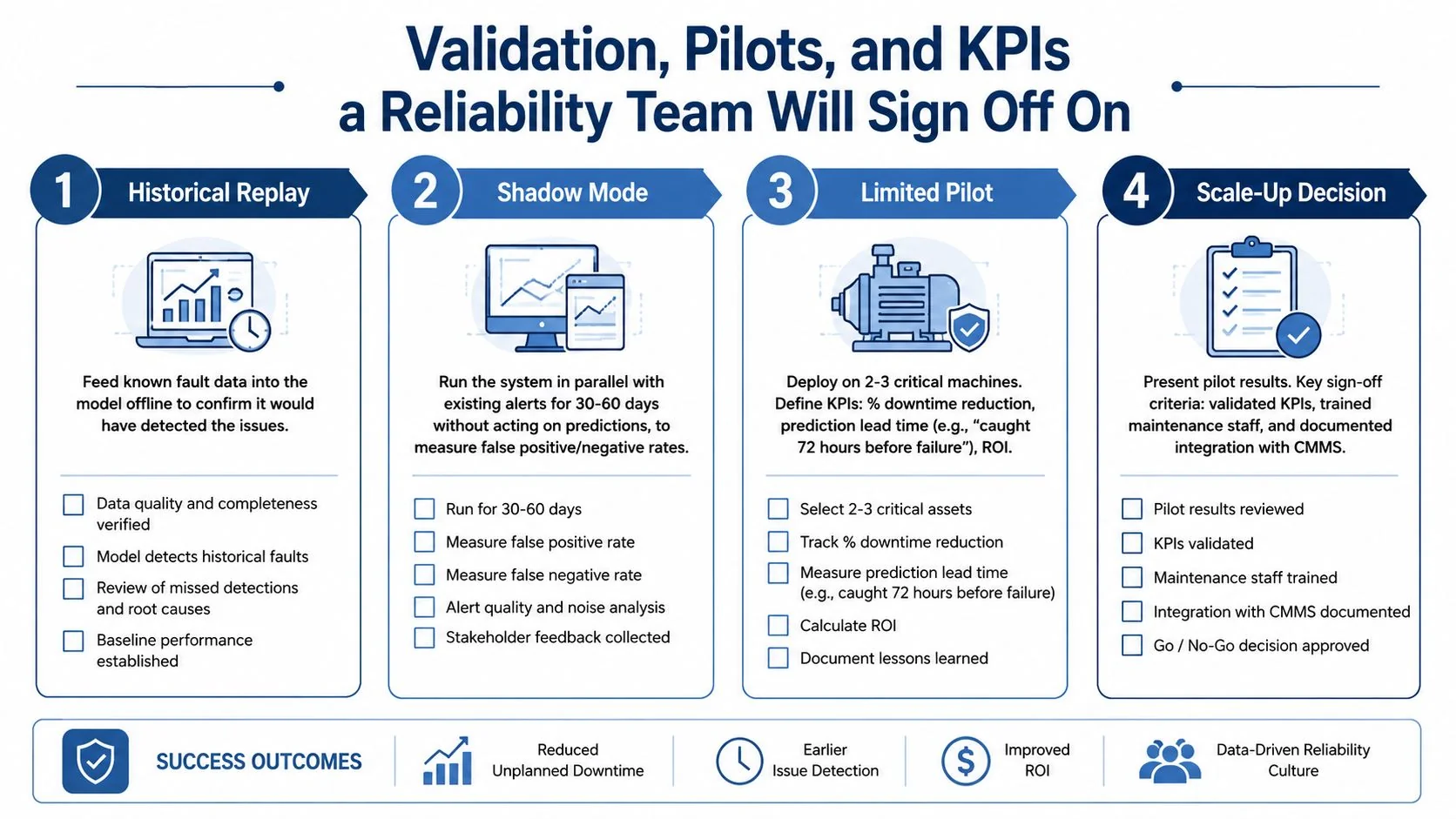
The best validation path starts with historical replay. Feed known fault data into the model offline and check whether it would have caught the issue early enough to matter. Then move to shadow mode, where the system runs in parallel with current processes but doesn't trigger work orders. Only after that should the plant move to a tightly supervised live pilot with conservative alerting.
KPIs that operations will recognize
Precision and recall matter, but they need to be translated into plant terms. A false positive is not just a statistical error, it's a technician interruption, a wasted inspection, or an unnecessary work order. A missed event is not just a recall miss, it's unplanned downtime and possible collateral damage.
The KPI set that usually wins sign-off is practical and work-centered.
- Precision on labeled faults: How often the alert was useful.
- Recall on labeled faults: How many known issues the system caught.
- Mean time between false alarms: How often the team gets interrupted.
- Alarm-to-work-order ratio: Whether alerts are turning into action.
- Unplanned downtime hours avoided: Whether the plant stayed up.
- Maintenance cost per asset-month: Whether the program is financially sane.
The 2026 guide's claim that continuous sensor data can support 25–30% maintenance-cost reduction and 35–45% unplanned-downtime reduction when the workflow is correctly deployed belongs in the business case, not the model review. Those gains only matter if the deployment is tied to action and adoption. Continuous sensor data and maintenance cost or downtime reduction guide
Practical rule: a pilot with too many alerts and no work orders is a documentation exercise, not a reliability program.
This section matters for AI in manufacturing because proof beats enthusiasm. A model that can't survive shadow mode, technician review, and CMMS integration won't scale, no matter how good the training metrics look in isolation.
Vendor Evaluation Checklist and Implementation Timeline
Vendor choice should follow the plant's operating model, not the other way around. A good vendor makes it easier to use open protocols, preserve data, and connect alerts to maintenance execution. A bad one makes every future step more expensive.
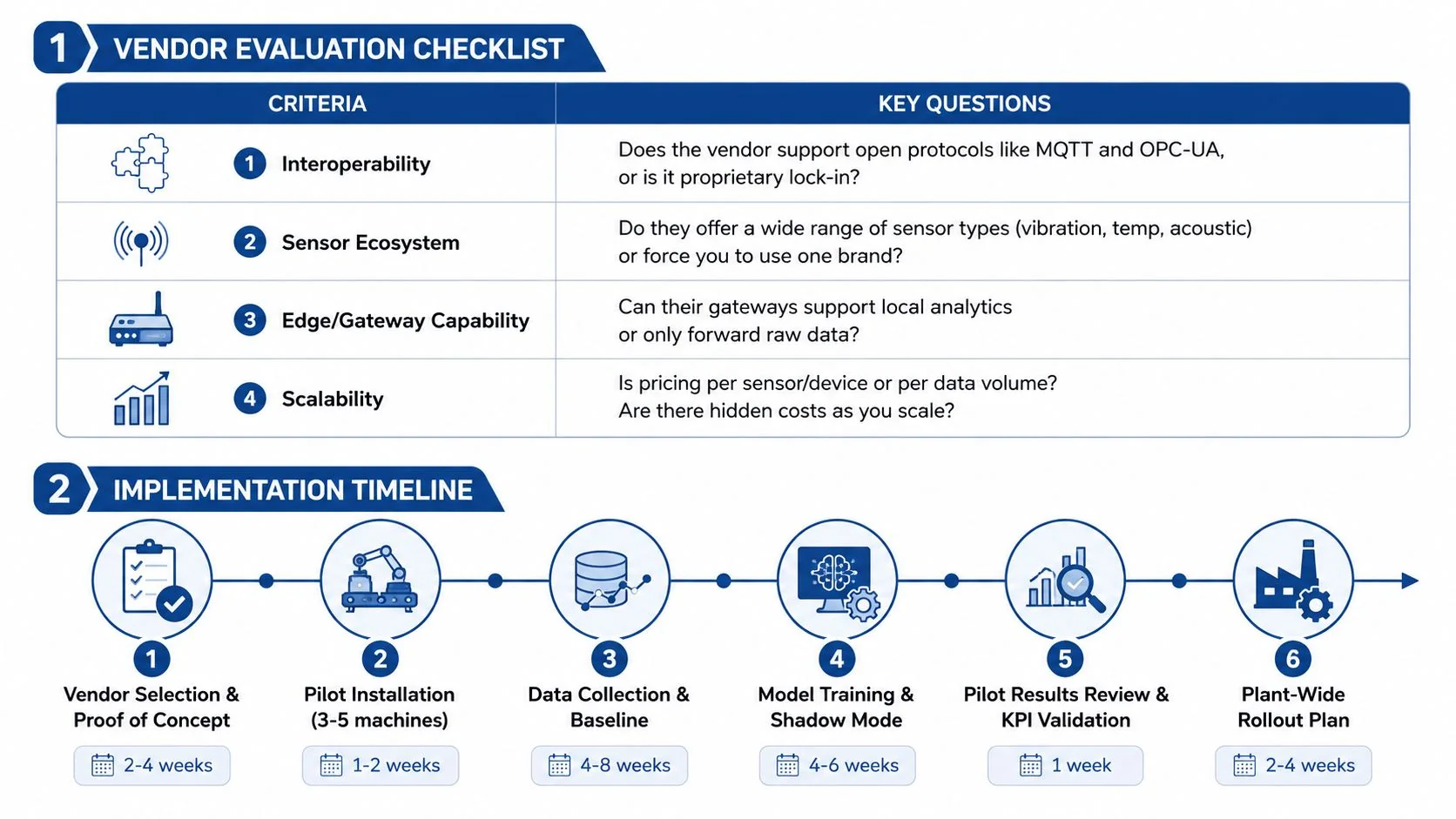
The first filter is interoperability. Ask whether the platform supports open protocols like OPC UA, MQTT, and Modbus, or whether it tries to keep everything inside a proprietary stack. Then check edge and gateway capability, because local preprocessing matters when network quality is uneven or when you want fast local alarms. Finally, ask how the vendor handles model transparency, CMMS integration, and evidence from real deployments rather than marketing claims.
What to ask before signing
- Interoperability: Does the vendor support open protocols and export data cleanly?
- Sensor ecosystem: Can the platform mix vibration, temperature, current, acoustic, and process sensors without lock-in?
- Edge support: Can gateways run local analytics, buffering, and alert logic?
- Model visibility: Can your team inspect features, thresholds, and anomaly logic?
- CMMS integration: Does the platform create work orders with asset context and priority?
- Evidence quality: Are case studies traceable, specific, and relevant to your asset class?
A phased rollout keeps the project grounded. Weeks 1 to 2 should go into asset criticality ranking and failure-mode mapping. Weeks 3 to 6 should instrument 5 to 20 representative assets. Weeks 7 to 10 should run shadow mode and KPI baselining. Weeks 11 to 12 should move the highest-value assets into live deployment, then expand plant-wide across the next two quarters.
The 2026 guide's point that the ROI threshold can open up around assets valued at roughly $5,000 or more is useful here because it pushes teams to prioritize by consequence, not by who asked loudest for a sensor. 2026 industrial IoT sensor cost and ROI guide
A low-cost prototype for small DC motors also matters because it proves the edge layer can be inexpensive enough for scale, not just impressive in a lab. That's useful when the plant wants condition monitoring across many assets without turning every point into a capital project. Low-cost ESP32-C6 and MEMS accelerometer prototype for small DC motors
This matters for AI in manufacturing because the sensor layer is the data foundation for every downstream model. If the vendor blocks access, the rollout stalls. If the signal is right, the data is clean, and the workflow closes the loop, the plant gets a predictive maintenance system that changes production outcomes.
If you're evaluating a rollout now, take the next step with the assets your team already knows are painful, map the dominant failure modes, and test the vendor against open data access and CMMS integration first. For deeper implementation patterns and evidence-backed manufacturing AI examples, start with the case studies and roadmaps at AI for Manufacturing and use them to pressure-test your sensor strategy before you buy the first node.
