Industrial Machine Learning: A Plant Team Playbook
Industrial machine learning explained for plant teams. Covers use cases, data needs, ROI, deployment, verification, and next steps using real case studies.
Written by AI for Manufacturing
Industrial machine learning is the disciplined application of data-driven models to manufacturing processes, equipment assets, and operational decisions. The business problem is substantial: a NIST study of machinery maintenance estimated $222.0 billion in average annual losses associated with inadequate maintenance. That estimate isn't a forecast of savings from machine learning, but it shows why plant teams should start with measurable operating losses rather than an algorithm shortlist.
Table of Contents
- What Industrial Machine Learning Actually Means
- Industrial Machine Learning Versus General Machine Learning
- High-Value Use Cases in Manufacturing
- Data Infrastructure and Models That Actually Work
- Building a Business Case Plant Finance Will Accept
- Verification and Benchmarking With Real Case Studies
- Deployment, Drift, and Change Management on the Plant Floor
- A Practical Next-Step Plan for Plant Teams
What Industrial Machine Learning Actually Means
Industrial machine learning connects a prediction to a decision someone can execute. A maintenance model might identify abnormal bearing behavior, but the deployment also needs an inspection procedure, a responsible technician, and enough warning to intervene. Without that connection, the plant has another dashboard, not an improved maintenance process.
The distinction matters because manufacturing teams work within physical and operational limits. A model can recommend a process setting, but engineers must determine whether that setting respects equipment capacity, product specifications, and approved operating procedures.
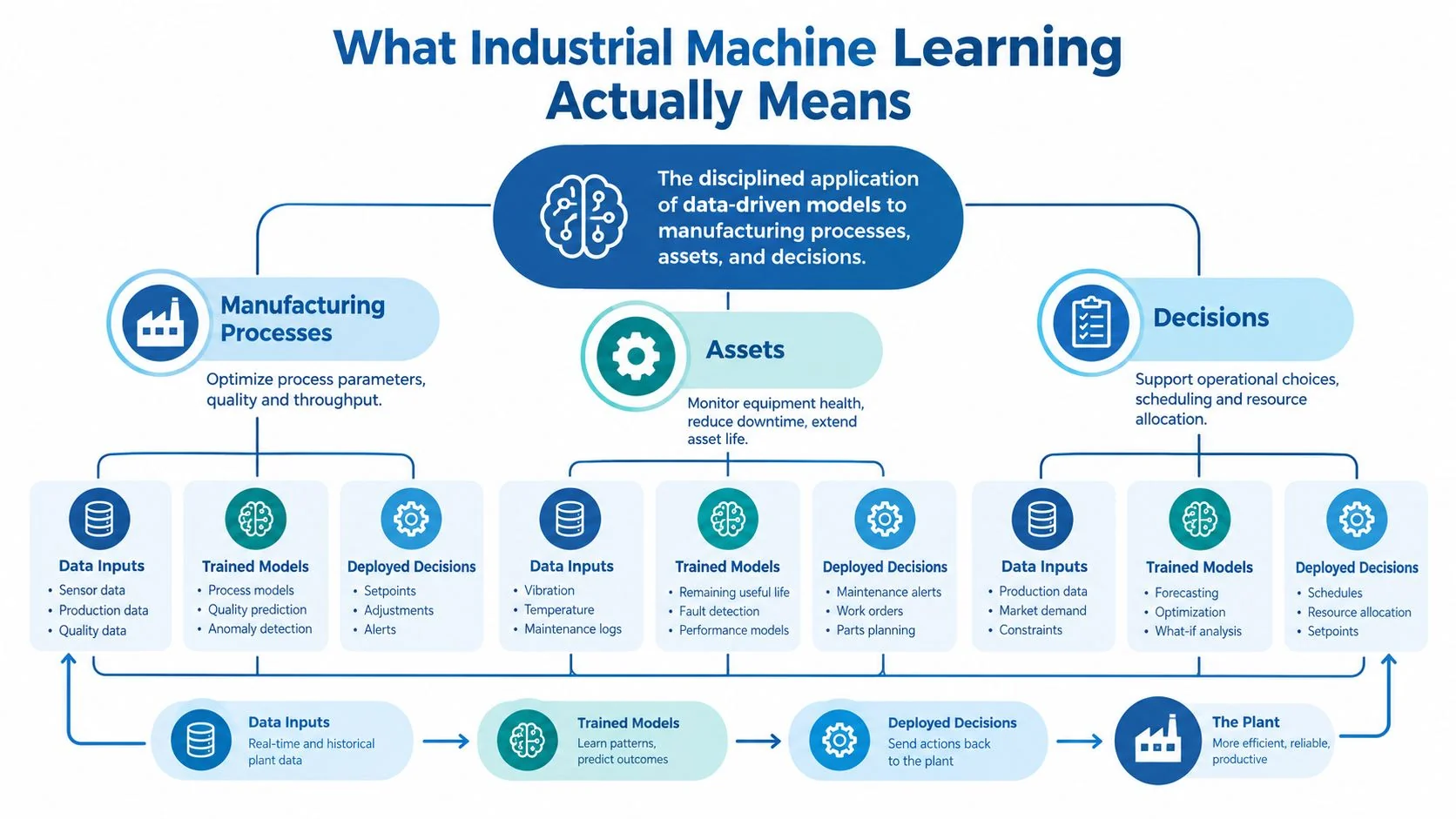
Define the decision before the prediction
Write the proposed application as an operating instruction: when specified evidence appears, a named person takes an approved action. Then work backward to the prediction and data required.
- Choose the loss: Identify the equipment failure, quality deviation, or process inefficiency worth addressing.
- Establish feasibility: Determine whether available records describe the condition early enough to change the outcome.
- Specify value: Decide which production measure should improve and how finance will verify it.
- Assign accountability: Name who can accept, reject, or suspend the recommendation.
These questions prevent a common design mistake: predicting something interesting that nobody can use. Detecting a failure shortly before shutdown may be statistically impressive but operationally useless if the plant can't inspect the asset or obtain the necessary part.
Practical rule: Don't approve a model objective until operations can describe what it will do differently when the prediction arrives.
For anyone pursuing AI in manufacturing, that operating instruction is the starting specification. Model development should serve it, not substitute for it.
Industrial Machine Learning Versus General Machine Learning
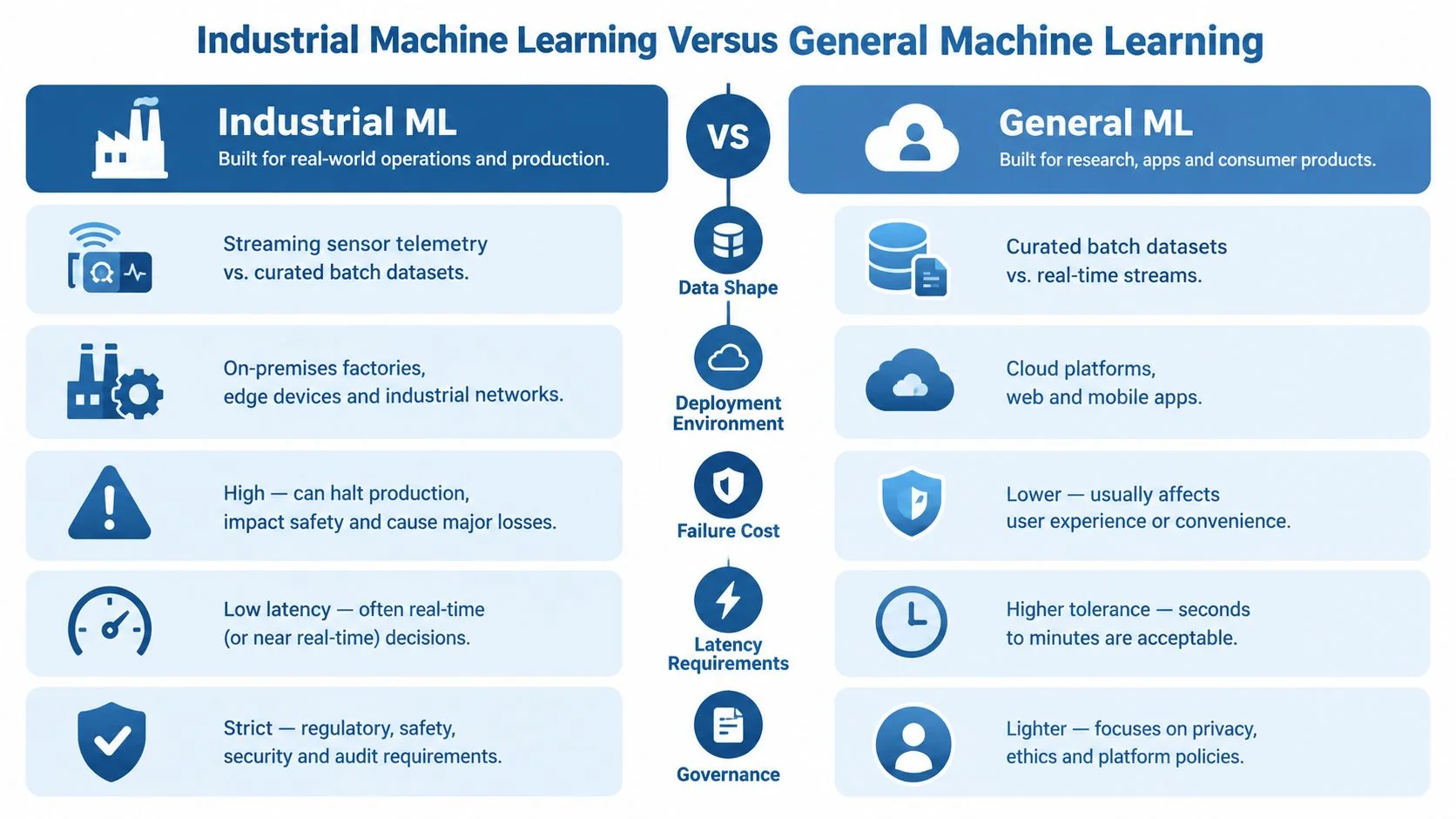
Industrial ML isn't a separate branch of mathematics. The difference is the deployment contract: what information arrives, when a decision must happen, what happens if it's wrong, and who maintains the application.
General-purpose systems can have demanding reliability requirements too. The useful comparison is with a conventional offline ML project, not an assumption that every nonindustrial application is easy.
Industrial ML vs General ML Across Production Constraints
| Dimension | General ML | Industrial Machine Learning |
|---|---|---|
| Data shape | Often begins with an assembled analytical dataset | Must reconcile telemetry, production context, inspections, and asset history |
| Latency | May permit batch scoring or flexible response times | Must meet the timing of the intended plant action |
| Interpretability | Explanation needs depend on the application | Operators need evidence sufficient to justify intervention |
| Failure cost | Often assessed through application-level outcomes | Must include scrap, interruption, unnecessary maintenance, and potential safety consequences |
| Lifecycle ownership | May sit primarily with a software or analytics team | Requires explicit coordination across operations, maintenance, engineering, and IT/OT |
Test the conditions around the model
A model that performs well on a prepared dataset hasn't demonstrated that it can handle missing tags, changing product recipes, or a disconnected gateway. Require vendors to show what the system does under those conditions, not merely replay clean historical data.
For a stamping-press application, ask whether scoring occurs per cycle, per part, or over an aggregated window. Ask what happens when the equipment identifier changes or the signal arrives late.
My evaluation rule is simple: judge the complete decision workflow, not the demo screen. A polished prediction is insufficient if the application can't identify the right asset, explain the warning, or stop issuing recommendations when its inputs become invalid.
High-Value Use Cases in Manufacturing
Choose a use case by asking where losses concentrate, which losses the plant can measure, and whether existing sensors capture relevant conditions. Don't start by asking where deep learning might fit.
Manufacturing ML is not new. A peer-reviewed survey of manufacturing research describes development waves extending back to the 1980s, with applications including production control and remaining-useful-life estimation. The practical implication is to evaluate established operational problems rather than assume novelty creates value.
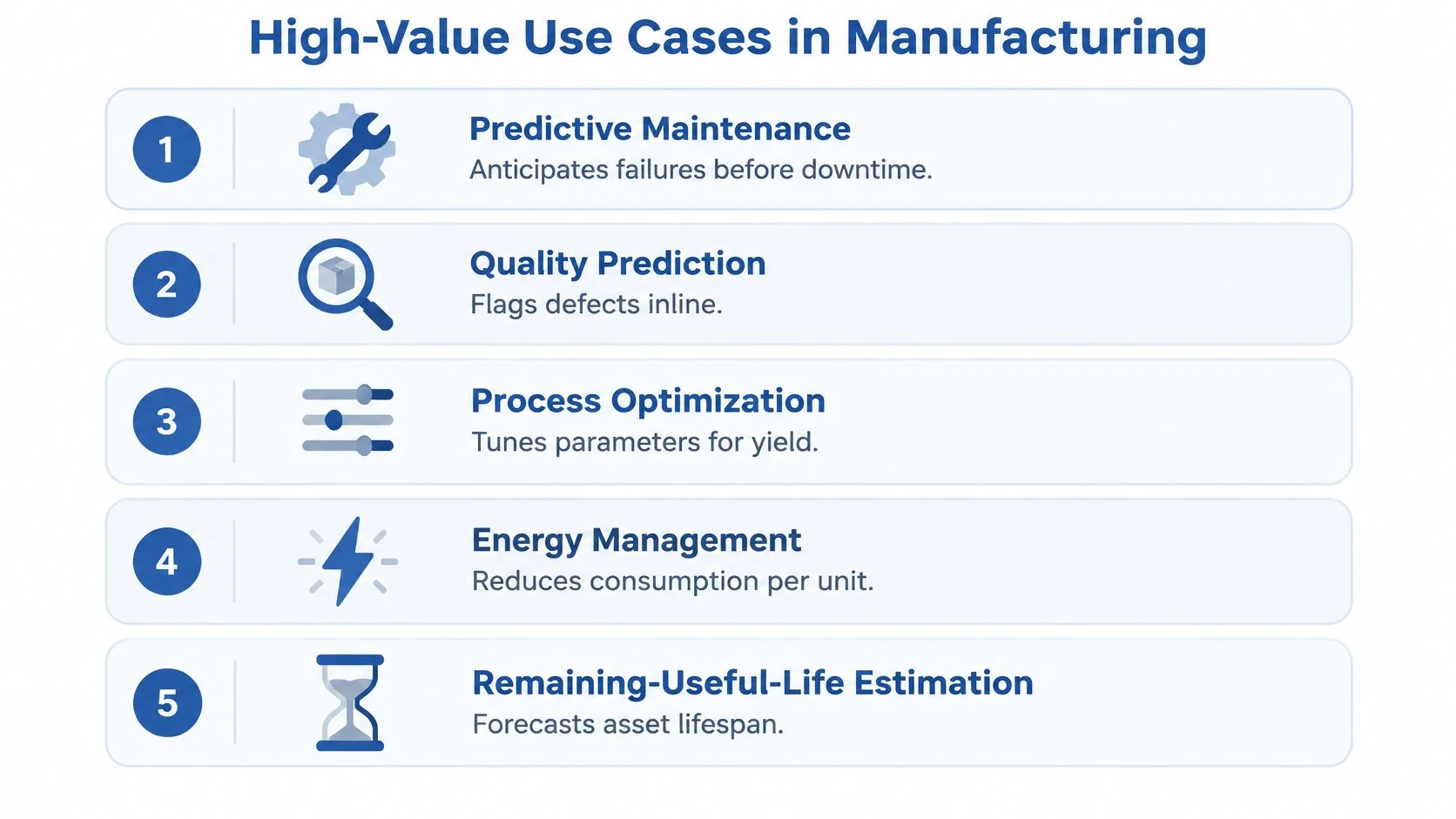
| Use case | Signals to assess | Candidate approach | Operational output |
|---|---|---|---|
| Predictive maintenance | Vibration, current, temperature, operating state, maintenance records | Anomaly detection or failure classification | Inspection priority and supporting evidence |
| Quality prediction | Process parameters, material lots, inspection results, product identifiers | Classification or regression | Risk of nonconformance before disposition |
| Process optimization | Setpoints, actual conditions, throughput, yield | Response models with constrained optimization | Recommendations within approved limits |
| Energy management | Meter readings, equipment state, output, recipe | Regression or operating-state models | Consumption deviation adjusted for production |
| Remaining-useful-life estimation | Degradation history, loading, service events | Survival or degradation models | A maintenance-planning horizon with uncertainty |
These are candidate designs, not universal prescriptions or promised outcome bands. A quality model without traceable part-to-process alignment may be less useful than a straightforward engineering investigation.
Energy projects deserve the same production discipline. The Department of Energy's smart-manufacturing adoption program supports demonstrating energy and operational benefits in defined industrial processes. For a plant pilot, measure consumption alongside throughput and acceptable output, so reduced production doesn't masquerade as improved efficiency.
Start where the loss is largest and most measurable, provided the plant can act on the result.
Data Infrastructure and Models That Actually Work
Before selecting an algorithm, trace the proposed prediction through the plant's information systems. The historian may hold process values, SCADA may expose equipment state, the MES may identify the product and route, and maintenance records may explain interventions.
Treat this as a data-contract exercise. Define tag meaning, engineering units, timestamp conventions, asset identifiers, sampling behavior, and permissible missingness. Use an ISA-95 standards reference to organize the conversation about production and enterprise information boundaries, then document the actual interfaces at your site.
Choose models against plant constraints
Structured features are a sensible starting point when the application uses process summaries, operating conditions, and maintenance history. Compare a simple baseline with more complex alternatives before committing to infrastructure that the plant must support.
Model Families Used in Documented Industrial ML Deployments
| Model family | Where it fits | Main constraint |
|---|---|---|
| Decision trees | Tabular operating data where readable decision paths matter | Individual trees can be unstable or overly specific |
| Gradient boosting | Nonlinear relationships across engineered process features | Requires disciplined tuning and explanation |
| Logistic regression | A transparent classification baseline | May need additional features to capture complex behavior |
| Support-vector machines | Selected classification problems with controlled feature sets | Scaling and probability interpretation need attention |
| Neural networks | Signals or relationships that justify greater model complexity | Training data, compute, and maintenance burden |
A comparative predictive-maintenance study using the AI4I dataset reported 99.15% accuracy for a decision tree and 98.8% for a neural network. That's evidence that a lightweight model deserves evaluation, not proof of equivalent live-plant performance.
Choose edge inference when the required action cannot depend on a remote connection. Consider cloud resources for centralized training and cross-site analysis, but specify disconnected behavior first. The right architecture is the least complicated one that satisfies the operational requirement.
Building a Business Case Plant Finance Will Accept
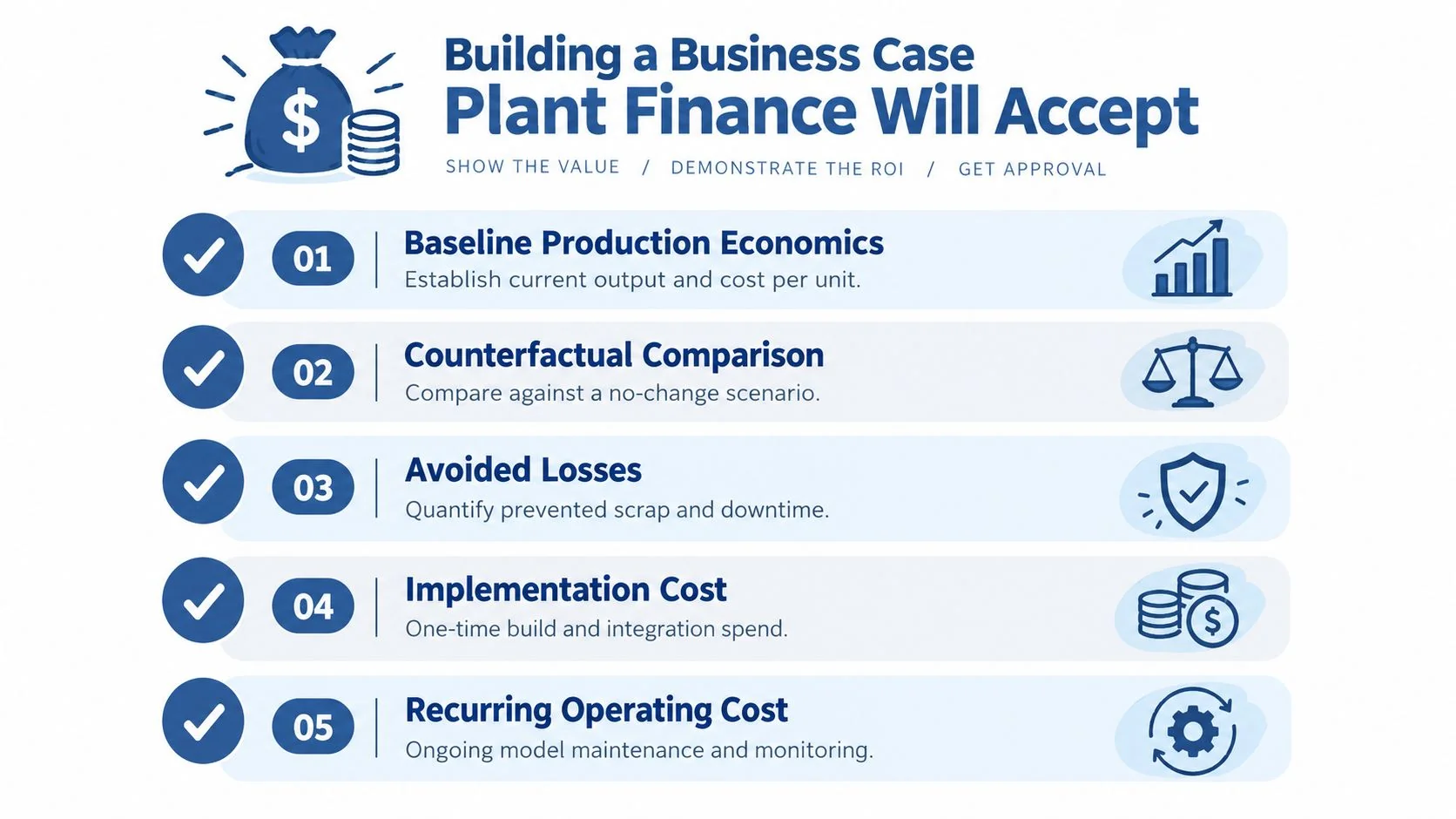
A technically successful pilot can still be a poor investment. Finance needs evidence that the proposed intervention changes production economics after integration, training, cybersecurity, infrastructure, and continuing support costs.
Expect scrutiny of the payback horizon. KPMG's 2025 industrial-manufacturing research found that 45% of executives expected AI returns within one to three years, while 7% expected returns in under six months; respondents measured value through productivity (61%), revenue (55%), and profitability (52%). These are expectations about AI investment, not demonstrated industrial-ML returns.
Build an auditable measurement architecture
- Baseline production economics: Agree on loss definitions and denominators. Use consistent manufacturing quality metrics so scrap, rework, and yield aren't interpreted differently across departments.
- Counterfactual comparison: Specify what would probably have happened without the intervention. Match operating conditions, product mix, and exposure where practical.
- Avoided losses: Separate observed savings from estimates. An alert alone doesn't establish that downtime was prevented.
- Full cost: Include engineering effort, integration, technician training, recurring licenses, monitoring, and model upkeep.
- Evidence confidence: Present conservative, expected, and favorable scenarios with explicit assumptions rather than a single precise promise.
An Auburn University smart-manufacturing study found that 20% of respondents cited a lack of business cases and 17% cited workforce skill gaps as adoption barriers. Address both in the proposal: explain who performs the changed work and budget for that capability.
Finance test: If the savings disappear when someone challenges an assumed avoided failure, the proposal needs stronger evidence before expansion.
Verification and Benchmarking With Real Case Studies
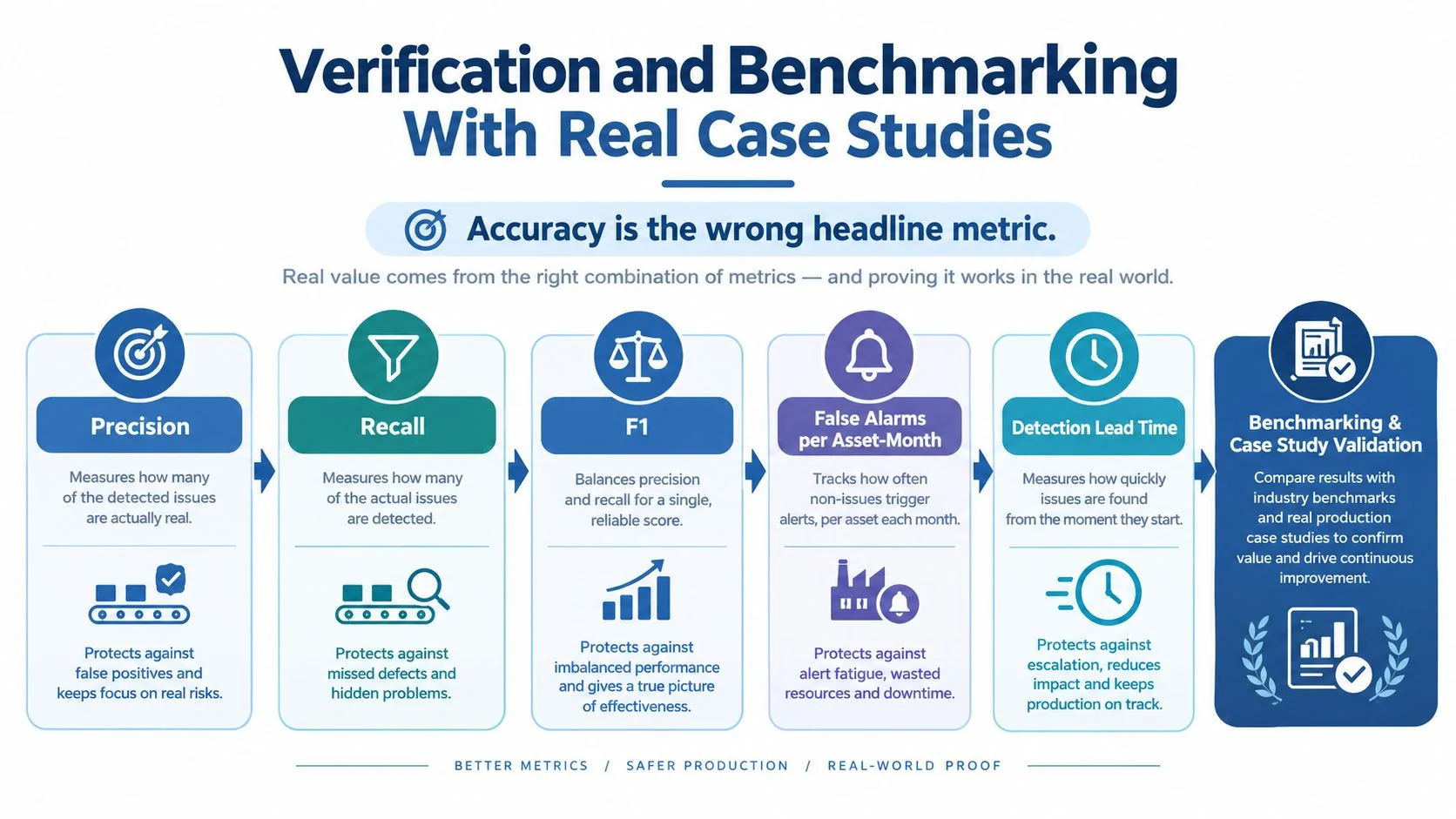
Overall accuracy is the wrong acceptance headline for failure prediction. In one manufacturing predictive-maintenance study, models achieved nominal accuracy between 0.97 and 0.99, yet logistic regression detected only 12% of actual failures. A tuned gradient-boosting model achieved precision of 0.77 and recall of 0.74.
That distinction changes the deployment decision. Maintenance teams need to know how many alerts merit action, how many failures remain undetected, and whether warnings arrive early enough to schedule useful work.
Require evidence beyond a leaderboard score
- Separate time and assets: Hold out later operating periods and unseen machines where feasible. Prevent information from after the predicted event entering training features.
- Inspect failure classes: Review confusion matrices by failure mode and operating regime, not only pooled results.
- Set an alert policy: Report precision, recall, F1, calibration, false alarms per asset-month, and detection lead time. Select thresholds against intervention capacity and missed-failure consequences.
- Check transferability: Document label definitions, exclusion rules, and the interval preceding failure that counts as a positive example.
A review of failure-prediction benchmarks found that only two of six examined public datasets were suitable for supervised learning. Treat performance claims as condition-specific until representative validation demonstrates otherwise.
Case studies help frame questions, not replace testing. Examine the Dana axle-rework case record for its application context and traceable evidence before comparing it with your process. For the organizational side, Ekipa's agile transformation at a dairy giant is a complementary change-management reference, not a predictive-model benchmark.
Deployment, Drift, and Change Management on the Plant Floor
Data readiness is a lifecycle obligation. A recalibrated sensor, firmware update, tooling replacement, changed recipe, or revised operator procedure can alter the relationship between inputs and outcomes.
Treat those events as controlled changes to the application's operating environment. Don't assume that retraining automatically resolves them, because a shifted signal may reflect a measurement fault or a changed process rather than something the model should learn.
Assign operational ownership
| Responsibility | Accountable function | Required control |
|---|---|---|
| Recommendation response | Operations or maintenance | Approved action, escalation, and override procedure |
| Signal integrity | Controls or instrumentation engineering | Sensor-change records and input-quality checks |
| Model performance | Analytics owner with a process engineer | Outcome review and release approval |
| Access and connectivity | IT/OT security | Network boundaries, access controls, and recovery procedures |
| Production continuity | Plant leadership | Authority to suspend the application and restore fallback operation |
Build monitoring around OT integration, data connectivity, cybersecurity, and scalability. Check whether interfaces remain compatible, records arrive with valid identities, access remains authorized, and additional assets can be supported without weakening service.
Define plant-specific triggers before handoff. Missing critical inputs should suppress recommendations; sustained performance deterioration should prompt investigation; an unvalidated change affecting machine behavior should block promotion. Distinguish an investigation trigger from authorization to retrain or release.
For AI embedded in machinery, also assess the intended use with qualified compliance support. European Commission guidance on high-risk AI systems identifies 2 August 2028 as the scheduled application date for relevant high-risk systems integrated into regulated products. Advisory maintenance analytics and a model controlling a safety function shouldn't be treated as equivalent procurement decisions.
Keep versioned models, input definitions, approval records, event logs, and a tested fallback procedure. Operators need to know when the application is unavailable and which established procedure replaces it.
A Practical Next-Step Plan for Plant Teams
A useful pilot ends with a decision, not a presentation. Agree on the evidence required to expand, extend, or stop before spending engineering time on model development.
Use the following 30-60-90-day plan as a proposed working schedule, not a promised payback period. Adapt it to the process cycle and the time needed to observe meaningful outcomes.
Establish the loss and the evidence
Days 1 through 30: Choose a bounded operating loss, appoint a process owner, and assemble the baseline. Search comparable implementations by use case and industry, then record which assumptions transfer and which don't.
Create a short evidence register covering the original source, operating context, reported outcome, and whether the result was vendor-reported or independently assessed. Pair that research with a data-access review before authorizing a build.
Days 31 through 60: Run the simplest credible baseline in advisory mode. Ask technicians or quality engineers to record whether each recommendation was actionable, what they did, and what happened afterward.
Use a vendor directory to identify relevant implementation experience, but require providers to answer the same acceptance questions. A roadmap deliverable can organize dependencies; it shouldn't replace site-specific engineering judgment.
Decide whether the workflow deserves expansion
Days 61 through 90: Review operational outcomes and total effort with finance, engineering, and the people who received the recommendations. Scale only when the evidence supports transfer to the next asset or line; otherwise revise the scope or stop.
Before go-live, approve the target loss, authorized action, evidence standard, accountable owner, and fallback procedure.
Ask the team to select its target loss this week and schedule a joint operations-finance review before procurement begins. Alongside the primary studies cited above, use AI for Manufacturing as one option for finding documented implementations, associated vendors, an AI Roadmap, and a weekly briefing. Compare its AI for manufacturing use cases with your plant's constraints, follow the original evidence, and turn the closest match into a testable operating proposal rather than a borrowed savings promise.
