Human Robot Collaboration: A 2026 Guide
Discover how human robot collaboration transforms manufacturing. This 2026 implementation guide covers integration, safety, and efficiency best practices.
Written by AI for Manufacturing
Human robot collaboration in manufacturing is a structured operating model in which people and robotic systems share workspaces, exchange tasks, and coordinate activities to achieve production objectives. Its growth is substantial but selective: collaborative robots represented 10.5% of industrial robots installed worldwide in 2022, with approximately 57,966 new installations, a 39% increase over the prior year, according to the International Federation of Robotics data. The practical surprise is that this still leaves conventional industrial robots dominant, so the question for an AI team isn't whether cobots are replacing automation. It's whether a human and robot can perform better as a coordinated production team.
Table of Contents
- Defining Human Robot Collaboration in Manufacturing
- Understanding Types of Robot Collaboration
- Safety Standards and Risk Assessment Requirements
- Measuring Benefits and Key Performance Indicators
- Implementation Roadmap for Collaborative Deployments
- Selecting Vendors and Evaluating Case Studies
Defining Human Robot Collaboration in Manufacturing
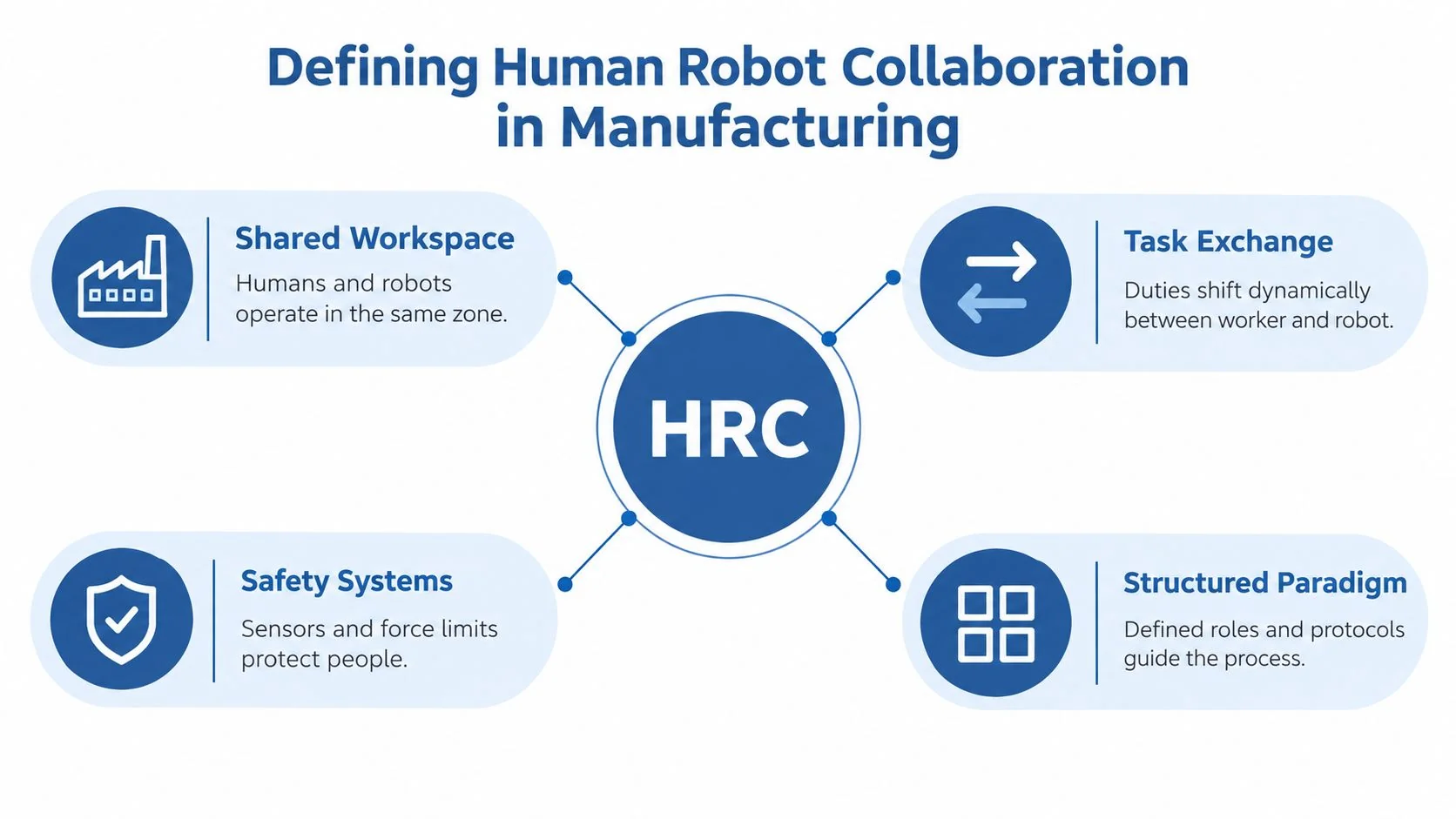
Human robot collaboration, or HRC, differs from a conventional robot cell because the human isn't separated from the automation by a permanent physical barrier or reduced to a distant supervisor. The operator and robotic system share defined responsibilities, exchange parts or information, and respond to changing production conditions within a controlled application. Robots generally suit repetitive, precise, physically demanding, or consistency-dependent actions, while people handle exceptions, dexterous manipulation, judgment, and process adaptation.
That distinction changes how manufacturing AI should be evaluated. A vision model that identifies a part accurately may still reduce performance if it creates unnecessary stops, delays a handoff, or sends the robot into a sequence the operator can't follow. The useful unit of analysis is the team, not the robot arm.
Start with the production objective
A sound HRC design begins by mapping the task rather than selecting a robot. Document the operator's movements, the robot's required actions, the points where materials change hands, and the exceptions that interrupt the normal sequence. Then define the measures that will show whether the collaboration works:
- Human idle time: How long the operator waits for the robot, parts, decisions, or recovery.
- Robot wait time: Whether the machine is blocked by human availability, uncertain perception, or an inefficient sequence.
- Handoff latency: The time between one teammate completing an action and the other beginning the next.
- Intervention frequency: How often a person must correct, restart, or override the system.
- Recovery time: How quickly the team returns to a stable process after an abnormal event.
This task-level view also affects tooling. A lightweight, application-specific tool can simplify handoffs and reduce awkward handling, which is why 3D printed tooling for assembly lines can be relevant during fixture and end-effector development. The tool still has to be included in the safety assessment. A collaborative label on the robot doesn't make a sharp gripper, unstable workpiece, or poorly positioned fixture safe.
AI matters because it can coordinate these interactions through part localization, intent inference, dynamic sequencing, and anomaly detection. The model should be judged by whether it improves the combined workflow without increasing unsafe interruptions or cognitive burden. That principle should remain in place through safety validation, KPI selection, deployment, and vendor review.
Understanding Types of Robot Collaboration
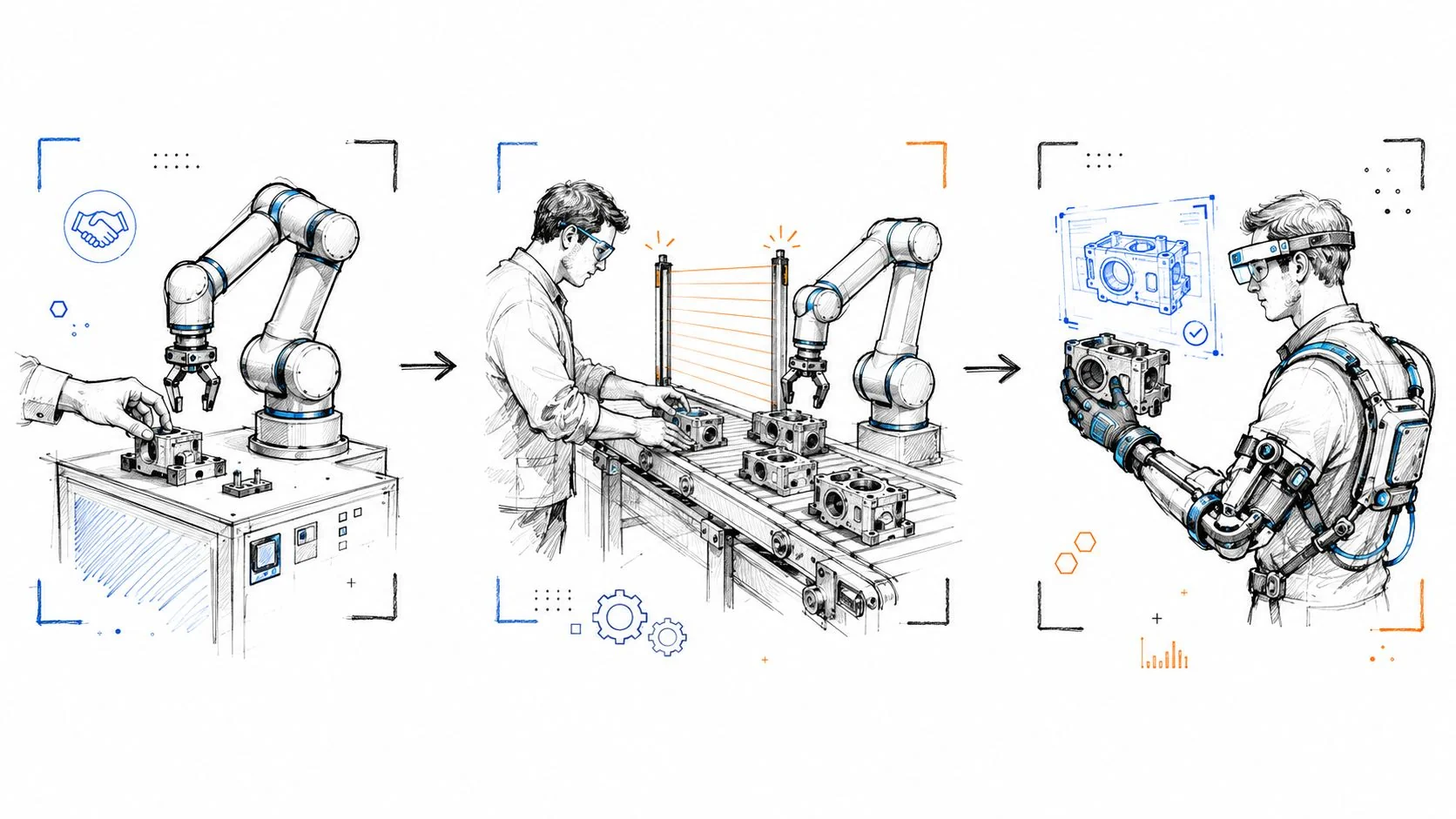
The right collaboration architecture depends on how much the human and robot operate concurrently, how often tasks change, and where responsibility sits during an exception. Three patterns appear frequently in manufacturing.
| Collaboration type | Typical arrangement | AI integration challenge | Suitable boundary |
|---|---|---|---|
| Cobot-centric cell | The robot performs a defined operation while the operator supplies parts, supervises, or handles exceptions | Vision, part localization, grasp planning, and recipe selection | Repetitive assembly, machine tending, inspection |
| Shared workspace | Human and robot work concurrently in the same area | Proximity sensing, intent inference, safe path changes, and timing coordination | Variable tasks requiring frequent interaction |
| Augmented operator system | Automation enhances human capability through tools, wearables, guidance, or recommendations | Sensor fusion, context recognition, and human-centered recommendations | Dexterous work, difficult ergonomics, and judgment-heavy processes |
A cobot-centric cell is often the easiest starting point because the task boundary is relatively clear. The operator may load a fixture, while the robot performs fastening or machine tending. This arrangement can work well when part presentation is stable and the exception set is known. It won't work well if the system depends on unreliable grasping, poorly defined product variants, or an operator who must constantly compensate for the robot's limitations.
A shared-workspace deployment has greater flexibility but a harder safety case. The system must understand where the person is, what the person is likely to do next, and when the robot must slow, stop, or change its path. AI perception can support that work, but inference isn't a substitute for validated safety functions. A model may estimate intent, while certified sensing and control logic determine the protective response.
An augmented operator system keeps the person central. Tool guidance, wearable assistance, contextual instructions, and decision support can reduce physical or cognitive effort without assigning the entire task to a robot. This may be preferable where product variation is high or where human judgment remains difficult to formalize.
Teams evaluating AI and robotics for manufacturing should compare these architectures against workflow complexity, not marketing categories. Ask which actions require shared space, which decisions require human authority, and which signals the AI can observe reliably. The best choice is often the least complex design that achieves the operational objective.
Safety Standards and Risk Assessment Requirements
A collaborative robot isn't a safe application just because its manufacturer calls it collaborative. Safety belongs to the complete system, including the robot, end effector, workpiece, layout, task, software, operating modes, and foreseeable contact scenarios.
ISO/TS 15066:2016 supplied the first international framework specifically for collaborative robot operation. It addressed force, pressure, and speed limits for human interaction, supplementing the broader industrial robot requirements in ISO 10218. The progression continued with ISO 10218-2:2025, which incorporated most collaborative-application requirements into the core robot-system integration standard.
Understand the four operating modes
ISO 10218 identifies four collaboration modes, and each supports a different operating model:
- Safety-rated monitored stop: The robot stops when a person enters the relevant area, then resumes under defined conditions.
- Hand guiding: An operator directly guides the robot through an approved control interface.
- Speed-and-separation monitoring: The system maintains a validated separation distance and adjusts robot behavior as the person approaches.
- Power-and-force limiting: The system limits contact energy so intentional physical contact can occur within applicable biomechanical limits.
Power-and-force limiting is the mode most associated with physical collaboration, but it requires application-level validation. Contact risk depends on body region, robot geometry, payload, posture, speed, contact direction, and whether the contact is transient or quasi-static. Relevant assessments report a 150 N maximum static force and 80 W dynamic power at the end-effector flange, while the more detailed ISO/TS 15066 limits govern specific application analysis. Transient contacts shorter than 0.5 seconds can permit higher force values than quasi-static contacts, making stopping behavior and reaction time important variables. These figures and distinctions are summarized in the technical discussion of collaborative robot safety limits.
Practical rule: Validate the worst-case tool, load, speed, approach direction, body position, and contact duration. Don't validate only the nominal robot configuration.
AI components belong inside this safety case. Computer vision, proximity sensing, motion planning, and anomaly detection must be tested against failure conditions, not just normal images and expected trajectories. Teams can use a structured FMEA and GMP controls guide to organize hazards, controls, and verification activities, then record the task envelope as a formal pilot acceptance criterion.
Lifecycle responsibility matters too. A software update, replacement gripper, changed speed profile, maintenance intervention, or new workpiece can alter the risk profile. The GuardLogix safety system case study is useful as a reference point for safety-system thinking, but no external case can replace an assessment of the cell being deployed.
Measuring Benefits and Key Performance Indicators
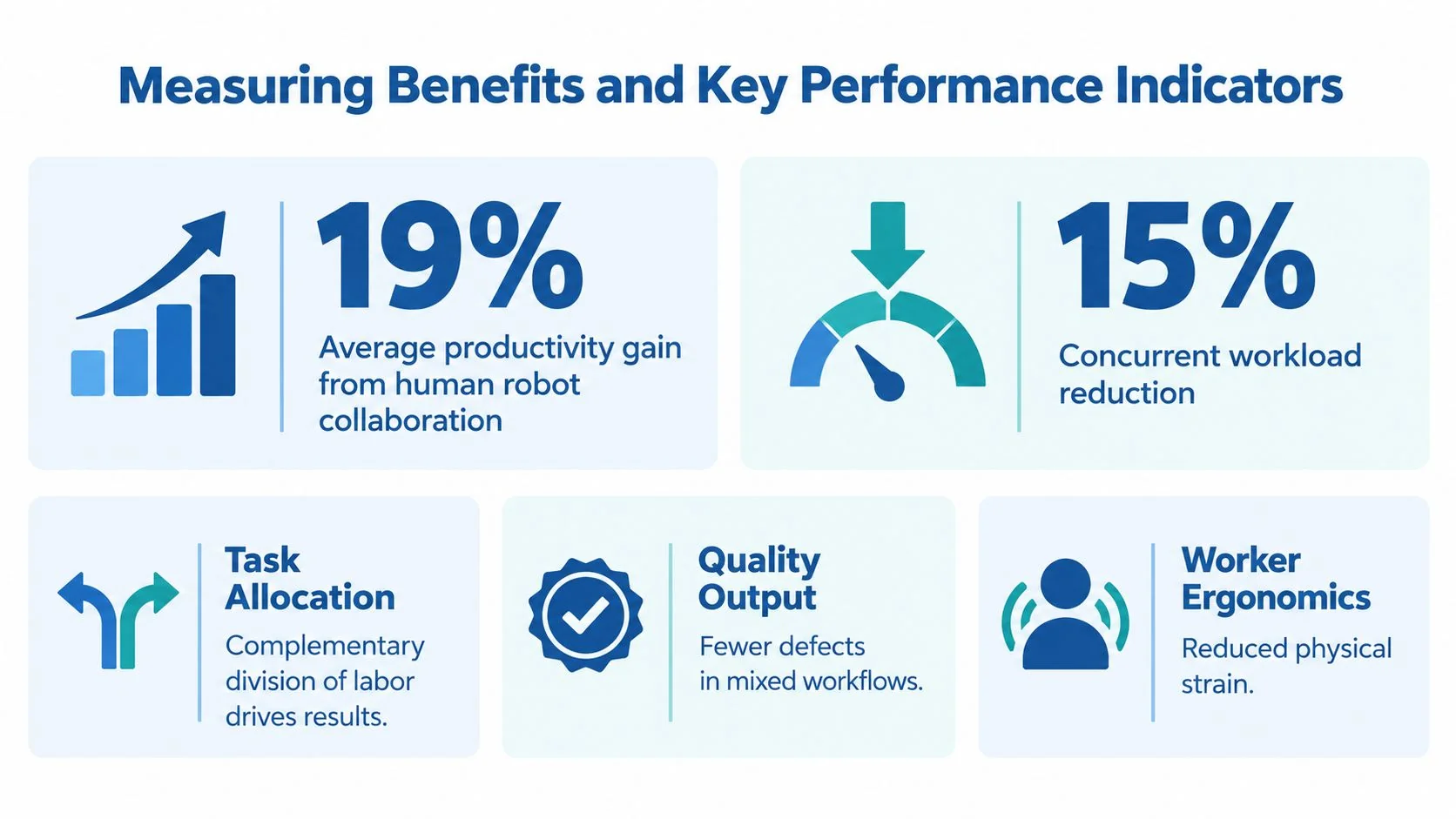
Human robot collaboration can produce up to 19% productivity improvement while reducing human workload by up to 15%, but those are maximum observed results from a manufacturing study, not universal benchmarks. The study of mutual human robot assistance attributes the value to complementary task allocation, not simple labor substitution.
Cycle time is necessary, but it isn't sufficient. A robot may complete its movement faster while the operator waits for a fixture, clears a fault, or repeats a quality check. That is why the pilot should compare baseline and assisted operation under the same product mix and staffing, then separate automation gains from improvements caused by line balancing or ergonomic redesign.
Use a team-performance scorecard
| Measurement area | What to record | Why it matters to AI |
|---|---|---|
| Flow | Throughput, human idle time, robot wait time, handoff latency | Shows whether sequencing improves the complete process |
| Interaction | Intervention frequency, override frequency, communication failures | Reveals whether the AI creates avoidable work |
| Quality | First-pass yield, defects, rework, inspection disagreements | Tests whether speed compromises output |
| Safety and ergonomics | Near misses, force or pressure events, ergonomic exposure, fatigue | Captures operational risk beyond certification |
| Resilience | Recovery time, false stops, cycle-time variation | Measures behavior during abnormal conditions |
NIST frames collaborative robot performance through five capabilities: temporal and spatial coordination, task decomposition and role allocation, communication protocols, validation of cognitive awareness, and assurance of collective team performance. Those capabilities provide a practical test plan for AI that infers operator intent, reallocates tasks, inspects parts, or dynamically sequences production. A locally accurate model can still damage the line if it interrupts the operator too often or increases robot waiting.
A slower system may deliver more value if it prevents injuries and preserves operator confidence. Safety should be treated as a dynamic operating capability, measured through real behavior and reassessed after changes, rather than treated as a one-time certification checkbox.
Implementation Roadmap for Collaborative Deployments
Deployment works best as a staged engineering program. Each stage should produce evidence that justifies moving forward, and each should include an AI validation checkpoint before the team increases system complexity.
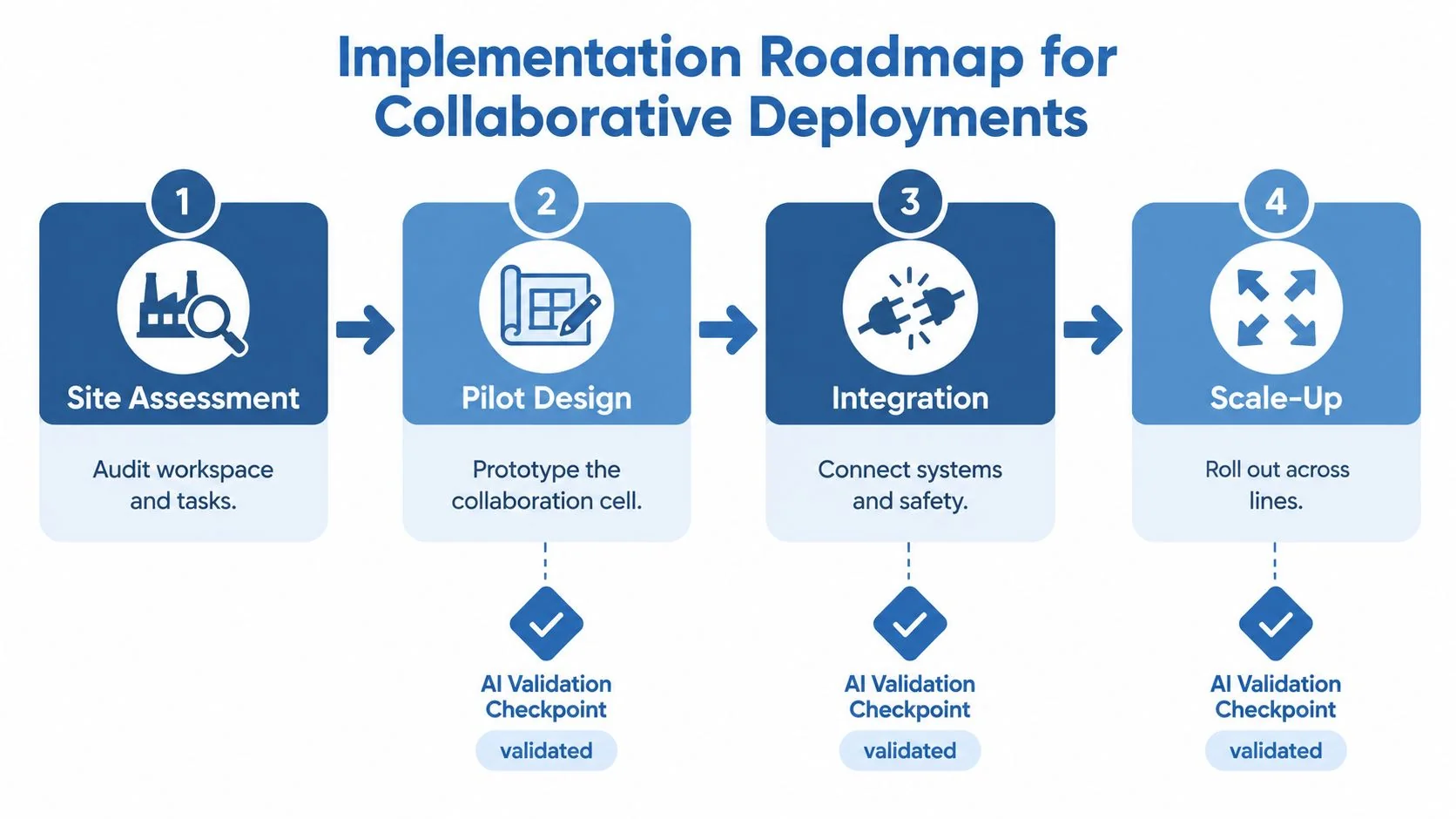
1. Site assessment
Start with the process, not the equipment catalogue. Observe the current workflow, identify bottlenecks, record operator movements, map material presentation, and document every exception that affects output. Confirm the available data infrastructure, sensor locations, control interfaces, maintenance capability, and space for safe operation.
The AI checkpoint is simple: can the proposed system observe the signals needed for its decisions? If a model must infer part identity or operator intent from views blocked by tooling, the concept needs redesign before procurement.
2. Pilot design
Select one bounded task with a clear baseline and a manageable exception set. Define the task envelope, expected contact scenarios, operating modes, acceptance criteria, and escalation responsibilities. Record safety assumptions before measuring productivity.
Include operators in the design. Their feedback can expose awkward reaches, confusing status signals, unrealistic replenishment assumptions, and workarounds that aren't visible in process data. A technically stable cell can still fail if the person must constantly monitor an opaque system.
3. Integration
Choose the robot, gripper, fixture, sensors, controller interfaces, and AI components as one application. Test tool variations, load changes, product variants, approach directions, and operator position shifts. Validate the model's perception and sequencing behavior against the same worst-case conditions used in the physical safety assessment.
Keep model versions, training data assumptions, overrides, incidents, and false stops traceable. An AI model that performs well during commissioning can drift when lighting, packaging, product mix, or operator behavior changes.
4. Scale-up
Scaling requires more than copying hardware to another line. Establish ownership for risk reassessment after software updates, new grippers, altered speed profiles, maintenance work, and temporary worker assignments. Define who can approve changes, who reviews incidents, and which events require a new validation cycle.
This governance should connect physical safety with operational autonomy. Guidance from the European Agency for Safety and Health at Work emphasizes technical, organizational, and psychosocial factors, worker involvement, and responsibilities before introduction. For broader transformation planning, a practical guide to manufacturing autonomy with SAP can help place the cell within enterprise workflows rather than treating it as an isolated robot project.
The AI validation checkpoint continues after launch. Monitor performance drift, intervention frequency, near misses, training completion, perceived control, fatigue, and operator retention alongside throughput and quality. The unified control solution deployment case illustrates why control integration and deployment discipline affect practical rollout speed.
Selecting Vendors and Evaluating Case Studies
Vendor selection should begin with evidence quality, not a demonstration cell. A polished demo can show successful motion under controlled conditions, but it won't answer whether the vendor can manage product variation, handoff delays, false stops, maintenance, operator training, or post-deployment risk reassessment.
Ask vendors to provide the underlying definition of every reported result. A credible case record should identify the baseline, production context, task boundary, measurement method, implementation conditions, and whether the result came from the vendor, a customer, or an independent evaluator. Treat claims without those details as leads for further diligence, not as benchmarks.
Compare evidence before capabilities
Use a scorecard that covers both technology and implementation maturity:
- Application fit: Can the system handle the actual payload, tooling, product mix, workspace, and operator interaction?
- Safety ownership: Does the vendor support complete-application risk assessment, validation, change control, and incident review?
- Integration depth: Can it connect robot control, perception, manufacturing execution, quality, maintenance, and analytics data?
- AI transparency: Can engineers inspect model versions, confidence behavior, fallback logic, and drift indicators?
- Human adoption: Does the program include operator training, feedback channels, workload measures, and clear override responsibilities?
- Evidence strength: Are results traceable, current, comparable, and explicit about vendor-reported versus independently verified outcomes?
For structured market research, AI for Manufacturing provides a searchable database of documented manufacturing AI implementations with use-case, technology, industry, company-size, metric, and source fields. Its records distinguish Verified, Contributed, and Scraped evidence levels, which gives procurement teams a more honest way to compare the strength of available information.
Use case studies to generate questions, not to copy expected returns. Filter for comparable processes, inspect how outcomes were measured, and check whether the deployment addressed the same safety and workflow constraints. A vendor with fewer impressive claims but stronger traceability may be the safer choice for a production pilot.
Human robot collaboration becomes valuable when AI improves the team's timing, task allocation, awareness, communication, and recovery without weakening safety governance. For AI in manufacturing, the final acceptance test should therefore combine production output, operator workload, handoff latency, quality, incident behavior, and model performance. Start with one measurable workflow, involve the people who run it, and scale only after the complete human-machine team has demonstrated reliable performance.
Choose a manufacturing task with a defined baseline and document its human, robot, safety, and AI metrics before selecting a vendor. Build the pilot around handoff latency, intervention frequency, recovery time, quality, and operator workload, then use the results to decide whether the collaboration is ready for scale.
