Enterprise AI Architecture: A Practical Guide For
Master enterprise AI architecture for manufacturing. Explore core layers, OT/IT integration, & plant floor deployment templates. Get your guide for 2026.
Written by AI for Manufacturing
Most advice on enterprise AI architecture is too IT-centric for manufacturing. It treats AI as a software stack that can sit cleanly on top of a data lake and a model platform, when the core challenge lies in connecting plant-floor signals, operational workflows, and decision rights without breaking latency, safety, or compliance requirements. Enterprise AI architecture for manufacturing is the operating blueprint that defines how data, models, infrastructure, integrations, governance, and human oversight work together across factories to run AI reliably in production. In practice, that means deciding where sensor data lands, how models are trained and registered, where inference runs, how outputs trigger MES or ERP actions, and where humans must approve or override a decision.
That definition matters because most manufacturing pilots don't collapse on model quality. They collapse on architecture. Genpact notes that 68% of AI pilots fail due to fragmented plant signals rather than model quality in manufacturing contexts, which is exactly the gap between data readiness and workflow integration that many generic guides skip (Genpact on autonomy by design in manufacturing). If your PLCs, historians, MES, ERP, CMMS, and quality systems don't line up, the model can be excellent and still produce no operational value. A good starting point is tighter manufacturing data collection architecture, because AI only scales when the signal path is dependable enough to support action, not just analysis.
Table of Contents
- Defining Enterprise AI Architecture for Manufacturing
- The Four Core Architectural Layers
- Key Components of the Model Lifecycle
- Integrating OT and IT Systems for Real-Time AI
- Embedding Security and Governance by Design
- Deployment Templates for High-ROI Use Cases
- Building the Foundation for Scalable Factory AI
Defining Enterprise AI Architecture for Manufacturing
In manufacturing, enterprise AI architecture isn't just the arrangement of cloud services, databases, and model endpoints. It's the full design for how production data is sourced from OT systems, normalized through IT systems, governed, turned into decisions, and then pushed back into operational workflows without disrupting production. That includes historians, SCADA, PLC-adjacent edge collection, MES, ERP, PLM, model lifecycle tooling, inference runtimes, identity controls, and operator-facing applications.
Why does this matter for someone pursuing AI in manufacturing? Because plant value comes from closed-loop execution. A defect model that only writes to a dashboard is interesting. A defect model that flags a batch, updates a quality hold in MES, and routes evidence to the right engineer before the next run is architecture doing its job.
The architecture has to support action
A manufacturing architecture has to answer a few hard questions early:
- Where does real-time data enter: At the line, cell, gateway, or central historian.
- Where is inference allowed to run: In cloud, on-prem, or at the edge near equipment.
- Which system owns the workflow: MES, ERP, CMMS, quality platform, or a dedicated orchestration layer.
- Who can approve exceptions: Operator, supervisor, maintenance planner, or central engineering.
Practical rule: If a model output can't be tied to an operational system of record, you don't have production AI yet. You have analytics.
Most generic enterprise guides stop at data pipelines and model serving. Manufacturing can't. The handoff from insight to action is where uptime, scrap, and safety are won or lost.
The Four Core Architectural Layers
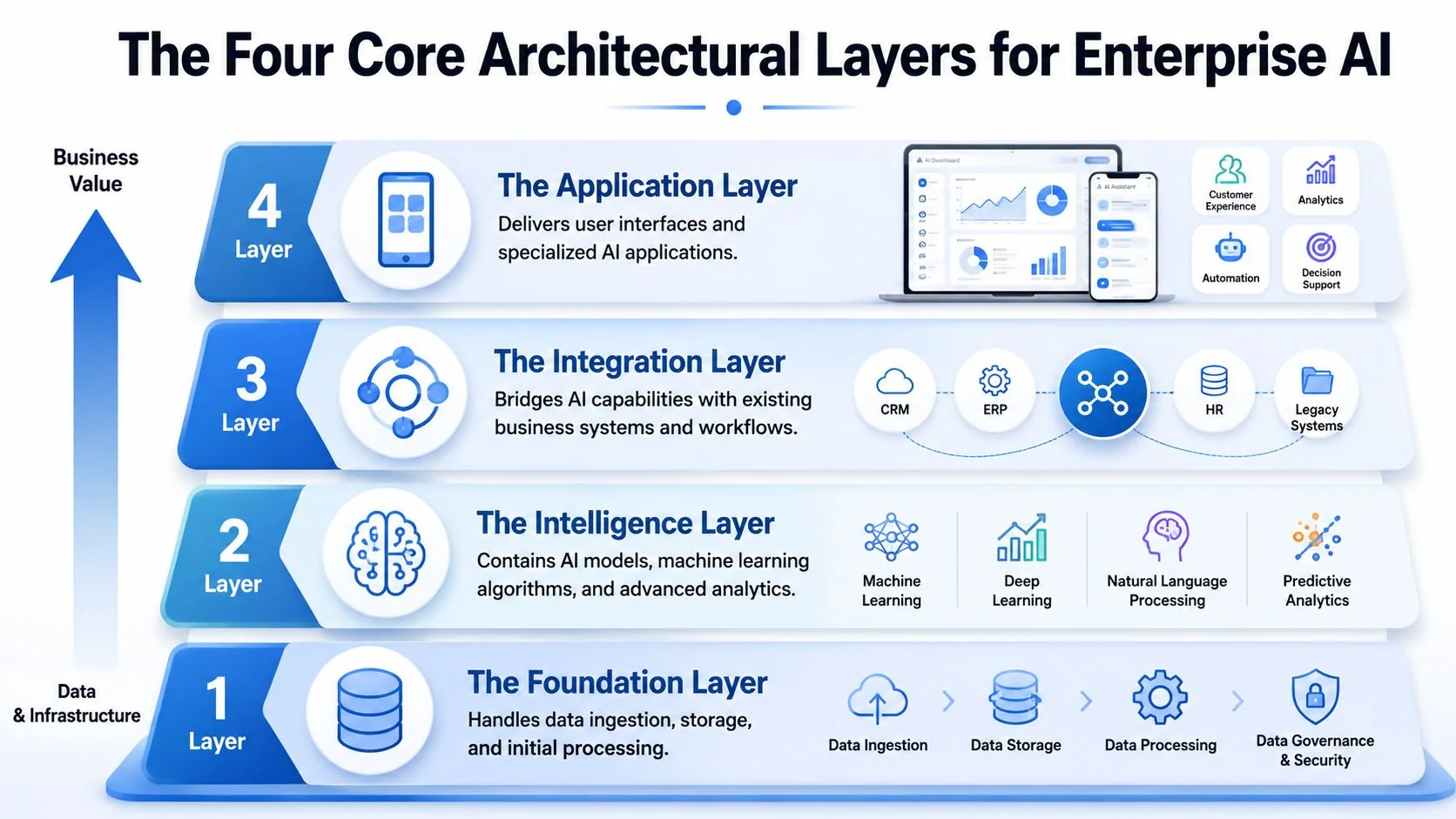
A manufacturing deployment gets simpler when you separate concerns instead of stuffing everything into one platform. TCS lays out a four-layer segmentation for manufacturing AI architecture: foundation, model enablement, agentic, and human interaction (TCS on next-generation manufacturing enterprise architecture). That structure works because it keeps plant systems stable while letting AI capabilities evolve faster.
Foundation layer
This is the essential foundation. It includes compute, storage, networks, hybrid cloud connectivity, and the systems of record already running the business, especially MES, ERP, and PLM.
If this layer is weak, every AI project becomes a custom integration job. That's expensive, slow, and fragile. In plants, the foundation layer also has to respect uptime windows, segmentation rules, and OT change control. You don't replace the MES because you want an AI pilot. You architect around it.
A production-grade on-prem setup may need dedicated AI infrastructure. NVIDIA describes a 2-8-5-200 infrastructure standard with 2 CPUs, 8 GPUs, and 5 network interface cards at 200 Gbps each, using NVIDIA BlueField-3 DPUs and Spectrum-X Ethernet, aimed at enterprise AI inference, physical AI, and simulation workloads with low-latency deployment near operations (NVIDIA enterprise reference architecture whitepaper).
Model enablement layer
Teams manage model development and release discipline. This management involves model training environments, registries, APIs, SDKs, and the DevSecOps processes that keep versions, approvals, and deployment pipelines under control.
A manufacturing program needs an AI OS layer here, not just a notebook environment. Leanware's framing is useful because it calls out the need for centralized services such as model registry, data catalog, standardized APIs and SDKs, unified monitoring, and embedded governance policies across use cases like predictive maintenance and vision inspection (Leanware on enterprise AI architecture). Why does this matter? Because once multiple plants start reusing models, inconsistency becomes a bigger risk than experimentation speed.
Agentic layer
Purpose-built task agents operate. In manufacturing, that could mean an agent that reviews machine alarms, one that assembles maintenance evidence packs, or one that correlates warranty claims with production lots and supplier inputs.
The mistake is letting this layer talk directly to everything without structure. Agents need scoped permissions, defined handoffs, and bounded actions. They should orchestrate across systems, not bypass them.
Human interaction layer
Operators, engineers, planners, and quality staff validate, reject, or refine AI outputs. Human-in-the-loop design matters because the highest-risk decisions still need controlled review.
The fastest way to lose trust in factory AI is to hide decision boundaries from the people who carry operating responsibility.
Why does this layered model matter for manufacturing? Because it separates legacy systems that must stay stable from AI components that will change often. That lets you modernize without turning the plant into a test environment.
Key Components of the Model Lifecycle
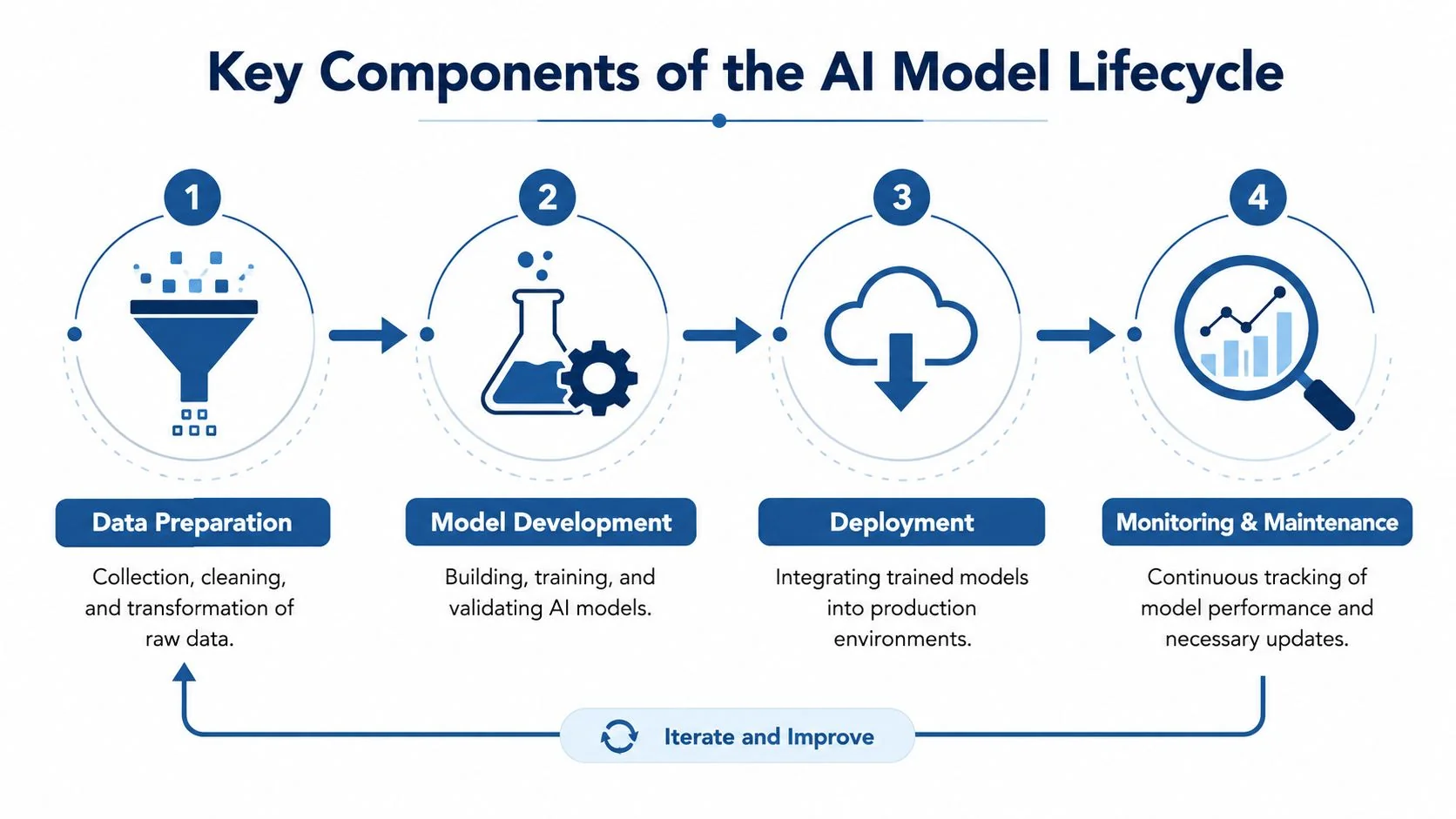
Architecture only creates value when the model lifecycle runs as an integrated production system. In factories, the handoffs matter more than the training code. Data preparation, development, deployment, and monitoring have to connect to execution systems that people already use.
From raw signals to usable model inputs
Start with ingestion. Manufacturing data comes in mixed forms: high-frequency time series from equipment, event logs from MES, maintenance history from CMMS, and contextual business data from ERP and PLM. These inputs need alignment before they become usable features.
The practical pattern looks like this:
- Collect line and equipment data through gateways, historians, and batch or streaming connectors.
- Normalize context so a signal can be tied to an asset, work order, shift, product, and lot.
- Store approved features and labels where development teams can reuse them without rebuilding the same transformations.
- Register models and versions so deployment teams know what has passed testing and what hasn't.
Without this discipline, every plant writes its own transforms, names assets differently, and creates local logic nobody else can trust.
Why deployment fails after a good pilot
The common failure mode isn't that the model stops predicting. It's that nobody wired the output into plant action. Agility at Scale argues that manufacturing AI needs integrated Execution, Integration, and Governance Layers, and notes that predictive maintenance pilots fail to scale when the Execution Layer can't orchestrate with MES work orders, creating a 30-45 day delay between detection and action (Agility at Scale on enterprise AI architecture implementation).
That delay is architecture debt made visible. Maintenance gets an alert. Someone exports a file. Another person checks asset history. A planner decides whether the issue is real. The work order gets created too late, or not at all.
A sound lifecycle closes that gap with specific controls:
- Execution logic: The inference service scores a failure risk and passes it to an orchestration service.
- Integration logic: The orchestration layer checks MES or CMMS context, asset availability, and maintenance windows.
- Governance logic: Rules decide whether the system can recommend, auto-create, or only escalate.
- Monitoring logic: Teams track model drift, queue failures, and whether recommendations turned into completed tasks.
Good MLOps in manufacturing doesn't end at model deployment. It ends when the right work order, hold, inspection, or planner action happens on time.
Why does this matter for someone pursuing AI in manufacturing? Because plant leaders don't buy models. They buy fewer breakdowns, fewer escapes, and faster corrective action. The model lifecycle has to be built around that outcome.
Integrating OT and IT Systems for Real-Time AI
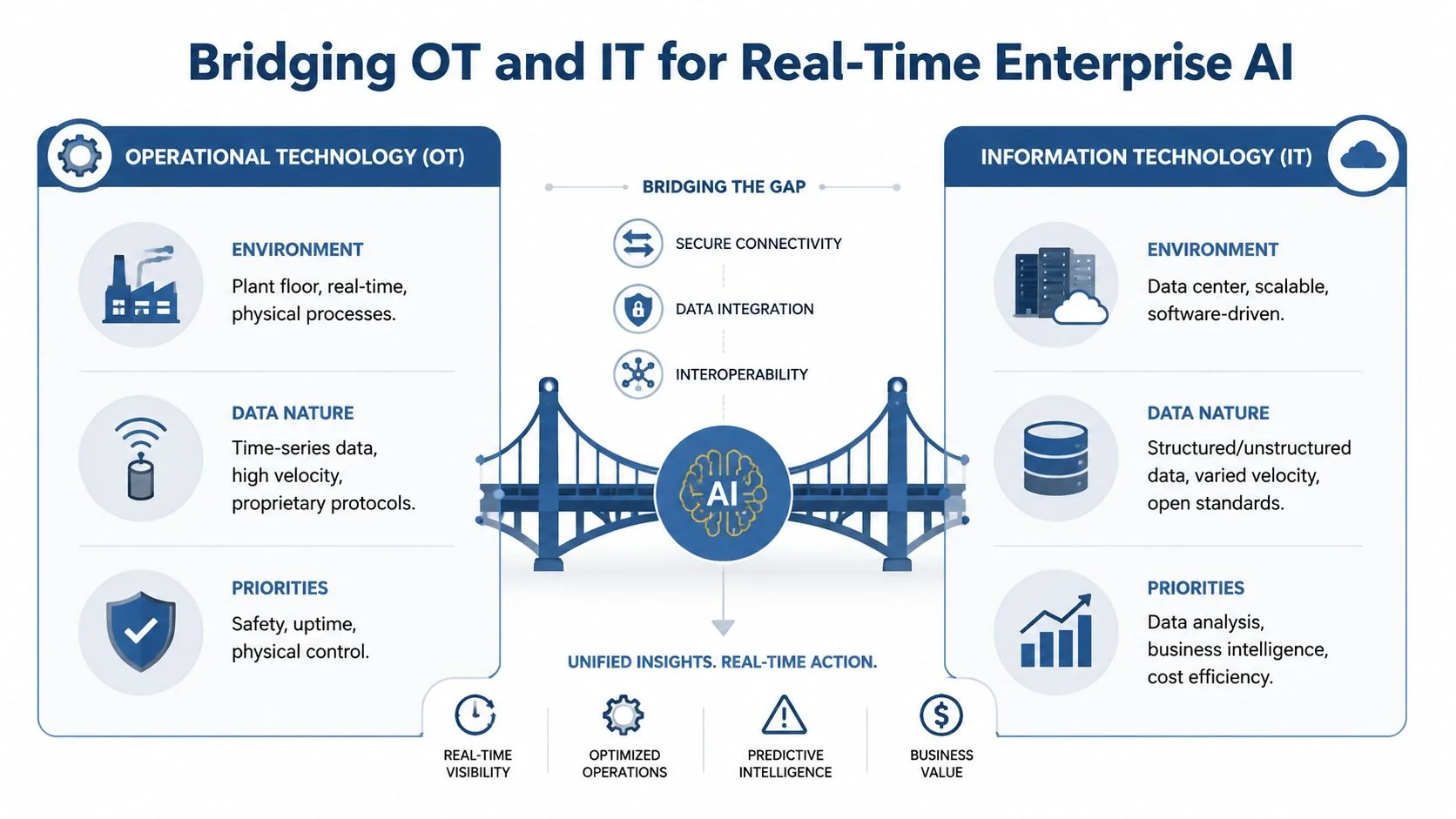
The center of gravity in manufacturing AI is OT/IT integration. OT systems manage real equipment, safety states, alarms, and process behavior. IT systems manage planning, business context, analytics, user identity, and enterprise-scale data handling. Enterprise AI architecture in manufacturing lives or dies at the boundary between those two worlds, not inside a slideware platform diagram.
What OT and IT each contribute
OT gives you the operating truth of the plant. That includes machine states, sensor values, alarm streams, quality station events, and the timing that makes those signals usable.
IT adds enterprise context. ERP tells you what order matters most. PLM tells you the product definition. Data platforms support training, enterprise identity, and reusable APIs. If you want a practical view of how these systems connect, this guide to manufacturing system integration patterns is aligned with what has to happen between line systems and enterprise platforms.
A workable integration pattern usually includes:
- Edge acquisition: Gateways or local services collect from PLCs, SCADA, historians, and vision systems.
- Context enrichment: Asset IDs, lot numbers, routing data, and maintenance history get attached before model scoring.
- Bidirectional orchestration: AI outputs go back into MES, ERP, quality, or maintenance workflows.
- Operational fallback: If the AI service is unavailable, the plant still runs safely.
Why hybrid cloud and edge is the only serious pattern
Cloud-only AI sounds efficient on paper. In factories, it usually fails on latency, data sovereignty, and operating control. Manufacturing needs a hybrid cloud pattern where cloud handles training and on-prem infrastructure handles inference, and one cited view states that 78% of manufacturing AI failures stem from all-in-cloud inference because it violates compliance expectations and introduces 2-3 second latency, well beyond the 500ms threshold needed for real-time quality control (discussion of manufacturing AI deployment latency and compliance).
That matters because quality and machine decisions often can't wait for round trips to a remote region. If a part moves to the next station before inference returns, the decision arrived too late even if the model was right.
Use cloud where it is strong:
- Model training and retraining
- Fleet-wide analytics across plants
- Central experimentation and registry services
- Burst compute for heavy jobs
Keep inference close to the process when timing and control matter:
- Vision-based quality checks
- Safety-adjacent monitoring
- High-frequency equipment anomaly scoring
- Line-side agent workflows that depend on current machine state
The trade-off is operational complexity. Hybrid is harder to build than cloud-only. It requires node pools, deployment pipelines across environments, and clear ownership between plant engineering and central IT. But it is the pattern that respects how factories run.
Embedding Security and Governance by Design
Security and governance can't sit in a separate committee deck while the architecture is built somewhere else. In manufacturing, they have to be embedded in the same execution paths that move data, trigger workflows, and authorize actions. If they aren't, the first serious audit, safety review, or plant incident will expose the gap.

Governance belongs in orchestration
A lot of teams describe governance as a policy layer. That isn't enough. Governance must be present where decisions are made. EY notes that 54% of industrial leaders cite safety and compliance as top barriers to scaling AI, which is why human-in-the-loop and human-on-the-loop boundaries need to be designed into orchestration and control, not documented after deployment (EY on how AI can unlock value for industrials).
That leads to a simple design rule. Reserve tight human approval for actions that affect safety, final quality disposition, or regulated records. Allow higher autonomy for routine, bounded exceptions where the blast radius is low, such as noncritical spare reordering or evidence compilation for maintenance review.
A practical governance stack should define:
- Decision classes: Recommendation only, approval required, or autonomous within limits.
- Policy enforcement points: The exact service where access, compliance, and action rules are checked.
- Auditability: Every prediction, prompt, approval, and downstream action should leave a trace.
- Fallback behavior: What happens when the model confidence is low, context is missing, or a connected system is unavailable.
Governance that isn't built into the workflow becomes manual cleanup after the fact.
Security controls that actually hold up in plants
Plant environments have different threat and reliability constraints than office software. Security controls must protect the model pipeline without blocking operations teams from doing their jobs.
Focus on controls that are enforceable in industrial environments:
- Identity by role and site: Separate plant operators, process engineers, data scientists, and administrators. Keep site-level permissions scoped tightly.
- Data path isolation: Segment model-serving traffic, training environments, and plant interfaces so a failure or exposure in one area doesn't spill into another.
- Version and change control: Treat models, prompts, connectors, and orchestration rules as controlled artifacts.
- Evidence retention: Keep logs of model versions, inputs, outputs, approvals, and actions for engineering review and compliance needs.
Why does this matter for someone pursuing AI in manufacturing? Because trust is an architectural property. If operators can't see why a recommendation appeared, if quality can't reconstruct a decision trail, or if IT can't prove access boundaries, adoption will stall even when the model performs well.
Deployment Templates for High-ROI Use Cases
Architecture gets real when it supports a use case with a clear operating owner, a known system of action, and enough data density to justify the effort. In manufacturing, the best starting points are the ones that already sit on top of repeatable workflows and rich signals. Capgemini highlights intelligent maintenance, product quality control, and demand planning as priority use cases, with measured outcomes of 15-25% reduction in unplanned downtime and 10-20% defect reduction when solutions scale with proper architecture (Capgemini on AI in manufacturing operations).
That matters because these use cases force the architecture to connect to real operations. They don't let teams hide behind dashboards.
Manufacturing AI architecture templates by use case
| Use Case | Primary Data Sources | Inference Location | Key System Integration |
|---|---|---|---|
| Predictive maintenance on rotating equipment | Vibration, temperature, current, alarm history, maintenance logs, asset hierarchy | Edge or on-prem near the line for timely scoring | MES or CMMS for work orders, historian for context, ERP for spare parts |
| Computer vision for quality inspection | Camera feeds, inspection labels, recipe context, lot and station data | On-prem or edge at the cell due to latency and bandwidth demands | MES for quality disposition, traceability systems, quality management workflows |
| Demand forecasting and supply planning | ERP orders, inventory, sourcing data, shipment history, planning assumptions | Central cloud or enterprise data center | ERP, supply chain planning tools, sourcing and warranty analytics |
The point isn't that every factory should copy this table exactly. The point is that the same core architecture shifts shape by use case. Vision needs line-side inference and strong image data handling. Maintenance needs deep asset context and work-order orchestration. Demand planning needs enterprise data quality and less line-side urgency.
How to choose what to deploy first
Don't choose based on whatever model demo looked best. Choose based on operational friction and signal quality.
A practical sequence looks like this:
- Start with intelligent maintenance when you have reliable asset data and a maintenance team that can act on recommendations. For deeper examples of where this pays off, review manufacturing predictive maintenance patterns.
- Move to quality inspection when defects are costly and inspection criteria can be tied directly to station-level context.
- Expand into demand planning when the plant already trusts enterprise data and wants to connect production decisions to supply performance.
If the use case has no clear system of action, it shouldn't be first in line for production AI.
Why does this matter for someone pursuing AI in manufacturing? Because high-ROI architecture isn't generic. It is shaped around how a plant creates, detects, and corrects value leaks.
Building the Foundation for Scalable Factory AI
A workable enterprise AI architecture for manufacturing is hybrid, layered, integrated, and governed at the point of execution. It respects OT constraints instead of pretending every decision can run from the cloud. It connects model outputs to MES, ERP, quality, and maintenance workflows instead of stopping at dashboards. It gives plants a way to scale AI without turning every site into a separate custom project.
This test is simple: Can the architecture support repeated deployment across factories with stable controls, low-latency inference where needed, and clear human oversight where risk demands it? If the answer is no, the pilot may still look impressive, but it won't scale.
That is why enterprise AI architecture matters directly to AI for manufacturing use cases. Predictive maintenance needs timely orchestration into work orders. Vision inspection needs edge inference before a defective part advances. Demand planning needs enterprise integration back into production and supply decisions. If you want evidence-based examples of how manufacturers are applying AI in those workflows, explore the AI for Manufacturing database and research resources.
