Digital Twin Manufacturing: A Practical Guide for 2026
Learn how digital twin manufacturing works in 2026, from data and architecture to KPIs, ROI, adoption roadmap, and real-world AI use cases.
Written by AI for Manufacturing
The counterintuitive lesson in digital twin manufacturing is that model fidelity usually isn't the first constraint. In brownfield plants, the harder problem is connecting legacy equipment, fragmented records, inconsistent timestamps, and operational ownership well enough for an AI system to make a useful decision. That matters because the global digital twin market has been projected to grow from about €16.42 billion in 2025 to €240.11 billion by 2032, with a 39.8% annual growth rate, while manufacturing is expected to be its fastest-growing sector (Hexagon's digital twin statistics). The opportunity is large, but the implementation work remains unglamorous.
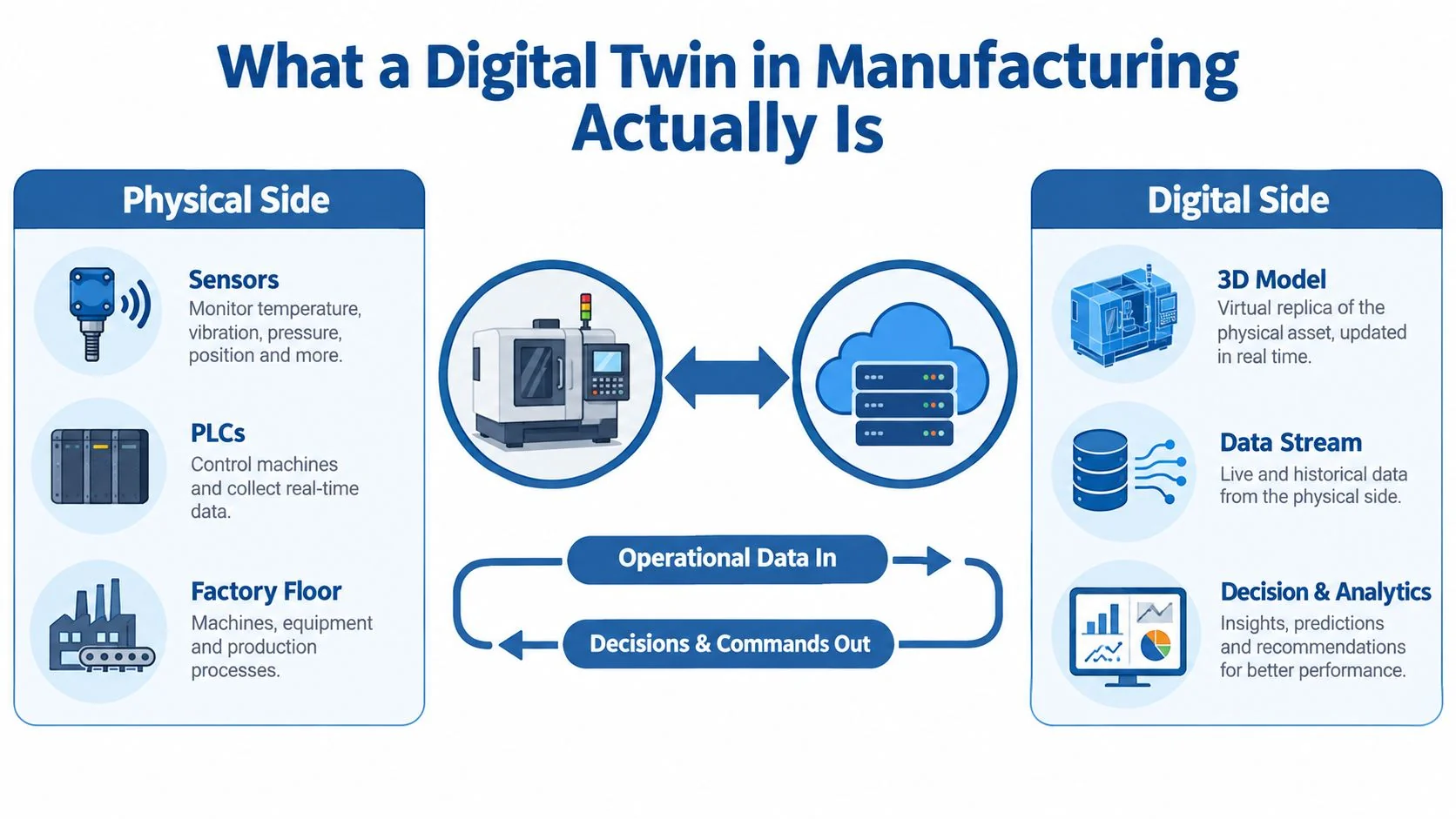
A manufacturing digital twin is a synchronized digital representation of an observable physical manufacturing element, such as equipment, material, process, product, facility, or workforce context. It receives operational data from the physical environment and can return information, recommendations, or commands through connected services. For manufacturing AI, that synchronization is the difference between a deployable use case and a static model that looks impressive in a demonstration.
Table of Contents
- What a Digital Twin in Manufacturing Actually Is
- The Four Main Types of Manufacturing Digital Twins
- Data, Integration and Architecture Requirements
- KPIs and ROI Patterns by Use Case
- A Practical Adoption Roadmap for Plant Teams
- Common Pitfalls and Misconceptions
- Evidence-Backed Case Studies and Metrics
- Connecting Digital Twins Back to AI for Manufacturing
What a Digital Twin in Manufacturing Actually Is
ISO 23247-1:2021 defines a manufacturing digital twin as a “fit for purpose digital representation of an observable manufacturing element with synchronization between the element and its digital representation” (ISO 23247-1). The phrase fit for purpose matters. A useful twin doesn't need to reproduce every physical detail. It needs enough state, behavior, context, and update frequency to support a defined manufacturing decision.
The framework separates the twin into connected concerns: the physical entity, the digital representation, the connection between them, the data exchanged, and the services that use that data. NIST describes ISO 23247 as a generic guideline and reference architecture that can be specialized for discrete, batch, or continuous manufacturing (NIST's analysis of ISO 23247).
The definition that keeps AI projects honest
For plant teams, three distinctions prevent expensive confusion:
- A model represents behavior or structure. It may be physics-based, statistical, discrete-event, or machine-learning based.
- An instance twin represents a particular machine, line, batch, or product and carries its own operational history.
- An aggregate twin combines multiple twins to represent a cell, line, plant, or wider production system.
A CAD file isn't a digital twin. A simulation run once a quarter isn't a digital twin. An MES dashboard isn't automatically a digital twin either, because a dashboard may display data without maintaining a computational representation or supporting a feedback loop.
A twin becomes AI-ready when its connection is automated, its state updates at the cadence of the decision, and its output reaches someone or something able to act. A millisecond control decision needs an edge-resident pathway. A capacity-planning model can tolerate slower updates. This is why a brownfield twin is best treated as an operational system, not as a visualization project.
Practical rule: Define the decision before defining the model. If the team can't name the action that follows a prediction, the project is probably building a data display rather than a twin-enabled AI use case.
ISO/IEC 30173:2023 establishes terminology covering digital twin concepts, life-cycle processes, functional views, twin types, and stakeholders (ISO/IEC 30173). Shared vocabulary helps engineering, operations, IT, and data teams agree on ownership before they argue about platforms.
The Four Main Types of Manufacturing Digital Twins
The useful way to classify digital twins is by the decision they support and the boundary they represent. A component or product twin covers a part or product. An asset or equipment twin follows a machine. A process or system twin represents an operating flow. A factory or plant twin combines production, logistics, capacity, and site context.
Each broader boundary increases the integration burden. A spindle vibration model may support maintenance, but it says little about product mix, labor constraints, material movement, or maintenance windows across a plant. Start with a decision and an observable failure mode, then expand the twin only when its data and operating process remain reliable.
| Twin Type | Primary Decisions Supported | Data Sources | Typical ROI Horizon |
|---|---|---|---|
| Component or product twin | Design-for-manufacturing, tolerance analysis, warranty and lifecycle decisions | CAD, PLM, quality records, test data, product genealogy | Longer horizon, often linked to product and lifecycle decisions |
| Asset or equipment twin | Condition monitoring, predictive maintenance, control-loop tuning | PLC tags, vibration and temperature sensors, historian, CMMS, maintenance records | Shorter horizon when tied to downtime or quality |
| Process or system twin | Line balancing, throughput optimization, sequencing, energy management | SCADA, MES, historian, recipes, labor and material events | Medium horizon, depending on operational integration |
| Factory or plant twin | Capacity planning, logistics flow, capital scenarios, network resilience | MES, ERP, WMS, PLM, QMS, production plans, facility data | Longer horizon, with value concentrated in planning and capital decisions |
Scope determines the data contract. An asset twin may need dense telemetry, operating modes, alarms, and maintenance history. A process twin also needs event sequencing, cycle times, recipe context, quality outcomes, and machine relationships. A plant twin adds enterprise and facility information that often sits outside the OT environment, creating identity, timestamp, and ownership problems before modeling even begins.
Model fidelity should follow the decision, not lead it. A component twin can use detailed geometry or engineering analysis. An equipment twin may combine sensor signals with a reduced-order physical model. A process twin often uses discrete-event or hybrid simulation. A plant twin may gain more from consistent scenarios and dependable planning data than from highly detailed geometry.
The strategic case is substantial. NIST's manufacturing assessment estimated that fully adopting digital twins across manufacturing could create about $37.9 billion in annual impact (NIST assessment). The estimate does not justify building the widest possible twin. AI projects usually earn operational trust faster when they begin with one measurable problem, connect predictions to an action, and expand only after the brownfield data path and working process hold up.
Data, Integration and Architecture Requirements
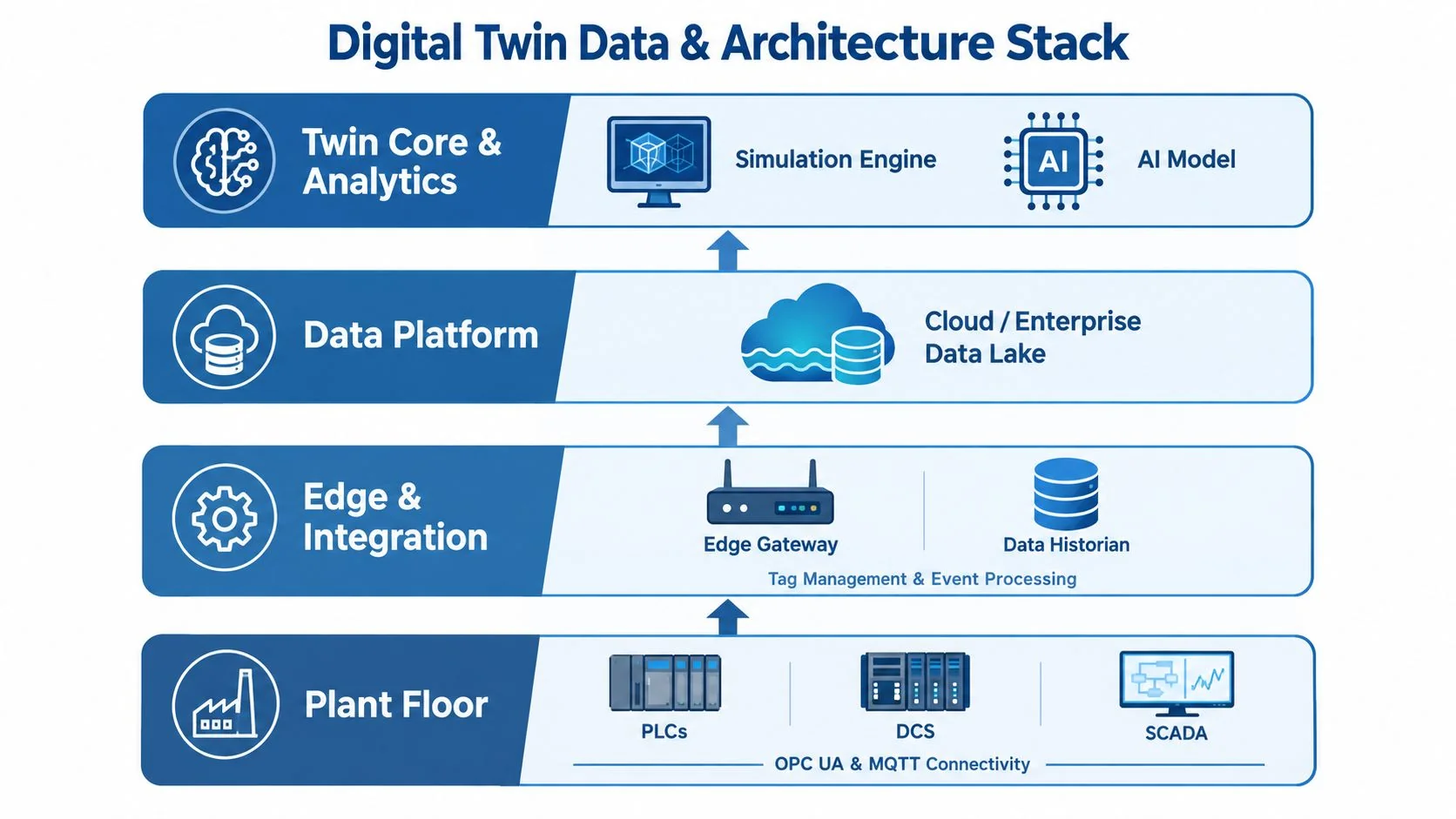
A brownfield architecture starts with the controls that already run the plant. That means PLCs, DCS, SCADA, machine gateways, sensors, and existing historians. Some controllers are decades old, use proprietary structures, or expose tags whose names make sense only to the engineer who commissioned the line. The integration team has to preserve safe operations while creating a reliable data path.
A workable stack usually has four layers:
- Plant floor connectivity gathers signals and events from controllers and supervisory systems. OPC UA and MQTT are common choices, but protocol support alone doesn't solve semantic inconsistency.
- Edge and integration services buffer data, normalize tags, process events, and handle intermittent network availability. Edge buffering is particularly important where cloud connectivity can't be treated as continuous.
- The data platform joins operational telemetry with MES, ERP, PLM, QMS, CMMS, and document context. The training data for manufacturing AI needs lineage, timestamps, units, operating modes, and asset identity.
- Twin and analytics services run simulation, state estimation, anomaly detection, forecasting, optimization, and decision support at the location appropriate to the latency requirement.
Data contracts matter more than attractive geometry
The most damaging failure mode is a twin model fed by data that arrives too late, loses its asset identity, or changes meaning between shifts. A temperature tag without a unit, calibration status, machine mode, or timestamp quality isn't reliable training data. An event stream that can't distinguish planned downtime from a fault will contaminate maintenance and OEE analysis.
Use a tagged asset model with stable identifiers and explicit relationships. Define data contracts for names, units, timestamp behavior, quality flags, event types, retention, and ownership. Store model versions alongside the data and record which version produced each recommendation.
For plant-facing AI, topology should follow the decision:
- Edge inference suits fast anomaly detection, interlocks, and control-loop support.
- Plant servers suit process twins, local scheduling, and operational what-if analysis.
- Cloud or enterprise platforms suit aggregate twins, cross-site benchmarking, and slower scenario simulation.
A practical starting point for protocol decisions is this guide to OPC UA communication in manufacturing. The important question isn't whether a platform supports a protocol. It's whether the resulting data remains synchronized, interpretable, secure, and actionable across the plant's existing systems.
KPIs and ROI Patterns by Use Case
ROI changes with the operating horizon. A twin that helps an operator catch a developing anomaly during a shift should be judged against downtime, scrap, quality, or intervention metrics. A plant-level twin that tests capacity scenarios should be judged against planning quality, capital avoidance, and resilience. Combining both into one blended business case makes the result difficult to validate.
Short-horizon use cases tend to be easier to prove because the feedback loop is visible. Anomaly detection can measure time to detection and false alarms. Predictive maintenance can track unplanned downtime and avoided interventions. Soft sensing can connect estimated process variables to first-pass yield or rejection behavior. Closed-loop optimization can evaluate process stability, energy intensity, and throughput under defined operating constraints.
| Twin Maturity Level | Typical Use Case | Primary KPIs | Indicative Payback | Supporting AI Workload |
|---|---|---|---|---|
| Level 1 | Asset monitoring and anomaly detection | Mean time to detect anomaly, alarm quality, unplanned downtime | Short horizon | Anomaly detection and classification |
| Level 2 | Quality and maintenance support | First-pass yield, scrap rate, rejection rate, maintenance response | Short horizon | Soft sensing, fault diagnosis, predictive maintenance |
| Level 3 | Process optimization | OEE, changeover time, energy per unit, throughput | Medium horizon | Process optimization and adaptive scheduling |
| Level 4 | Line and plant scenario planning | Capacity utilization, planned throughput, capital avoidance | Long horizon | Discrete-event simulation and what-if analysis |
| Level 5 | Coordinated multi-twin operations | Resilience, cross-line flow, resource allocation | Long horizon | Optimization, orchestration, and constrained autonomy |
The exact payback depends on baseline stability, intervention authority, production economics, and data readiness. Avoid treating maturity labels as financial guarantees. A narrowly scoped asset twin can outperform a broader process twin if the asset has a clear failure mode, reliable telemetry, and an owner who can act on alerts.
The manufacturing data analytics guide is useful for connecting telemetry to measurable production outcomes. The same discipline applies here: define the baseline, specify the action, log the intervention, and separate correlation from verified operational effect.
The 2026 critical review of AI-driven digital twins in sustainable manufacturing compares optimization approaches, energy reduction, carbon impact, and decision horizon (Sustainability review). Its practical implication is clear. Energy and emissions value is strongest where the model updates continuously and the optimization can influence the process within its decision window.
A Practical Adoption Roadmap for Plant Teams
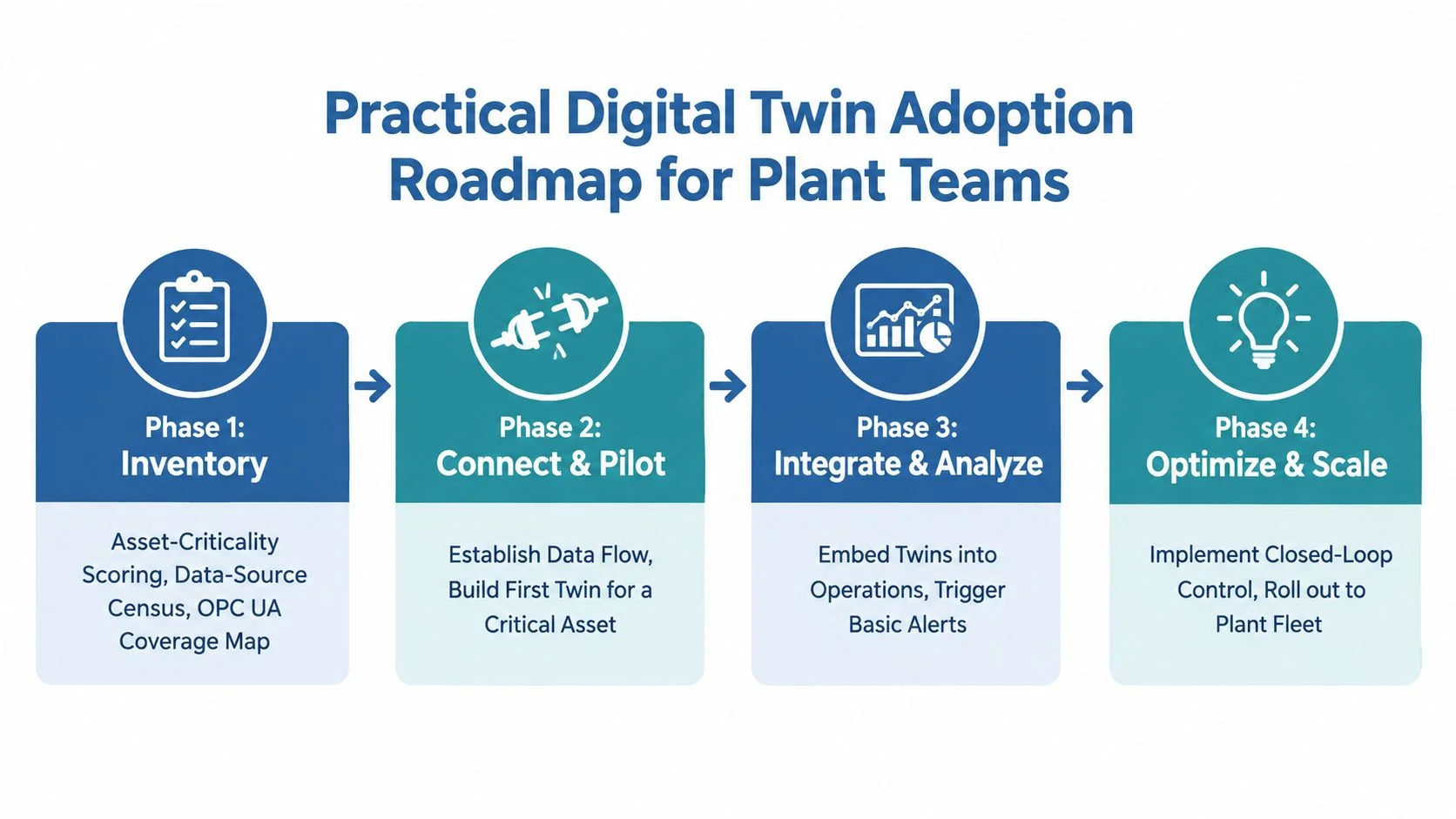
Plant engineers can make progress without starting with an enterprise platform. The roadmap below keeps each phase tied to an exit criterion, so the project advances because evidence improved, not because a vendor delivered another demonstration.
Phase 1, Inventory
Score assets by production criticality, failure consequence, observability, and the authority available to intervene. Census the data sources, including PLCs, SCADA, historians, MES, QMS, CMMS, maintenance documents, and operator logs. Map OPC UA coverage and identify proprietary PLC structures that need gateway work or manual interpretation.
The exit criterion is a signed-off data readiness report. It should identify missing signals, timestamp conflicts, ownership, security constraints, and the KPI baseline. The common pitfall is assuming that a tag exists because a screen displays a value. A displayed value may be derived, sampled slowly, or unavailable outside the HMI.
Phase 2, Stand Up
Choose one asset class or tightly bounded process. Establish the historian pipeline, define the twin state, version the model, and assign a plant owner who can approve actions. Validate the baseline against two weeks of known operating states, including normal production, planned stops, changeovers, and relevant disturbances.
The exit criterion is a validated baseline model that reproduces those known states within an agreed operational tolerance. Don't train a complex model until the team can explain the deterministic baseline.
Phase 3, Operationalize
Put the twin into the daily operating rhythm. Use shift-huddle views, alarm tuning, maintenance work preparation, or operator recommendations. A closed-loop setpoint adjustment should begin with documented limits, approval rules, rollback behavior, and audit logs.
The exit criterion is a documented control loop with measurable KPI movement. If operators ignore the recommendation, investigate usability and trust before adding more algorithms.
Phase 4, Scale
Replicate the integration pattern across cells, then compose twins into a line-level model. ISO/DIS 23247-6 addresses configuration, communication, combination, and collaboration between manufacturing twins (ISO/DIS 23247-6). The common pitfall is scope creep. Scaling should reuse proven interfaces and state definitions, not restart an undefined enterprise model.
Common Pitfalls and Misconceptions
Model fidelity isn't the main brownfield differentiator. A high-resolution mesh can't compensate for missing sensors, drifting calibration, unaligned clocks, or an event taxonomy that changes by shift. Use the simplest model that supports the decision, then invest in observability and validation.
The single “enterprise twin to rule them all” also sounds better in strategy documents than it works on mixed plant floors. Different assets have different update rates, owners, safety boundaries, and model assumptions. Federated twins, connected through explicit interfaces, are usually easier to govern and replace.
A beautiful visualization with stale data is still stale data.
Cybersecurity, model versioning, and data contracts belong in the architecture from the beginning. NIST notes that current digital twin applications are still largely customized, expensive to create, and difficult to integrate with other systems (NIST brownfield review). That is an integration problem before it's a rendering problem.
3D visualization is another frequent misunderstanding. A renderer becomes part of a twin only when it carries semantic context, current state, history, and a useful service. Otherwise, it helps people explore geometry but doesn't support manufacturing AI.
Finally, don't chase autonomy before stabilization. Establish a deterministic baseline, validate state estimation, and make recommendations reviewable. Reinforcement learning or self-learning control should come after the plant has reliable data, explicit constraints, and a safe rollback path.
Evidence-Backed Case Studies and Metrics
ROI claims for digital twins require a baseline, a defined intervention, and a post-deployment measure. Without those details, examples involving CNC spindles, steel mills, or packaging lines should remain hypotheses rather than reported outcomes. Filling gaps with vendor language or remembered figures would weaken the analysis.
One documented 2025 metalworking case reported a 30% reduction in material waste, a 40% drop in rejection rate, and 233% ROI over five years (independent digital twin ROI coverage). Those results apply to that implementation, not to every factory. They do establish a practical pattern: bounded quality and material use cases are easier to measure than broad claims about enterprise transformation.
A separate Fresenius Medical Care digital twin case study is useful for evaluating how a named manufacturer connects twin work to operational improvement. Read it for the plant context, data inputs, intervention, and reported outcome. The same checks should apply to any case used in a business case.
| Use Case | Twin Type | Baseline Metric | Post-Deployment Metric |
|---|---|---|---|
| Metalworking waste and quality improvement | Process or asset-focused twin | Not stated in the verified evidence | 30% reduction in material waste and 40% drop in rejection rate |
| Metalworking financial outcome | Process or asset-focused twin | Investment baseline not stated | 233% ROI over five years |
| CNC spindle health | Asset twin | Not available in the verified evidence | Not available in the verified evidence |
| Steel mill energy optimization | Process twin | Not available in the verified evidence | Not available in the verified evidence |
| Packaging line throughput | Process or system twin | Not available in the verified evidence | Not available in the verified evidence |
The reviewed manufacturing literature covered 240 academic articles spanning digital twin concepts, enabling technologies, and 15 industrial application areas (manufacturing digital twin review). That breadth supports treating twins as an engineering stack serving multiple applications, not as a single pilot template. Procurement teams should request source-linked baselines, data descriptions, twin boundaries, intervention details, and evidence that the result survived brownfield integration. Case databases can identify comparable plants, but each comparison still needs validation against local equipment, controls, and data quality.
Connecting Digital Twins Back to AI for Manufacturing
A digital twin is the data substrate and operating context that makes manufacturing AI practical. Anomaly detection needs synchronized normal-operation data. Predictive maintenance needs asset identity, condition history, duty cycle, and maintenance events. Closed-loop optimization needs current state, constraints, and a controlled route from recommendation to action. Generative scheduling needs capacity, sequence rules, material availability, and process dependencies.
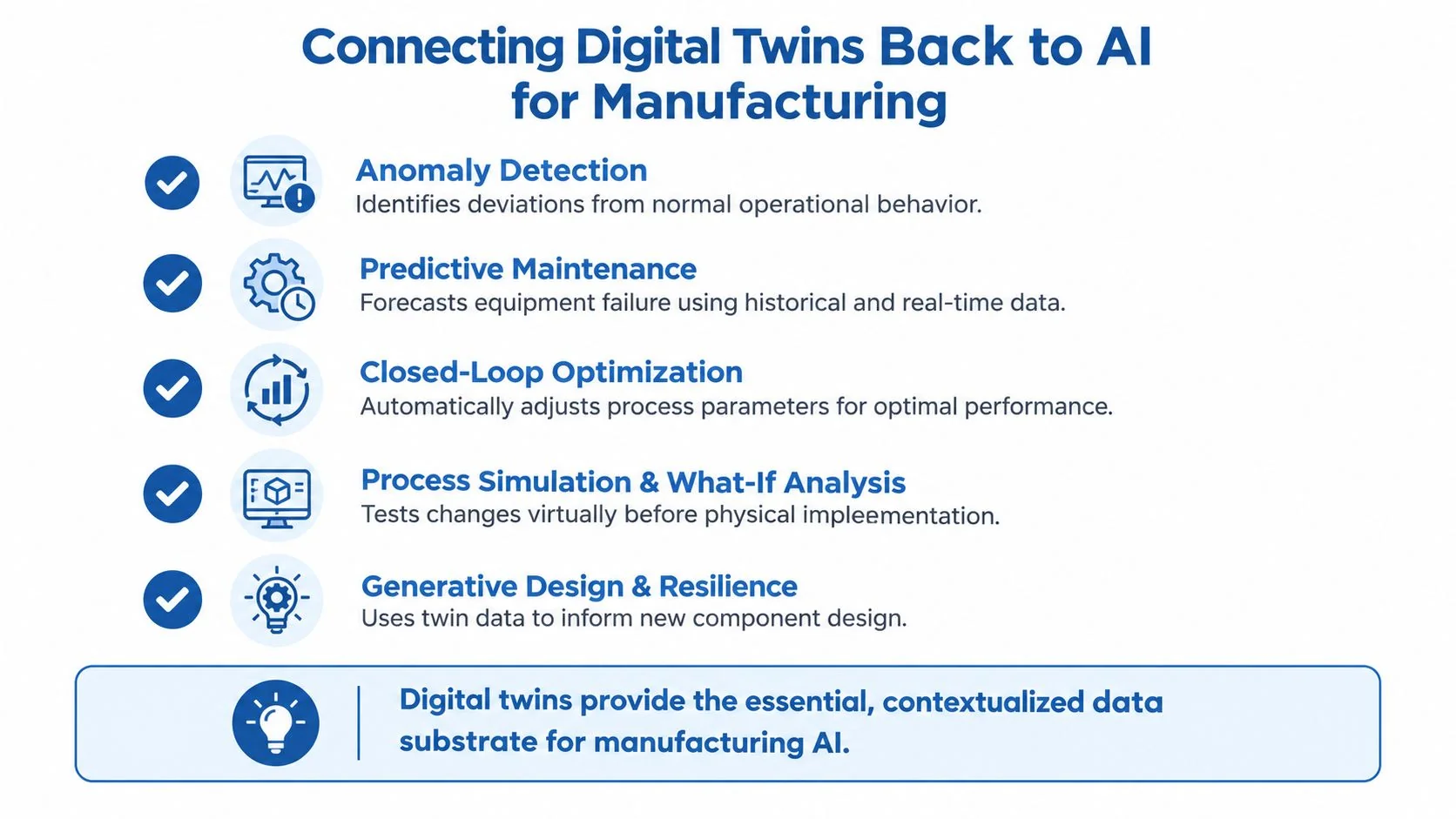
The twin is infrastructure, not the outcome. The outcome is a better factory decision, such as fewer unplanned stops, less scrap, or a schedule operators can execute. This distinction matters in brownfield plants, where tag mapping, historian gaps, and controls integration often limit value before model fidelity does. Define the decision and KPI first, then build only the twin boundary that supports them.
Adoption has moved beyond isolated experiments. The NIST assessment referenced broad organizational use of digital twin technology, including manufacturing adoption and longer-running deployments, but maturity does not guarantee clean data or reliable integration. The practical question is whether a plant can connect data to an action that survives production conditions. (NIST digital twin assessment)
This week, a plant team can take three concrete actions:
- Audit the instrumentation, tag quality, and event history of one production line.
- Define one KPI, its baseline, and the operational action intended to change it.
- Use the AI for Manufacturing database to shortlist two documented use cases, then test their data and integration requirements against the line.
Treat the twin as an iterative factory asset. Start with one synchronized asset, connect it to a measurable AI decision, validate the recommendation with operators, and scale only what continues to work in production.
Audit one critical line this week, document its data gaps and KPI baseline, then evaluate two twin-enabled AI use cases against that evidence before scheduling vendor demonstrations.
