Customer Solutions Manager Role: Duties, Skills and KPIs
Learn what a Customer Solutions Manager does in manufacturing AI, from responsibilities and skills to KPIs, governance and a job description template.
Written by AI for Manufacturing
A Customer Solutions Manager is the post-sale role accountable for turning a product's technical capability into measured customer outcomes after purchase. The job begins where the sale ends: it owns adoption, value realization, retention, and the governed handoff that keeps a system running inside a customer's operation. In a plant, that means three things held on one desk: adoption on the line, measured results against a stated baseline, and a documented handoff to support with named owners.
The surprise is where accountability usually goes missing. Most industrial AI failures I've reviewed weren't model failures. They were ownership failures after go-live, when nobody could say who owned the KPI, who could stop an automated recommendation, or which records proved the system stayed fit for use once the integrator left site.
Table of Contents
- What a Customer Solutions Manager Does
- Responsibilities and Skills at a Glance
- Running an AI Deployment from Requirements to Handoff
- Governance and Regulatory Readiness for Plants
- KPIs That Prove Value After Go-Live
- Pay, Hiring and a Job Description Template
- Benchmark Your Next AI Deployment Before You Hire
What a Customer Solutions Manager Does
The role grew out of customer-success work that software vendors formalized in the late 1990s. The first named customer-success group is generally traced to Vantive Corporation, a CRM vendor, in 1997, and the discipline gained wider visibility when Siebel OnDemand created a customer-success group in 2004 and Salesforce built comparable functions after 2007. That history explains the job's logic: software vendors moved customer outcomes from the buyer's responsibility to a named post-sale owner for adoption, value realization, retention, and expansion, as this customer success text from Wiley documents.
The title spread fast. The same source reports that the Customer Success Manager title increased by 736% between 2015 and the period studied, and it counted 153,654 recently posted customer-success-related jobs worldwide, with 30% located outside the United States. The profession went global rather than staying inside the North American software market.
That growth created a naming problem. Customer Solutions Manager, Customer Success Manager, Client Success Manager and related labels often describe overlapping duties across markets. Read the responsibilities, not the label. Employee count in the title is a poor guide; scope of ownership is a good one.
Here's the working test I use when a posting is ambiguous:
- It's a solutions role if the job owns outcomes after purchase: a baseline, a KPI, a named owner for adoption, and the authority to escalate a stalled deployment.
- It's support if the job answers tickets, documents fixes and closes cases, with no accountability for whether the customer ever hits the number that justified the purchase.
- It's project coordination if the job tracks tasks and schedules but hands off value measurement to someone else, usually nobody.
Practical rule: If you can't name the KPI this person reports and the person who receives it, you're hiring a coordinator, not a Customer Solutions Manager.
In plant terms, the role owns three outcomes. Adoption on the line means operators use the system inside their shift routine, not just during commissioning. Measured results against a stated baseline means avoided downtime, scrap reduction or first-pass yield improvement compared with a period someone wrote down before the pilot began. A governed handoff means the plant team holds an accountability matrix, an escalation path and training evidence when the vendor's engineer leaves.
Why this matters for anyone pursuing AI in manufacturing: the same post-purchase logic applies when a plant takes over an industrial or enterprise AI system from a vendor. The model is rarely the hard part. The hard part is reaching measured results with the people, records and escalation rules that outlast the pilot.
Responsibilities and Skills at a Glance
Survey evidence shows how wide the job is. In a survey of customer-success professionals, 78.5% identified product or service adoption as a primary responsibility, 76.2% cited renewals and churn, and 68.6% cited onboarding. The remainder of the portfolio, per the 2024 Custify customer success study, ran from customer-success operations at 65.7% and expansion revenue at 63.4% to business reviews at 58.1%, integration or implementation at 52.3% and support at 51.2%.
Read that distribution carefully. The four biggest items (adoption, renewals, onboarding, operations) tell you the role is built around keeping the customer successful enough to stay, not around answering questions. Support, at 51.2%, is the smallest listed item and still appears in half the responses.
The survey also hints at how the market prices this breadth: 38% of respondents received a salary increase of 10% to 30% during the prior year, while 2.3% received increases above 50%. Scarce cross-functional expertise moves pay.
| Responsibility Area | What the Role Owns | Evidence It Produces |
|---|---|---|
| Adoption and onboarding | Operator training, workflow integration and user enablement | Training completion and active-user rates |
| Implementation governance | Scope, milestones, risk and change control | Signed solution scorecard |
| Renewal and expansion | Retention analysis, expansion cases and executive reviews | Net revenue retention by cohort |
| Customer feedback loop | Routing field issues to product, engineering and support | Logged requests and resolution times |
| Compliance support | Documentation, activity logs and human-oversight evidence | Compliance-readiness checklist |
The skills map directly onto those rows. A manufacturing-facing manager needs to convert plant objectives, such as fewer unplanned stops on a filling line, into technical requirements an engineering team can build. That requires working knowledge of where MES, ERP and SCADA systems sit in the data path, and enough data literacy to read model drift and defend a KPI baseline. It also requires the stakeholder range to sit in a room with a shift supervisor, a plant IT lead, a procurement manager and a vendor's solution architect in the same afternoon and leave with one agreed next step.
The imbalance cuts both ways. A manager strong only in account relationships will miss implementation barriers, such as an integration that can't meet the latency the line needs. A manager strong only in technical delivery will ship a working system into a plant where nobody changed the shift routine, then discover the adoption and renewal risk on the quarterly review call. The survey numbers above describe a job that has to hold both.
Running an AI Deployment from Requirements to Handoff
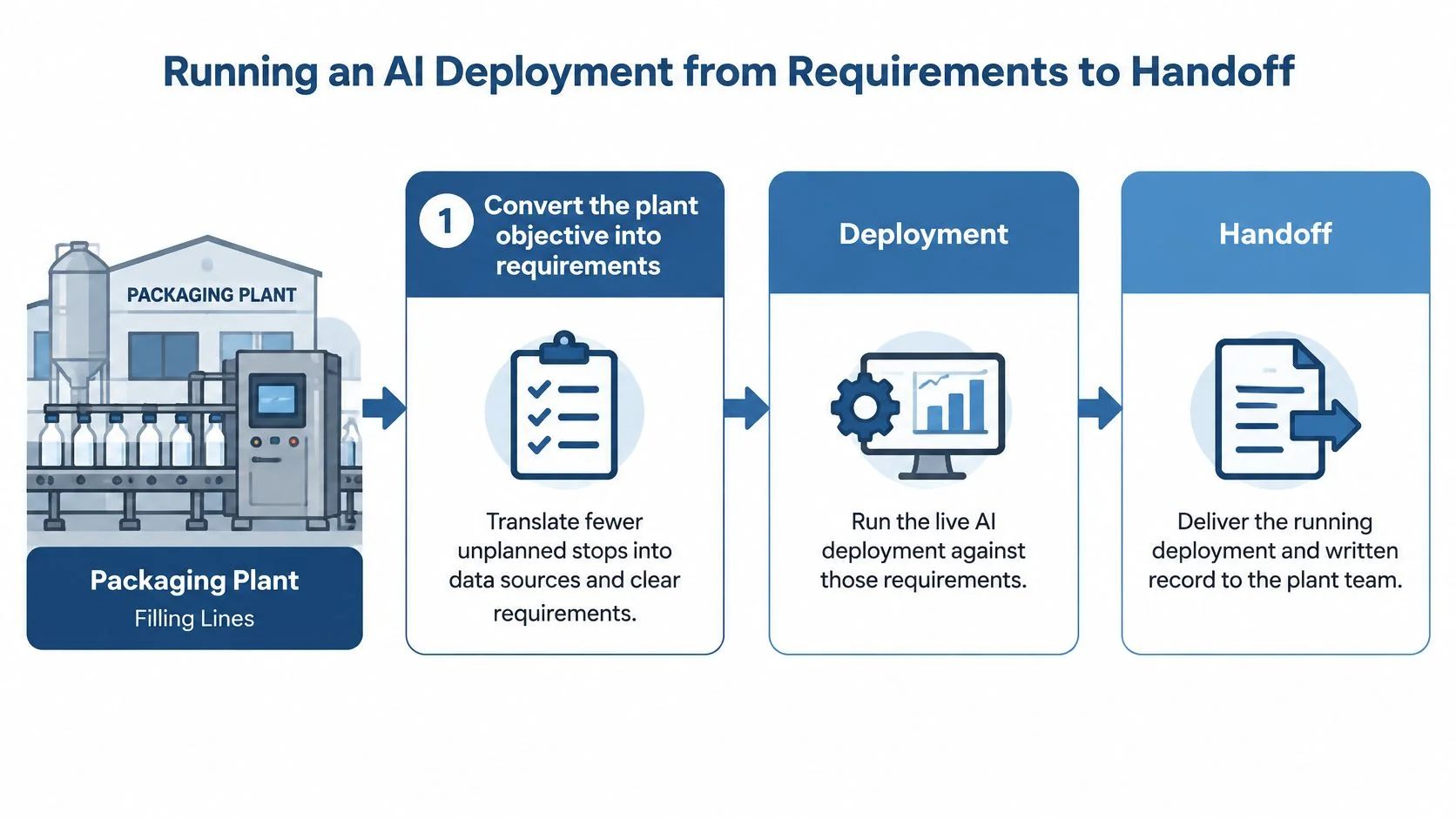
Take a packaging plant that wants fewer unplanned stops on its filling lines. The sequence below is the version I'd run, and it applies whether the system is predictive maintenance, visual inspection or process optimization.
1. Convert the plant objective into requirements. "Fewer unplanned stops" is not a specification. Written properly it names data sources, latency limits, model-performance thresholds, integration points with MES, ERP and SCADA, the operator workflow, cybersecurity constraints and a benefits-realization baseline. The requirements discipline that enterprise software implementations depend on, covering scope, schedules, resources, quality assurance, milestone reviews and handoff, is described in this technical solution manager role breakdown.
2. Sign a solution scorecard. Each requirement gets an owner, a validation method, an acceptance threshold and a post-deployment KPI, and the customer signs it. Without that artifact, a technically accurate model gets judged a business failure because nobody agreed in advance what success looked like, or a persuasive business claim scales without operational evidence behind it.
3. Keep a decision log. Assumptions, data-quality exceptions, model changes and unresolved risks go in one running record. You need it when performance shifts six months later and the argument becomes whether the model changed or the plant did.
4. Run a controlled pilot against a stated baseline. Use comparison lines or historical periods, and record confounders such as product mix and production volume. A pilot without a control is an anecdote with a dashboard.
5. Hold a production-readiness review before scale-up. This is the gate where you check monitoring, alert routing, retraining triggers and support coverage. Skipping it is how a pilot that worked on one line fails on the fourth.
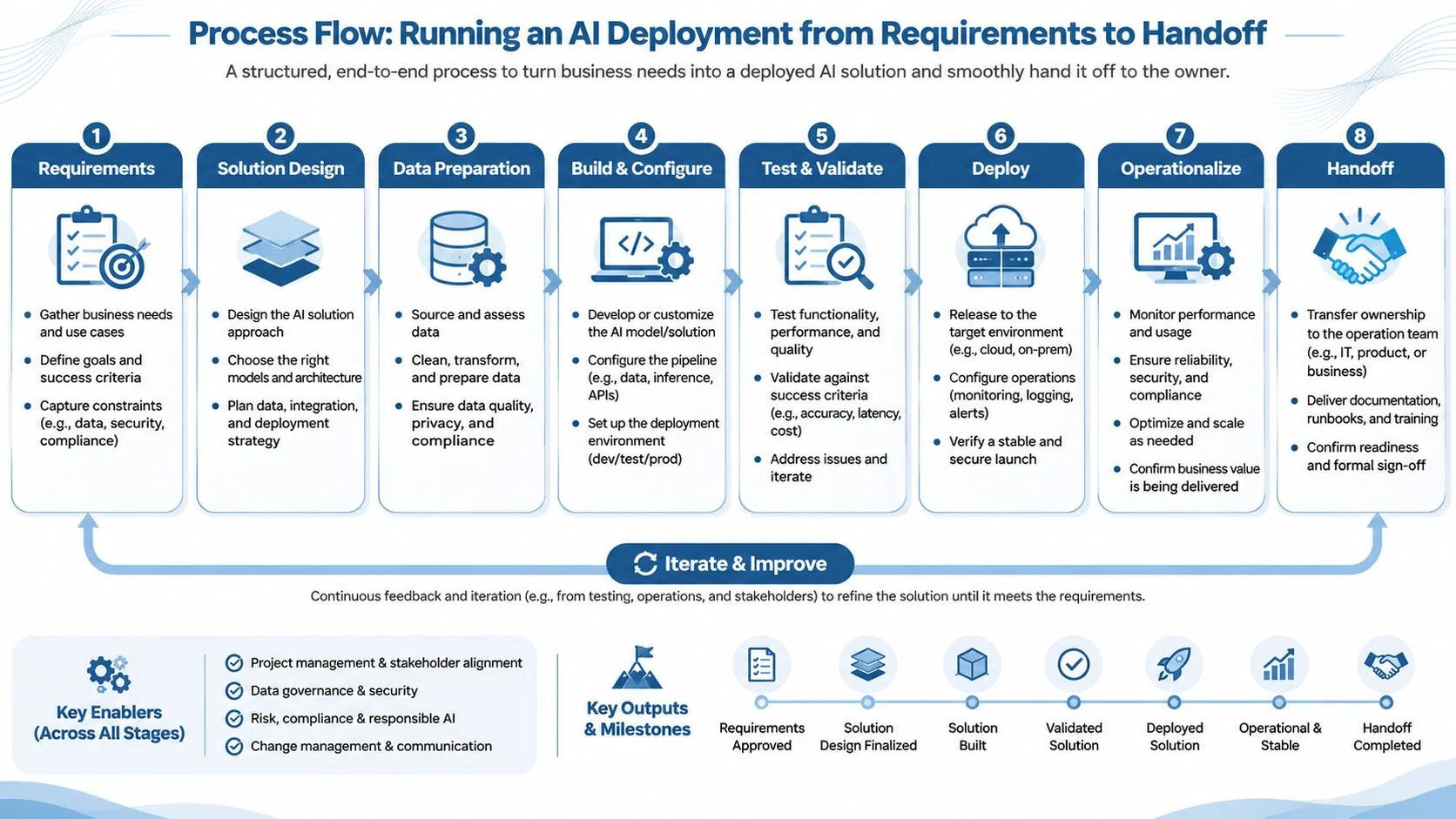
6. Hand off with records, not a demo. The handoff pack contains an accountability matrix, an escalation path and evidence that operators were trained, plus the monitoring plan. Then monitor two families of signal: technical ones such as drift and inference availability, and operational ones such as avoided downtime, scrap reduction and maintenance-response time. Manufacturing performance degrades when product mix, tooling, sensors or operating regimes change, so technical monitoring alone won't tell you the value is holding.
A requirements template saves weeks at step one, and the AI workflow automation requirements template is a usable starting structure for capturing operator workflows before engineering gets involved.
Where this gets harder in practice is the modelling layer itself. Industrial machine learning has constraints that consumer ML doesn't: small failure datasets, class imbalance, sensor drift and labels that arrive weeks after the event. The guide to industrial machine learning is worth reading before you write acceptance thresholds, because thresholds that look reasonable on a benchmark can be unachievable on a line with three failures per year.
Trade-off to settle early: a stricter acceptance threshold buys confidence and delays go-live. On a line losing significant output to unplanned stops, a looser threshold with tight human review usually beats a perfect model that ships a quarter later.
Governance and Regulatory Readiness for Plants
The assumption worth challenging is that a model which works technically needs no named owner. It does, and the framework says so in operational terms. NIST's AI Risk Management Framework requires organizations to define and differentiate roles for human-AI configurations and oversight under GOVERN 3.2, while MAP 3.5 requires human-oversight processes to be defined, assessed and documented, as set out in the NIST AI Risk Management Framework.
Translated into plant language, that means four written answers:
- Who reviews model alerts during each shift, and how quickly.
- Who can stop or override an automated recommendation, including during a production event.
- How escalation runs when an alert is contested or a recommendation conflicts with a maintenance instruction.
- Which metrics decide the system stays fit for use, and who signs that review.
These controls matter because AI used for visual inspection, predictive maintenance or process optimization touches safety, quality, uptime and product release decisions. An accountability matrix without override authority is a phone tree.
Then there's the regulatory clock. The European Commission states that obligations for high-risk systems listed in Annex III apply from 2 December 2027, while high-risk AI embedded in regulated products covered by Annex I applies from 2 August 2028, per the EU AI Act regulatory framework. The requirements include risk assessment and mitigation, high-quality datasets, activity logging for traceability, technical documentation, information for deployers, human oversight, resilience, cybersecurity and accuracy.
| Requirement or Date | Applies To | What the Customer Solutions Manager Does |
|---|---|---|
| Annex III high-risk systems | Standalone operational AI | Obligations apply from 2 December 2027; classify and document early |
| Annex I regulated products | AI embedded in regulated machinery | Obligations apply from 2 August 2028; confirm the machinery integration |
| Risk assessment and logging | All high-risk deployments | Keep risk mitigation records and traceable activity logs |
| Human oversight | Operator-facing AI | Name reviewers, override authority and the escalation path |
| Technical documentation | Every plant handoff | Record intended purpose, data governance and model changes |
The first check is classification: is the AI a standalone operational application, or is it embedded in regulated machinery? That answer decides which date applies, and it's far easier to establish before rollout than after an audit request. Build the compliance-readiness checklist into the customer success plan from the start, covering intended purpose, data governance, activity logs, model-change records, operator instructions and evidence of human oversight.
Plants care about this commercially, not just legally. A plant can reject or delay a system that can't produce traceable records or show who was responsible for oversight, and procurement teams increasingly ask. The same documentation speeds commissioning, incident investigation, supplier due diligence and expansion from one line to several sites. The ISA-95 hierarchy is the other piece of scaffolding worth knowing well, since it determines where data originates and which layer a deployment touches: ISA-95 standards explained.
KPIs That Prove Value After Go-Live
Measure this role through a causal chain, not a satisfaction score. Time-to-value and adoption are leading indicators; renewal, gross retention and expansion are lagging commercial outcomes. Satisfaction surveys sit outside the chain because they move independently of both.
Net revenue retention is calculated as:
NRR = (Starting ARR + Expansion − Contraction − Churned ARR) / Starting ARR
The formula's weakness is that expansion can conceal account losses, so gross retention needs its own line. OpenView's customer-success benchmark, summarized in this customer success metrics benchmark, identifies an 85% net-renewal threshold below which companies are likely struggling to grow efficiently, and reports that expansion revenue reached a median of 21% of revenue even among the largest surveyed companies.
Those figures are software-economy numbers. Don't copy them into industrial AI. Contract duration, deployment complexity, plant count and implementation cost all shift the economics, and a plant paying for integration across three lines is not a SaaS account buying seats.
| KPI | Type | What to Track | Reference Point |
|---|---|---|---|
| Time-to-value | Leading | Days from deployment to first measured benefit | Defined in the scorecard before go-live |
| Adoption | Leading | Active operators and workflow use per shift | Training completion as the floor, not the target |
| Milestone completion | Leading | Planned versus completed acceptance steps | Every threshold in the signed scorecard |
| Gross retention | Lagging | Revenue kept from the starting base | Report separately from expansion |
| Net revenue retention | Lagging | (Starting ARR + Expansion − Contraction − Churned ARR) / Starting ARR | Can hide account losses |
| Net renewal | Lagging | Share of contracts renewed | 85% threshold (OpenView) |
| Expansion revenue | Lagging | Added plants or use cases | Median 21% of revenue for the largest companies (OpenView) |
For each deployment, write a value hypothesis before implementation. "Reduce unplanned downtime by a stated percentage within a named baseline period" is a usable form. Then compare treatment plants with a historical or control baseline and document confounders such as production volume and product mix, which is the same discipline the controlled pilot above depends on.
Report by cohort, not by average: customer segment, use case, deployment stage and plant. A blended number hides the line that isn't working. Keeping leading and lagging indicators tied to one written baseline is the part teams skip, and measuring outcomes after go-live covers how to hold that connection when the deployment moves to a second plant.
Who receives this reporting matters as much as the numbers. Procurement and operations leaders need an auditable basis to scale to the next plant, so the manager, not the account executive, signs the value claim.
Pay, Hiring and a Job Description Template
Set the budget against two different measures, because postings often quote one and candidates quote the other. PayScale reports an average U.S. base salary of $80,000 for a Customer Solutions Manager in 2026, with a base-salary range of $56,000 to $110,000, according to PayScale salary data. That's base only. Total compensation includes variable components, so a $181,000 median U.S. total compensation figure reported by Levels.fyi describes a different quantity than the base range, and comparing them directly is a mistake. If your offer mixes base, bonus and expansion-linked variable pay, show the split explicitly.
The bigger risk in hiring is a posting that describes a coordinator. Write the job around outcomes with this structure.
- Role purpose in one sentence. Name the outcome, not the activity: accountable for measured customer results after go-live across named plants.
- Scope. Plants, sites, use cases and product lines, with the count and the geography.
- Responsibilities. Requirements translation, ownership of the solution scorecard, pilot execution, production-readiness review, handoff and KPI monitoring.
- Required skills. Manufacturing process knowledge, integration literacy across MES, ERP and SCADA, and data literacy sufficient to read drift and defend a baseline.
- Governance duties. Escalation paths, override authority, oversight evidence and regulatory classification support.
- KPIs owned. The specific metrics with the baseline period stated, so the hire knows what they'll be judged on.
- Experience. Industrial deployments with measurable outcomes, not generic account management. Ask for the baseline they used and what confounders they documented.
Describe duties and measurable outcomes rather than leaning on the title, since Customer Solutions Manager and Customer Success Manager postings overlap heavily. A candidate filtering on titles will miss relevant people, and a candidate reading duties will self-select correctly. If posting volume across several roles is becoming the bottleneck, tools that simplify your recruitment process help, but they can't fix a vague scope statement.
Benchmark Your Next AI Deployment Before You Hire
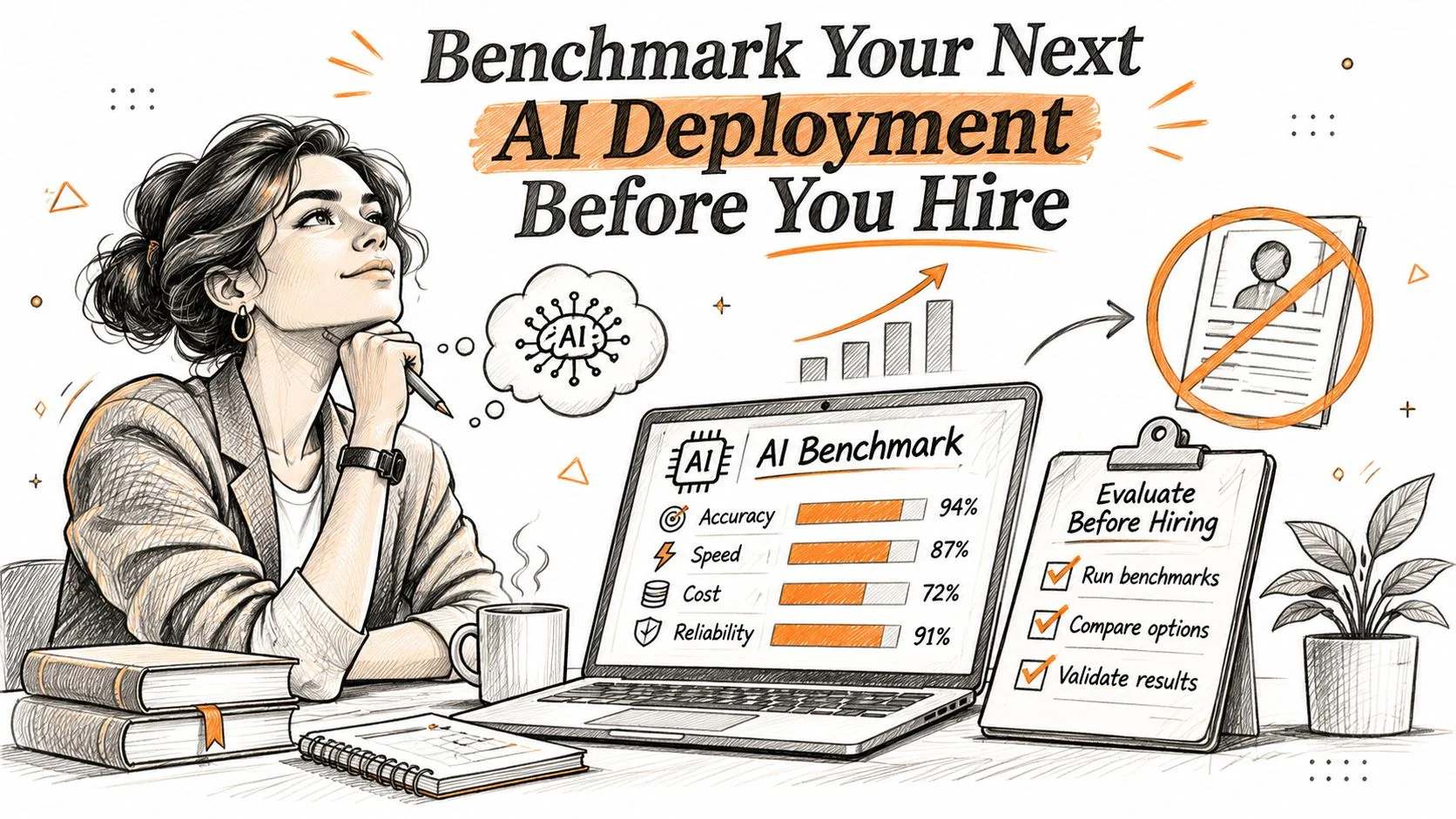
Before you approve a hire or greenlight a pilot, benchmark one live deployment against four checks and write each answer down. This is the cheapest diligence available, and it takes an afternoon.
- Value baseline and owner. Confirm a baseline exists and that a named person reports the KPI to a named recipient. If the answer is "the vendor reports it", you don't have an owner.
- Escalation and override. Confirm the escalation path and the individual with override authority over the system during a production event.
- Regulatory classification. Confirm whether the deployment is Annex III or Annex I, and therefore which EU date governs it.
- Traceability. Confirm the vendor can supply activity logs and model-change records on request, not on promise.
Any missing answer is a pilot-approval blocker, not a fix for later. Retrofit governance costs more than design-time governance, and plants are unforgiving about systems they can't audit.
For anyone budgeting the hire, the fully loaded cost is more than salary plus benefits. The hiring cost math for founders is a reasonable way to size the recruiting side before you commit to a plant-level role.
For comparable evidence, our case study directory lets plant managers, operations leaders and engineering teams filter records by industry, use case, technology and company, with links back to original sources wherever available. A weekly briefing sends new case studies, vendor updates and implementation data to manufacturing professionals tracking this over time.
The Customer Solutions Manager is the role that turns a plant AI pilot into measured, governed production value. Hiring for it well, or checking that the role exists before approving a pilot, protects the investment long after the model has left the sandbox. Start with the four checks above, then browse manufacturing AI case studies by industry, use case and technology to see how comparable deployments were scoped, measured and handed off.
