AI Use Cases in Manufacturing: 10 Examples for 2026
Explore 10 AI use cases in manufacturing across maintenance, quality, planning, and safety, with metrics, tips, and links to source case records.
Written by AI for Manufacturing
AI use cases in manufacturing are software applications that analyze production, equipment, quality, planning, or workforce data to predict conditions, detect variation, recommend actions, or support operational decisions. The strongest applications solve a defined plant problem and connect to an existing workflow, rather than adding another dashboard. The ten workflows below are grouped by maintenance, quality, process control, planning, supply chain, automation, energy, safety, and shop-floor knowledge. Each entry separates reported outcomes from independently documented evidence, then ends with baseline metrics and pilot checks. That distinction matters because Deloitte reports that 84% of manufacturers generate measurable value from AI, while only 20% of use cases have reached scale (Deloitte's manufacturing AI analysis). Start with a workflow your plant already measures, and use these predictive maintenance AI examples as a reference point rather than a substitute for local validation.
Table of Contents
- 1. Predictive maintenance
- 2. AI-based visual quality inspection
- 3. Demand forecasting and production planning
- 4. Closed-loop process parameter optimization
- 5. Digital twins with AI simulation
- 6. AI-guided robotic picking and adaptive automation
- 7. AI-driven energy management and optimization
- 8. Inventory and supply-chain risk prediction
- 9. Computer vision for worker safety and PPE compliance
- 10. Generative AI assistants for shop-floor knowledge and work instructions
- 10 AI Use Cases in Manufacturing, Comparison
- Turning These AI Use Cases into a Funded Plant Pilot
1. Predictive maintenance
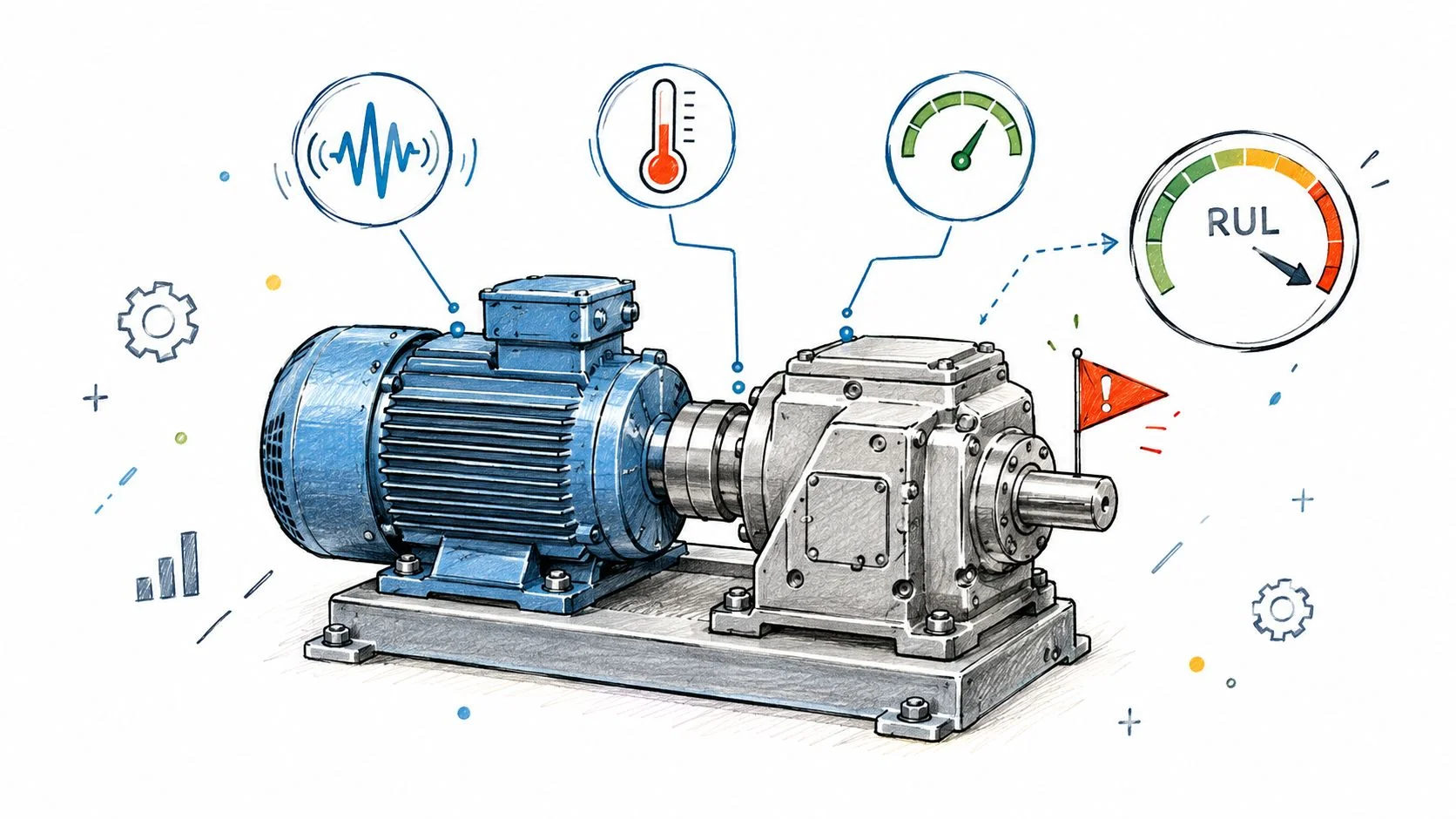
Unplanned equipment failure stops production, disrupts schedules, and creates urgent maintenance work. Predictive maintenance models analyze vibration, temperature, pressure, current, and acoustic-emission signals to detect abnormal patterns before a component fails. They can flag an anomaly, estimate failure risk, or suggest a remaining-useful-life window. The signal matters only when planners and technicians can act on it.
The practical advantage is access to existing historian and condition-monitoring data without changing the production process. Siemens Senseye, Augury, and Uptake are established platform examples, but their downtime-reduction figures are vendor-reported, not universal benchmarks. NIST identifies predictive or preventive maintenance as a leading manufacturing AI application, reported by 54% of surveyed respondents (NIST report on AI in manufacturing).
Pilot checks
Choose one bottleneck asset with a known failure cost. Maintenance technicians should label historical failures and separate bearing wear, lubrication issues, electrical faults, and process-induced events. A model that detects “something unusual” without identifying an actionable failure mode will struggle to gain trust.
Track mean time between failures, unplanned downtime hours, false alarms, diagnosis time, and work-order backlog. Run the model in shadow mode before it can create work orders. Connect it to the CMMS, asset hierarchy, and technician notes, and assign an owner to review alerts. Teams assessing IoT sensors for predictive maintenance should confirm that the proposed measurements capture the failure modes that matter at their plant.
2. AI-based visual quality inspection
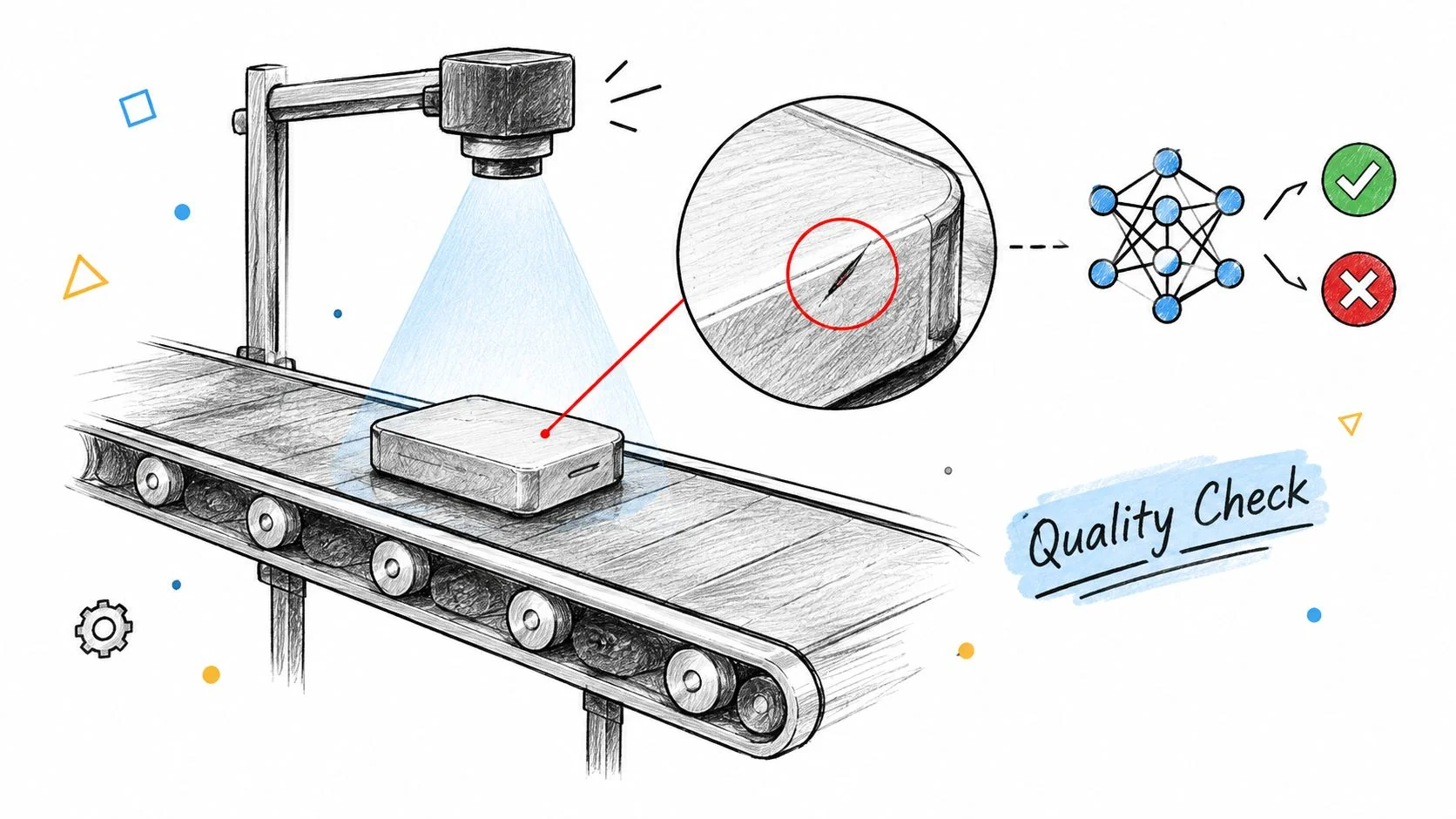
Escaped defects create scrap, rework, warranty exposure, and customer risk. On a fast line, AI vision can inspect surfaces, component presence, assembly, and dimensions without slowing production. The plant problem comes first: inconsistent lighting, camera placement, product variation, and vague defect definitions can undermine a model before its architecture becomes relevant.
Quality improvement is a commonly reported manufacturing AI application in surveys, and the published computer-manufacturer case study provides a more specific plant example. Its autoencoder exceeded a Faster R-CNN baseline by as much as 12.89 percentage points in mean average precision in a one-labeled-defect setting. The study also estimated about 150 person-years of labor saved and roughly US$2 million in annual cost at one factory (the published computer-manufacturer case study). These results are case-specific, not a forecast for every line.
Pilot checks
Measure both escape rate and overkill rate. A system that catches more defects but rejects too many good parts can reduce yield. Quality engineers should define the defect taxonomy before labeling begins, and the pilot should report false negatives by defect type, not only aggregate accuracy.
Document baseline defect rate, inspection cycle time, rework, and downstream escapes. Test with supplier, material, and product variation. Plan retraining when those conditions change, and use industrial vision systems as a quality-system intervention, not a camera installation.
3. Demand forecasting and production planning
Demand volatility forces plants into two costly choices: hold excess inventory or miss delivery commitments. AI forecasting combines orders, seasonality, pricing, promotions, and other planning signals to estimate demand by product and period. Its value depends on whether those estimates improve capacity allocation, material planning, production schedules, and sales and operations planning. A production planning and scheduling guide can help define how the forecast enters that workflow.
Coca-Cola's Tuas Bay facility combined machine-learning-supported demand forecasting with robotics and advanced scheduling. Reported results included 28% higher output, 70% higher labor productivity, 80% fewer product shortages, and a 31% improvement in on-time delivery. This is a broader digital-operations result, not evidence that a forecasting model alone caused every improvement. Treat the figures as a documented site example, not a transferable forecast.
Planners should retain decision authority. Their overrides capture promotions, customer behavior, supply constraints, and unusual events that may be absent from training data. Platforms such as o9 Solutions, Blue Yonder, and Kinaxis can support the process, but clean master data and disciplined review remain plant responsibilities.
Pilot checks
Benchmark current forecast accuracy by SKU class with an agreed measure such as MAPE or WAPE. Start with high-volume or high-value products, compare the model with the existing planning process, and track forecast value added.
Then measure operational effects: inventory, schedule adherence, shortages, and expedite activity. Test who accepts the forecast, when overrides are permitted, and how approved changes reach the ERP or APS system. A pilot should also record override reasons, latency, and planner adoption before the plant commits budget.
4. Closed-loop process parameter optimization
A process can be stable and still run below its economic optimum. Closed-loop optimization models process behavior and recommends, or eventually applies, changes to variables such as temperature, pressure, flow, feed rate, or residence time. This differs from a reporting dashboard because the system influences operating decisions.
At CITIC Pacific Special Steel, AI was used to predict blast-furnace behavior and optimize production parameters. The reported result was a 15% increase in throughput alongside an 11% reduction in energy consumption (McKinsey's manufacturing lighthouse analysis). Treat this as a documented site result, not a guaranteed outcome. Existing advanced process control, operator practice, raw materials, and safety limits all affect transferability.
Pilot checks
Begin in advisory mode. Operators should accept or reject recommendations while the system logs the predicted effect and the actual result. Process safety engineers must define hard constraints before model training, including temperature, pressure, chemistry, quality, equipment protection, and emissions limits.
Baseline throughput per hour, energy per unit, yield, off-specification rate, interventions, and operator overrides. Test whether the existing APC layer can host the model before purchasing a parallel control stack. A model that raises throughput while increasing scrap or equipment wear isn't an improvement.
5. Digital twins with AI simulation
Production changes are expensive when teams discover problems only after commissioning. A digital twin represents a line, cell, or plant with synchronized operational data. AI components can test schedules, layouts, process settings, or capacity scenarios before engineers change physical equipment.
BMW has described using NVIDIA Omniverse for factory planning and training. Siemens provides digital-twin tools through its Xcelerator portfolio, and Dassault Systèmes supports virtual manufacturing planning. These examples show the role of a twin as an engineering and decision environment, not just a three-dimensional rendering of a factory.
Pilot checks
Limit the first deployment to one line or cell and one decision. Calibrate it against actual production data before using it to approve a change. The model owner must remain responsible after commissioning, because obsolete routing logic, cycle times, or asset states will undermine results.
Useful measures include schedule feasibility, predicted versus actual cycle time, commissioning rework, throughput constraints, and changeover effects. The twin can also validate scheduling or optimization models before they influence production. That makes it a foundation for other AI use cases in manufacturing, rather than an isolated visualization project.
6. AI-guided robotic picking and adaptive automation
Fixed automation struggles when parts arrive in different orientations, shapes, or conditions. AI-guided picking combines cameras, grasp estimation, and motion planning so a robot can identify and handle variable parts without a dedicated fixture for every position. This expands automation into mixed-model and lower-volume production, but it also introduces perception failures that conventional automation avoids.
Covariant develops AI-based robotic picking systems, while Universal Robots and ABB offer collaborative robot platforms that can be combined with vision systems. NVIDIA Isaac provides simulation and perception tools for robotics development. These product examples demonstrate available approaches, not a universal business case.
Pilot checks
Define grasp success rate, cycle time, recovery time, and acceptable human intervention before testing. Use real variation, including dirty, damaged, reflective, and partially hidden parts. Clean demonstration samples produce misleading confidence.
Safety validation must cover the complete cell, not just the robot arm. Include applicable requirements such as ISO 10218 and ISO/TS 15066, then compare total cost of ownership with conventional automation for the same task. In some plants, a fixture remains cheaper, faster, and easier to validate. AI is justified when variation is the constraint, not because adaptive automation sounds more advanced.
7. AI-driven energy management and optimization
Energy waste often starts with idle equipment, poorly sequenced utilities, compressed-air leaks, or schedules that ignore production conditions. AI combines meter, production, weather, and equipment data to forecast demand, identify anomalies, and recommend load shifts or setpoint changes. The plant problem comes first: savings must not reduce throughput, quality, or delivery performance.
A World Economic Forum report on Global Lighthouse Network factories described an average 22% reduction in energy consumption through process modeling and root-cause analytics. That network-level result reflects wider digital operations, so treat it as evidence of potential, not a guaranteed plant outcome. Schneider Electric's EcoStruxure and Siemens industrial energy-management tools are examples of platforms that can support this workflow.
Pilot checks
Verify sub-metering for the largest energy-consuming systems before modeling. Establish a seasonal baseline and define the savings method before deployment. Separate production-volume effects from genuine efficiency gains, and require recommendations to respect constraints such as minimum furnace temperature and compressed-air pressure.
Start with a narrow process where operators can review each recommendation. Measure energy per accepted unit, peak demand, idle consumption, production output, and off-specification events. Compare results with the baseline, and record overrides. A schedule that reduces electricity use but causes late orders has shifted cost rather than created value. Evidence is strongest when plant measurements confirm savings without harming output or quality.
8. Inventory and supply-chain risk prediction
A missing component can stop a line even when the part has modest purchase value. AI risk models combine supplier performance, lead-time history, logistics signals, inventory, and production requirements to flag likely shortages and recommend review actions. This extends AI beyond the plant floor into procurement and materials planning.
The practical mistake is to prioritize parts by spend alone. A low-cost component with no substitute may have greater operational risk than an expensive item with multiple qualified suppliers. Blue Yonder and Kinaxis offer supply-chain planning capabilities, while Resilinc and Everstream Analytics focus on supplier and disruption intelligence. Consultancy claims about inventory reductions and service improvements should be checked against plant baselines.
Pilot checks
Clean supplier master data, part relationships, lead times, and purchase-order history first. Rank components by line-stoppage impact, then use risk scores to trigger review meetings rather than automatic sourcing changes during the initial deployment. Procurement needs to understand why a part was flagged.
Track stockout frequency, line interruptions, expedite spend, service level, inventory value, and planner overrides. Teams reviewing stock planning with MA Hydraulics Ltd should apply the same discipline to their own material constraints. A prediction that nobody can act on is only another alert.
9. Computer vision for worker safety and PPE compliance
Safety teams need earlier signals than injury records provide. Vision systems can detect missing PPE, restricted-zone entry, unsafe proximity, or other defined conditions using existing or added cameras. They can create real-time alerts or aggregate patterns by area and shift, but surveillance design can damage trust if the system becomes an individual disciplinary tool.
Intenseye, Viisights, and Protex AI provide industrial safety-analytics products. Vendor-reported improvements commonly emphasize compliance rates, while independent evaluation is less common. The evidence standard should therefore include detection performance, false alerts, response behavior, and whether the system changes leading indicators such as near-miss reporting.
Pilot checks
Involve works councils, unions, or employee representatives before installation. Define what data is stored, how long it remains available, and who can access it. Prefer aggregated trend analysis over individual punishment, especially during the learning phase.
Measure PPE compliance, near misses, alert response time, false alerts, restricted-zone events, and worker acceptance. The use case matters to AI for manufacturing programs because it tests governance as much as computer vision. A technically accurate system can still fail if employees avoid, distrust, or work around it.
10. Generative AI assistants for shop-floor knowledge and work instructions
Technicians lose time searching manuals, maintenance histories, standard operating procedures, and shift notes. A generative AI assistant can retrieve approved documents, summarize equipment history, answer troubleshooting questions, and draft work instructions. It should not invent a procedure or replace authorization for safety-critical work.
A biopharmaceutical manufacturing operation reported that a generative-AI maintenance copilot reduced execution time by 30% and cut corrective-maintenance workload by 40% to 50% (McKinsey's biopharma operations analysis). The result is a reported operational case, and the assistant's value depends on controlled records, retrieval quality, and workflow adoption. Siemens Industrial Copilot is one commercial example, while cloud providers offer retrieval-augmented-generation frameworks for industrial document assistants.
Pilot checks
Restrict the first deployment to one equipment family and one controlled document set. Require a source citation in every answer, test responses against a known question set, and route generated work instructions through quality and safety review. Document versioning and access control aren't optional.
Measure time to diagnose, task completion time, answer accuracy, repeat failures, technician workload, and human overrides. Keep final maintenance authorization with qualified personnel. This is one of the newer AI use cases in manufacturing, so rigorous measurement matters more than a polished demonstration.
10 AI Use Cases in Manufacturing, Comparison
| Use case | Implementation complexity | Data & resource requirements | Expected outcomes / metrics | Ideal use cases | Key advantages |
|---|---|---|---|---|---|
| Predictive Maintenance | Medium, ML pipelines, integration with CMMS | Historical sensor/historian data, good tagging, sensors on critical assets | Reduced unplanned downtime; RUL estimates; failure probability; MTBF | Critical rotating equipment, bottleneck assets | Short path to ROI; condition-based maintenance; pilotable on single assets |
| AI-Based Visual Quality Inspection | Medium, CV models, edge deployment, camera standardization | Labeled images (or good-part images), consistent lighting, GPU/smart cameras | Defect rate, escape rate, false positives, throughput | Surface defects, assembly checks, high-volume visual inspection | Consistent inspections; auditable quality metrics; feeds root-cause analysis |
| Demand Forecasting & Production Planning | Medium, forecasting models + ERP integration | Historical orders, promotions, pricing, master-data quality | Forecast accuracy (MAPE/WAPE), inventory metrics, service level | SKU-level planning, S&OP, inventory reduction | Connects AI to financial outcomes; improves schedule adherence |
| Closed-Loop Process Parameter Optimization | High, control integration, safety reviews, APC/DCS interface | Dense process sensors, control system access, process engineering input | Yield, throughput, energy use, quality stability | Continuous processes (chemicals, refining, pharma, food) | Improves yield/efficiency without new capex; stabilizes quality |
| Digital Twins with AI Simulation | High, model building, calibration, cross-system sync | 3D/physics models, PLC/MES data, CAD/PLM links, significant engineering time | Reduced commissioning risk, throughput scenarios, changeover time | Line changes, commissioning, layout and throughput planning | Evaluates options before capital spend; shared engineering model |
| AI-Guided Robotic Picking & Adaptive Automation | High, perception, motion planning, safety integration | 3D vision, simulation for training, robot hardware, safety validation | Grasp success rate, cycle time, uptime | Mixed-model lines, bin picking, low-volume automation | Enables automation for variable parts; reduces fixture costs |
| AI-Driven Energy Management & Optimization | Low–Medium, analytics + controls or recommendation layer | Metering/sub-metering, production and weather data, energy models | Energy cost, peak demand, emissions intensity, savings % | Compressed air, HVAC, motors, furnaces, utilities | Quick verifiable savings; supports sustainability reporting |
| Inventory & Supply Chain Risk Prediction | Medium, forecasting + external signals, ERP integration | Supplier performance, lead times, market signals, master data cleanup | Stockouts, safety stock, expedite spend, risk scores | Critical components, multi-tier supplier risk management | Earlier disruption warnings; better working capital allocation |
| Computer Vision for Worker Safety & PPE Compliance | Medium, video analytics, governance, privacy controls | Camera coverage, labeled safety events, legal/privacy processes | PPE compliance rates, near-miss indicators, incident trends | EHS monitoring, high-risk zones, compliance programs | Continuous coverage; leading indicators for prevention |
| Generative AI Assistants for Shop-Floor Knowledge | Low–Medium, RAG pipelines, access control, validation workflows | Document repositories, version-controlled manuals, secure models | Task completion time, answer accuracy, adoption metrics | Maintenance troubleshooting, work instructions, shift handover | Faster access to technical knowledge; captures tacit expertise |
Turning These AI Use Cases into a Funded Plant Pilot
The best first project is not necessarily the most advanced one. Choose the workflow where four conditions already exist: a costly operational problem, a measurable baseline, usable data, and a person who owns the response. NIST's manufacturing findings point to maintenance, productivity and cost reduction, and quality improvement as practical starting points, with reported adoption of 54%, 50%, and 49%, respectively (the World Economic Forum summary). Those figures describe application prevalence, not a ranking of guaranteed returns.
Evidence quality should determine how aggressively you fund a use case. Separate independently documented case results from vendor-reported figures, consultancy estimates, and early demonstrations. Deloitte identifies implementation cost at 43%, technical expertise and resistance to change at 35% each, compliance concerns at 34%, and data-quality or availability problems at 30% as leading obstacles (Deloitte's manufacturing research). That explains why a technically strong model can still fail during integration.
Use a simple decision record before a vendor demo:
- Define the baseline: Record downtime, defect rate, energy per unit, forecast error, shortage frequency, or task time before deployment.
- Set the threshold: Decide what improvement would justify software, integration, training, monitoring, and ongoing support.
- Bound the pilot: Choose one asset, line, product family, document set, or supplier group.
- Assign ownership: Name the maintenance planner, quality lead, operator, engineer, or buyer who acts on the output.
- Plan the fallback: Specify what happens when data is missing, the model is unavailable, or the recommendation conflicts with operating constraints.
- Measure the workflow: Track adoption, overrides, false alarms, response time, and operational outcomes, not model accuracy alone.
Manufacturers also need to test whether a use case can scale. KPMG reports that 59% of manufacturing executives believe traditional KPIs are no longer sufficient for tracking AI performance, while 76% identify unreliable data as a major expected AI risk (the Manufacturers Alliance report). A successful pilot can become an isolated experiment if the second plant requires a new data model, new integrations, and new ownership structure.
For practical research, filter the AI for Manufacturing database by industry, workflow, technology, and company size. Its case records distinguish evidence levels and link to source material, which helps teams compare predictive maintenance, inspection, planning, process optimization, energy, safety, robotics, and document workflows without treating every claim as equally strong. Then review HireDevelopers.com if the project needs additional engineering capacity for integration or deployment.
Write down the baseline metric and success threshold before any vendor demo. That keeps the business case tied to plant economics and measured production outcomes instead of a model demonstration.
Choose one constrained workflow this week, document its current performance, and ask the people who operate it what evidence would change their decisions. Then compare documented AI implementations by industry, use case, and technology, select a pilot owner, and fund only the integration and measurement work needed to prove whether AI improves that specific manufacturing process.
