AI Data Cleansing Guide for Factory Sensors
AI data cleansing steps for plant sensors: outlier rules, alignment, labels, features, and a holdout check before predictive maintenance.
Written by AI for Manufacturing

AI data cleansing is the systematic identification and correction of errors, inconsistencies, inaccuracies, duplicates, invalid values, and missing information in datasets before or during model use.
Cleaning data can consume nearly as much effort as using it: Anaconda's State of Data Science research found that data professionals spent about 45% of their time loading and cleansing data, according to Docsumo's review of data-quality costs. In a factory, the objective is not only to remove suspicious records. It is to distinguish recording faults from the rare failures, startups, and abnormal batches that a useful predictive model must recognize.
Table of Contents
- AI Data Cleansing Acceptance Tests for Every Source
- How to Clean Manufacturing Sensor Data
- Align Timestamps and Build Leak-Free Features
- Clean Defect Labels Without Dropping Rare Failures
- Example Pipeline and Tool Stack
- Run Cleansing as a Shift-Level Control
- Measure the Payoff and Choose a Plant Use Case
AI Data Cleansing Acceptance Tests for Every Source
Turn data quality into a release specification before choosing a cleansing algorithm. IBM's data quality management guidance defines six dimensions: accuracy, completeness, consistency, timeliness, validity, and uniqueness. Apply them separately to each source and production line.
Six data-quality tests for a manufacturing AI source
| Dimension | Plant acceptance test | Typical fail |
|---|---|---|
| Accuracy | Reading, status, or label matches the real event | Vibration peak stored on the wrong bearing |
| Completeness | Cycle time, asset ID, timestamp, variant, and failure code exist | Cycle time blank on changeover |
| Consistency | Same asset, unit, and defect name across MES, SCADA, historian, ERP, and quality | P-204, Pump204, and 204 |
| Timeliness | Value arrives inside the use-case delay limit | Correct temperature too late for the detector |
| Validity | Format and physical operating range are legal | Pressure of -999 or text N/A |
| Uniqueness | One event per defined key | Duplicate count doubles production volume |
A passing format check doesn't establish accuracy. A vibration reading can be numeric, timely, and physically plausible while belonging to the wrong bearing. Verify representative records against maintenance evidence, production orders, and inspection decisions.
Define completeness by record type. A failure code may be mandatory for a failure event but legitimately absent from a normal production cycle. Distinguish not applicable, not recorded, and sensor unavailable rather than converting them all to blanks.
Score the source, not the company
A company-wide average can hide a defective quality feed behind a large volume of clean routine telemetry. For manufacturing AI, errors in a rare-defect set deserve separate attention because they can distort the relationship the model needs to learn.
Use a manufacturing data collection specification to settle source ownership and capture requirements. Where laboratory measurements feed production models, Polymerize's guide to reliable experimental data offers a complementary reference for experimental-data assurance.
Before training, write field-level rules for physical ranges, timestamp tolerance, mandatory identifiers, approved units, and duplicate keys. Assign each failed test an explicit outcome: stop the release, quarantine the record, or request review.
How to Clean Manufacturing Sensor Data
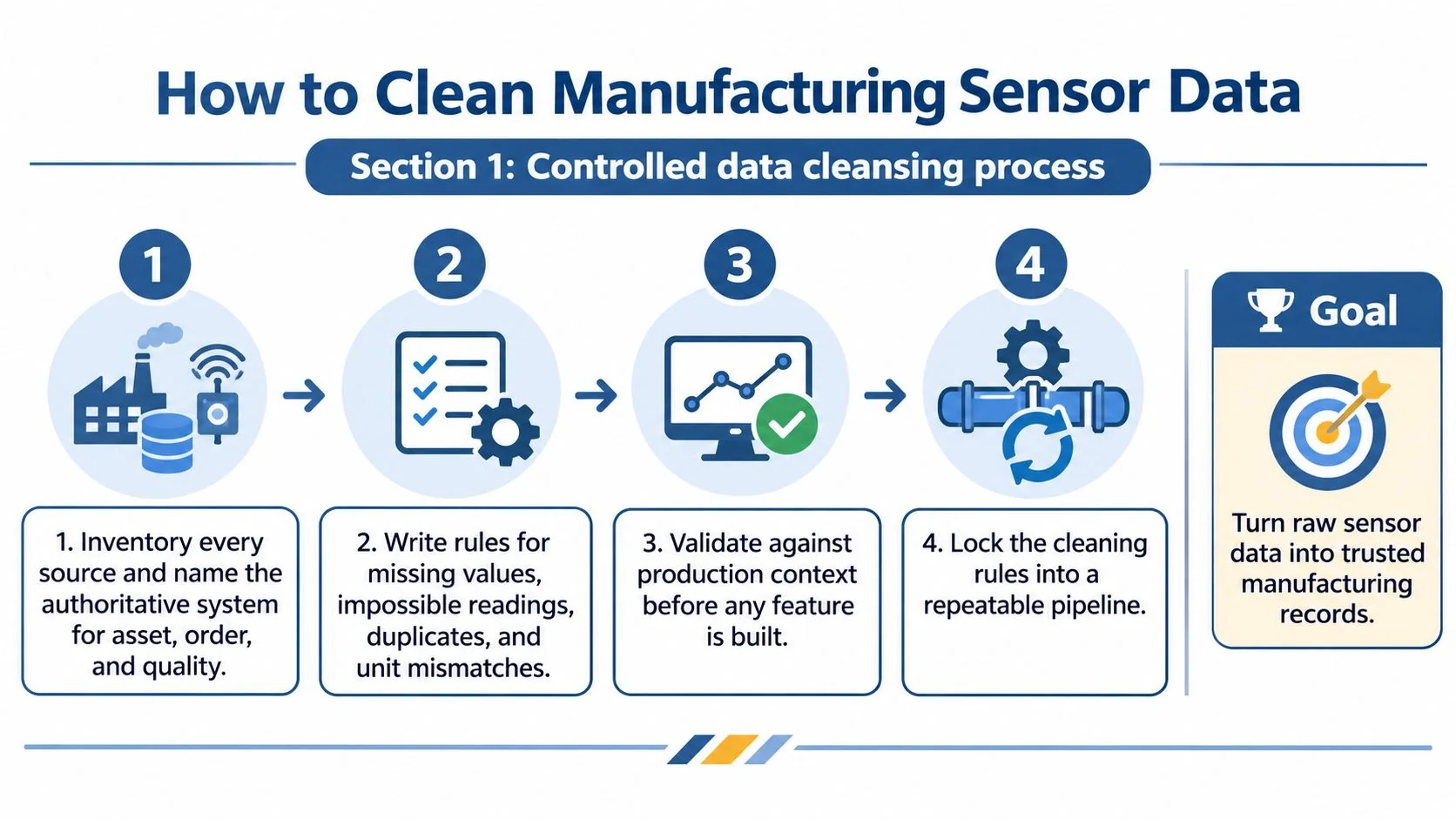
Run cleansing as controlled engineering, not an editable notebook that nobody can reproduce. The NIST-hosted AI risk-management submission recommends cataloging data, identifying authoritative sources, resolving inconsistencies, checking outliers and train/test separation, and examining false-positive versus false-negative impacts.
- Inventory the sources. Name the authoritative system for asset identity, production orders, and quality outcomes. Record extraction paths and responsible owners.
- Write a data dictionary covering units, timestamps, time zones, asset IDs, defect labels, null meanings, and acceptable ranges.
- Profile before changing anything. Measure accuracy, completeness, consistency, relevance, and timeliness. Detect schema drift, including renamed tags and changed field types.
- Identify duplicates, impossible readings, statistical outliers, and conflicting labels. Choose treatment by defect type, not a universal delete rule.
- Reconcile corrections to source systems. Store the raw value, transformed value, rule ID, and responsible actor so reviewers can reconstruct each decision.
- Gate release using production-period and asset-level holdouts, not random row splits that distribute repeated measurements across training and evaluation.
Choose treatment from physical context
Treatment rules for common plant data defects
| Defect | How to detect | Allowed action | Do not |
|---|---|---|---|
| Physically impossible value | Outside engineered process limit | Quarantine and keep raw row | Replace with a mean |
| Unusual but possible value | Beyond statistical limit, inside physical limit | Retain and flag for review | Delete as an outlier |
| Short missing gap | Gap shorter than the documented limit | Interpolate and set a missingness flag | Fill silently |
| Long sensor outage | Gap longer than the use-case limit | Quarantine the window | Invent a continuous signal |
| Clock skew | Timestamp outside tolerance or wrong zone | Correct with a logged offset | Join on raw clocks |
| Unit mismatch | Celsius versus Fahrenheit or bar versus psi | Map through the unit dictionary | Leave mixed units |
| Duplicate event | Same asset, timestamp, and signal key | Keep one and count the duplicate | Train on both copies |
| Rare real failure | Matches a known failure mode or startup | Keep and label | Drop as noise |
Say a press reports pressure above its documented relief-valve limit. Quarantine the reading and investigate the measurement chain; don't replace it with an average. A rare spike inside the engineered physical envelope stays available for process review.
Interpolate only short gaps approved for that signal and decision. A longer dead-sensor window must remain visibly unavailable, rather than becoming an invented continuous trace.
Practical rule: Statistical unusualness is a review trigger, not proof that a record is wrong.
The damaging shortcuts are imputing a failed sensor without a flag, deleting a genuine failure as an outlier, mixing Celsius and Fahrenheit, and allowing a future quality outcome into a training feature. Put acceptance thresholds on a dashboard of data-defect rates. Model accuracy isn't a substitute for those rates, especially when routine operation dominates the evaluation set.
Align Timestamps and Build Leak-Free Features
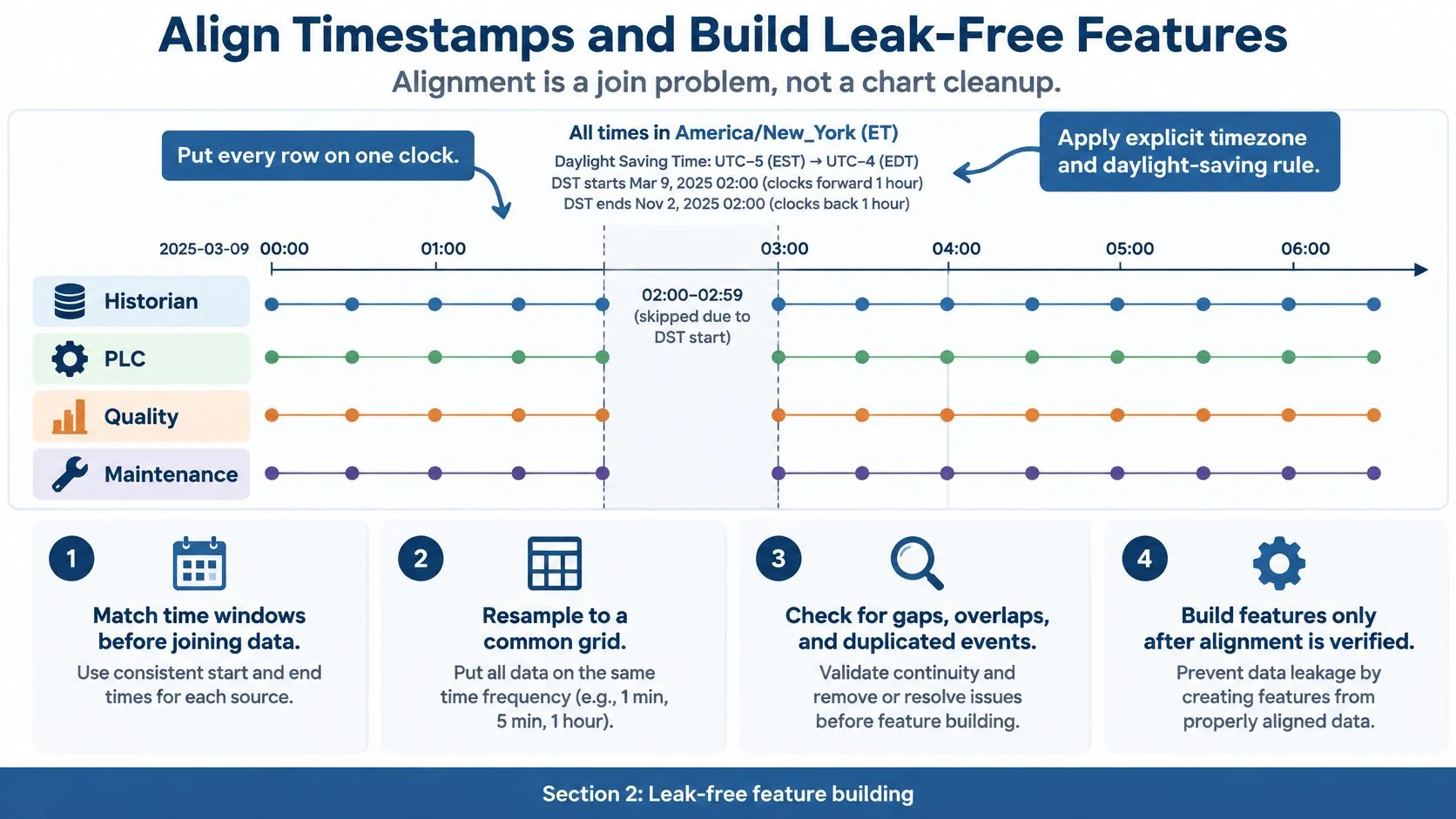
Timestamp alignment is a join problem, not chart cleanup. A maintenance record attached to the wrong operating window can create a convincing but false relationship between machine behavior and failure.
Put historian, PLC, quality, and maintenance records on a shared clock. Preserve event time and ingest time separately, record the source timezone, and specify how ambiguous daylight-saving timestamps are resolved. Don't infer an offset merely because two curves look similar.
Match the grid to the decision
For cycle-level quality prediction, build cycle-level records. For continuous anomaly detection, choose a fixed interval that preserves the behavior the detector needs. Use explicit window boundaries and a documented aggregation for each signal; averaging a peak-sensitive signal may remove the event of interest.
Apply the maximum-gap rule before generating features, retaining original missingness indicators. A missing temperature can use a documented estimation method; a missing defect label cannot be invented. The distinction matters because fabricated targets change what the model is trained to predict.
IBM's AI data-quality guidance extends completeness to coverage of edge cases, rare events, and minority populations. Build a coverage matrix crossing asset, product, operating mode, shift, season, maintenance state, and known failure mode, with record count, label availability, and time span in each cell.
A large dataset can still lack bearing failures, low-load operation, startups, or changeovers. Fill those coverage gaps through targeted collection or expert labeling, rather than assuming more routine telemetry solves them.
Enforce decision-time availability
Use a time-series AI workflow that distinguishes when an event occurred from when its information became available:
- Allowed features: Rolling statistics ending at the decision timestamp, time since maintenance already recorded, and the current order's product variant.
- Forbidden features: Future scrap results, future downtime, retrospective maintenance findings, and the target label itself.
- Evaluation distribution: Preserve the original event rate even when training uses governed resampling.
A feature isn't available merely because its timestamp precedes the prediction. The production system must actually have received it.
Finish with a reproducibility test: run identical feature code against the training window and a later production window. For an unchanged raw sample under identical context and rules, the feature values must match.
Clean Defect Labels Without Dropping Rare Failures
Human verification of errors identified by confident learning estimated a 3.4% lower-bound test-label error rate across ten public audio, image, and text datasets in the MIT-hosted label-error study. That's benchmark evidence, not a factory defect-rate estimate, but it demonstrates why apparently small labeling errors can affect model rankings.
For manufacturing inspection, use disagreement to prioritize review, not to authorize automatic relabeling. A model trained mostly on acceptable parts may confidently reject the correct annotation of an unfamiliar catastrophic defect.
Build an inspector review queue
- Train a provisional model with strict separation from the evaluation set.
- Generate out-of-sample probabilities, so candidate scores aren't based on memorized training records.
- Estimate the joint distribution of observed noisy labels and inferred latent labels.
- Rank records by high disagreement or low confidence.
- Have qualified inspectors review a statistically sampled subset, including rare classes.
- Correct confirmed errors or quarantine ambiguity, then rerun evaluation on the corrected holdout.
Use active review queues, as in Google's DataPerf cleaning task, instead of requiring inspectors to examine every image indiscriminately. Reserve protected review capacity for uncommon defects so the largest class doesn't consume the whole queue.
Reviewers must distinguish true defects, acceptable variation, occlusion, and camera or lighting faults. Store the original image, original annotation, revised annotation, inspector decision, and reason together. If an image is uninspectable, abstention is more defensible than forcing a good-part label.
Check whether the difficult class survived
Report precision and recall separately for each defect class. Include reviewer agreement, relabel yield, abstention rate, and before-versus-after performance so operations can see whether corrections improved recognition or merely simplified the dataset.
A higher aggregate score isn't persuasive if rare catastrophic defects disappeared during cleaning. Compare class membership and retained failure examples before approving the release, and investigate disagreements between inspectors rather than letting majority voting settle safety-critical cases.
A label change is a governed data release, not a silent edit. Quality engineering should approve the revised taxonomy and annotations before the model team replaces the production training set.
Example Pipeline and Tool Stack
Build a fixed execution sequence with named outputs. For manufacturing AI, the useful property isn't how many tools you deploy; it's whether an engineer can reproduce the exact records behind a maintenance alert or inspection decision.
Pipeline stages and tools for a sensor cleansing run
| Stage | Output | Example tools |
|---|---|---|
| 1. Raw landing | Immutable files with ingest timestamps | Object storage, Parquet |
| 2. Schema and range checks | Pass or fail per field and rule ID | pandera, Great Expectations |
| 3. Alignment and resampling | One row per cycle or fixed interval | pandas, Polars |
| 4. Treatment rules | Cleansed table, quarantine table, duplicate log | Versioned Python rule module |
| 5. Label review queue | Ranked records for expert review | cleanlab, Label Studio |
| 6. Versioning and lineage | Dataset and rule versions tied to model runs | DVC, MLflow |
| 7. Monitoring | Dashboard metrics and alerts | Scheduled SQL, Grafana |
Land historian, PLC, MES, and quality extracts without overwriting prior files. Run schema checks before alignment, then apply versioned treatment rules that write missingness and unit-conversion flags into the cleansed output. Use cleanlab scores to rank label candidates and Label Studio to capture inspector decisions.
Make reconciliation a release gate
For a press-line pressure tag, accept bar values from zero through the approved relief-valve limit, reject text N/A as a measurement, and convert psi through a logged conversion rule. Bind the dictionary version to the dataset in DVC and the model run in MLflow.
At the row-disposition stage, enforce input rows = cleansed rows + quarantined rows + removed duplicates. Reconcile before resampling changes row counts, then validate the expected grid separately. Any unexplained gap fails the run.
Historical backfills and scheduled review scoring are suitable batch jobs. For execution options, explore batch processing use cases from Beam, while keeping low-latency plant decisions on their required operating path.
Run Cleansing as a Shift-Level Control
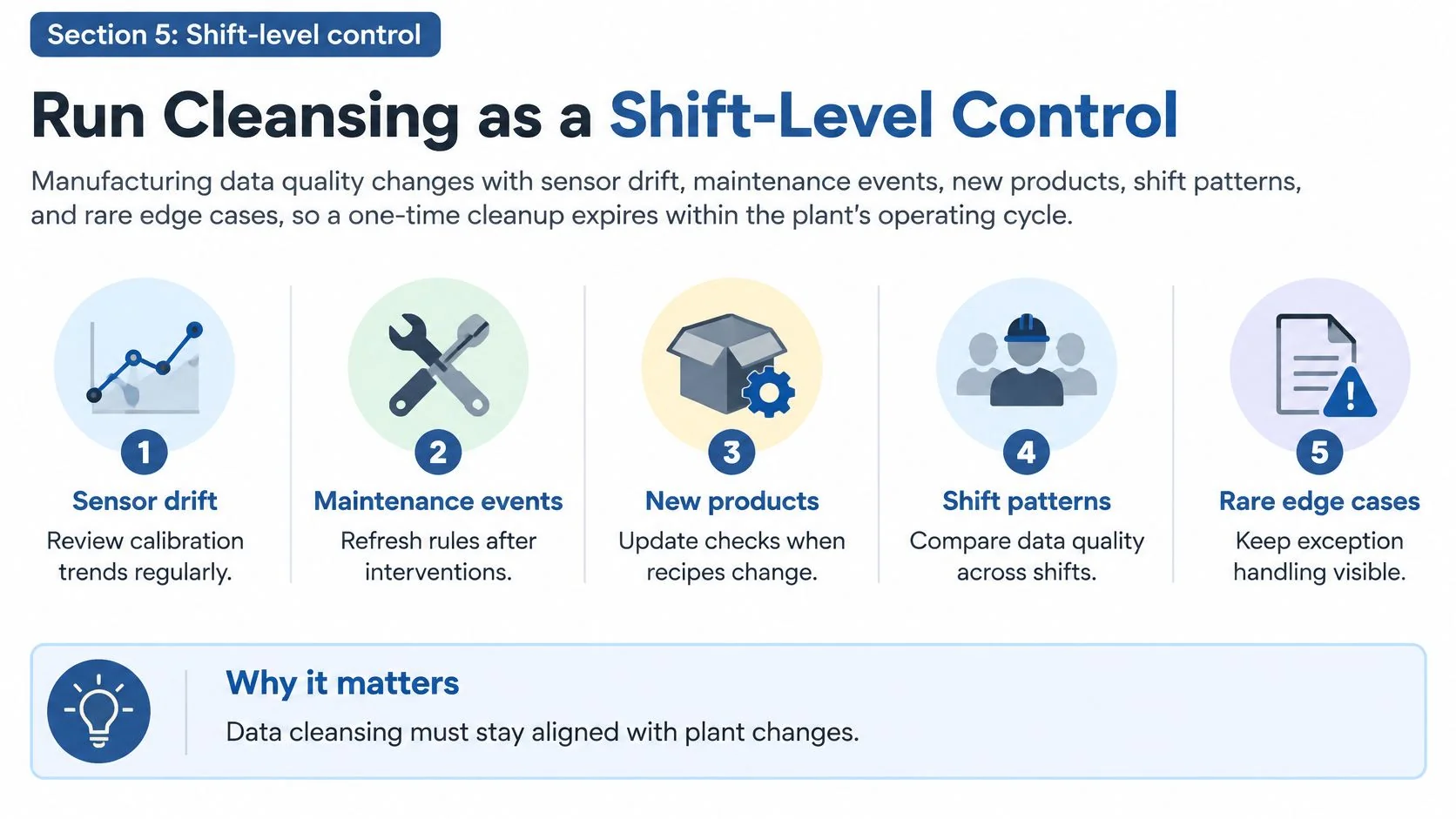
Sensor drift, maintenance interventions, new products, shift patterns, and rare operating conditions change what acceptable data looks like. A cleanup approved before a recipe or gateway change isn't automatically valid afterward.
An ARC discussion of industrial data fabrics reports that more than half of industrial respondents ranked data quality among their top three AI implementation challenges, and cites a manufacturing pulse survey in which 54% of firms had duplicate data across systems and 51% had siloed data.
Post-cleansing monitors and owners
| Monitor | What it measures | Owner |
|---|---|---|
| Completeness of required fields | Share of mandatory fields populated per source | Data engineering |
| Invalid-value rate | Values failing range or format rules | Process engineering |
| Duplicate-event rate | Repeated asset, timestamp, and signal keys | Data engineering |
| Unmatched-asset rate | Asset IDs not resolved to the master list | Data engineering |
| Timestamp lateness | Share of records beyond the use-case delay limit | Data engineering |
| Unit-conversion failures | Records the unit dictionary cannot map | Data engineering |
| Quarantine share | Share of rows held out per window | Process engineering |
| Retained edge-case coverage | Rare failures, startups, and abnormal batches kept for training | Quality |
Give owners authority to intervene
Keep raw data immutable and attach rule versions and lineage to every cleansed release. Assign a named owner to each monitor, with use-case-specific thresholds and a response such as pausing predictions, requesting inspection, or using an approved fallback.
Rerun validation and compare outputs after PLC, MES, historian, or mapping changes. A jump in null vibration readings requires a sensor or gateway investigation, not median filling. A changed defect frequency requires checking camera calibration, inspection standards, and product mix before declaring better quality.
Process engineering owns physical limits, quality owns labels, and data engineering owns pipeline execution. No automated job should overwrite a safety-critical value without sign-off. Retain anomalies confirmed as genuine failure modes, startups, or abnormal batches.
A cleansing job can raise completeness scores while degrading the model if it removes the rare failures the plant needs to predict.
Measure the Payoff and Choose a Plant Use Case
Don't claim success from a higher quality score alone. Compare before-and-after baselines over a holdout period, keeping sensors, process settings, and model configuration stable where possible. Document relabeling separately so its contribution isn't confused with signal cleansing.
A 2025 oil-gasket manufacturing study using Random Forest, Autoencoder, KNN, and multivariate regression reported a 6.5% Data Quality Index improvement and evaluated defects, production speed, and resource use. That narrow result doesn't establish a transferable benefit for another plant.
Require operational evidence
Track cost per corrected record, false-correction rate, downstream model improvement, and retained failure coverage. Require the business outcome in scrap, downtime, or maintenance cost, not just a dashboard score. Distinguish vendor-reported gains from controlled production evidence, following an explicit approach to measuring manufacturing outcomes.
Use a bounded pilot with an accountable process owner and an agreed stop condition. If false corrections increase or critical failure coverage falls, withhold release even when aggregate model performance improves.
For AI for manufacturing use cases, reliable predictive maintenance, process optimization, and visual inspection depend on this governed data. This week, choose a candidate line, document its acceptance tests, and match its cleaned data to a documented implementation. Alongside plant trials and original technical reports, use the AI for Manufacturing database to compare use case, technology, industry, and measured outcomes, preferring records with visible evidence levels before selecting a pilot.
